How to Learn Difficult Concepts Quickly [For Students]

Mastering the Art of Rapid Learning
University life often feels like a constant race against time, especially when you are faced with complex theories that seem impossible to grasp. Whether it is a dense engineering formula, a convoluted legal principle, or a sophisticated economic model, the challenge remains the same: how do you break down high-level information into something your brain can actually process? The secret isn't just working harder or pulling more all-nighters. Instead, it is about shifting your approach to how you consume and digest information. Effective learning is a skill that can be developed, and once you master the right framework, you can cut your study time in half while improving your grades.
The Power of Atomic Breakdown
When you encounter a difficult concept, the biggest mistake is trying to swallow it whole. Your brain naturally resists massive, unintelligible blocks of data. To overcome this, use the atomic breakdown method. This involves peeling back the layers of a concept until you find the foundational blocks. If you are struggling with a complex physics problem, go back to the basic laws that govern it. If a philosophical argument feels too abstract, find the simple definitions of the terms used. By mastering the small parts first, the larger picture starts to assemble itself automatically. This modular approach reduces the mental tax on your working memory and allows you to build confidence as you check off the smaller, understandable components.
Active Recall and the Testing Effect
Many students fall into the trap of passive learning, which involves reading and re-reading highlighted notes. This creates an illusion of competence where you recognize the text but don't actually understand the underlying concept. To learn quickly, you must force your brain to retrieve information. Active recall is the process of testing yourself before you feel ready. Close your textbook and try to write down everything you remember about a specific topic. Use flashcards or practice questions early in the process. This discomfort is where the real learning happens. When your brain struggles to find an answer, it strengthens the neural pathways associated with that information, making it much easier to recall during an actual exam.
Leveraging Duetoday AI for Efficiency
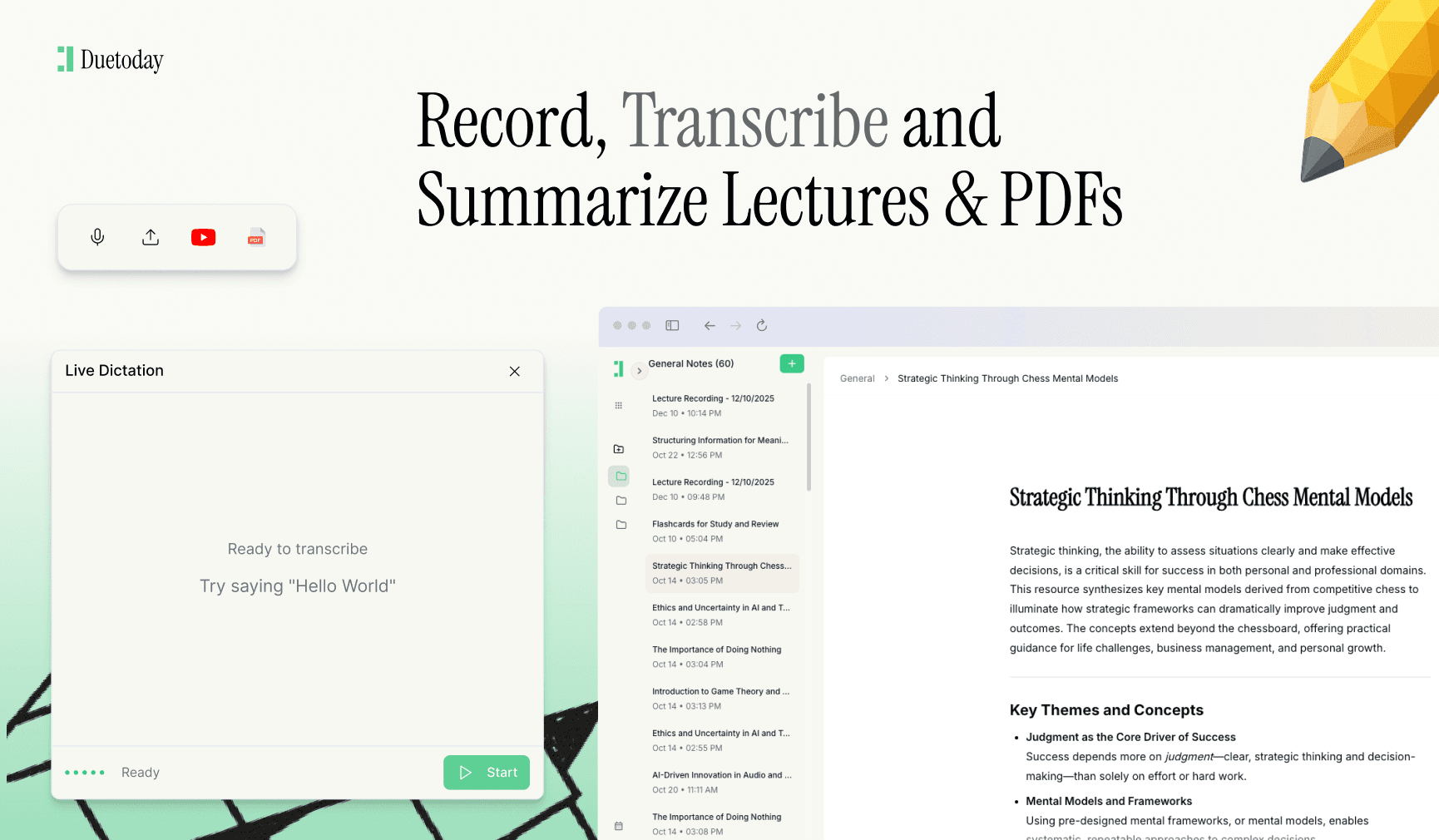
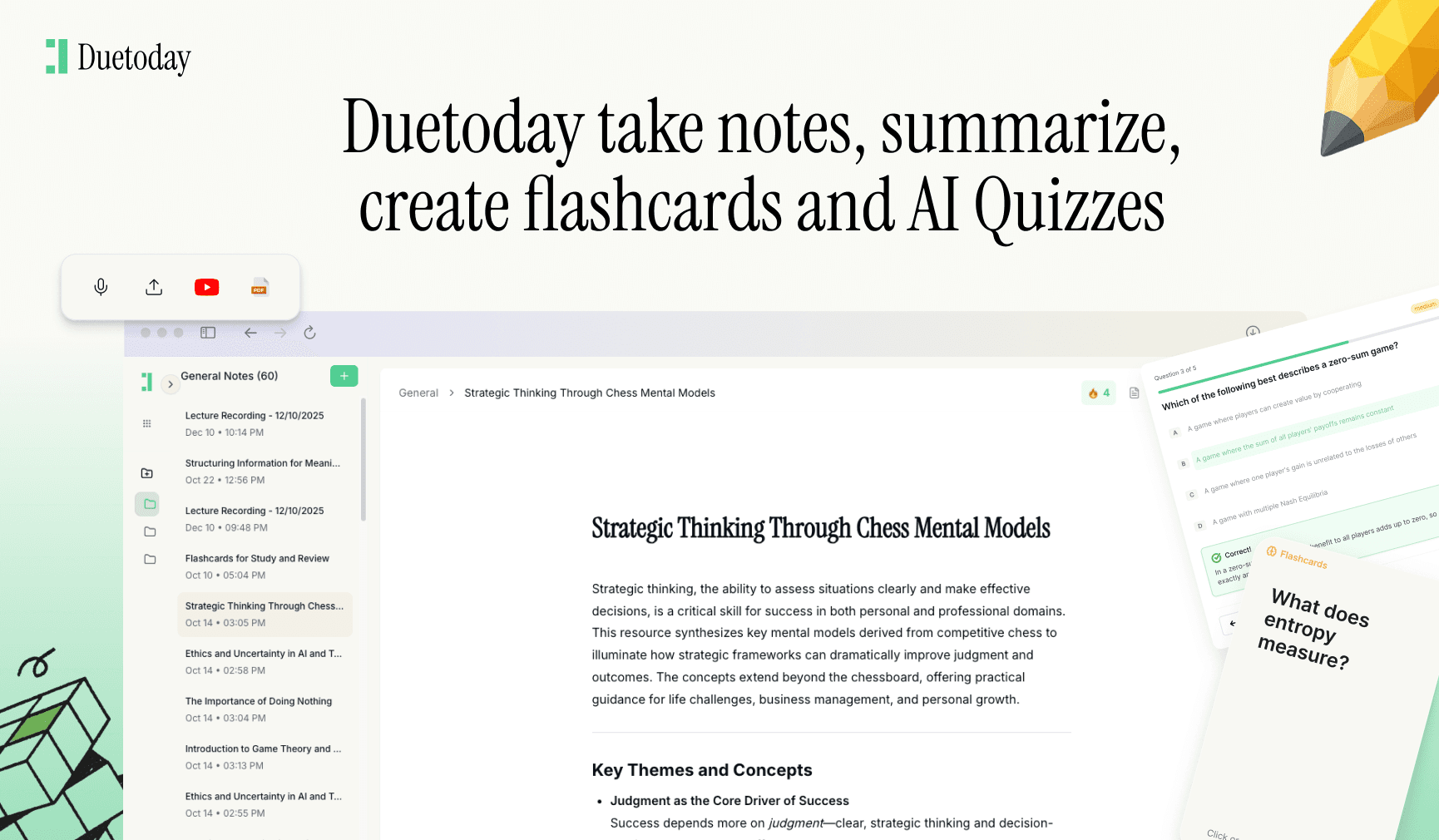
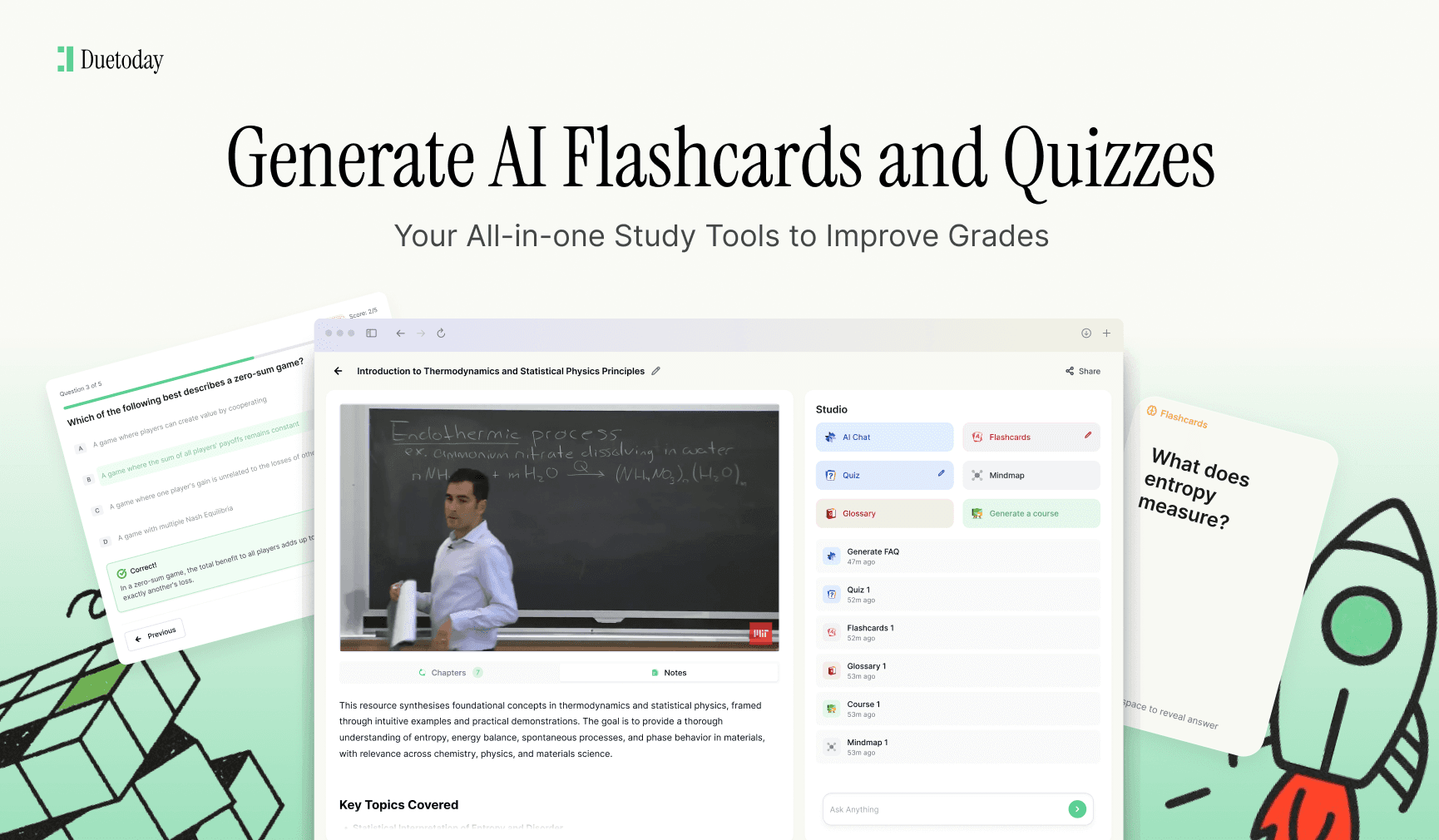
In the modern academic landscape, you don't have to do all the heavy lifting alone. This is where Duetoday AI comes in to revolutionize your workflow. Duetoday is an AI-powered learning platform that turns lectures, PDFs, and messy notes into summaries, flashcards, quizzes, and structured study tools automatically.
It acts like a personalized AI tutor, helping you learn faster and stay organized without spending hours manually rewriting notes or formatting study guides. By outsourcing the administrative part of studying to Duetoday, you can focus your mental energy on deep work and truly mastering the difficult concepts that matter most for your degree.
The Feynman Technique: Teaching to Learn
One of the most effective ways to simplify a difficult topic is the Feynman Technique. Named after the Nobel Prize-winning physicist Richard Feynman, this method involves explaining a concept in the simplest terms possible, as if you were teaching it to a ten-year-old. If you find yourself using jargon or complex academic language to explain a point, it usually means you don't fully understand it yet. Grab a blank sheet of paper and write the name of the concept at the top. Explain it in plain English. Whenever you get stuck, go back to your source material to fill the gaps. This process exposes your weaknesses and forces you to create mental shortcuts that stick in your long-term memory.
Dual Coding and Visual Mapping
Humans are naturally visual creatures, yet most university coursework is text-heavy. To learn faster, you should utilize dual coding, which is the process of combining words with visuals. If you are learning a sequence of events, draw a timeline. If you are studying a biological system, sketch the components. Creating mind maps allows you to see the relationships between different ideas that might seem disconnected when reading a linear textbook. These visual anchors serve as mental hooks, making it significantly easier to retrieve information during high-stress situations like midterms or finals. Don't worry about being an artist; even rough sketches are enough to trigger your memory and enhance your understanding.
Optimizing Your Cognitive Load
Your brain has a limited capacity for processing new information at any given time, known as cognitive load. To learn difficult concepts quickly, you must manage this load effectively. This means eliminating distractions like social media notifications or loud environments that compete for your attention. It also involves the Pomodoro Technique, where you study in intense 25-minute bursts followed by short breaks. During these breaks, avoid looking at screens. Let your mind wander. This period of 'diffuse mode' thinking allows your brain to subconsciously process the difficult information you just took in, often leading to 'aha!' moments where complex ideas suddenly start to make sense.
Spaced Repetition for Long-Term Retention
Quick learning is useless if you forget everything two days later. Spaced repetition is the practice of reviewing information at increasing intervals. Instead of cramming for ten hours once, study for one hour over ten different days. This approach hacks the forgetting curve, ensuring that just as you are about to forget a concept, you reinforce it. Most top-performing students use software to manage these intervals, ensuring they spend less time on things they already know and more time on the difficult concepts that haven't quite clicked yet. By spreading out your review sessions, you move information from short-term memory into deep-seated knowledge that is ready for any exam question.
The Role of Curiosity and Context
It is significantly harder to learn something when you don't care about it. If a concept feels dry or irrelevant, try to find a real-world application for it. Why does this formula matter? How does this historical event affect the current political climate? When you attach meaning and curiosity to a subject, your brain's dopamine system kicks in, making the learning process feel less like a chore and more like a discovery. Engage with the material by asking 'why' and 'how' rather than just accepting 'what'. This depth of inquiry builds a more robust mental framework, allowing you to synthesize information rather than just memorizing it by rote.
How can I understand a concept I have never seen before?
Start by finding a simplified version of the topic, such as a high-level summary or an introductory video. Once you have the basic gist, move into the detailed academic material to fill in the nuances.
How long should I spend trying to solve a hard problem?
If you are stuck for more than 20 minutes without making progress, take a break or move to a different topic. This allows your brain to enter diffuse mode and solve the problem in the background.
Can AI really help me learn faster?
Yes, tools like Duetoday AI can automate the time-consuming parts of studying, like making flashcards or summarizing long PDFs, allowing you more time to actually engage with the difficult material.
Is cramming effective for difficult subjects?
Cramming might help you pass a basic recognition-based test, but it is highly ineffective for complex subjects that require deep understanding and application of concepts.