Mastering the Art of Writing a Powerful Thesis Statement

The Foundation of Academic Writing
Entering university brings a wave of new challenges, and perhaps the most recurring one is the pressure to write high-quality academic essays. At the heart of every great essay lies a strong thesis statement. Think of the thesis statement as the DNA of your paper. It contains all the vital information, dictates the structure, and ensures that every paragraph has a purpose. Without a clear thesis, your essay can quickly become a collection of random thoughts rather than a persuasive argument.
For many students, the struggle begins with trying to condense an entire research project into just one or two sentences. It feels like a daunting task because it requires absolute clarity of thought. You are essentially telling your professor exactly what you are going to prove and how you plan to do it. This isn't just a summary of your topic; it is a specific claim that others might dispute. Understanding this distinction is the first step toward moving from a basic student writer to an advanced academic communicator.
The process of crafting this statement usually happens after you have done some initial reading but before you start your full draft. It acts as a compass for your writing process. When you feel lost in the middle of a five-page paper, you should be able to look back at your thesis and ask yourself if the paragraph you are currently writing actually supports that main claim. If it doesn't, you either need to change the paragraph or refine your thesis. This iterative process is what makes university-level writing so dynamic and intellectually rewarding.
What Exactly is a Thesis Statement?
In simple terms, a thesis statement is a short, concise summary of the main point or claim of an essay, research paper, or dissertation. It is usually found at the end of your introductory paragraph. Its job is to provide a roadmap for the reader, letting them know what to expect in the pages to follow. However, it is not just a statement of fact. For example, saying that the sky is blue is not a thesis because it is an observable fact. Saying that the sky appears blue due to the specific scattering of sunlight by the atmosphere which impacts human psychological perception is a thesis, because it makes a claim that requires evidence and explanation.
University assignments often require you to take a stand on a particular issue. Whether you are studying history, sociology, or literature, your professors want to see your ability to analyze data and form an original conclusion. A weak thesis statement often results from a lack of research or a fear of taking a definitive stance. To avoid this, you must dive deep into your subject matter until you find a specific angle that interests you. The more specific your thesis is, the easier it will be to write the rest of your paper because your focus will be narrowed down to a manageable set of ideas.
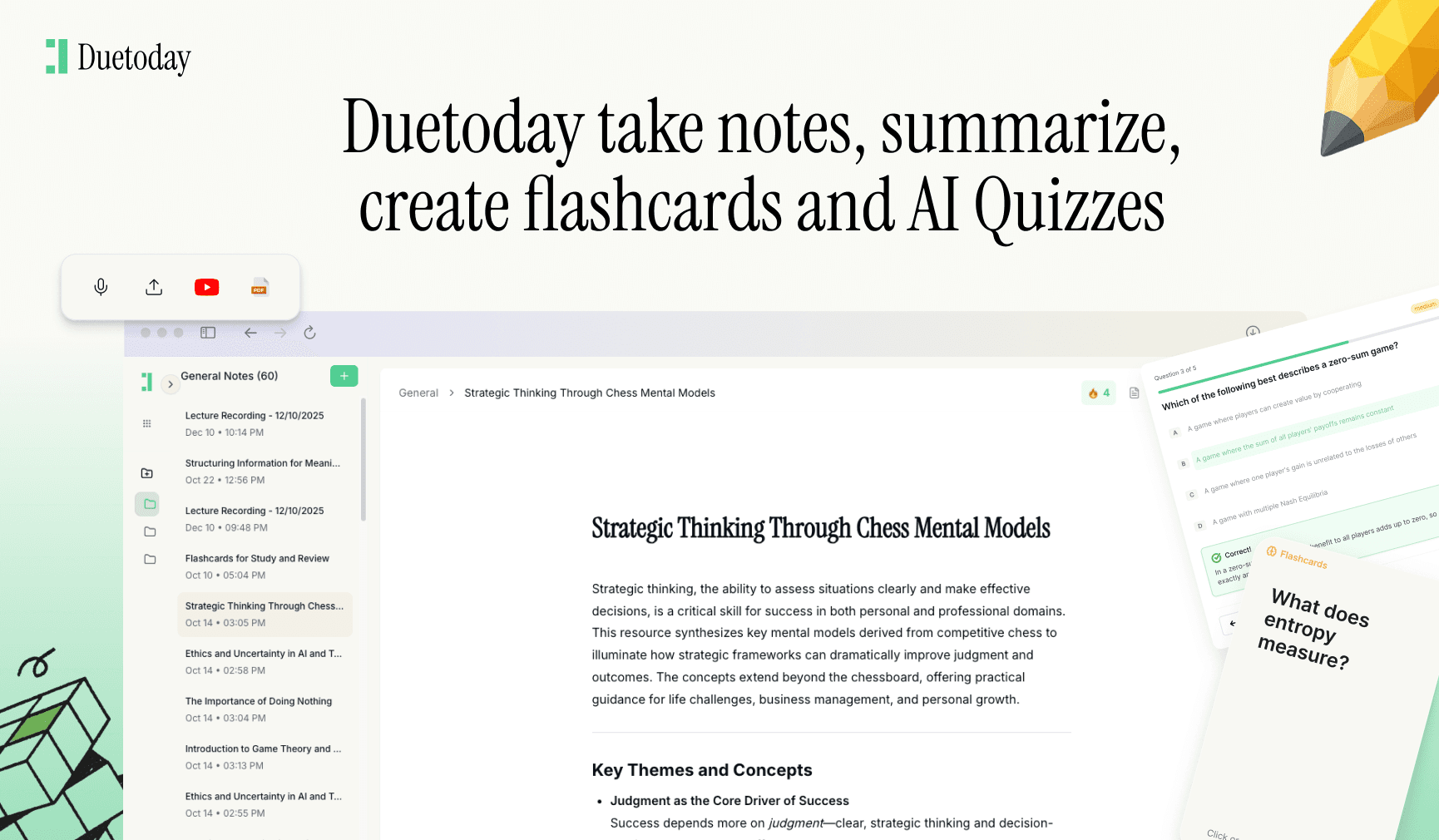
As you navigate these complex academic requirements, staying organized is key to maintaining your mental health and your GPA. This is where Duetoday AI becomes an essential part of your study routine. Duetoday is an AI-powered learning platform that turns lectures, PDFs, and notes into summaries, flashcards, quizzes, and structured study tools automatically. It acts like a personalized AI tutor, helping you break down complex research materials into digestible pieces so you can find the core arguments needed for your thesis. Instead of spending hours manually rewriting notes or highlighting printed PDFs, you can use Duetoday to stay organized and retain the information you need to build a compelling academic argument.
Steps to Create a Compelling Thesis
Start by asking a question. Most essays are answers to a specific prompt or question provided by your instructor. If you are given a topic like the impact of social media, turn it into a question: how has social media changed the way university students communicate? Your answer to that question will be the basis of your thesis. For instance, you might argue that while social media increases the frequency of communication, it decreases the depth of interpersonal relationships due to the curated nature of online personas.
Once you have a working answer, you need to add your evidence or reasons. A common formula for a thesis statement includes your claim plus the 'because' clause. This gives the reader a preview of your main supporting points. If your claim is that renewable energy is the best solution for the climate crisis, your 'because' clause might mention its decreasing costs, its potential for job creation, and its ability to reduce carbon emissions. By including these points, you have already outlined the three main body paragraphs of your essay.
Refining your language is the final stage of the process. Avoid using vague words like 'good,' 'bad,' or 'interesting.' Instead, use strong verbs and precise nouns. Instead of saying the law had a bad effect on people, say the legislation marginalized low-income families by restricting their access to basic healthcare. This level of precision shows your professor that you have a deep understanding of the material and that you are capable of high-level critical thinking. It also makes your writing much more professional and persuasive to the reader.
Common Mistakes to Avoid
One of the biggest mistakes students make is writing a thesis that is too broad. If your topic is too wide, you will find yourself overwhelmed by the amount of information you need to cover. A thesis that tries to discuss all of European history in five pages is bound to be shallow. Always try to narrow your focus to a specific time period, a specific group of people, or a specific event. This allows you to provide deep analysis rather than just scratching the surface of a giant topic.
Another common pitfall is the hidden thesis. Some students wait until the very end of the essay to reveal their main point, thinking it creates a sense of mystery or suspense. In academic writing, this is usually a mistake. Your reader should never be surprised by your conclusion. The goal is to be as transparent as possible from the very beginning. By stating your thesis in the introduction, you allow the reader to follow your logic and evaluate your evidence as they go along, leading to a much more satisfying and convincing reading experience.
Finally, remember that a thesis is not set in stone. As you write your paper, you might discover new evidence that contradicts your original claim. Don't be afraid to go back and change your thesis to match your findings. University is a place for learning and discovery, and it is perfectly normal for your ideas to evolve as you engage more deeply with the research materials. The most successful students are those who are flexible and willing to let the evidence guide their conclusions rather than forcing the evidence to fit a preconceived notion.

Where does the thesis statement usually go?
In most university essays, the thesis statement is placed at the end of the introductory paragraph to transition into the body of the paper.
How long should it be?
A standard thesis statement is typically one to two sentences long, depending on the complexity of the argument.
Can I change my thesis after I start writing?
Yes, it is common to refine or completely change your thesis as you discover more evidence during the writing process.
What makes a thesis statement strong?
A strong thesis is specific, arguable, and supported by evidence. It avoids vague language and takes a clear stance on the topic.