How to Use the Feynman Technique to Master Any Subject

The Secret to Learning Faster at University
University life often feels like a constant race against time. Between complex lectures and massive textbooks, many students find themselves memorizing facts without actually understanding them. This is where the Feynman Technique becomes a game-changer. Named after the Nobel Prize-winning physicist Richard Feynman, this method is built on a simple premise: if you cannot explain a concept in simple terms, you do not truly understand it. By forcing yourself to strip away jargon and complex language, you reveal the gaps in your knowledge and build a foundation that lasts far beyond the final exam.
The Feynman Technique is not just for physics or math; it is a universal framework that works for law, medicine, business, and any other field that requires deep comprehension. Instead of staring at your notes and hoping the information sticks, you actively engage with the material. This active recall process transforms you from a passive consumer of information into a teacher. When you assume the role of an educator, your brain processes information differently, focusing on the logic and connections between ideas rather than just the words on the page.
Step 1: Choose Your Concept and Study It
The first step is straightforward but requires focus. Choose the specific topic you are struggling with and write it at the top of a blank sheet of paper. Spend some time reviewing your primary materials, whether they are lecture slides or textbook chapters. The goal here is not to memorize the entire chapter but to identify the core principles you want to master. Once you feel you have a basic grasp, set the books aside. The real magic happens when you move away from the source material and start relying on your own mental models.
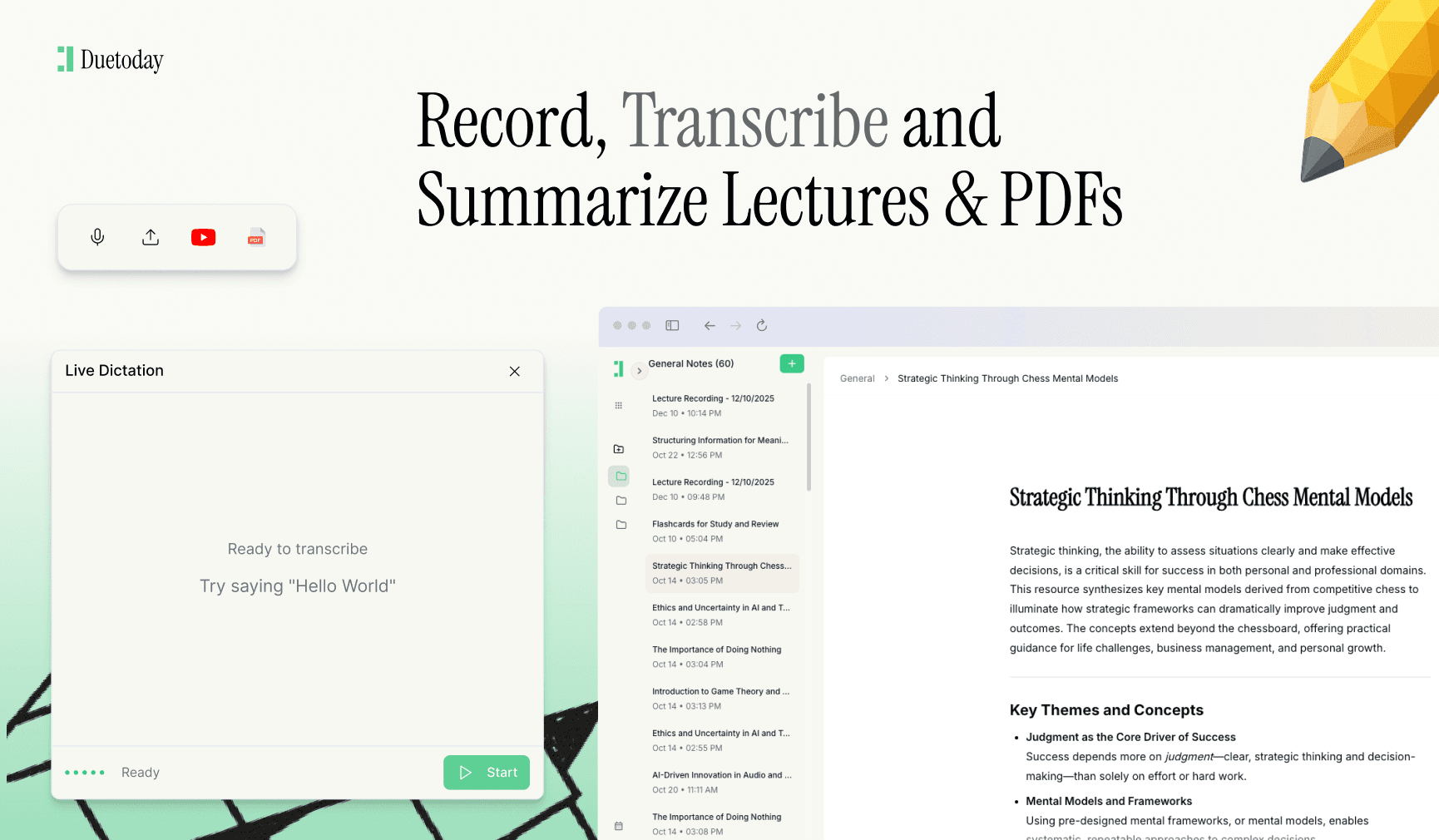
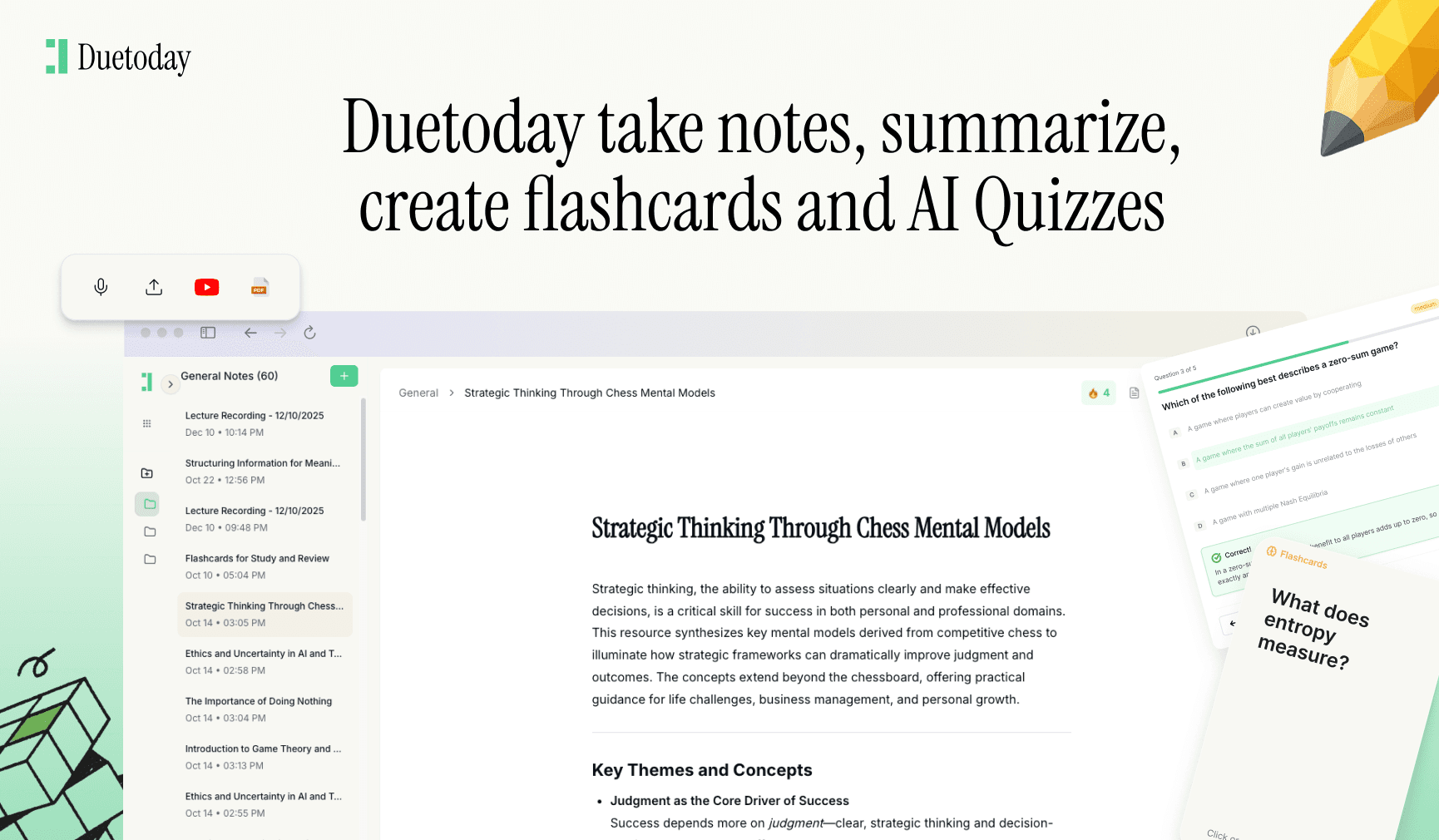
As you dive into these complex subjects, you might find that organizing your initial research is the hardest part. This is where Duetoday AI becomes an incredible asset for modern students. Duetoday AI is an AI-powered learning platform that turns lectures, PDFs, and notes into summaries, flashcards, quizzes, and structured study tools automatically. It acts like a personalized AI tutor, helping you learn faster and stay organized so you can focus on applying the Feynman Technique rather than spending hours just rewriting your messy notes into something readable.
Step 2: Explain It Like I Am Five
Now, imagine you are explaining this concept to a child or someone with no background in your field. Use simple language and avoid any technical jargon. If you find yourself using a complex word, challenge yourself to explain that word too. This step is critical because jargon often masks a lack of understanding. If you can explain the core of organic chemistry or macroeconomics using plain English, you have officially moved past rote memorization and toward genuine mastery. Write this explanation out on your paper as if you were talking to a friend who missed the lecture.
Step 3: Identify the Gaps in Your Knowledge
As you write your explanation, you will inevitably hit a wall. You might find a specific part of the process that you cannot explain simply, or a connection between two ideas that feels fuzzy. These are your knowledge gaps. Instead of being frustrated, view these gaps as a roadmap for your next study session. Go back to your source material—your textbooks, recorded lectures, or research papers—and specifically target those weak areas. Once you have clarified those points, return to your simple explanation and refine it until the flow of logic is seamless from start to finish.
Step 4: Refine, Simplify, and Use Analogies
The final step is to polish your explanation. Review what you have written and look for any remaining complexities. A great way to solidify your understanding is to use analogies. Analogies bridge the gap between the unknown and the known. For example, if you are explaining how a cell membrane works, you might compare it to a security guard at a club. If your analogy makes sense and explains the mechanism correctly, you have achieved a high level of cognitive integration. This simplified version of the topic is now burned into your long-term memory, making it much easier to recall during high-pressure exam situations.
Why This Method Works for Busy Students
The beauty of the Feynman Technique is its efficiency. Many students spend hours highlighting textbooks, which is a low-utility study habit. The Feynman Technique, however, is a high-intensity workout for your brain. It forces you to think critically and solve the problem of 'explanation.' By the time you finish the four steps, you won't just remember the facts; you will understand the 'why' behind them. This deep understanding allows you to answer essay questions more effectively and solve complex problems that require you to apply knowledge in new contexts.
Implementing the Technique in Your Daily Routine
You don't need to spend hours on every single page of your notes. Save the Feynman Technique for the big, difficult concepts that carry the most weight in your courses. You can practice this out loud while walking to class or use a dedicated notebook for your simplified explanations. Over time, you will find that your ability to grasp new information improves because you have trained your brain to look for the simplest version of the truth in every lecture you attend. It turns the overwhelming sea of university data into a manageable and logical set of ideas.

Does the Feynman Technique work for math?
Yes, it is highly effective for math. Instead of just memorizing a formula, explain why the formula works and what each variable represents in a real-world scenario.
How long does it take to use this method?
It depends on the complexity of the topic, but usually, a thorough Feynman session takes between 15 to 30 minutes per major concept.
Can I use the Feynman Technique in a group?
Absolutely. Teaching a peer is one of the best ways to apply this technique. If your friend understands your explanation, you have mastered the topic.
Is it better to write or speak the explanation?
Writing is generally better for initial learning as it slows down your thinking, but speaking is great for quick reviews and testing your fluency with the material.