How to Study Mathematics [Uni Student Guide]

The Foundation of Mastering Mathematics
Mathematics is often perceived as a daunting mountain of complex formulas and abstract concepts. However, for university students, mastering math is less about natural talent and more about building a consistent, logical workflow. The secret to excelling in higher-level calculus, linear algebra, or statistics lies in understanding that math is a cumulative subject. You cannot skip the basics and expect to understand the advanced theories. To begin your journey, you must first cultivate a mindset that views mistakes as data points rather than failures. Every wrong answer is an opportunity to identify a gap in your logic.
The first step in any effective math study plan is active engagement during lectures. It is not enough to simply copy what the professor writes on the board. You need to ask yourself why a specific step was taken. University mathematics moves at a rapid pace, and falling behind by even a week can make the rest of the semester feel like an uphill battle. Take messy, quick notes during class, but ensure you revisit them within twenty-four hours to refine them into something readable. This initial review helps solidify the connections in your brain before the memory begins to fade.
Create a Dedicated Math Workspace
Unlike writing an essay, studying math requires intense focus and zero distractions. High-level problem solving requires your brain to hold multiple variables in its working memory simultaneously. If you are constantly checking your phone or listening to lyrical music, you break the cognitive thread. Set up a dedicated space with plenty of scratch paper, pencils, and your textbooks. Some students find that a physical whiteboard helps them visualize problems better, allowing them to map out the 'flow' of a proof or a derivative before committing it to paper.
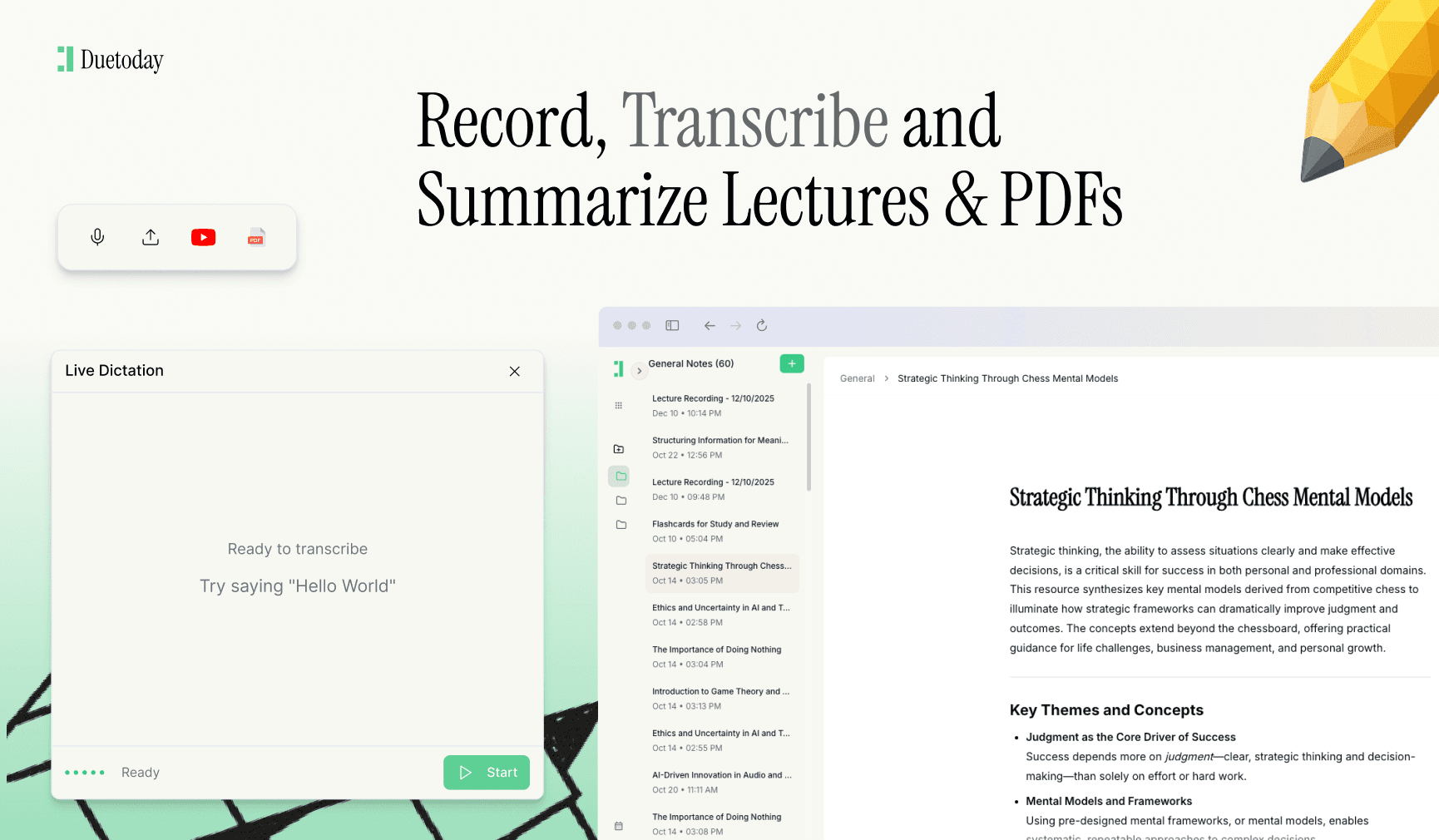
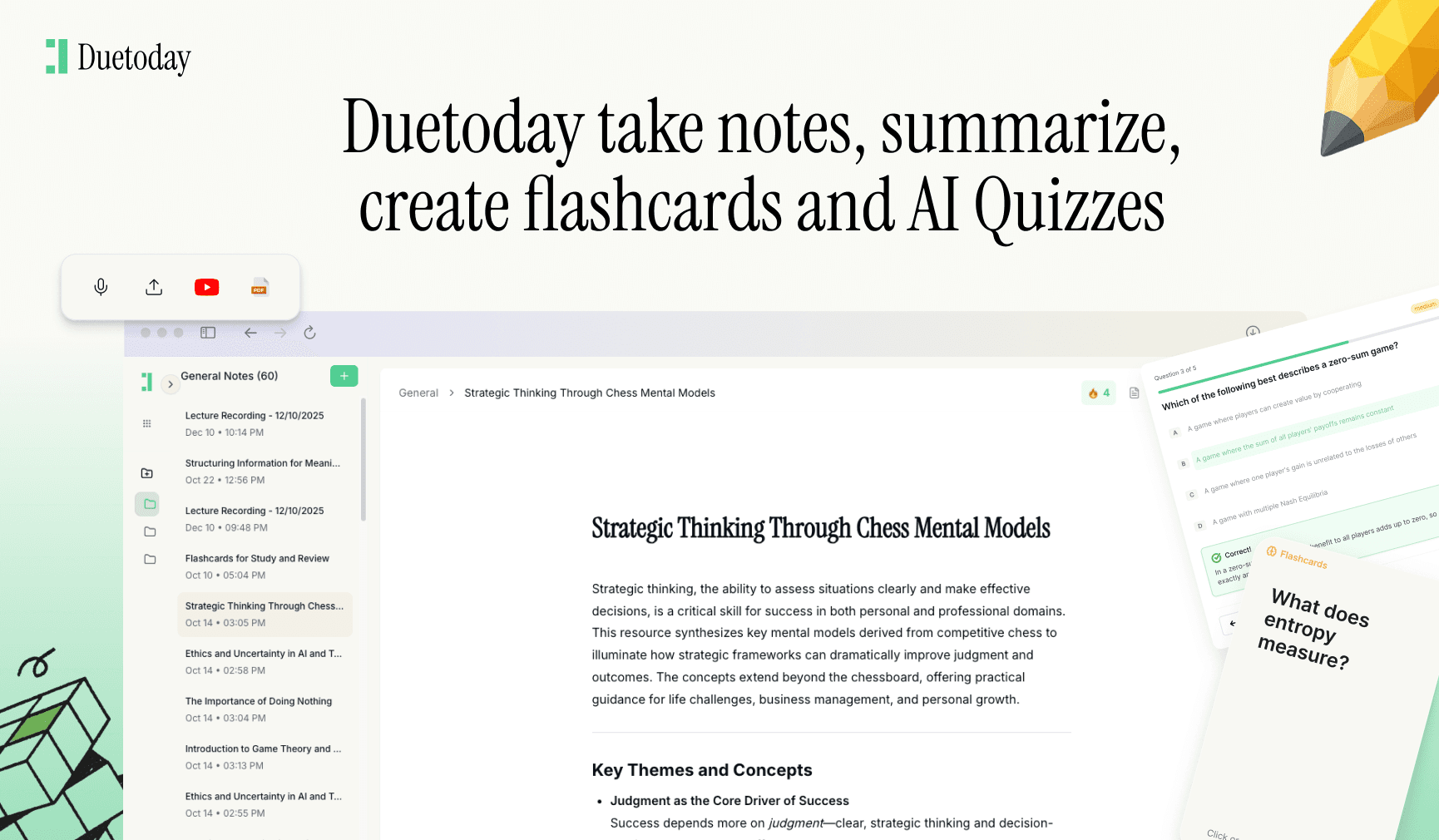
One of the most effective tools for modern students is Duetoday AI. This AI-powered learning platform acts like a personalized tutor that never loses patience. It can take your messy lecture notes or complex PDFs and turn them into structured study tools like flashcards and summaries. If you are struggling to understand a specific theorem, Duetoday AI helps you break down the information into digestible pieces, ensuring you retain the logic behind the formulas rather than just memorizing strings of numbers. It is a game-changer for staying organized when your course load feels overwhelming.
Understand the Logic Not Just the Formula
Memorization is the enemy of mathematics. While you do need to know certain identities and rules, the 'why' is always more important than the 'what.' When you encounter a new formula, try to find its derivation. Understanding where a formula comes from allows you to reconstruct it if you forget it during an exam. This deep level of comprehension is what separates top-tier students from those who merely get by. When you practice, explain each step out loud as if you were teaching it to someone else. If you can't explain why a step is necessary, you don't fully understand the concept yet.
The Power of Consistent Practice
In mathematics, passive reading is useless. You cannot learn how to solve an integral by looking at a solved example in a textbook. You must pick up the pen and do it yourself. Start with the easy problems to build your confidence and ensure your basic arithmetic and algebraic manipulations are solid. Many students lose marks not because they didn't understand the calculus, but because they made a simple sign error early in the problem. Practice helps automate these basic steps so your brain can focus on the higher-level logic.
As you progress, move on to the medium and hard problems. Do not look at the solution manual the moment you get stuck. Struggle is a vital part of the learning process. Give yourself at least ten to fifteen minutes of pure brainstorming before seeking help. If you still can't find the path forward, look at only the first step of the solution and then try to finish the rest on your own. This partial assistance keeps your brain engaged and prevents the 'illusion of competence' that comes from simply reading a completed answer key.
Group Study and Peer Review
Math is often seen as a solitary pursuit, but discussing problems with peers can expose you to different ways of thinking. Often, a classmate might have a more elegant way of solving a problem or a mnemonic device that makes a concept click. Try to find a small group of focused students who are committed to doing the work. Use these sessions to challenge each other with difficult problems from past exam papers. Teaching a concept to a friend is one of the highest forms of learning and will expose any lingering weaknesses in your own knowledge.
Preparing for the Mathematics Exam
When exam season approaches, your strategy should shift from learning individual topics to integrating everything you have learned. Go back through your homework assignments and identify the 'types' of problems that are frequently tested. Most math exams follow a predictable pattern. Practice under timed conditions to simulate the pressure of the exam hall. This helps you manage your time effectively, ensuring you don't spend forty minutes on a five-mark question.
Finally, focus on your mental and physical health. Math requires a high degree of cognitive clarity. Late-night cramming sessions fueled by caffeine often lead to 'silly' mistakes on the actual test. Get a full night’s sleep before your exam so your brain can function at its peak. Ensure you have all the necessary tools—calculators, rulers, and spare pens—ready the night before. Approach the exam with a calm, methodical mindset, tackling the easiest questions first to build momentum before diving into the complex multi-part problems at the end of the paper.

Is it better to study math alone or in a group?
A mix of both is best. Start alone to master the basics, then join a group to solve harder problems and explain concepts to each other.
How can I stop making simple mistakes in math?
Slow down and write out every single step. Most mistakes happen when students try to do mental math for multiple steps at once.
How long should I study math every day?
Consistency is key. It is better to study for 60 to 90 minutes every day than to do a ten-hour marathon once a week.
What do I do if I am completely stuck on a concept?
Use online resources, ask your professor, or use Duetoday AI to break the concept down into simpler notes and flashcards for better retention.