How to Study for Multiple Choice Exams

Understanding the Psychology of Multiple Choice Tests
Multiple choice exams are often perceived as easier than essay-based tests because the correct answer is technically right in front of you. However, university-level exams are designed to challenge your recognition and recall abilities. Professors use distractors—options that look plausible but are slightly incorrect—to ensure you actually understand the nuances of the material. To succeed, you need to move beyond simple memorization and focus on identifying relationships between concepts.
Preparation begins long before the exam date. It is about shifting your mindset from identifying the right answer to understanding why the other three are wrong. This level of critical thinking is what separates top-performing students from the rest. When you study, don't just read your notes; actively question how a specific fact could be turned into a tricky question. Thinking like the test-maker is one of the most effective strategies for navigating complex university assessments.
The Power of Active Recall and Spaced Repetition
Traditional passive reading is the enemy of high grades. Research shows that active recall—the process of forcing your brain to retrieve information—is significantly more effective for retaining facts needed for multiple choice questions. Instead of highlighting textbooks, try quiz-based learning. Create flashcards that focus on definitions, key dates, and comparative concepts. By spacing out these review sessions over several days, you move information from your short-term memory into your long-term storage.
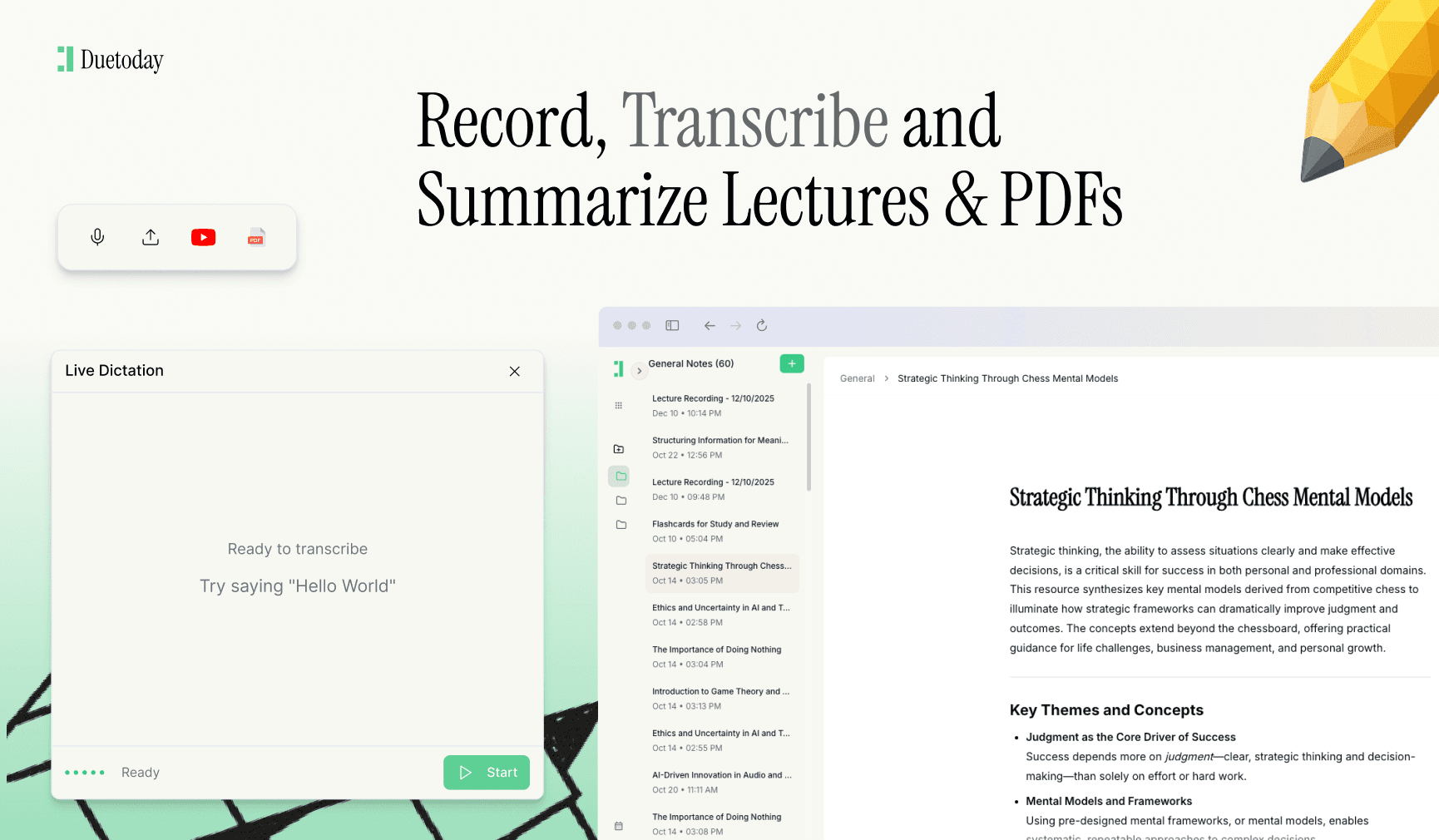
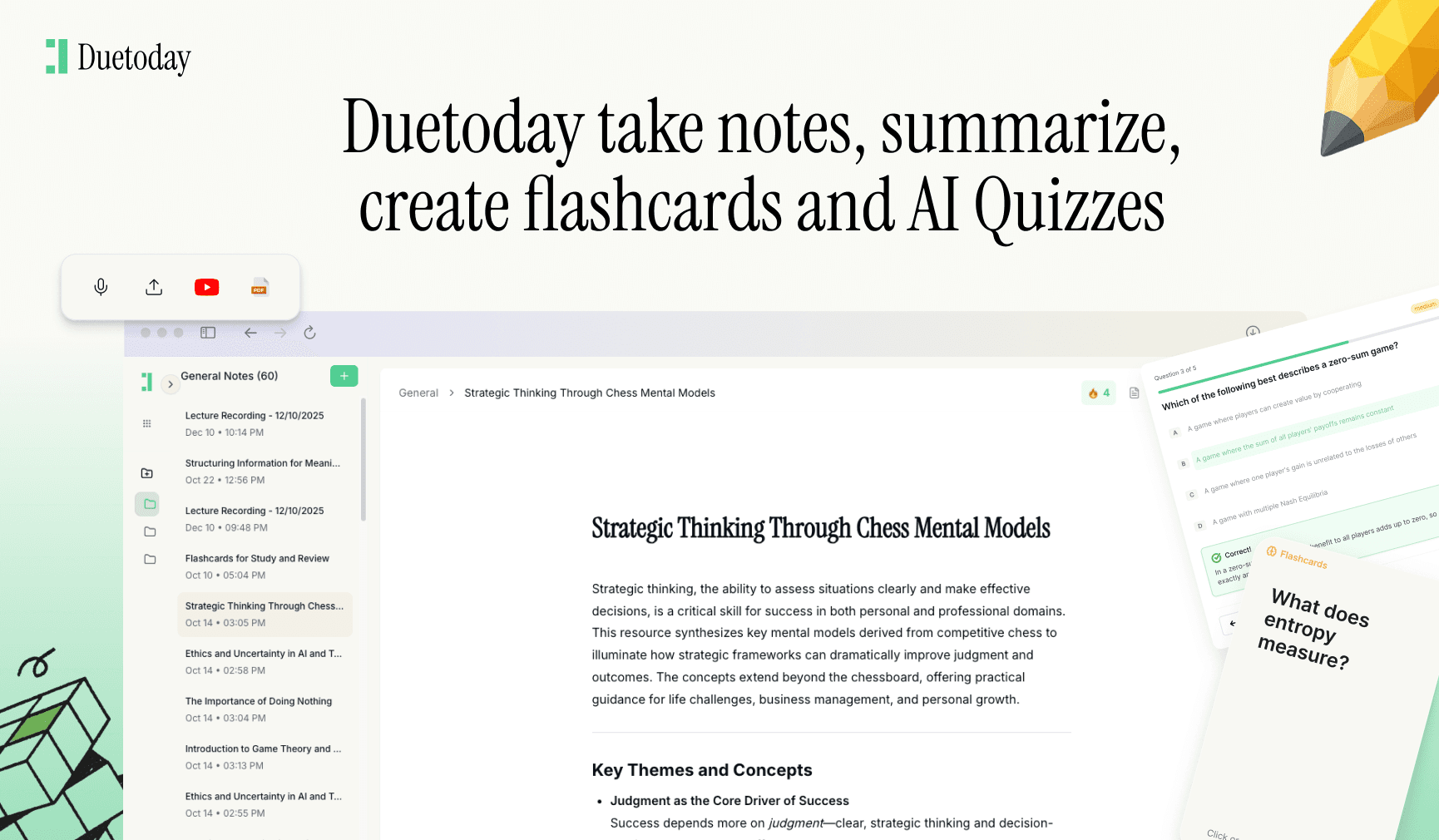
Using technology can significantly streamline this process. Duetoday AI is an AI-powered learning platform that turns lectures, PDFs, and notes into summaries, flashcards, quizzes, and structured study tools automatically. It acts like a personalized AI tutor—helping students learn faster, stay organized, and retain information without spending hours rewriting notes. By automating the creation of study materials, it lets you focus on the actual learning phase rather than the tedious organization phase, making your study sessions far more productive.
Decoding the Question Structure
Every multiple choice question has three parts: the stem (the question), the correct answer, and the distractors. High-performing students spend a lot of time analyzing the stem before even looking at the options. Often, the stem contains keywords like 'always', 'never', 'except', or 'most likely'. These words change the entire context of the question. Practice reading the stem and trying to answer the question in your head before looking at the provided choices to avoid being swayed by convincing distractors.
Mastering the Process of Elimination
One of the most valuable skills in a university exam hall is the process of elimination. Even if you are unsure of the correct answer, you can usually identify at least two options that are clearly incorrect. By narrowing your choices down to two, you immediately increase your odds of success from 25% to 50%. Look for options that are polar opposites; often, the correct answer is one of those two. Also, be weary of options that use absolute language, as real-world scenarios in most academic fields rarely have absolute, exception-free rules.
Time management is another crucial factor. In a timed environment, it is easy to panic when you hit a difficult question. A good rule of thumb is the 'three-pass system.' On your first pass, answer every question you are 100% sure about. On your second pass, tackle the ones that require more thought or calculation. On your third pass, use your best logic to guess on the remaining difficult items. This ensures you never run out of time and leave easy points on the table by being stuck on a single hard problem.
The Night Before and Exam Day Strategy
Avoid the temptation to pull an all-nighter. Your brain needs sleep to consolidate the information you have studied. Lack of sleep impairs your cognitive function and makes you more likely to fall for trick questions. On the morning of the exam, eat a light meal and arrive early enough to settle in without feeling rushed. Read every instruction carefully—sometimes double-marks are given for certain sections, or there might be negative marking for incorrect guesses, which would change your entire strategy.
Finally, trust your gut. Statistics show that your first instinct is often correct. Only change an answer if you find a clear reason to do so, such as misreading the question or finding a clue in a later part of the exam. Consistent practice and a calm mind are your best tools for success. By combining logical elimination techniques with modern tools and consistent review, you can approach any multiple choice exam with total confidence and achieve the grades you deserve in your university career.

Should I guess if I don't know the answer?
In most university exams, there is no penalty for an incorrect guess, so you should always provide an answer. However, check if your course uses negative marking before using this strategy.
How can I avoid trick questions?
Pay close attention to qualifiers like 'always', 'not', or 'mostly'. These words are designed to test your precision and are the primary way professors create trick questions.
Is cramming effective for multiple choice?
Cramming might help with short-term recognition, but it often leads to confusion between similar concepts. Spaced repetition over a week is much more effective.
How do I manage my time during the test?
Divide the total time by the number of questions to find your average time per question. Don't spend more than two minutes on any single question during your first pass.