How to Study Calculus: A Comprehensive Guide for University Students

The Fundamentals of Mastering Calculus
Calculus often feels like a massive wall that stands between university students and their degrees. Whether you are studying engineering, economics, or pure mathematics, calculus is the language that describes how things change over time. Many students struggle because they try to memorize formulas rather than understanding the underlying logic. To succeed in calculus, you need to shift your mindset from rote learning to conceptual application. It starts with a solid foundation in algebra and trigonometry. Without these, the complex derivatives and integrals you encounter later will feel twice as hard as they actually are.
The first step in your calculus journey is understanding limits. Limits are the bridge between basic math and the calculus world. They allow us to talk about what happens as a value gets infinitely close to a point without actually reaching it. Once you grasp limits, derivatives become much easier to visualize. A derivative is simply the rate of change at a specific moment. Think of it like a speedometer in a car; it tells you exactly how fast you are going at one precise second, not your average speed over the whole trip. Developing this visual intuition is crucial for long-term retention.
As the semester progresses, you will move into integration, which is essentially the reverse process of differentiation. While derivatives break things down into tiny pieces to find a rate, integrals put those pieces back together to find a total accumulation, like the area under a curve. Many students get lost here because the techniques for integration are more varied and complex. However, regular practice and identifying patterns in problems can make this process mechanical. Consistency is more important than intensity; studying for thirty minutes every day is far more effective than an eight-hour cram session before a midterm.
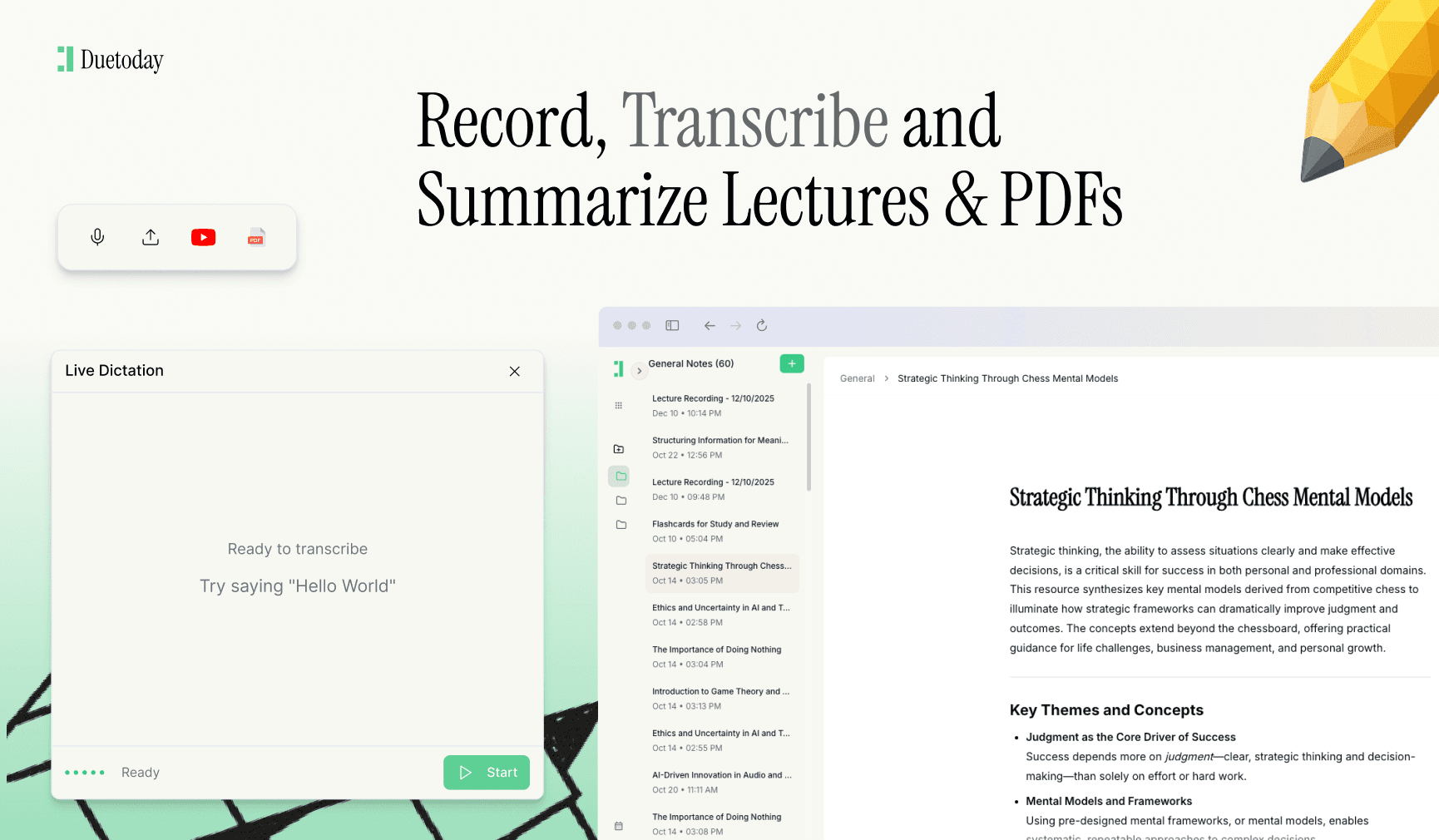
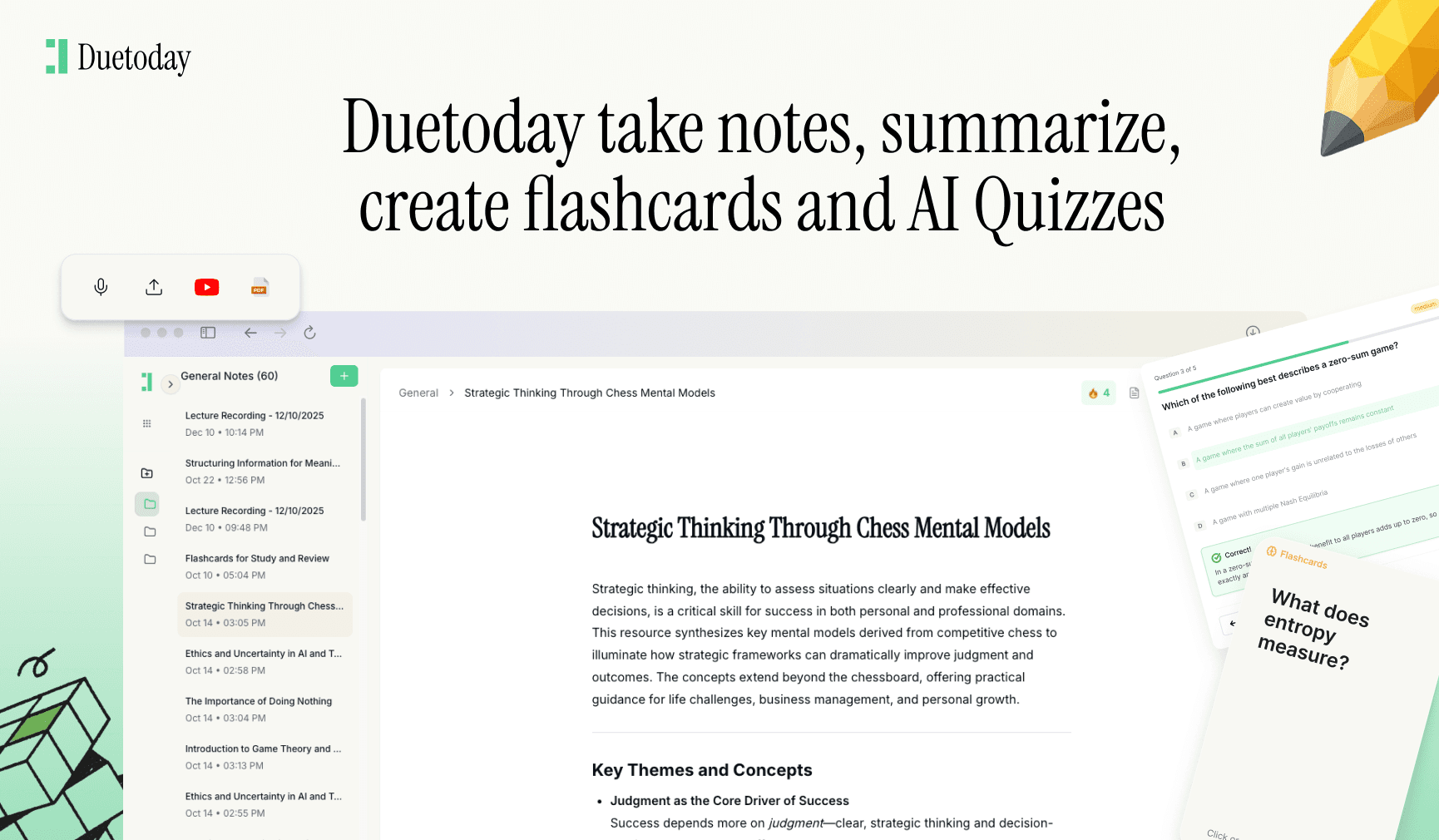
To make your study sessions even more efficient, you should consider using modern technology. Duetoday AI is an AI-powered learning platform that turns lectures, PDFs, and notes into summaries, flashcards, quizzes, and structured study tools automatically. It acts like a personalized AI tutor, helping students learn faster, stay organized, and retain information without spending hours rewriting notes. By letting an AI handle the organization, you can focus entirely on solving problems and understanding the theoretical nuances of your calculus course.
Effective Note Taking Strategies for Math
Taking notes in a calculus lecture is different from taking notes in a history or literature class. You cannot simply write down what the professor says; you must write down what the professor does. When a lecturer solves a problem on the board, pay close attention to the 'why' behind each step. Often, the transition between two lines of an equation involves a subtle algebraic identity or a specific rule that isn't explicitly mentioned. Labeling these steps in your notes will save you hours of confusion when you review them later that evening.
Focusing on Problem Solving and Logic
Calculus is a skill, and like any skill, it requires repetition. You should aim to solve as many problems as possible from different sources. Don't just stick to the assigned homework; find extra problems in your textbook or online repositories. The goal is to reach a point where you can look at a function and immediately know which rule to apply, whether it is the chain rule, product rule, or integration by parts. This level of familiarity only comes from getting your hands dirty with calculations. If you get stuck, don't look at the solution immediately. Struggle with the problem for at least ten minutes; that mental effort is where the actual learning happens.
Forming a study group can also be incredibly beneficial. When you explain a concept to a peer, you are forced to organize your thoughts and clarify your own understanding. If you can't explain why a certain step is necessary, it means you don't fully grasp the concept yet. Group sessions are also great for tackling the highly complex word problems that characterize university-level calculus. These problems require you to translate a real-world scenario into a mathematical equation, which is often the hardest part of the exam. Discussing different interpretations with classmates can provide the perspective needed to solve them.
Finally, utilize your resources wisely. Most universities offer math labs, tutoring centers, and office hours with teaching assistants. These are paid for by your tuition, so make sure to use them. YouTube creators like 3Blue1Brown provide excellent visual representations of calculus that can help bridge the gap between abstract symbols and physical reality. Combining these external resources with your textbook and lecture notes creates a robust learning ecosystem. Remember that calculus is cumulative; if you fall behind in week three, week ten will be nearly impossible. Stay on top of the schedule and seek help the moment you feel lost.
Preparing for the Final Exam
When finals week approaches, your strategy should shift from learning new material to refining your speed and accuracy. Time management is a hidden difficulty in calculus exams. You might know how to solve every problem, but if you take twenty minutes on a single derivative, you won't finish the test. Practice with a timer to simulate the pressure of the exam room. Look at past exams if they are available, as many professors have favorite types of questions or specific formats they prefer. This will help reduce anxiety and allow you to walk into the hall with confidence.
Ensure you are getting enough sleep and eating well during your prep period. Your brain needs fuel and rest to handle the high-level cognitive demands of mathematics. A tired mind is much more likely to make simple 'calculator errors' or sign mistakes that can cost you easy points. Double-check your work as you go, especially the basic arithmetic. With a disciplined approach and the right tools, mastering calculus is an achievable goal for any dedicated university student.

Is calculus harder than algebra?
Calculus builds upon algebra. While the concepts are more abstract, the difficulty often stems from weaknesses in algebra rather than the calculus itself.
How many hours should I study calculus per week?
Most students find success by spending 8 to 12 hours a week outside of class focusing solely on calculus problems and review.
Can I pass calculus if I am bad at math?
Yes, math is a skill that can be developed. Focus on the logic and use tools like Duetoday AI to stay organized and reinforce your learning.
What are the most important topics in Calculus 1?
The core pillars are limits, derivatives, and the basics of integration. Mastery of the Chain Rule is particularly vital for everything that follows.