How to Improve Memory for Exams

The Science of Memory in University Life
Stepping into a university exam hall can feel like walking onto a battlefield where your only weapon is your memory. For many students, the struggle isn't necessarily a lack of intelligence, but rather a lack of strategy when it comes to how their brain encodes and retrieves information. Improving your memory for exams is less about 'working harder' and more about understanding the biological mechanisms of how we learn. When you sit through a lecture, your brain is bombarded with thousands of data points. Without a specific system to filter and store that data, most of it vanishes within twenty-four hours.
To build a memory that lasts until finals week, you have to move past passive reading. Simply highlighting a textbook or re-reading your notes creates an illusion of competence. You feel like you know the material because it looks familiar, but familiarity is not the same as recall. True memory improvement starts with active engagement. This means forcing your brain to work during the study session rather than just letting your eyes glide over the page. Scientists call this desirable difficulty; the harder your brain works to retrieve a fact, the stronger that neural pathway becomes.
Mastering the Art of Active Recall
Active recall is arguably the single most effective technique for university students. Instead of looking at the answer and saying 'I know that,' you ask yourself a question and try to produce the answer from scratch. This process strengthens the connections in your brain. You can do this by closing your book after reading a chapter and writing down everything you remember, or by using flashcards. The goal is to simulate the exam environment where you won't have the textbook there to prompt you. It feels uncomfortable at first, but that discomfort is the feeling of your memory improving.
Another vital pillar of memory is the spacing effect. Our brains are not designed to absorb massive amounts of information in a single sitting. Last-minute cramming might help you pass a quiz the next morning, but that information will likely be gone by the time the final exam rolls around. Spaced repetition involves reviewing material at increasing intervals. You might review a concept today, then again in two days, then in a week, and then in a month. This moves the information from your short-term working memory into your long-term storage, making it much easier to access when you are under pressure.
Optimizing Your Study Environment
Your physical surroundings play a massive role in how well you retain information. If you are studying in a noisy dorm room with your phone buzzing every thirty seconds, your brain is constantly switching tasks. This 'task-switching' tax drains your mental energy and prevents deep encoding. To improve memory, you need to enter a state of flow. Find a quiet corner of the library, put your phone in another room, and dedicate specific blocks of time to deep work. Even the lighting and temperature of your room can impact your cognitive load, so choose a space where you feel alert but calm.
Leveraging Duetoday AI for Smarter Retention
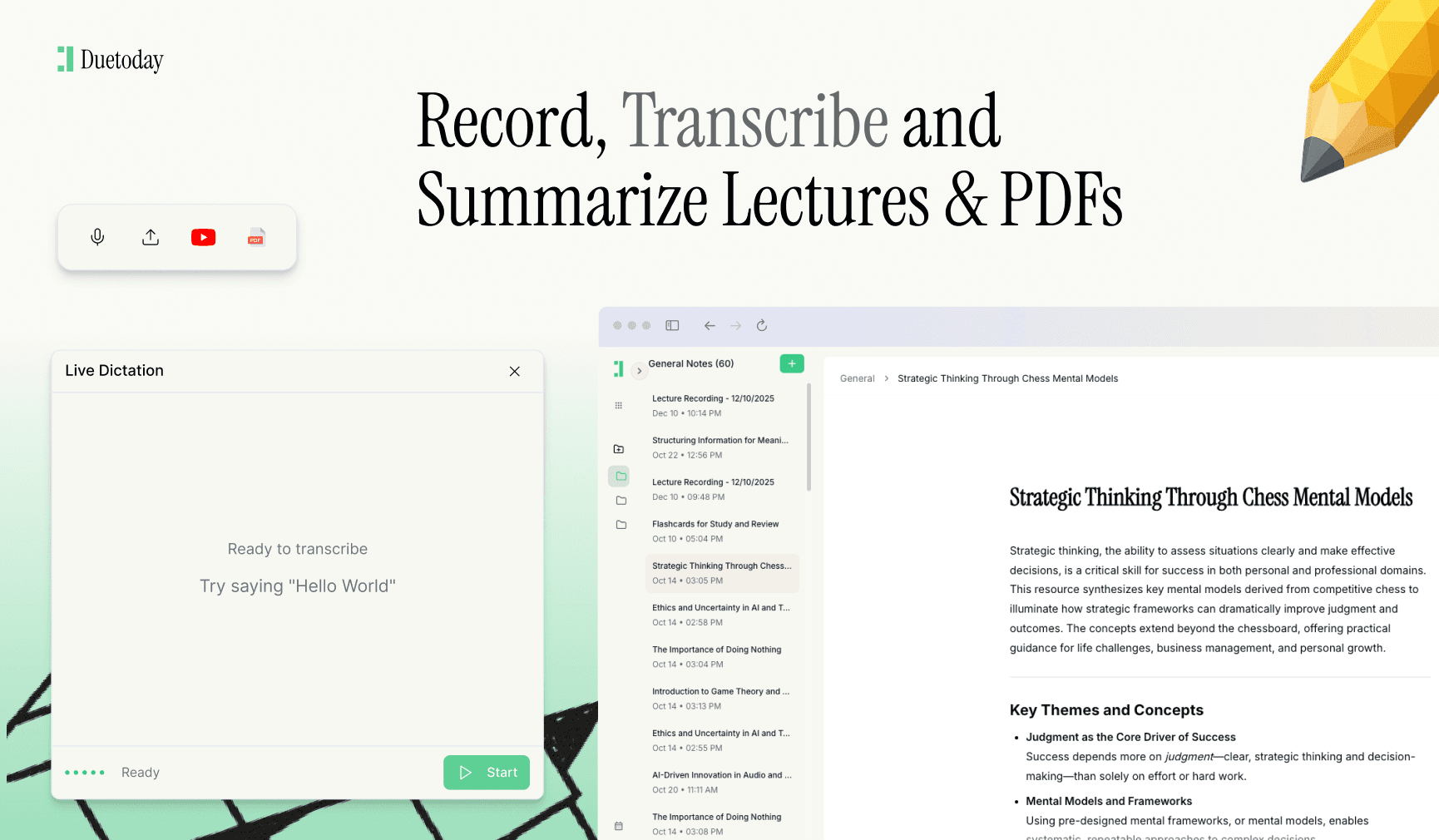
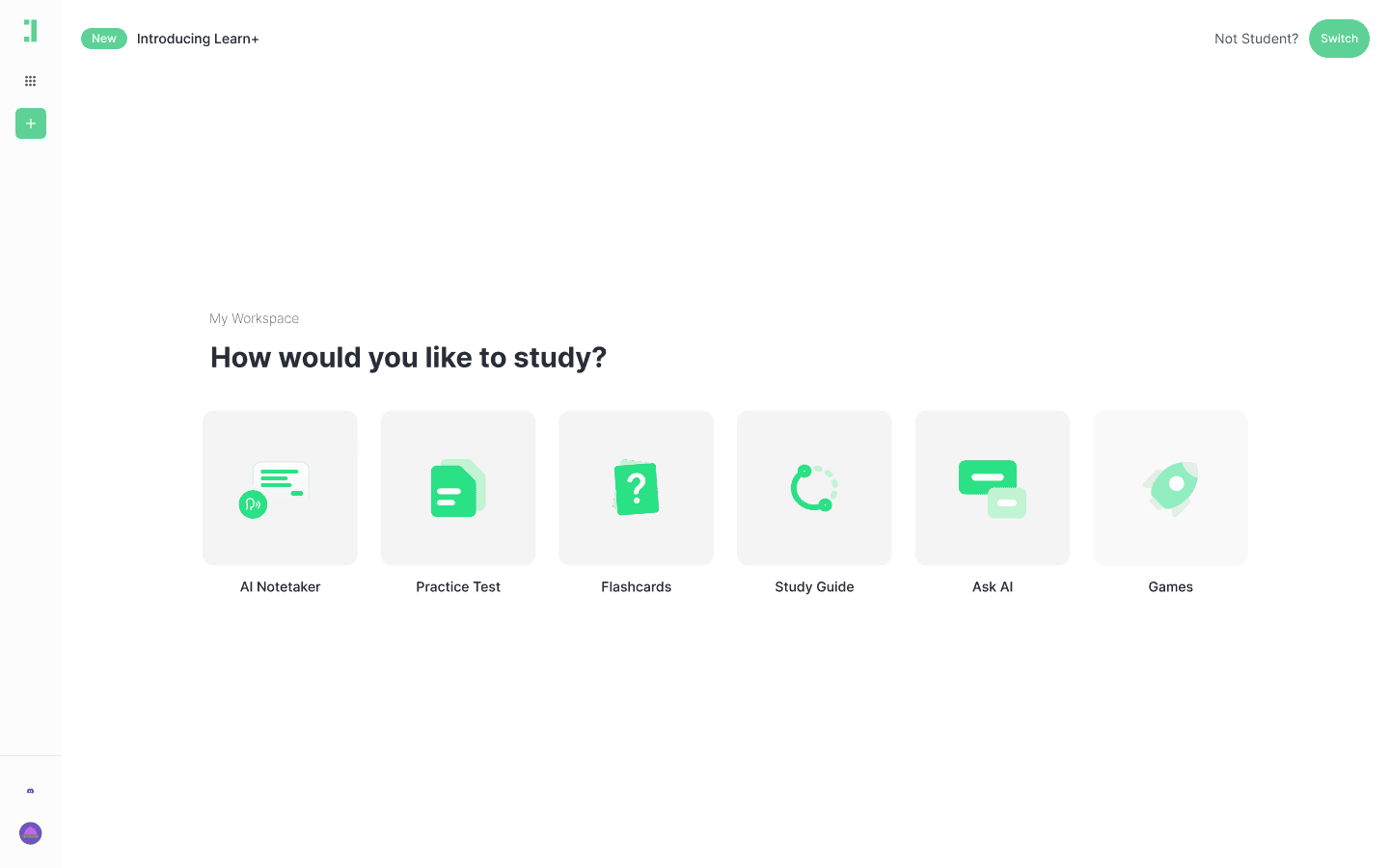
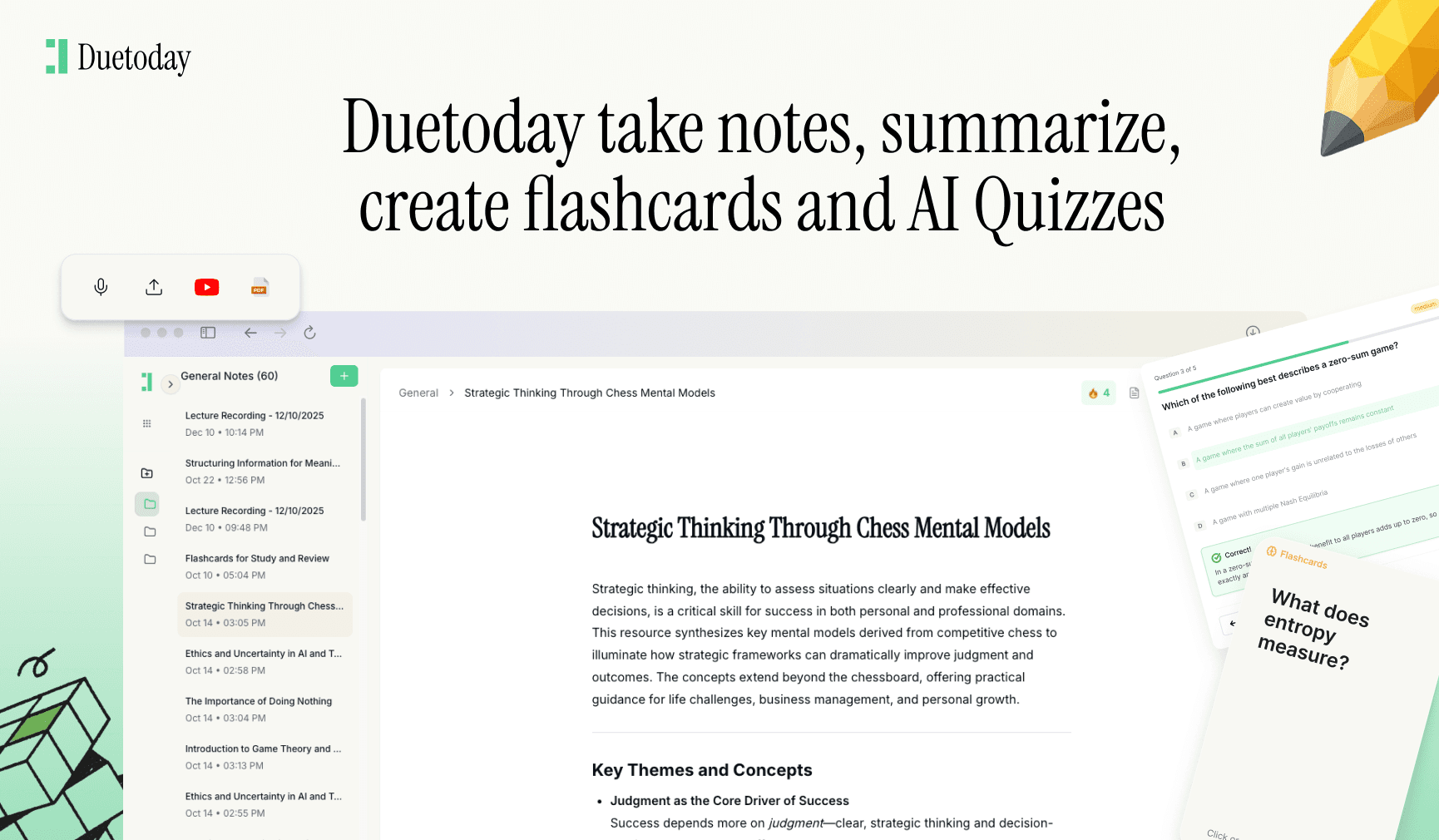
While traditional methods are great, modern students can gain a massive edge by using technology designed for the brain. Duetoday AI is an AI-powered learning platform that turns lectures, PDFs, and notes into summaries, flashcards, quizzes, and structured study tools automatically. It acts like a personalized AI tutor, helping students learn faster, stay organized, and retain information without spending hours rewriting notes. Instead of manually creating your own study materials, you can let the AI handle the heavy lifting of organization, allowing you to focus entirely on the active recall and spaced repetition phases that actually move the needle on your grades.
The Power of Mnemonic Devices and Association
Sometimes, raw data is just boring and hard to remember. This is where mnemonics come in. By associating a complex concept with a funny story, an acronym, or a vivid image, you give your brain a 'hook' to grab onto. For example, medical students often use elaborate stories to remember the bones in the hand. The weirder and more visual the association, the better. Your brain is evolved to remember stories and locations much better than abstract text, so try to turn your study material into a narrative or visualize it as part of a 'memory palace' where you place facts in different rooms of a house you know well.
Sleep and Nutrition as Memory Enhancers
You cannot talk about memory without talking about sleep. During sleep, your brain performs a process called consolidation, where it literalizes the memories you formed during the day. If you pull an all-nighter, you are essentially cutting off the recording process. Research shows that a well-rested brain outperforms a sleep-deprived one even if the latter spent more hours studying. Aim for seven to nine hours of sleep, especially in the week leading up to an exam. Additionally, staying hydrated and eating foods rich in omega-3 fatty acids, like walnuts or salmon, provides the physical building blocks your neurons need to function at their peak.
Teaching Others to Solidify Knowledge
The ‘Feynman Technique’ suggests that the best way to see if you truly understand something is to try and explain it to someone else in simple terms. When you teach a concept to a friend or even an imaginary audience, you quickly identify the gaps in your own knowledge. If you hit a point where you can't explain a step clearly, that is exactly where your memory is weak. This method forces you to simplify and structure the information logically, which is a high-level cognitive task that cements the material in your mind far better than any passive reading ever could.

How many hours should I study to improve memory?
It is not about the total hours but the quality. High-intensity study for 2-3 hours using active recall is better than 8 hours of passive reading.
Does listening to music help memory?
Instrumental or lo-fi music can help some students focus, but music with lyrics often competes for the same part of the brain used for processing language, which can hinder memory.
What is the best food for exam memory?
Blueberries, nuts, dark chocolate, and oily fish are often cited as brain foods that support cognitive function and focus during long study sessions.
Is cramming effective for long-term memory?
No, cramming is only effective for very short-term recall. To remember information for a final exam or future career, you must use spaced repetition over several weeks.