Guide to Creating Practice Questions from Your Study Notes

Why Practice Questions are the Secret to University Success
Stepping into a university lecture hall can feel like being hit by a tidal wave of information. You scribble down pages of notes, highlight key terms, and hope that by reading them over a few times, the information will somehow stick. However, passive reading is one of the least effective ways to study. If you really want to master your course material, you need to stop just consuming information and start testing yourself on it. Creating practice questions from your own notes is the most powerful way to trigger active recall, a cognitive process that strengthens memory pathways and ensures you can actually retrieve information during a high-stakes exam.
When you shift your focus from reading to questioning, you force your brain to engage with the material on a deeper level. Instead of recognizing a concept on a page, you are tasked with producing that concept from scratch. This gap between 'knowing of' something and 'knowing' something is where the real learning happens. In this guide, we will explore the best strategies for turning your messy lecture notes into a structured bank of practice questions that will help you stay ahead of the curve and reduce study stress.
Identifying High-Value Information in Your Notes
Before you can write great questions, you need to know what to ask. Not every sentence in your notebook is exam material. The first step in this process is scanning your notes for 'power markers.' These are often signaled by your professors during lectures. Did they repeat a specific term three times? Did they spend twenty minutes on a single diagram? These are clear indicators that the topic is likely to appear on a test. Focus your question-making efforts on definitions, cause-and-effect relationships, and comparison points between two different theories or historical events.
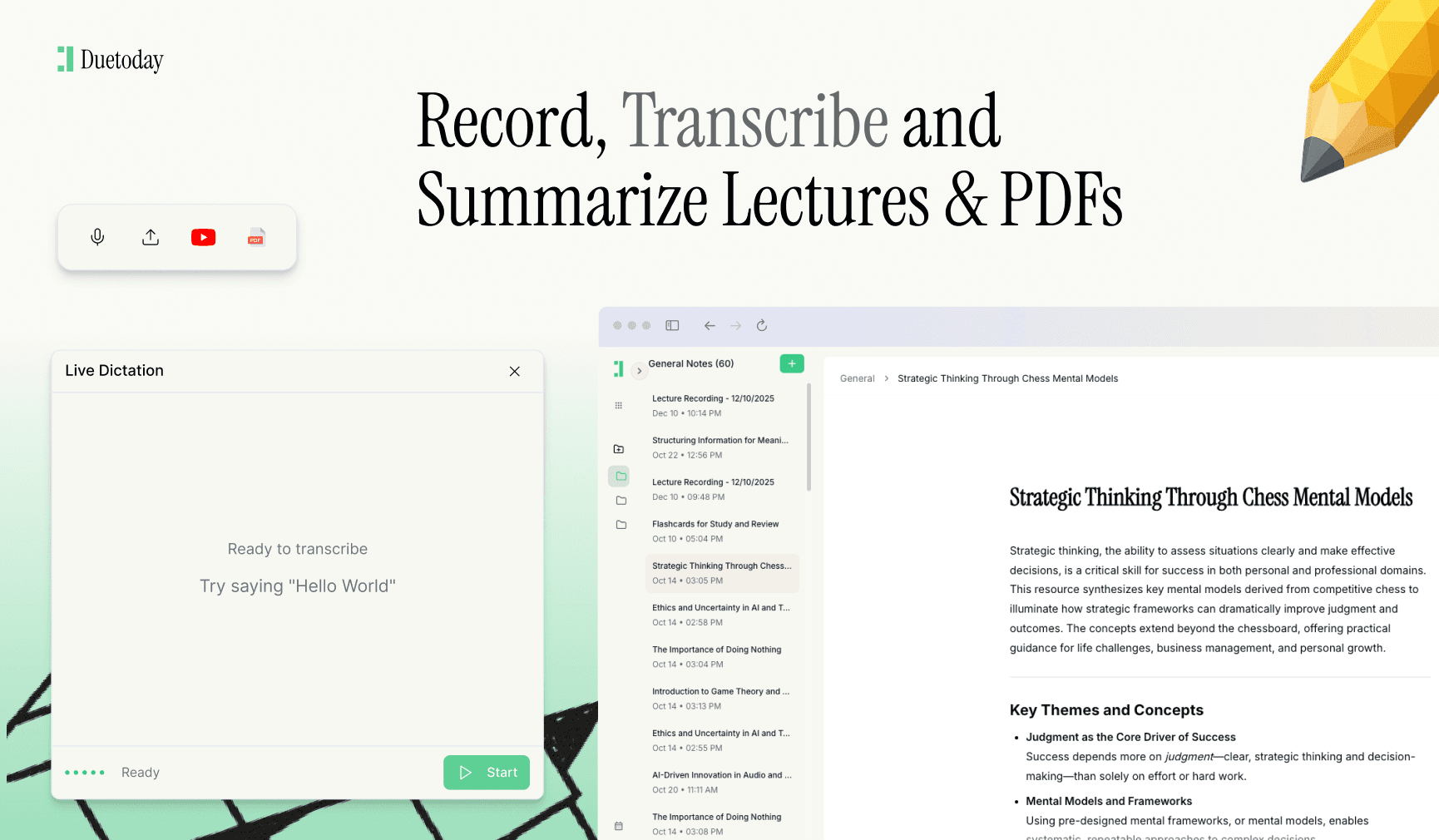
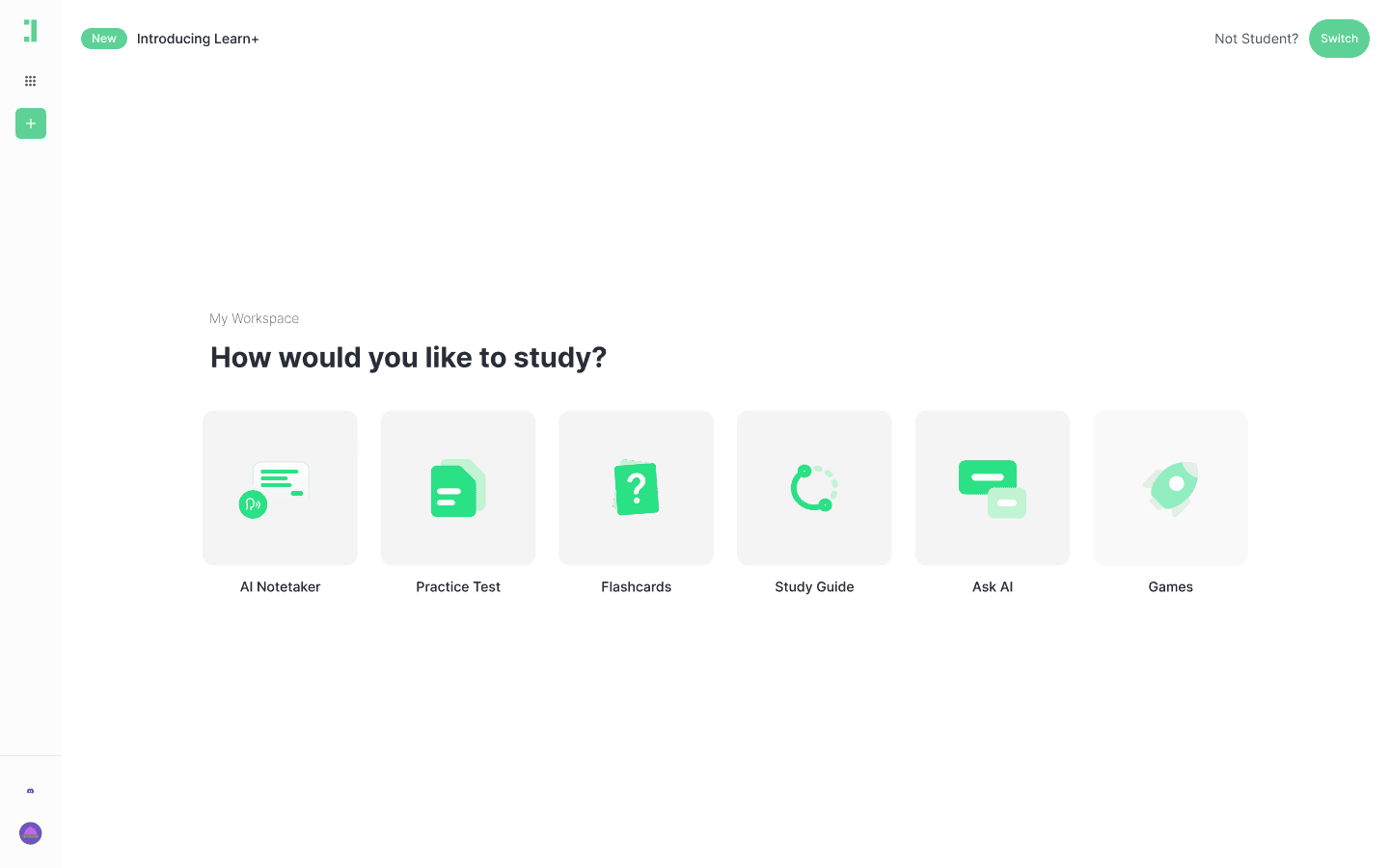
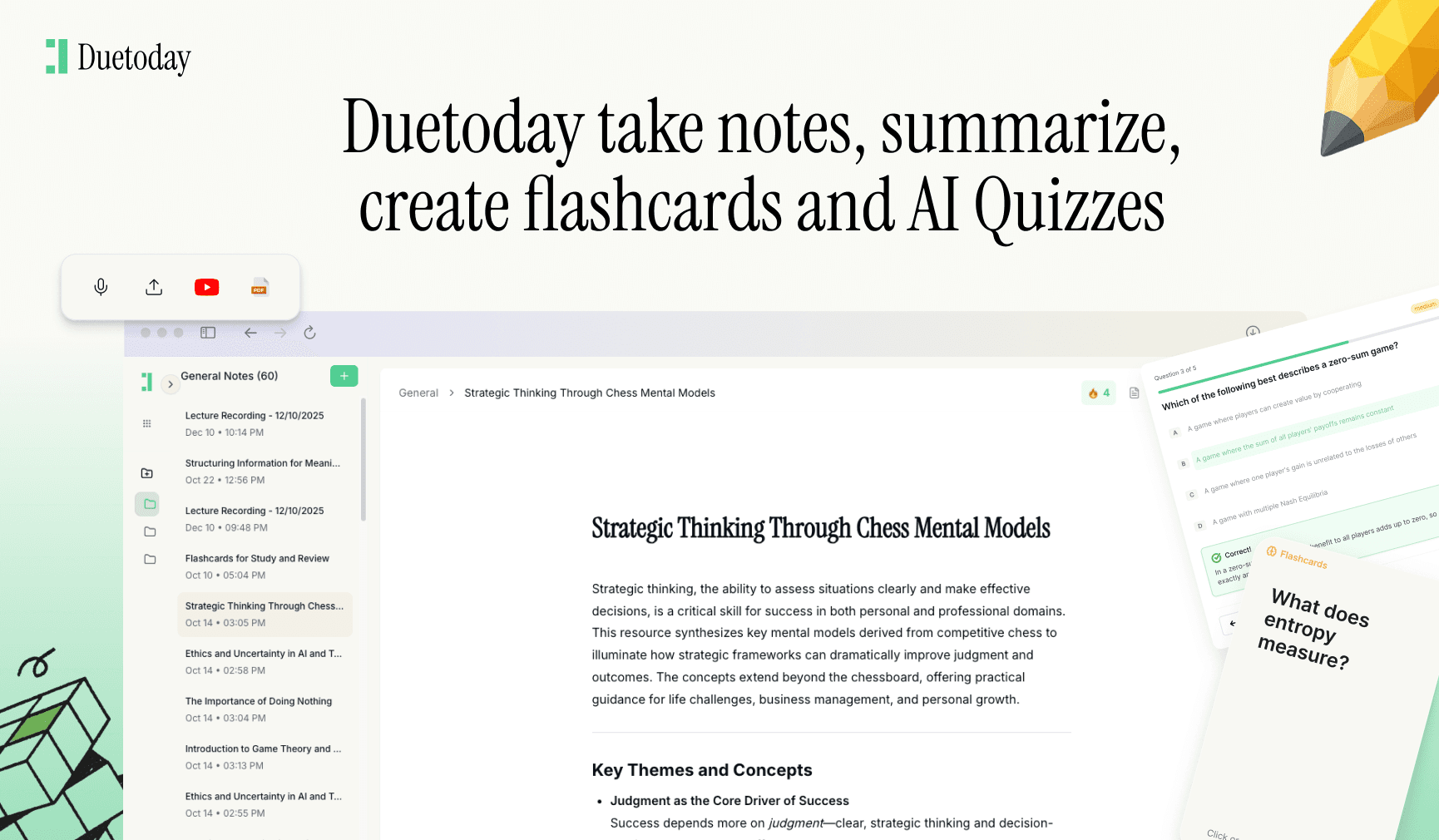
A great way to streamline this entire process is by using Duetoday AI. Instead of manually scanning through hundreds of pages of PDFs and handwritten notes, Duetoday AI serves as a personalized learning assistant that automatically scans your materials. It identifies the most important concepts and instantly converts your lectures and notes into structured summaries and quizzes. This allows you to focus more on studying the material rather than spending hours just trying to organize it into a testable format. It is like having a private tutor who knows exactly what is in your notebook.
The Cornell Method for Quick Question Generation
If you prefer a structured manual approach, the Cornell Note-Taking System is a classic for a reason. By dividing your paper into a main note-taking column and a narrow 'cue' column on the left, you are essentially building a question bank as you sit in class. During the lecture, write your normal notes on the right. Immediately after class, look at those notes and write a corresponding question in the left-hand column that the note answers. When it comes time to study, you can simply cover the right side of the page and see if you can answer the questions you wrote for yourself earlier.
Converting Concepts into Different Question Formats
To truly master a subject, you should practice with various types of questions. Multiple-choice questions are great for testing your ability to distinguish between similar terms, while short-answer questions challenge your ability to recall specific facts. However, the gold standard for university-level learning is the 'Why' and 'How' question. Instead of asking 'What is photosynthesis?', try asking 'How does the lack of sunlight affect the chemical output of photosynthesis?' This forces you to understand the underlying logic of the subject rather than just memorizing a definition by rote.
Essay-style prompts are also invaluable, especially for humanities and social science students. Look at a major theme in your notes and turn it into a debate. If you are studying history, don't just note the date of a treaty; ask yourself to argue whether that treaty was the primary cause of a later conflict. By preparing for the hardest possible version of a question, the actual exam questions will feel much easier by comparison. This method builds confidence and ensures you aren't caught off guard by a curveball question from your professor.
The Importance of Spaced Repetition
Creating the questions is only half the battle; you also need a system for revisiting them. Spaced repetition is the practice of reviewing information at increasing intervals. If you get a practice question right today, check it again in two days, then four days, then a week. This prevents the 'forgetting curve' from taking hold. If you find yourself struggling with a specific set of questions, move those back to your daily review pile. Consistency is what turns short-term memorization into long-term knowledge that lasts until finals week.
Collaborating with Study Groups
Another excellent way to generate questions is to swap notes with a classmate. Everyone perceives information differently, and a peer might pick up on a nuance in a lecture that you missed. By trading question banks, you expose yourself to different wording and perspectives on the same material. Explaining your answer to a friend is also the ultimate test of your understanding. If you can't explain a concept simply to someone else, you probably don't understand it well enough yet. This social aspect of learning makes the process less redundant and keeps you accountable to your study schedule.
Refining Your Questions After Mock Exams
After you take your first practice run, take a moment to evaluate your questions. Were they too easy? Did they focus too much on vocabulary and not enough on application? Use your results to refine your question-making process for the next unit. The goal is to make your practice sessions slightly harder than the actual exam. When you push your brain to work harder during preparation, the neuroplasticity involved in learning is heightened, making the final performance feel like second nature.

How many practice questions should I make per lecture?
Aim for 5 to 10 high-quality questions that cover the core themes and complex details rather than dozens of easy ones.
Is it better to write questions by hand or digitally?
Digital questions are easier to organize and edit, but writing by hand can sometimes help with initial memory retention. Use whatever method keeps you most consistent.
Should I make questions for things I already know?
Focus 80% of your energy on the topics you find difficult, and use the remaining 20% to briefly reinforce the topics you feel confident about.
When is the best time to create these questions?
The best time is within 24 hours of the lecture while the information is still fresh in your mind.