How to Study Nursing [Full Guide]

Mastering the Art of Nursing Education
Stepping into nursing school is like entering a completely different world where the vocabulary, the expectations, and the workload feel miles ahead of anything you experienced in general education. For university students, the challenge isn't just about memorizing facts; it is about learning how to apply complex clinical reasoning under pressure. To succeed, you need shift your mindset from rote memorization to deep conceptual understanding. This guide will walk you through the most effective strategies to navigate your courses and excel in your clinical rotations.
Prioritizing Active Learning Over Reading
Many nursing students make the mistake of spending hours highlighting textbooks. While it feels productive, it is often a passive activity that doesn't lead to long-term retention. Instead, focus on active recall.
After reading a section on the endocrine system or pharmacology, close the book and try to explain the concept out loud as if you were teaching a peer. If you can't explain it simply, you don't understand it well enough yet. This transition from consuming information to producing it is what builds the neural pathways required for the NCLEX and real-world practice.
The Power of Nursing Case Studies
Nursing exams are notorious for having multiple correct answers where you must choose the most correct one. This is why practicing with case studies is vital. Case studies force you to prioritize patient care using the ABCs—Airway, Breathing, and Circulation. When you study, don't just look at the symptoms of a condition; look at the patient as a whole. Ask yourself what the first priority action would be for a nurse in that specific scenario. By simulating these decision-making processes early on, you prepare your brain for the high-stakes environment of clinical finals.
Leveraging Technology with Duetoday AI
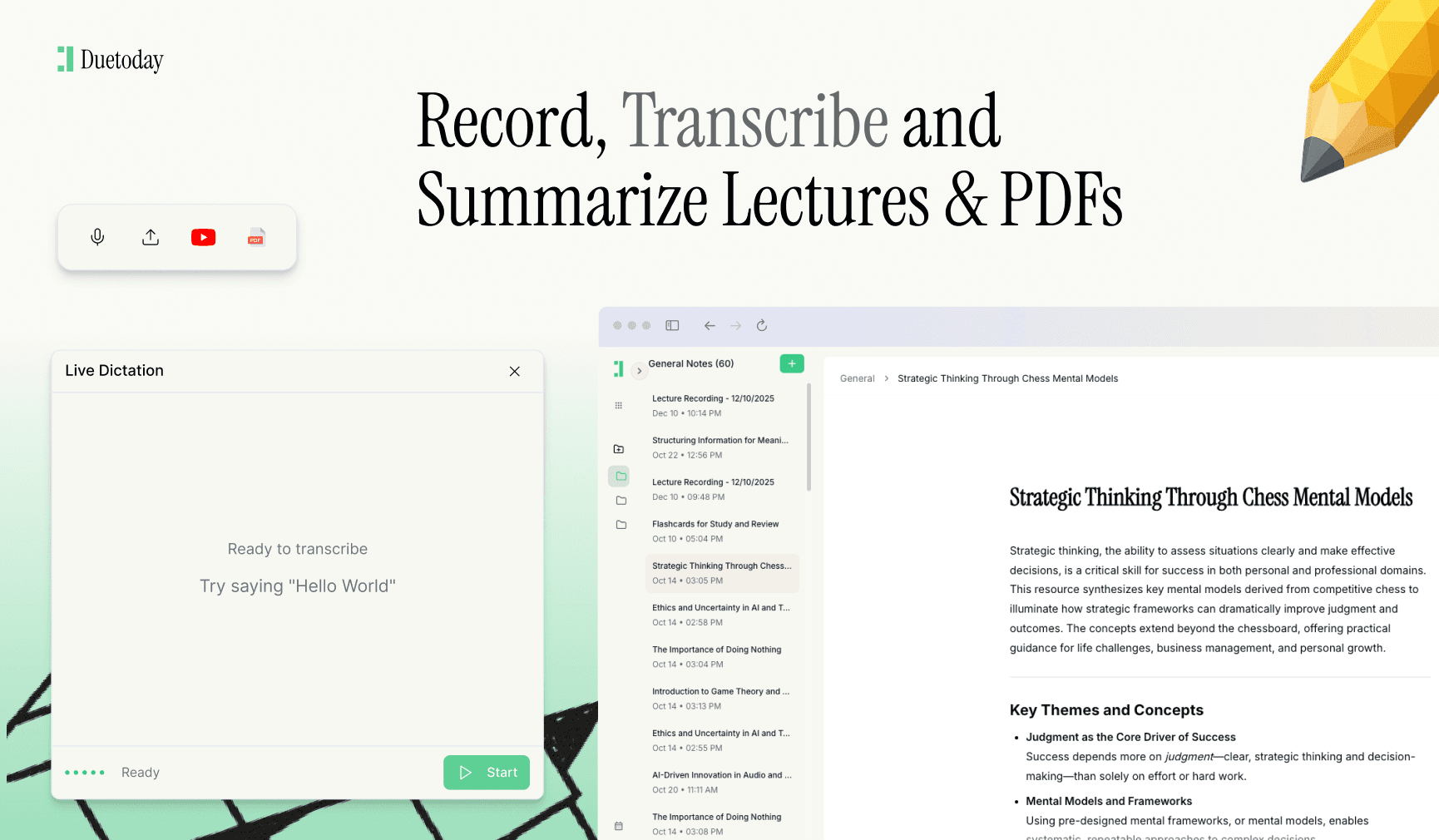
Between clinical shifts and back-to-back lectures, nursing students often find themselves drowning in PDFs and lecture slides. This is where Duetoday AI becomes an essential part of your study toolkit. Duetoday is an AI-powered learning platform that turns your dense nursing lectures and complex medical PDFs into concise summaries, flashcards, and quizzes automatically. It acts like a personalized AI tutor, helping you break down difficult subjects like pathophysiology or biochemistry into structured study tools. By using Duetoday, you can spend less time organizing your notes and more time actually mastering the material, ensuring you stay organized and retain critical information without the burnout of manual rewriting.

Understanding Pharmacology and Lab Values
Pharmacology is often cited as the most difficult subject in nursing school. The sheer volume of drug classes, side effects, and contraindications can be overwhelming. To study this effectively, focus on the suffixes of drug names and the general characteristics of drug classes rather than trying to memorize every individual pill. Create a system for lab values as well. Instead of just memorizing the numbers for potassium or sodium levels, understand what happens to the body when those levels are too high or too low. Connecting the data to a physiological response makes the numbers much harder to forget.
Organizing Your Clinical Preparation
Your time in the hospital is just as important as your time in the library. To make the most of clinicals, prepare the night before by researching your assigned patient’s diagnosis and medications. Bring a small notebook to jot down observations, but focus primarily on being present and asking questions. Nursing is a hands-on profession, and the bridge between theory and practice is built on the hospital floor. Don't be afraid to jump in and assist with procedures; the more you do, the more the classroom theory will start to make sense in a practical context.
Forming Effective Study Groups
While solo study is necessary for deep focus, nursing is fundamentally a team-based profession. Finding a small group of dedicated peers can help clarify confusing topics. Use your study group sessions to quiz each other on nursing interventions and rationales. Ensure the group stays on task by setting a specific agenda for each meeting, such as focusing entirely on maternal-child health or cardiac rhythms. Explaining a concept to a classmate is one of the best ways to solidify your own knowledge and identify gaps in your understanding before the actual exam day arrives.
Managing Stress and Burnout
Nursing school is a marathon, not a sprint. Proper sleep, nutrition, and mental breaks are not luxuries; they are requirements for cognitive function. Schedule your study blocks in manageable chunks, perhaps using the Pomodoro technique, to avoid total exhaustion. Remember why you started this journey whenever things get difficult. Taking care of yourself allows you to take better care of your future patients. Resilience is a skill just like taking a blood pressure reading, and it is one you will need throughout your entire nursing career.

How many hours a day should I study for nursing?
Most successful students recommend 3 to 4 hours of focused study per day outside of class and clinicals, ensuring they take breaks to avoid burnout.
What is the hardest subject in nursing school?
Pharmacology and Pathophysiology are generally considered the most challenging due to the heavy volume of memorization and complex systems involved.
How can I pass nursing exams with multiple correct answers?
Focus on the nursing process (ADPIE) and prioritize patient safety using the ABCs (Airway, Breathing, Circulation) to identify the most critical action.
Is it better to study alone or in a group for nursing?
A mix is best. Use solo time for initial memorization and group time for discussing case studies and testing your application of the material.