The Ultimate Guide to Structuring Your University Assignment
Getting Started with Your Assignment Structure
University life often feels like a balancing act between social commitments and a mountain of coursework. One of the biggest challenges students face isn't just researching the topic, but knowing how to organize those thoughts into a cohesive, logical structure. A well-structured assignment acts as a roadmap for your professor, guiding them through your arguments and evidence without confusion. When you nail the layout, you make it significantly easier for the marker to give you high grades because your logic is transparent and your flow is seamless.
Before you even type the first word of your introduction, you need to dissect the prompt. Many students dive straight into writing, only to realize halfway through that they have missed the core objective of the task. Look for directional verbs like 'analyze,' 'critically evaluate,' or 'compare.' These words dictate the shape of your structure. For instance, a comparison piece will require a balanced layout between two subjects, while a critical evaluation requires a deep dive into the strengths and weaknesses of a single theory or event.
The Power of a Solid Introduction
The introduction is your first opportunity to make an impression. It should represent about 10% of your total word count. Start with a broad opening statement that introduces the general field of study, then narrow it down to the specific problem or question at hand. Mention the key theories or themes you will be discussing. Most importantly, your introduction must include a clear thesis statement. This is a one or two-sentence summary of your main argument. It tells the reader exactly what you are going to prove, saving them from guessing your stance as they read through the body paragraphs.
A common mistake is being too vague in the introduction. You want to provide a 'map' of the essay. Explicitly stating things like 'This essay will first examine... before moving on to analyze...' might feel mechanical, but it provides the clarity that university markers look for. It shows that you have a plan and that your writing is purposeful. Once the intro is set, the rest of the structure should naturally follow the sequence you just outlined.
Maximizing Efficiency with Duetoday AI
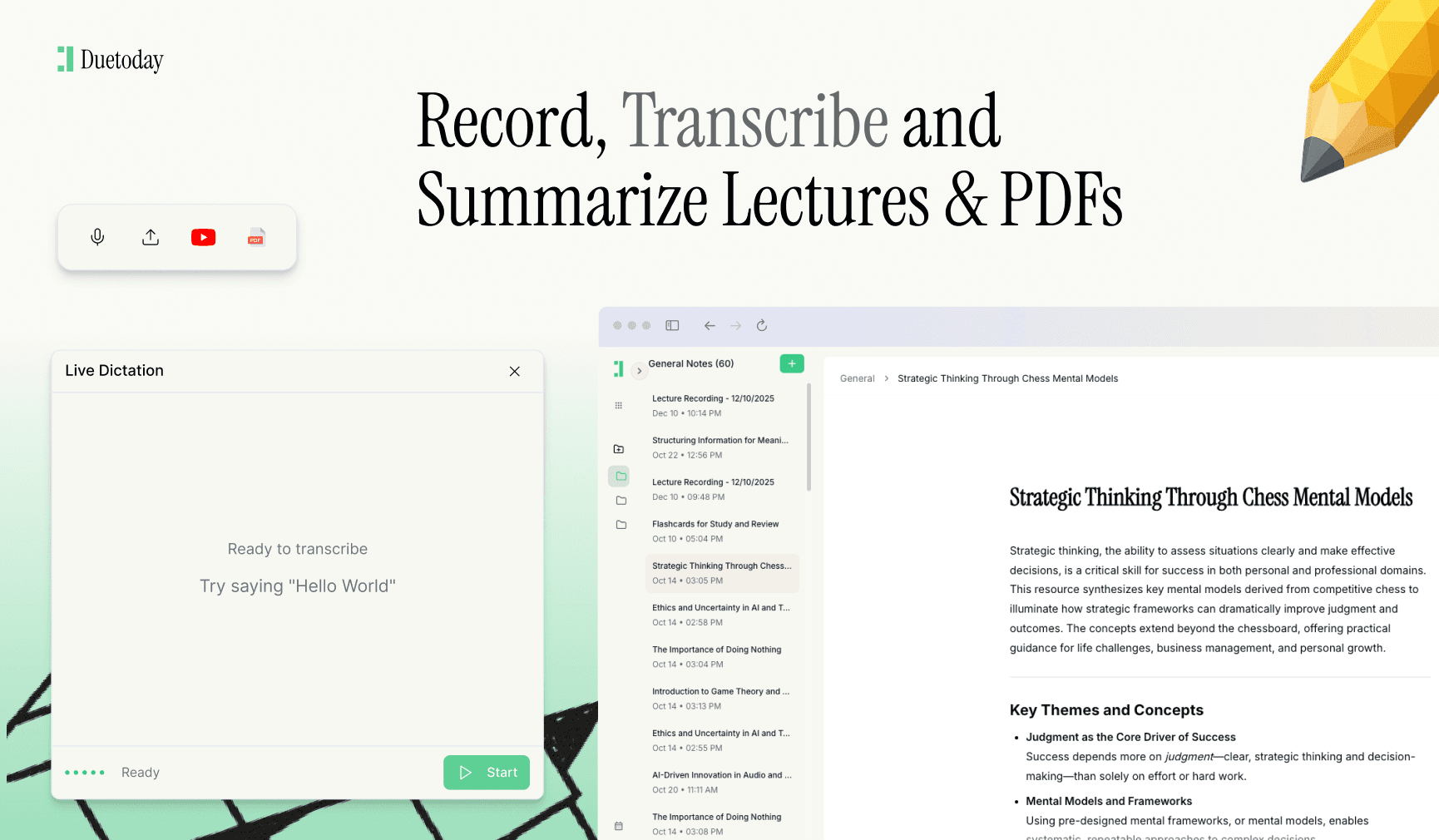
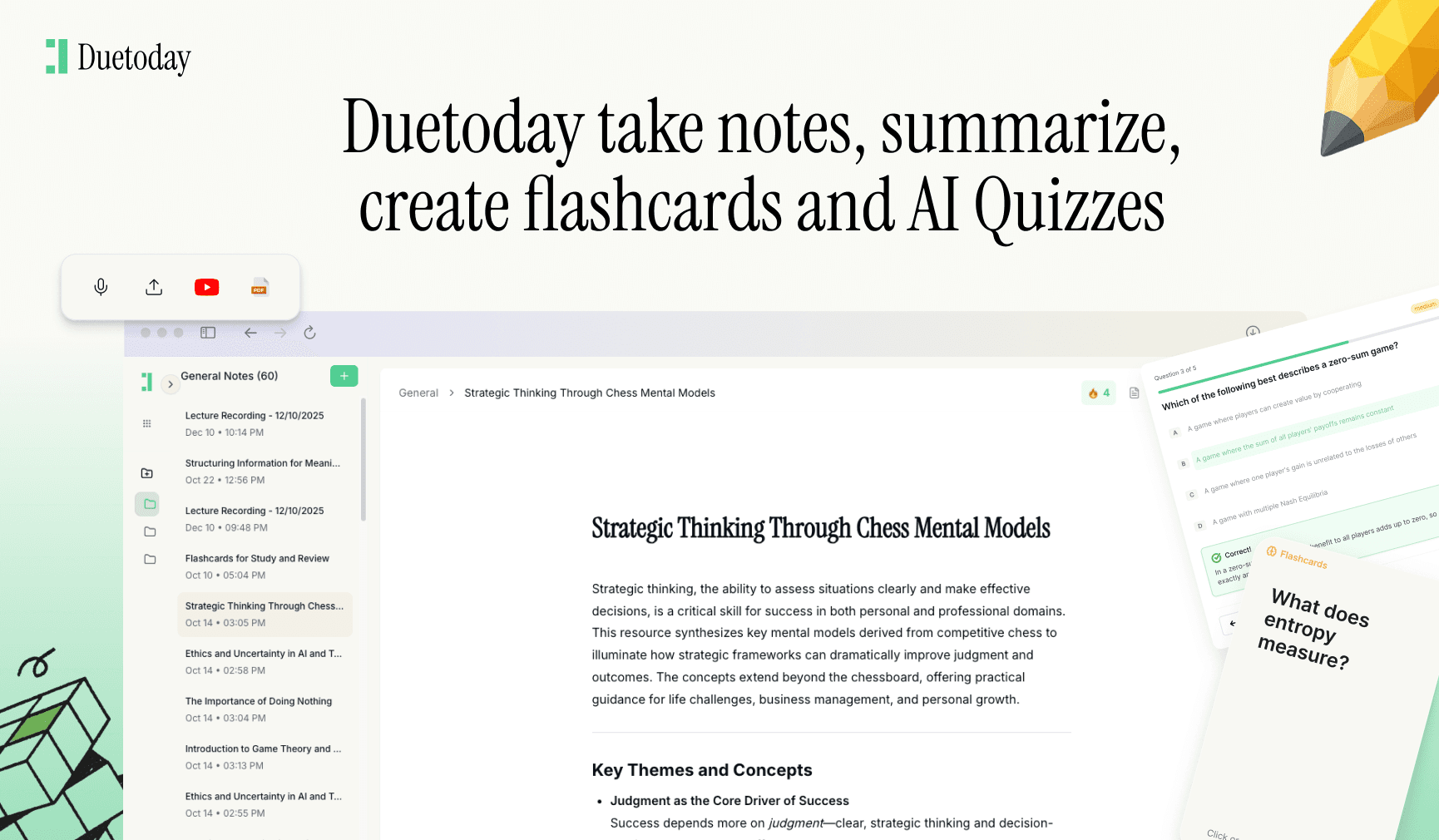
Structuring an assignment becomes ten times easier when you actually understand your source material. This is where Duetoday AI becomes a game-changer for university students. Duetoday is an AI-powered learning platform that turns complex lectures, dense PDFs, and messy notes into clear summaries, flashcards, and structured study tools automatically. Instead of spending hours squinting at a 40-page journal article trying to find the main points, you can use Duetoday to extract the core arguments and create a personalized study guide. It acts like a private tutor that helps you organize your thoughts and retain information, ensuring that when you sit down to write your assignment, you actually have a solid grasp of the content you are talking about.
Building the Body Paragraphs
The body of your assignment is where the heavy lifting happens. Each paragraph should focus on a single main idea that supports your thesis. A great way to ensure each paragraph is effective is to use the PEEL method: Point, Evidence, Explanation, and Link. Start with a clear topic sentence (the Point), provide a quote or data (the Evidence), explain how that evidence supports your point (the Explanation), and finally, link it back to the overall assignment question (the Link). This prevents your writing from becoming a list of facts and instead turns it into a persuasive argument.
Transitions between paragraphs are equally important. You don't want your assignment to feel like a collection of isolated thoughts. Use transitional phrases such as 'Furthermore,' 'In contrast,' or 'Consequently' to show the relationship between your ideas. If your next paragraph builds on the previous one, use additive transitions. If you are introducing a counter-argument, use adversative transitions. This creates a logical flow that keeps the reader engaged and makes your logic easy to follow from start to finish.
The Importance of the Conclusion
Your conclusion is your final chance to reinforce your argument. It should also be about 10% of your word count. Start by restating your thesis in different words, then summarize the main points you made in the body paragraphs. Do not introduce any new information or new evidence in the conclusion; this is a place for synthesis, not new ideas. End with a broad statement about the implications of your findings or a suggestion for future research. This leaves the marker with a sense of completion and shows that you have fully addressed the assignment brief.
Finally, leave time for a thorough review. A perfect structure can be undermined by poor formatting or inconsistent referencing. Ensure that your headings, if allowed, are clear and that your bibliography matches the citations in your text. Check that the proportion of your sections feels right; if your introduction is longer than your main body, you likely need to move some of that background information into the body paragraphs. A well-proportioned, logically sequenced assignment is often the difference between a pass and a distinction.

How long should an introduction be?
In most university assignments, the introduction should be approximately 10% of the total word count. For a 2,000-word essay, aim for about 200 words.
Can I use subheadings in my assignment?
This depends on your department and the type of assignment. Reports usually require subheadings, while traditional essays might prefer a continuous flow of prose. Always check your module handbook first.
What is a thesis statement?
A thesis statement is a concise summary of the main point or claim of your essay. it usually appears at the end of the introduction and acts as a guide for the reader.
What should I do if I go over the word count?
Focus on your body paragraphs. Look for repetitive explanations or overly long quotes. Ensure every sentence adds value to your argument or provides necessary evidence.