How to Make Flashcards That Actually Work

The Science Behind Why Your Flashcards Might Be Failing You
Every university student has been there: you spend five hours meticulously hand-writing a stack of flashcards, only to realize during the exam that you can remember the color of the ink you used but not the actual information. Most students treat flashcards like a transcription project rather than a learning tool. If you are just copying definitions from a textbook onto a piece of cardstock, you are engaging in passive learning. To make flashcards that actually work, you need to transition into active recall.
Active recall is the process of challenging your brain to retrieve information rather than just recognizing it. When you look at a textbook, your brain feels a sense of familiarity, which you mistake for mastery. Flashcards, when done correctly, force you to produce an answer from scratch. This mental effort strengthens the neural pathways associated with that information, making it much harder to forget when the pressure of finals week hits. The goal is to move knowledge from your short-term memory into your long-term storage through repeated, effortful retrieval.
One of the biggest mistakes students make is putting too much information on a single card. This is known as the kitchen sink method. When a card has three different concepts or a paragraph-long answer, your brain likely only remembers the first part and glosses over the rest. This creates a false sense of security. To fix this, you must adhere to the principle of atomic discovery. Each card should contain exactly one question and one specific answer. If a concept is complex, break it down into five separate cards that cover different angles of the same topic.
The Power of Visual Cues and Personalization
Your brain is wired to process images much faster than text. When you are building your deck, try to incorporate simple sketches, diagrams, or even memes that relate to the concept. These visual anchors provide a secondary pathway for retrieval. If you can't remember the verbal definition of a chemical reaction, you might remember the drawing of the flask you put in the corner of the card. This dual-coding approach is a proven way to increase retention rates among university students who are dealing with heavy workloads.
Personalization is another secret weapon. Instead of using the generic examples provided by your professor, try to relate the concept to your own life or something you’re passionate about. If you’re studying psychology, relate a behavioral trait to a character in your favorite Netflix show. The more 'sticky' the information is, the less work your brain has to do to keep it. This makes the session feel less like a chore and more like a puzzle you are solving.
Automating Your Study Workflow with Duetoday AI
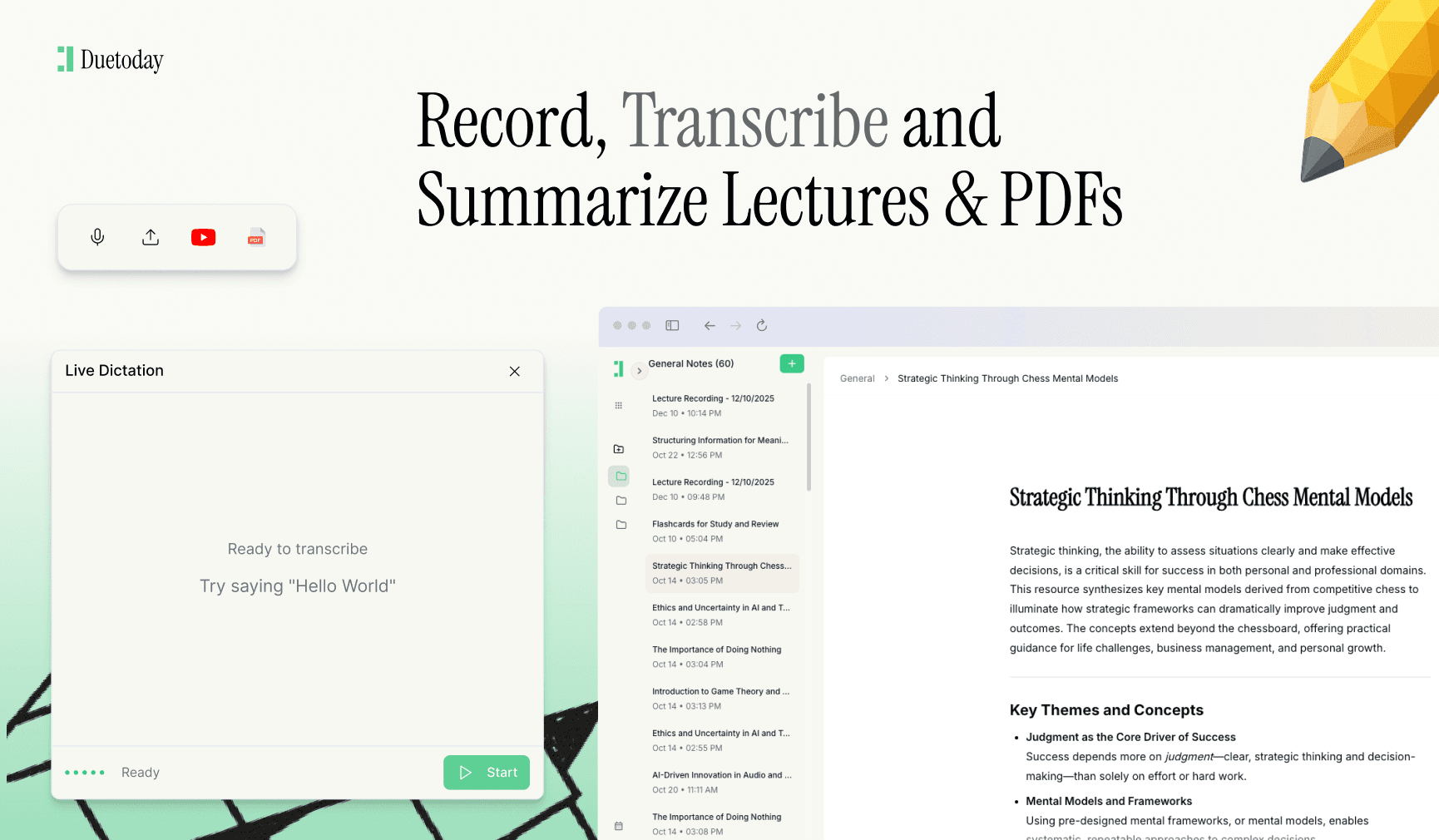
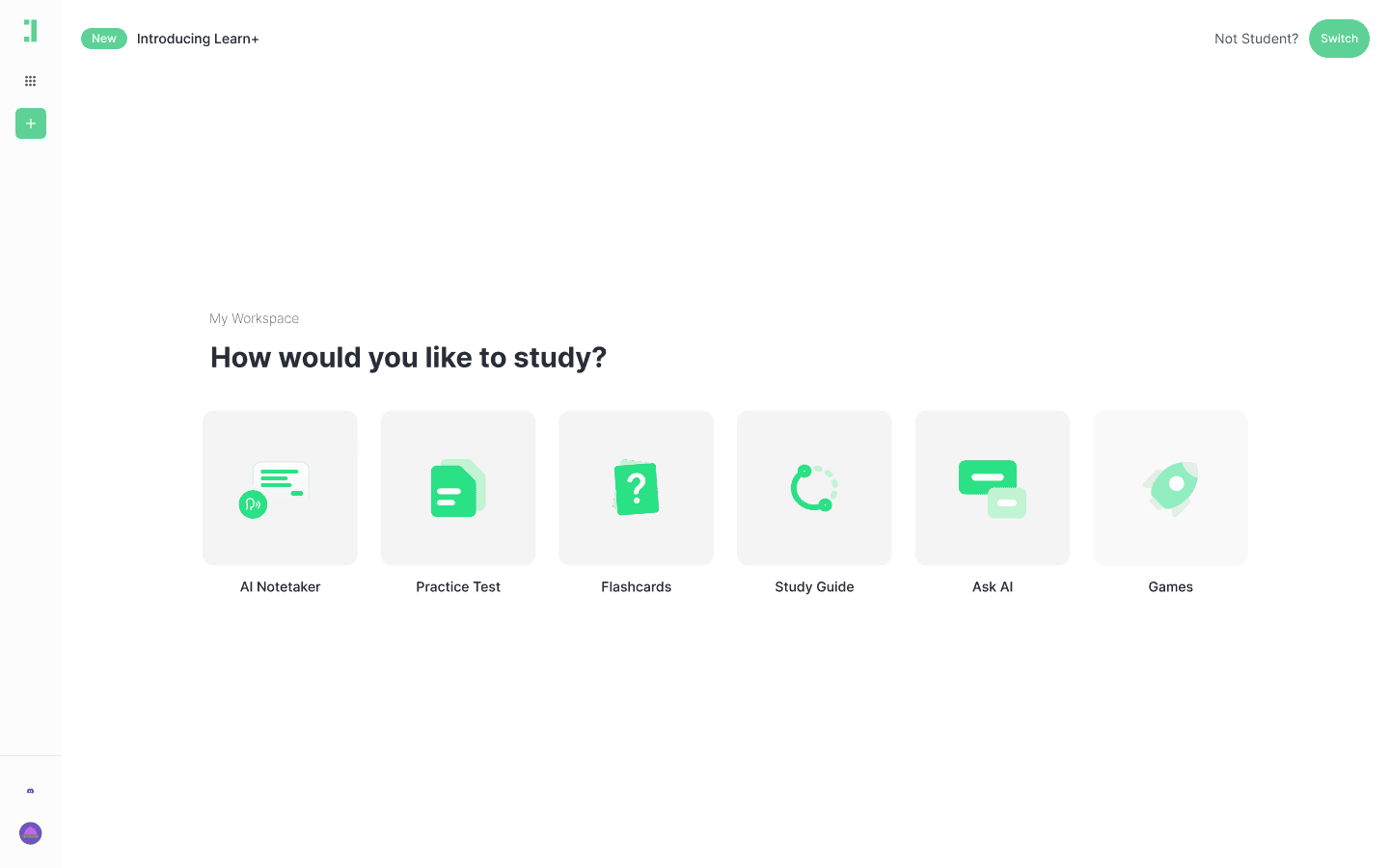
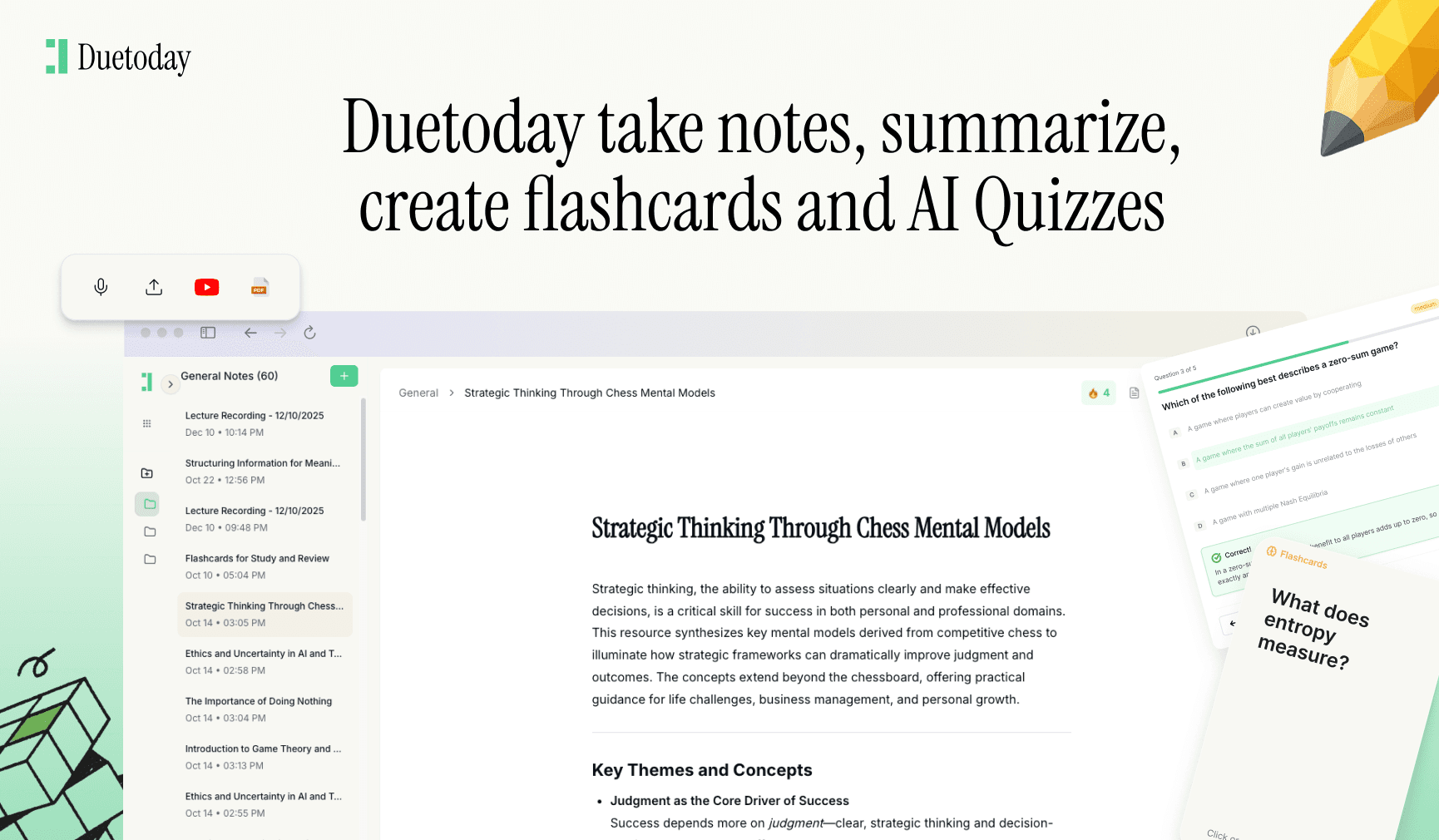
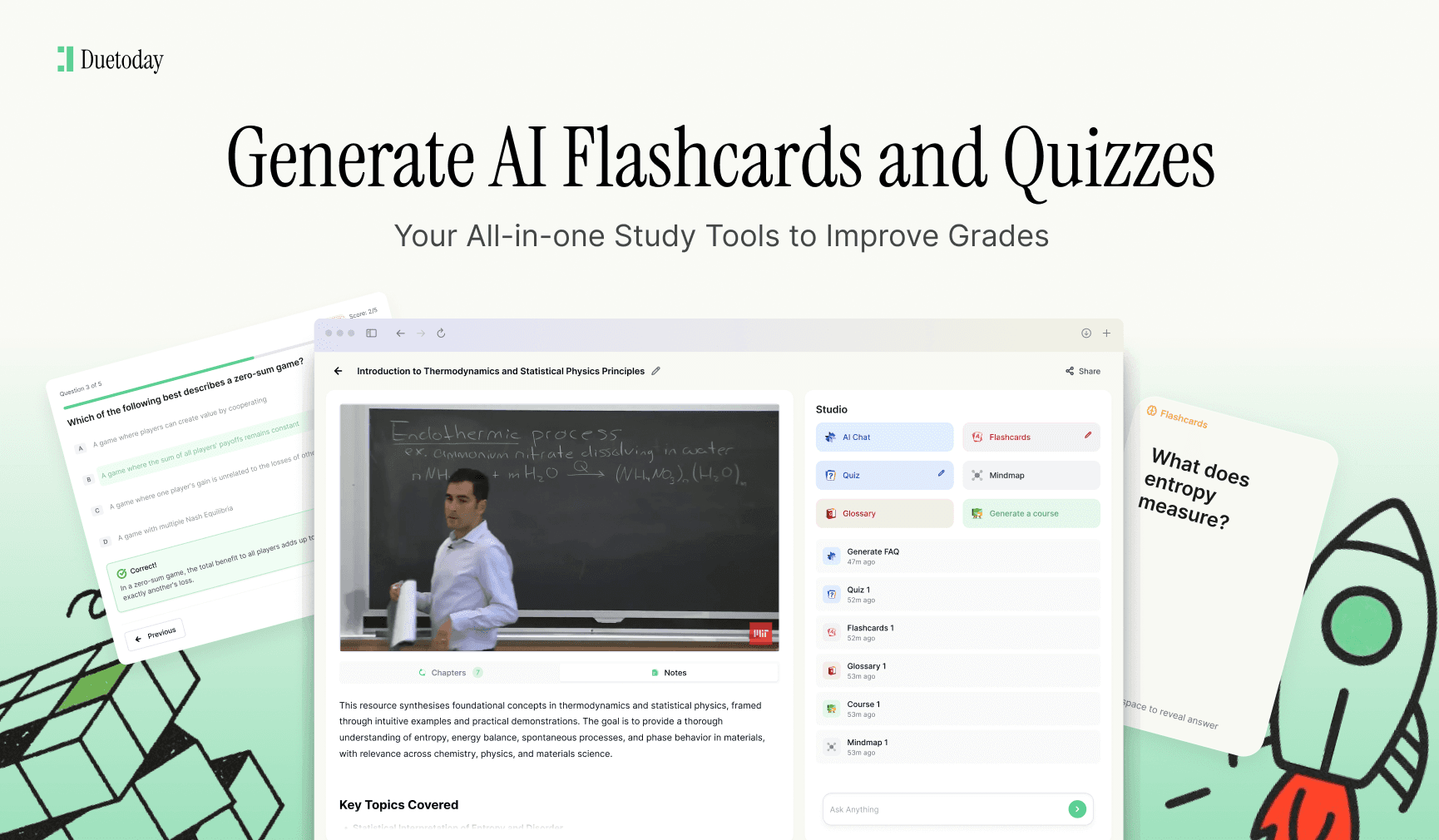
While manual flashcards have their charm, most university students simply don't have the time to sit down and write hundreds of cards by hand while keeping up with lectures. This is where Duetoday AI becomes a game-changer for your academic routine. Duetoday is an AI-powered learning platform that turns lectures, PDFs, and notes into summaries, flashcards, quizzes, and structured study tools automatically. It acts like a personalized AI tutor, helping students learn faster and stay organized without spending hours on the tedious parts of note-taking. By letting the AI handle the card creation, you can spend 100% of your time actually studying and retaining the material rather than just formatting it.
Implementing Spaced Repetition for Long-Term Mastery
Once you have your cards, the 'when' is just as important as the 'how.' Cramming your flashcards the night before an exam is the least effective way to use them. Instead, you should utilize Spaced Repetition Systems (SRS). This involves reviewing your cards at increasing intervals. If you get a card right, you see it again in three days; if you get it right again, you see it in a week. If you get it wrong, it goes back to the daily pile. This method hacks the forgetting curve, ensuring you review information exactly when you are about to forget it.
Consistency is the final piece of the puzzle. It is much better to spend 15 minutes a day reviewing flashcards during your commute or while waiting for a coffee than to spend six hours on a Sunday trying to memorize a whole deck. High-performing students integrate these micro-study sessions into their daily lives. By the time the exam rolls around, the information isn't just something they studied; it's something they know intuitively. Start small, keep your cards simple, and use technology to bridge the gap between your notes and your memory.
Should I use paper flashcards or digital apps?
Digital apps are generally more efficient for university students because they built-in spaced repetition algorithms and allow you to carry thousands of cards in your pocket. However, paper cards can be better for subjects requiring complex drawings or for students who get easily distracted by phone notifications.
How many flashcards should I study per day?
Quality over quantity is key. Aim to review your 'due' cards daily, which might range from 20 to 50 cards depending on your deck size. Don't try to learn 100 new cards in one sitting.
What do I do if I keep getting the same card wrong?
If you're stuck on a card, the information is likely too complex or poorly phrased. Try breaking it down into two smaller cards or adding a visual hint to help your brain make the connection.
Can I use flashcards for subjects like Math or Physics?
Yes, but focus on formulas, key constants, and the 'why' behind certain steps rather than just trying to memorize entire problems. Flashcards are great for learning the building blocks of quantitative subjects.