How to Answer Exam Questions Strategically: A Full Guide
The Art of Navigating University Exams
Stepping into a university exam hall can feel like walking into a high-stakes arena. Most students focus entirely on how much information they can cram into their heads the night before, but the secret to top grades often lies in how you handle the paper itself. Strategy is the bridge between knowing the material and proving you know it. Whether you are facing a multiple-choice marathon or a grueling three-hour essay exam, having a roadmap for how to approach each question is essential for staying calm and maximizing your marks.
The first step in any strategic approach is a rapid initial scan of the entire paper. Before you pick up your pen to write a single word, take three minutes to look through every page. This helps your brain start processing the requirements of the larger questions in the background while you work on the smaller ones. It also ensures there are no nasty surprises waiting for you on the final page when you only have ten minutes left on the clock. By understanding the breadth of the task ahead, you can allocate your mental energy and time more effectively.
Decoding the Question Phrasing
Many students lose marks not because they lack knowledge, but because they fail to answer the specific question asked. Academic exams use directive verbs that tell you exactly what the examiner wants to see. If a question asks you to 'critically evaluate,' simply describing the topic won't cut it. You need to weigh different perspectives and provide a judgment. Understanding the difference between 'summarize,' 'analyze,' and 'compare' is the quickest way to ensure your response hits the marking criteria exactly where it needs to.
When you encounter a complex prompt, try to break it down into smaller sub-questions. If a question has two or three parts, underline them. This visual reminder keeps you from ignoring half of the requirements during the stress of writing. It is helpful to quickly jot down a few keywords or a tiny outline in the margin as soon as you read the prompt. This prevents 'brain freeze' mid-paragraph, allowing you to follow a logical path even when you feel the pressure rising.
Managing Your Time Allotment
Time management is arguably the most critical component of exam strategy. A common mistake is spending 50% of your time on a question that is only worth 10% of the total marks. Before you start, calculate how many minutes you can afford to spend per mark. If the exam is 100 minutes for 100 marks, you have a simple one-minute-per-mark rule. Stick to this strictly. If time runs out on a particular section, leave a gap and move on. You can always come back at the end, but you cannot get back the time you lost by failing to start the high-value questions at the end of the paper.
Using Duetoday AI for Smarter Prep
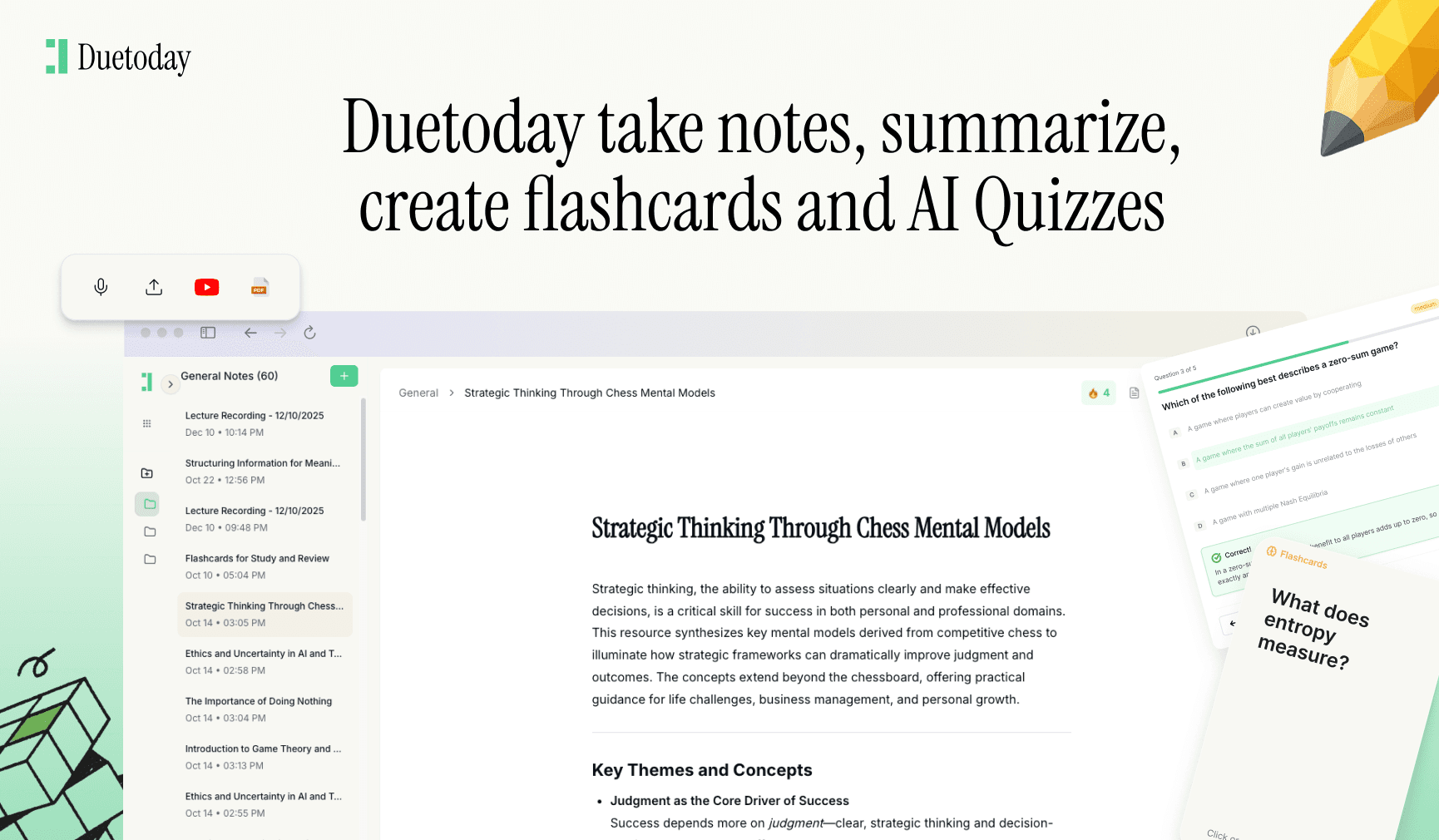
Preparing for these high-pressure moments becomes significantly easier when you have the right tools in your corner. Duetoday is an AI-powered learning platform that turns lectures, PDFs, and notes into summaries, flashcards, quizzes, and structured study tools automatically. It acts like a personalized AI tutor — helping students learn faster, stay organized, and retain information without spending hours rewriting notes. By using Duetoday to create practice quizzes ahead of time, you can simulate the exam environment and practice your strategic answering techniques before the real day arrives.
Strategic Approaches for Different Question Types
Multiple-choice questions (MCQs) require a process of elimination. Even if you aren't 100% sure of the correct answer, you can usually identify one or two that are definitely wrong. This shifts your odds from a 25% guess to a 50/50 choice. For short-answer questions, the best strategy is brevity and precision. Be direct, use the relevant terminology, and move on. Don't feel the need to fill the entire space provided if you have already hit the core points required by the mark scheme.
For essay questions, the structure is your best friend. A quick two-minute plan consisting of an introduction, three main points, and a conclusion can save you twenty minutes of aimless writing. Start with your strongest argument to make a powerful first impression on the marker. If you find yourself running out of time on an essay, switch to bullet points for your final arguments. Most examiners will still award marks for the points made, even if they aren't in full prose, whereas an unfinished sentence earns nothing.
Reviewing and Refining Your Work
If you have managed your time well, you should have at least five to ten minutes at the end of the exam for a final review. This is not the time to rewrite whole sections, but rather to catch silly mistakes. Check your calculations, ensure you haven't missed a 'not' or 'except' in a multiple-choice question, and make sure your handwriting is legible. Sometimes, a quick read-through reveals a missing link in your logic that only takes a sentence to fix. This final polish is often what separates a grade boundary.
Remember that exams are as much a test of endurance and strategy as they are of memory. By staying calm, reading carefully, and managing your clock, you put yourself in the best possible position to succeed. Every exam you take is an opportunity to refine this process, turning you into a more efficient and confident student as you progress through your university journey.

How do I stop panicking when I see a question I dont know?
Take a deep breath and look for any part of the question that feels familiar. If you are truly stuck, move to a question you can answer to build confidence, then return to the difficult one later.
Is it better to write a long answer or a short one?
Quality always beats quantity. Focus on addressing the prompt directly using technical terms rather than adding filler text that doesn't earn marks.
Should I answer questions in order?
Not necessarily. Many students prefer starting with the questions they find easiest to build momentum and secure early marks effectively.
What should I do if I run out of time?
Switch to bullet points for the remaining part of your answer. This allows you to show the examiner your main points and potentially snag partial marks.