Transcribe windows Lectures to Notes (Next-Level Notes in Minutes)
Learn how to transcribe lectures on Windows and turn recordings into structured study notes. Step-by-step guide for student-success using AI tools.
Upload Your Recording
Transcribe windows Lectures to Notes (Next-Level Notes in Minutes)
Windows users often face the challenge of keeping up with fast-paced academic lectures. Whether it is a dense technical briefing or a theory-heavy seminar, the sheer volume of information can be overwhelming. Manual note-taking frequently results in missed context, as students struggle to balance listening with writing down complex terminology or case study details specific to their Windows-based coursework.
Using transcription software on Windows is a genuine cheat code for staying ahead. By converting a lecture recording into a full text transcript, you ensure that every nuanced explanation, off-the-cuff example, and crucial exam hint is captured in writing. This allows you to stay present in the moment and engage with the material rather than staring at a notebook or screen trying to catch every word.
This workflow is incredibly versatile and works perfectly with both live dictation and file uploads. Whether you are using your laptop’s microphone to record a live session or uploading pre-recorded video files from online classes like Zoom or Microsoft Teams, you can bridge the gap between raw audio and high-quality study materials. Any audio or video file type can be transformed into a searchable text format ready for revision.
Why Transcribing Lectures is Especially Powerful for windows
For Windows-based students, transcription provides a centralized way to handle the massive amounts of data generated across different modules. Instead of having fragmented papers or scattered digital documents, a transcript acts as a single source of truth for your entire semester's content.
Keep every definition and specific example provided by the lecturer.
Access searchable revision materials to find keywords quickly before exams.
Pull out specific frameworks, formulas, or process steps for deeper study.
Complete your weekly reviews faster without ever having to rewatch a full lecture.
The Next-Level Workflow: Lecture to Transcript to Clean Notes
Step 1: Capture the lecture (dictation or recording) OR upload a file (audio/video). You can use your Windows laptop’s built-in voice recorder, a phone memo app, or even a screen recording of an online lecture. If you already have the file saved, simply prepare it for upload to your transcription tool.
Step 2: Transcribe and structure it for study. Modern Windows-compatible AI tools are highly accurate. Once the transcription starts, focus on organizing the output with clear headings, section breaks, and speaker labels to distinguish between professor insights and student questions.
Step 3: Turn the transcript into notes that match how windows is tested. Do not just keep the wall of text; shape it into a format that aids memory. Organize the content by defining key concepts, outlining specific processes or formulas, and highlighting the comparisons or case studies mentioned in class.
Step 4: Do a quick cleanup pass. Spend five minutes reviewing the automated output to ensure the core message is clear and technical terms are spelled correctly for your windows studies.
Fix key terms and proper names.
Highlight essential definitions.
Pull out formulas or frameworks into bold text.
Mark examples that are likely to appear on the exam.
Add missing context lines for clarity.
Split long paragraphs into readable sections.
Step 5: Study smarter with the notes (revision loop). Use your new, structured notes for spaced repetition and active recall. Because the notes are digital and searchable, you can quickly jump to specific topics during your study sessions without wasting time scrolling through endless pages.
What to Include in Your windows Notes
To get the most out of your Windows transcription workflow, ensure your final notes contain these specific elements tailored to your academic success:
Key definitions and their meanings in plain English.
Formulas or frameworks and exactly what they are used for.
Step-by-step processes or logical sequences.
Real-world worked examples or case studies provided in class.
Common mistakes or misconceptions the lecturer warned about.
Specific hints regarding what will be on the final exam.
Comparison tables for competing theories or methods.
Key assumptions or conditions where certain rules apply.
Duetoday: Your AI Note-Taking Companion
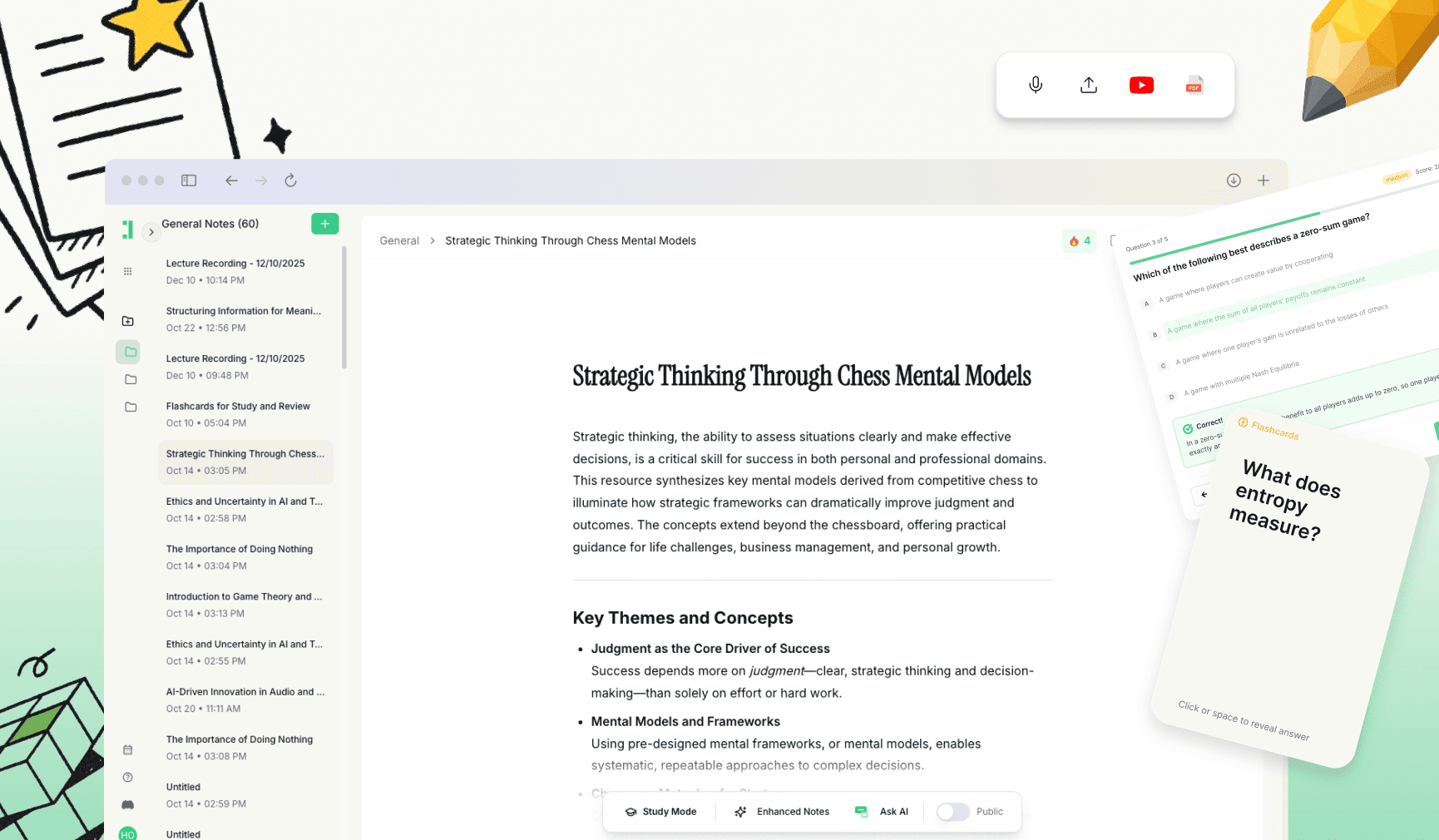
Duetoday is a powerful AI note-taker and study tool designed to help students maximize their productivity on Windows and other platforms. It simplifies the transition from listening to studying by providing a seamless interface for both live dictation and file uploads. Whether you have an MP4 of a Zoom lecture or an MP3 of a seminar, Duetoday processes the audio to give you more than just text.
Beyond standard transcription, Duetoday generates organized notes and offers a suite of study tools. You can turn your Windows lecture transcripts into flashcards, practice quizzes, or chat with an AI tutor to clarify difficult concepts. It is a comprehensive solution for students who want to save time and improve their grades through better organization.
Common Issues and Simple Fixes
Too far from the speaker: If the audio is faint, try to sit closer to the front row in the future or use a directional microphone. For recorded files, boost the volume before uploading.
Background noise: Background chatter or keyboard clicking can interfere. Try to record in a quiet spot or use noise-canceling software settings on your Windows device.
Multiple speakers: When several people are talking, use the speaker labeling feature to keep track of who said what, which is vital for seminars or group discussions.
Long lectures: For two-hour sessions, it is best to split the files into chapters or use the AI summary feature to break down the main points into digestible chunks.
Example: Transcribing a Concept
Raw Transcript: "So today we are looking at the Windows kernel architecture which basically manages the hardware resources and... uh... it acts as a bridge, you know? It's the core part of the OS."
Clean Notes: Topic: Windows Kernel Architecture
• Definition: The core part of the Operating System.
• Function: Acts as a bridge between software and hardware resources.
• Key Role: Responsible for managing hardware resource allocation.
Frequently Asked Questions
How accurate is lecture transcription for windows? Accuracy is typically very high with modern AI, often exceeding 95% depending on audio quality and the clarity of the lecturer's voice.
What file types can I use (audio/video)? You can use almost any standard format including MP3, WAV, M4A for audio, and MP4, MOV, or AVI for video recordings.
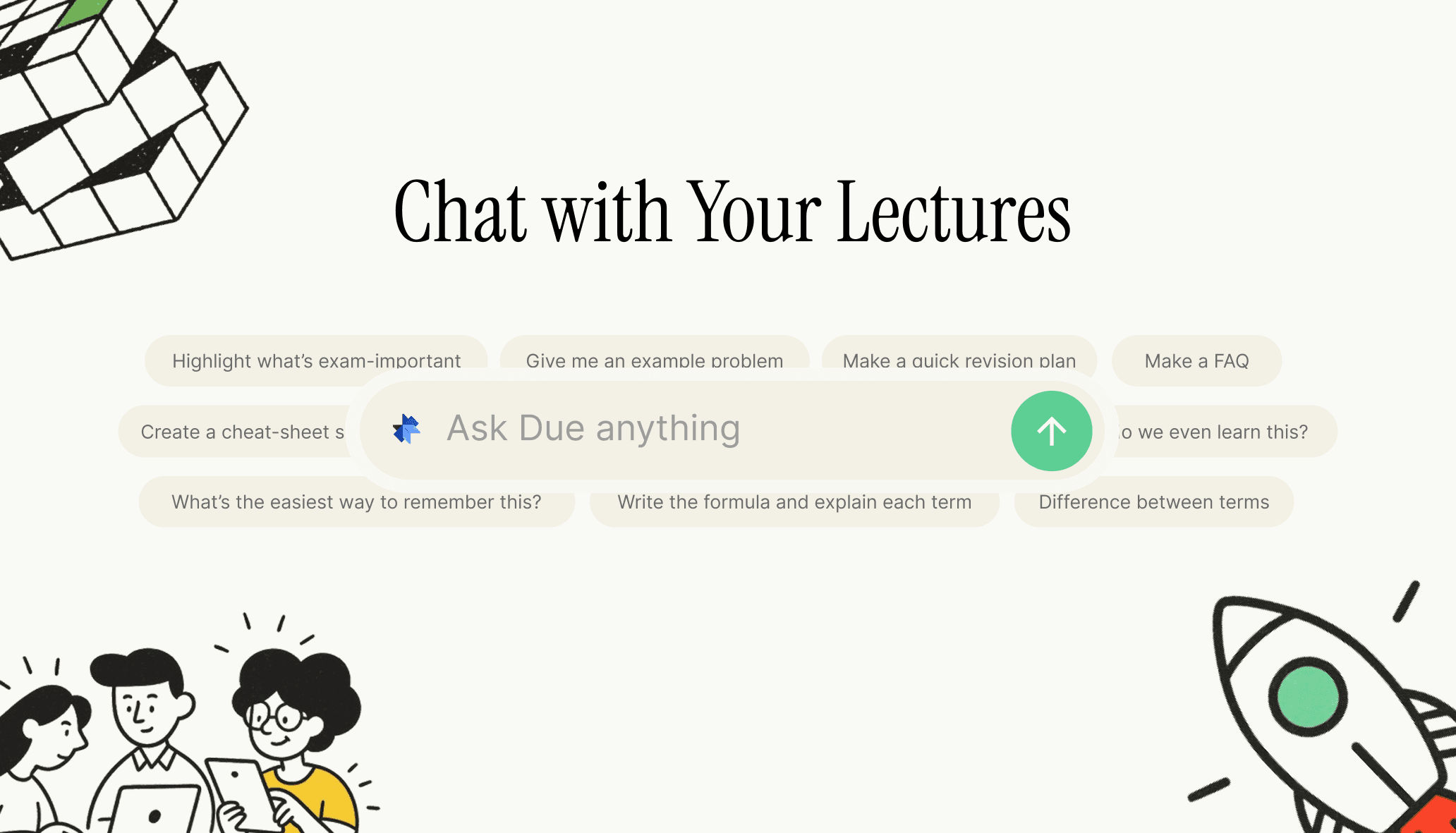
Can I use dictation instead of uploading a file? Yes, you can use the live dictation feature to record and transcribe in real-time as the professor speaks.
Can I transcribe online lectures (Zoom/Teams/recorded video)? Absolutely. You can record the audio from these platforms or upload the saved video file directly to the tool.
How long does it take to transcribe a 60-minute lecture? Usually, it takes only a few minutes to process an hour of audio, significantly faster than manual typing.
Is a transcript enough, or should I convert it into structured notes? A transcript is great for searching, but converting it into structured notes is better for long-term memory and efficient revision.
Can I turn windows notes into flashcards and practice questions? Yes, tools like Duetoday allow you to instantly generate flashcards and quizzes from your transcribed notes.

Duetoday is an AI-powered learning OS that turns your study materials into personalised, bite-sized study guides, cheat sheets, and active learning flows.
GET STARTED
Most Powerful Study Tool
for Students and Educators
Try Out Free. No Credit Card Required.