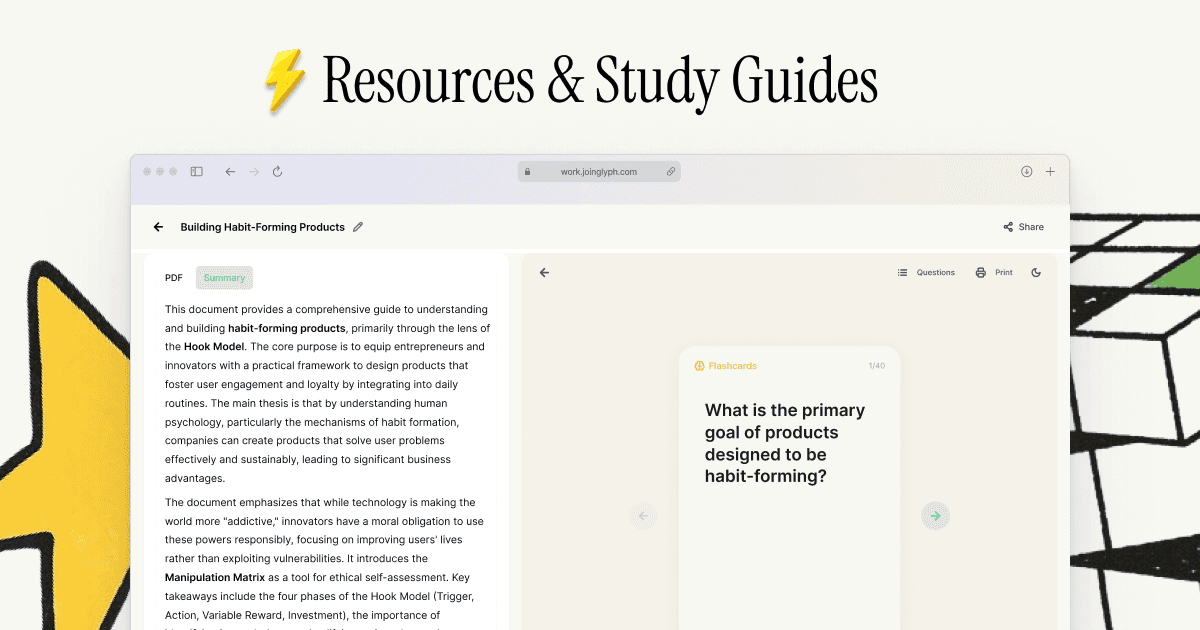
Transcribe Study Lectures to Notes (Next-Level Notes in Minutes)
Learn how to transcribe study lectures to notes. A step-by-step guide to turning audio/video recordings into searchable, organized study materials.
Upload Your Recording
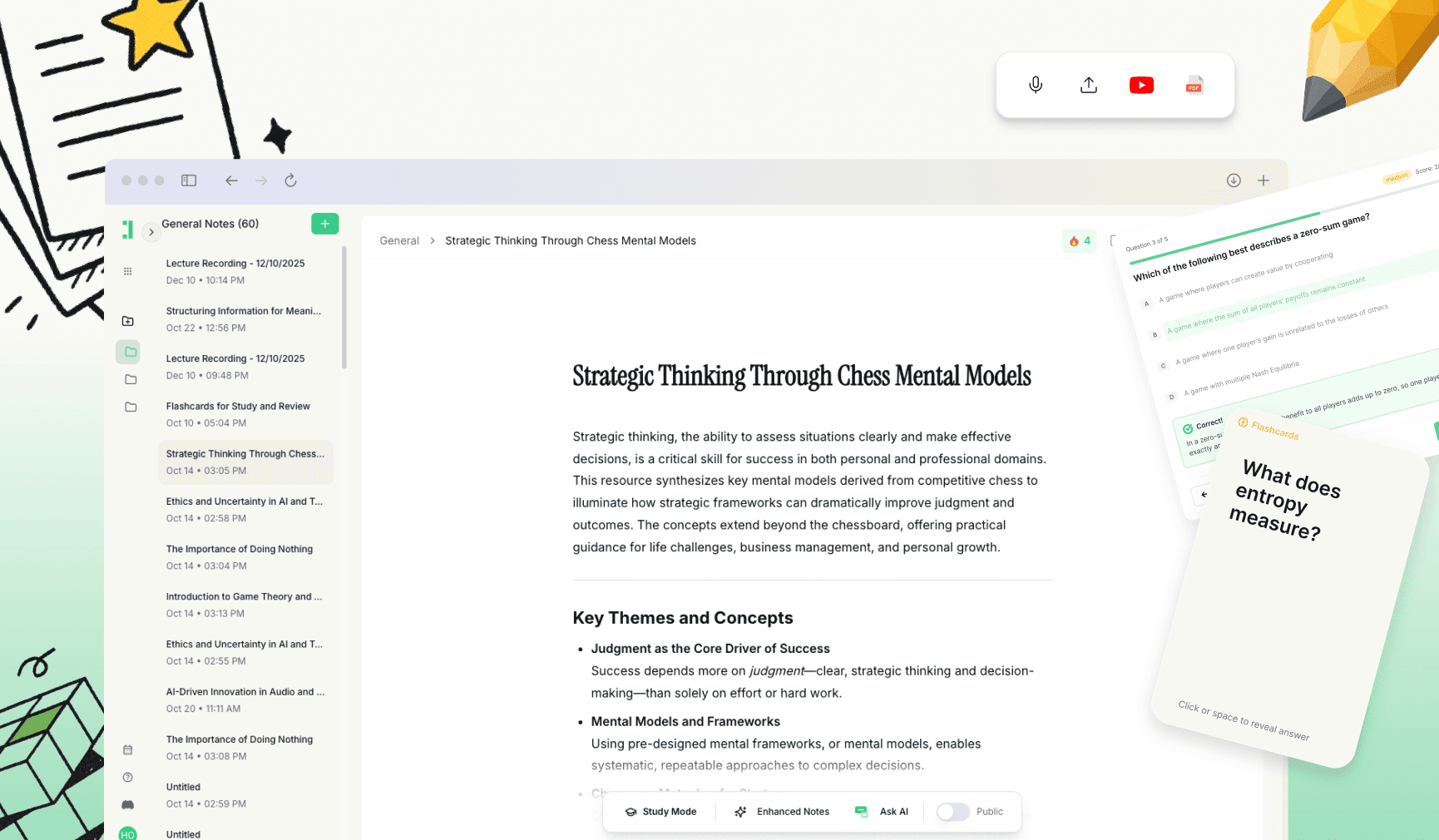
The Challenge of Manual Note-Taking in Study Sessions
Keeping up with a fast-paced study lecture is a constant battle against time. Whether it is a dense theoretical framework or a complex set of case studies, the moment you look down to write one sentence, you likely miss the next three. This creates a fragmented understanding of the material that makes revision significantly harder when exam season approaches.
Transcribing your study lectures into structured notes is the ultimate productivity cheat code. Instead of frantically scribbling, you can focus entirely on the lecturer's delivery, knowing that every explanation, nuance, and exam hint is being captured. This shift allows you to move from being a passive recorder to an active participant in your own learning process.
This modern workflow is incredibly flexible. It works perfectly whether you are recording a live session via dictation or uploading pre-recorded files. From audio voice memos to high-definition lecture videos and Zoom recordings, every format can be converted into a searchable, organized asset that serves as the foundation for your revision.
Why Transcribing Lectures is Especially Powerful for Study
In a deep study environment, the sheer volume of information can be overwhelming. Transcription ensures that you don't just have a summary, but a full record of the primary source material. This is particularly useful when you need to revisit a specific segment where a professor explained a difficult concept in their own words—something a textbook often fails to do.
By converting speech to text, you create a digital library that is fully searchable. Instead of skimming through hours of video or flipping through hundred-page notebooks, you can hit 'Ctrl+F' to find every mention of a specific keyword or theory. This drastically reduces the friction of weekly reviews and allows for more frequent, low-effort engagement with the material.
Capture every definition and niche example without missing a beat.
Create a searchable archive for rapid revision before major exams.
Extract specific frameworks and process steps for practical application.
Perform faster weekly reviews without the need to rewatch entire videos.
The Next-Level Workflow: Lecture to Transcript to Clean Notes
Transforming a raw recording into a polished study tool requires a systematic approach. Follow these five steps to ensure your notes are high-quality and exam-ready.
Step 1: Capture the lecture or upload your file. You have several options here depending on your environment. If you are in a physical classroom, a high-quality voice memo from your phone or laptop works well. For online classes, you can use the direct recording from platforms like Zoom or Teams, or even a downloaded lecture video file. Any audio or video format serves as a valid starting point.
Step 2: Transcribe and structure for study. Once you have your file, use a transcription tool to generate the text. Modern accuracy is high, so your main focus here should be on structure. Ensure the output includes headings, sections, and speaker labels if there is a Q&A portion. Having timestamps is also a major advantage, as it lets you jump back to the original audio if a section of text feels unclear.
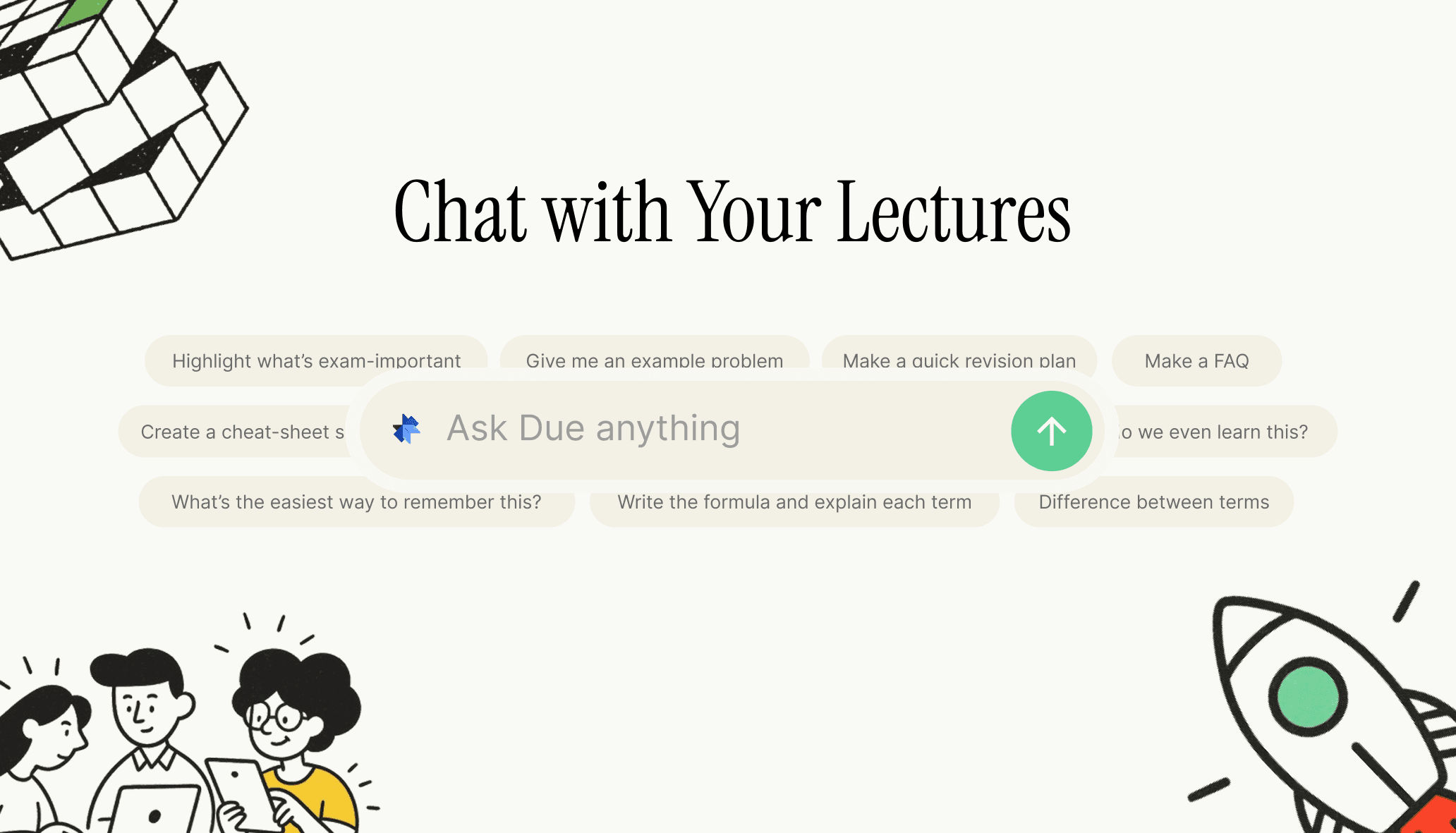
Step 3: Shape Notes for How the Subject is Tested
A transcript is a wall of text; notes are a tool. To make the transcript useful, you must reorganize it based on how you will be assessed. If your exam focuses on definitions, highlight those. If it’s about processes or formulas, pull those into a dedicated section. Tailor the layout to reflect the logic of the subject matter, such as comparing two competing theories side-by-side.
Step 4: The Cleanup Pass
Take ten minutes after the transcription is finished to refine the output. This is where you transform raw data into a polished study guide. Focus on the following check-list items:
Correct the spelling of technical terms and proper names.
Bold or highlight central definitions and core concepts.
Extract formulas, frameworks, or step-by-step processes into separate boxes.
Identify and mark specific examples mentioned as "likely for exams."
Add a few lines of missing context if the lecturer referred to a physical handout.
Break down large blocks of text into smaller, readable sections.
Step 5: Study Smarter with a Revision Loop
Now that you have structured notes, integrate them into your study routine using spaced repetition. Instead of reading the notes once, use them to create active recall triggers. You can easily turn parts of your transcript into practice questions or summaries. This method ensures that the information stays fresh and that you aren't just memorizing words, but truly understanding the underlying concepts.
What to Include in Your Subject Notes
To ensure your notes are comprehensive, they should go beyond just the transcribed words. Aim to include these specific elements to make your study material robust:
Clear definitions translated into plain English for better retention.
Core formulas or frameworks with a note on when they are applied.
Step-by-step processes or logical flows discussed in class.
Case studies or worked examples used by the lecturer to illustrate points.
Common pitfalls or misconceptions highlighted during the session.
Specific "hints" or areas the lecturer emphasized for upcoming tests.
Comparison tables that contrast different theories or methods.
Key assumptions or conditions under which a rule or theory applies.
Using Duetoday for Your Study Workflow
Duetoday is an AI note-taker designed specifically for students who need to turn lecture content into actionable study tools. It handles both live dictation and file uploads, meaning you can record a session in real-time or process a saved video file later. The platform doesn't just provide a transcript; it organizes the information into structured notes that are easy to navigate.
Beyond basic transcription, Duetoday offers a suite of revision tools that complement your notes. You can automatically generate flashcards and practice quizzes directly from your lecture content. There is even an AI tutor feature that allows you to ask questions about your transcript, helping you clarify complex topics long after the lecture has ended.
Common Issues and Simple Fixes
Too far from the speaker: If your transcript has gaps, the mic likely struggled to pick up the audio. Sit closer to the front row or use an external directional microphone for better clarity.
Background noise: Sudden loud sounds or keyboard typing can interfere with the recording. Try to record from a quiet area and avoid placing your recording device directly next to your laptop's mechanical keyboard.
Multiple speakers: In seminars or Q&A sessions, it can be hard to track who said what. Use a tool that supports speaker diarization to separate the professor's lecture from student questions.
Long lectures: Extremely long files can be tedious to edit. Split your recordings into 20-30 minute chunks or use an AI tool to summarize the key points of each chapter automatically.
A Brief Example
Raw Transcript: "So the second law of thermodynamics, basically, it says that entropy in an isolated system always increases, right? This is why heat flows from hot to cold, never the other way naturally..."
Cleaned Notes:
Concept: 2nd Law of Thermodynamics
Definition: Entropy in an isolated system always increases over time.
Key Example: Natural heat flow (Hot → Cold).
Exam Note: Heat never flows the other way without external work.
How accurate is lecture transcription for study?
Modern AI transcription is highly accurate, often reaching 95% or higher. While it may occasionally struggle with very niche technical jargon or heavy accents, it provides a functional and reliable foundation for your notes that requires minimal manual correction.
What file types can I use (audio/video)?
You can use almost any standard media format. This includes audio formats like MP3, M4A, and WAV, as well as video formats like MP4, MOV, and AVI. Whether it is a phone recording or a downloaded online lecture, the workflow remains the same.
Can I use dictation instead of uploading a file?
Yes, dictation is a great way to capture notes in real-time. You can speak into your device during a study session or record the lecturer live, and the tool will convert your speech into text as it happens or immediately after you finish.
Can I transcribe online lectures (Zoom/Teams/recorded video)?
Absolutely. You can upload the recorded files from these platforms or use a screen recorder to capture the audio/video. Once you have the file, simply upload it to your transcription tool to generate your study notes.
How long does it take to transcribe a 60-minute lecture?
Using modern AI tools, a 60-minute lecture can typically be transcribed in less than 5 to 10 minutes. This is significantly faster than manual transcription, which can take up to four hours for every hour of audio.
Is a transcript enough, or should I convert it into structured notes?
A transcript is a great starting point, but structured notes are better for learning. Converting the transcript into notes allows you to highlight key concepts, remove filler words, and organize the information in a way that aligns with your study goals.
Can I turn study notes into flashcards and practice questions?
Yes, this is one of the biggest benefits of digital transcription. Once you have your text, you can use integrated AI study tools to automatically generate flashcards and quizzes, which are essential for active recall and long-term retention.
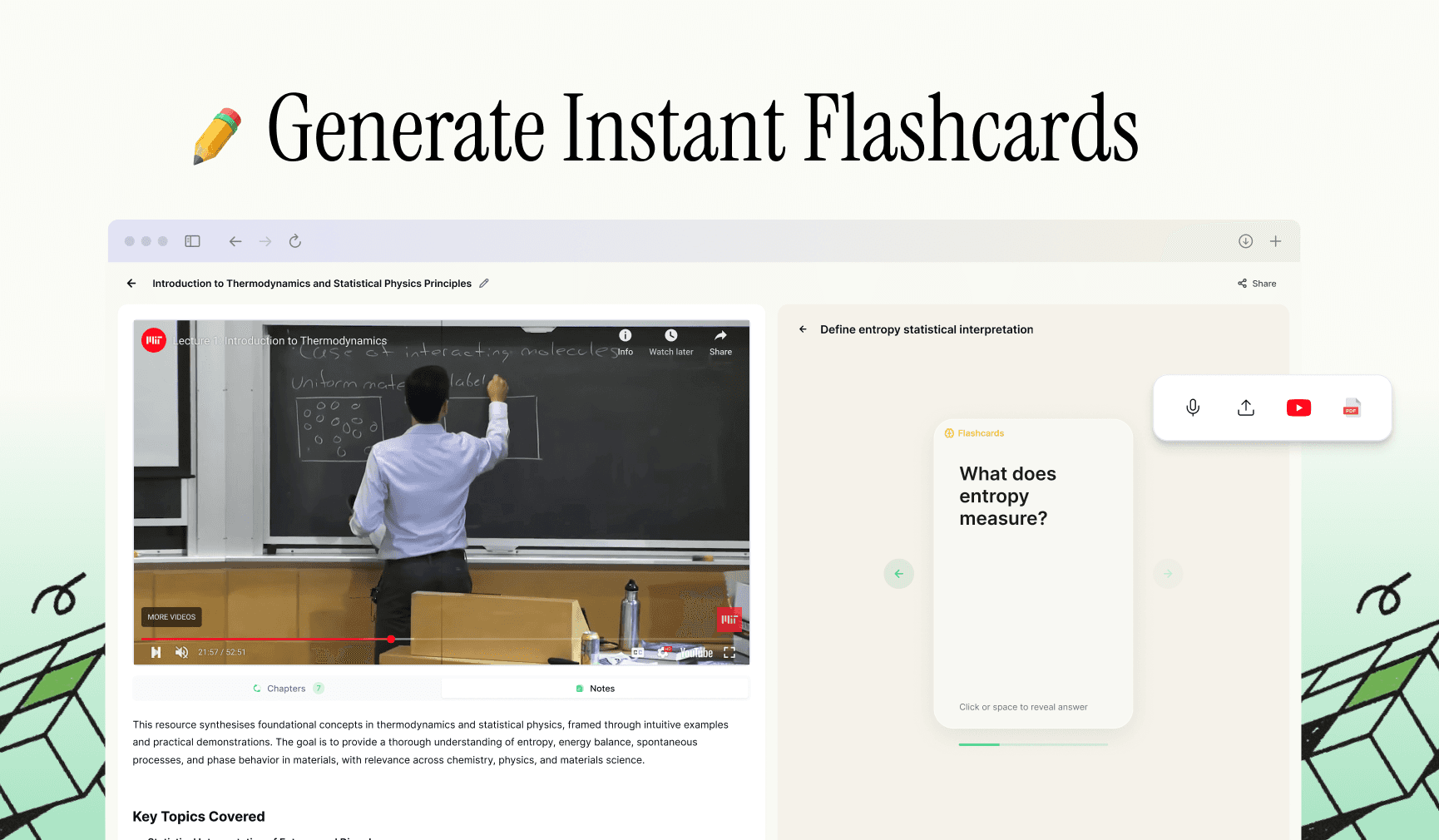
Duetoday is an AI-powered learning OS that turns your study materials into personalised, bite-sized study guides, cheat sheets, and active learning flows.
GET STARTED
Most Powerful Study Tool
for Students and Educators
Try Out Free. No Credit Card Required.