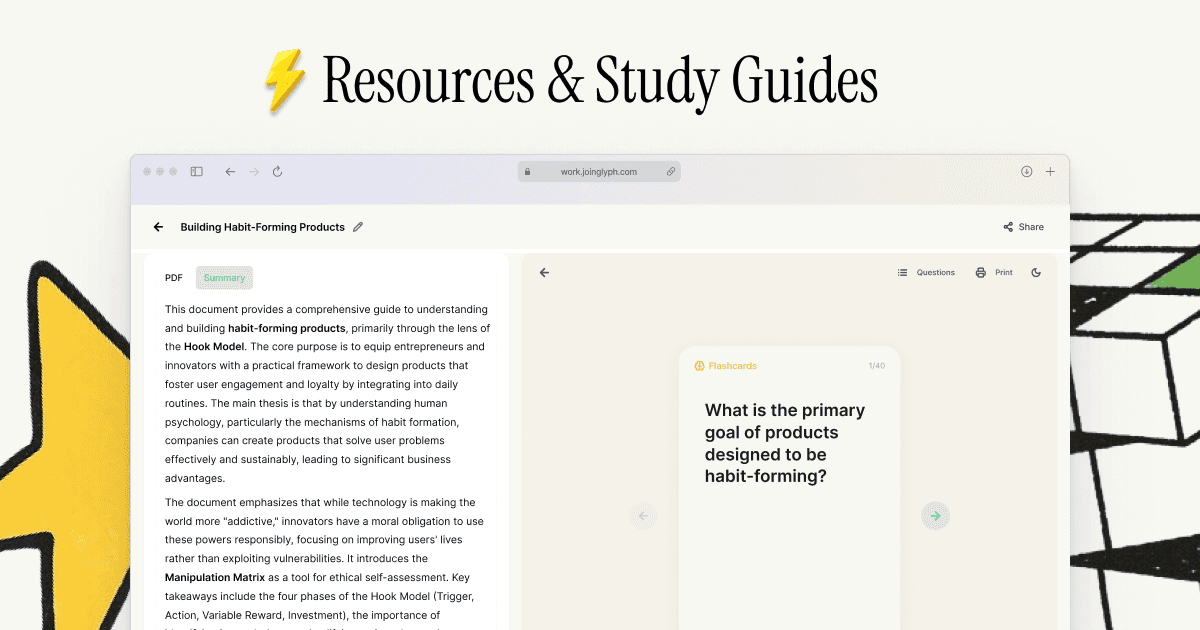
Master Complex Content with a PDF to Derivations Summary
Learn how to use Duetoday AI to convert complex PDF documents into clear derivations summaries, flashcards, and study guides automatically.
PDF to Derivations Summary
Creating a PDF to derivations summary is the fastest way to understand complex mathematical formulas, scientific proofs, or logical arguments hidden in dense documents. If you are struggling to follow how a concept moves from point A to point B, using an AI-powered tool can bridge that gap instantly.
At Duetoday, we simplify the heavy lifting by analyzing your technical PDFs and breaking them down into logical steps. This guide will show you how to transform any academic or professional document into a clear, actionable summary of its core derivations.
TL;DR:
Upload any PDF and get a step-by-step breakdown of formulas and logic.
Generate flashcards and quizzes directly from your derived summaries.
Use the AI Tutor to clarify specific steps in the derivation process.
How to do PDF to derivations summary in Duetoday (step-by-step)
Create your account: Log into Duetoday and head to your dashboard to start a new project.
Upload your PDF: Drag and drop your technical document or textbook chapter into the upload zone.
Select 'Study Guide' mode: Choose the study guide option to ensure the AI focuses on structured explanations rather than just a brief overview.
Check for text clarity: Ensure your PDF isn't just a low-quality scan; Duetoday works best when it can clearly read the characters and symbols.
Define the focus: Use the AI chat to specify if you want the summary to focus on mathematical proofs, legal logic, or scientific methodology.
Split by chapters: If your PDF is an entire textbook, use the 'split' feature to focus specifically on the chapter containing the derivations you need.
Rename headings: Organize your output by renaming the generated headings to match your specific syllabus or project requirements.
Choose question style: Toggle the settings to generate 'Why' and 'How' questions that test your understanding of each derivation step.
Select output format: Decide if you want the derivation summary in a standard paragraph format or structured Cornell notes.
Generate flashcards: Instantly convert the logical steps into flashcards to memorize the sequence of the derivation.
Refine with AI Tutor: If a specific step in the derivation is unclear, ask the built-in AI tutor to Explain this step like I'm five.
Export your work: Once satisfied, save your summarized derivations for offline study or share them with classmates.
What you can generate from your PDF
Step-by-Step Proofs: A chronological breakdown of how a formula or conclusion is reached.
Concept Flashcards: Cards that focus on the definitions and axioms used within the derivation.
Practice Quizzes: Multiple-choice questions that ask you to identify the next logical step in a sequence.
AI Tutor Support: A dedicated chat window to hunt down the why behind every variable.
Upload Your PDF Here
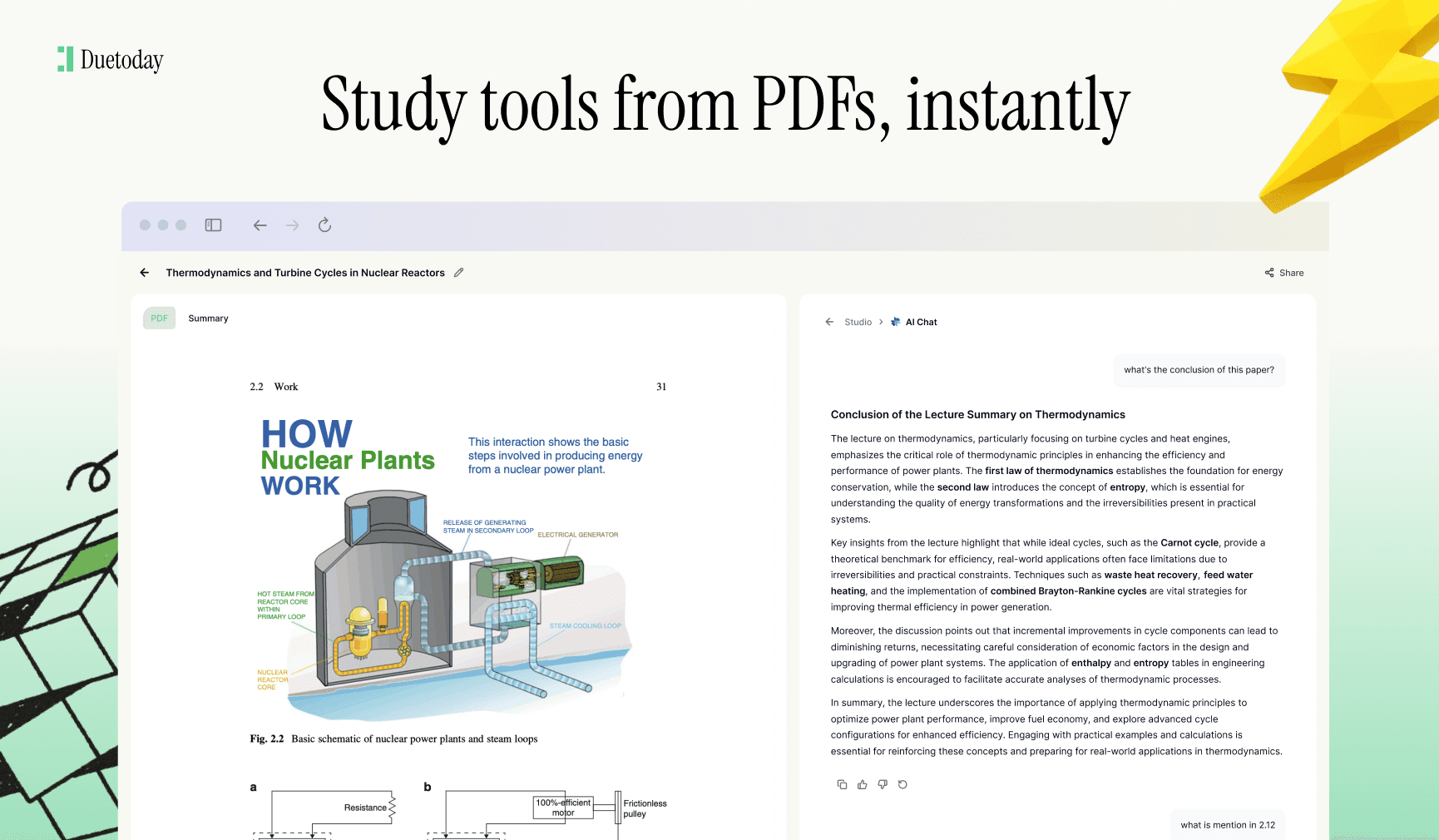
Mini example (what the output looks like)
Example Topic: The Derivation of the Quadratic Formula
Input: A 3-page PDF explaining the completion of the square for the standard form equation ax² + bx + c = 0.
Output (Study Guide Format):
Step 1: Divide the entire equation by 'a' to isolate the x² term.
Step 2: Move the constant term (c/a) to the right side of the equation.
Step 3: Add the square of half the coefficient of x to both sides to complete the square.
Step 4: Factor the left side into a perfect square binomial.
Step 5: Take the square root of both sides, remembering the plus/minus sign.
Step 6: Isolate x to finalize the Quadratic Formula.
Tips to get higher-quality results
Check Image Quality: If your PDF contains handwritten derivations, make sure they are high-contrast and legible.
Remove Junk Pages: Delete title pages, bibliographies, or ads from the PDF before uploading to keep the AI focused on the data.
Provide Context: Use the AI chat to tell Duetoday: I am studying for a Calculus II exam; focus on the integration steps.
Review Symbols: For high-level physics or engineering, double-check that subscripts were captured correctly by the AI.
Troubleshooting (common issues + fixes)
Scanned PDF is blurry → Use a mobile scanning app to take a clearer picture or find a digital version of the text.
PDF is too long → Use the chapter selection tool to upload only the relevant 5–10 pages.
Output is too generic → Change the settings to 'Comprehensive' mode or ask the AI Tutor for more detail on specific lines.
Wrong difficulty level → Prompt the AI to Explain this for a PhD student or Explain this for a high schooler to adjust the technical depth.
Final step
Stop wasting hours trying to deconstruct complex proofs on your own. Turn any PDF to derivations summary in seconds and spend your time actually learning the material instead of transcribing it. Ready to level up your study game? Try Duetoday AI today and master your most difficult subjects with ease.

Duetoday is an AI-powered learning OS that turns your study materials into personalised, bite-sized study guides, cheat sheets, and active learning flows.