Best Whisper Alternatives in 2026 [For Students]
Discover why Duetoday is the top Whisper alternative for students. Compare transcription features and see how to transform recordings into study systems.
Why people look for a Whisper (OpenAI) alternative
Whisper by OpenAI has set a high bar for transcription accuracy, making it a go-to tool for developers and tech-savvy students who need to turn audio into text. However, many students quickly realize that a transcript is just the beginning of the learning process. While Whisper provides the raw data from a lecture or seminar, it serves as a standalone utility rather than a comprehensive workflow. For a university student, having a text file of a two-hour lecture doesn't solve the problem of information overload; it often just creates a different kind of clutter that still requires hours of manual labor to organize and study.
The search for an alternative usually begins when the friction of managing separate tools becomes too high. Using Whisper often involves technical setups, command lines, or finding third-party wrappers just to get the text out. Once the text exists, students then have to copy it into another app for notes, another for flashcards, and yet another for scheduling. This fragmented approach leads to productive procrastination, where the student spends more time managing the transcription pipeline than actually learning the material. People look for an alternative that treats transcription as a functional step within a larger, unified study system.
Quick verdict
At-a-glance:
Best for building a knowledge vault: Whisper (OpenAI)
Best for a real study system: Duetoday
Best if you want both: Use Whisper for raw transcriptions of archival data and Duetoday for active course retention and exam preparation.
What Whisper (OpenAI) is great at
Whisper is an incredible piece of technology when it comes to raw speech-to-text capabilities. It handles diverse accents, technical jargon, and background noise with a level of precision that few other models can match. For students involved in research projects or long-term data collection, its ability to process vast amounts of audio into text is invaluable. Because it is open-source, it offers a level of privacy and local control that appeals to those who prefer to keep their data on their own hardware.
The strength of Whisper lies in its purity. It focuses on doing one thing exceptionally well: transcription. It doesn't try to be a note-taker or a planner. This makes it a powerful building block for developers or power users who want to create their own custom workflows. If your only goal is to have a searchable text record of a conversation or a lecture without any need for further educational processing, Whisper is arguably the most robust engine available today.
Where Whisper (OpenAI) breaks for students on deadlines
The primary issue for students using Whisper is that it is a tool, not a system. When you are five days away from an exam, a 15,000-word transcript of three weeks of lectures is actually more overwhelming than the original audio. Whisper does not tell you what is important, it does not connect the lecture to your textbook PDF, and it does not help you memorize the content. It solves the transcription problem but ignores the retention problem. Students often fall into the trap of thinking that because they have the transcript, they have learned the material, only to realize they have merely moved the information from an audio file to a text file.
Furthermore, Whisper is inherently text-heavy and markdown-focused in its common implementations. Modern learning is mixed-media. Students need to see the diagram from the lecture slide alongside the transcript, or link a YouTube explainer to a specific paragraph of the professor's notes. In Whisper-based workflows, these elements are often disconnected. Navigating between a command-line interface or a transcript viewer and a study app creates a cognitive load that breaks the flow of deep work, leading to fragmentation across multiple browser tabs and windows.
What Duetoday does instead
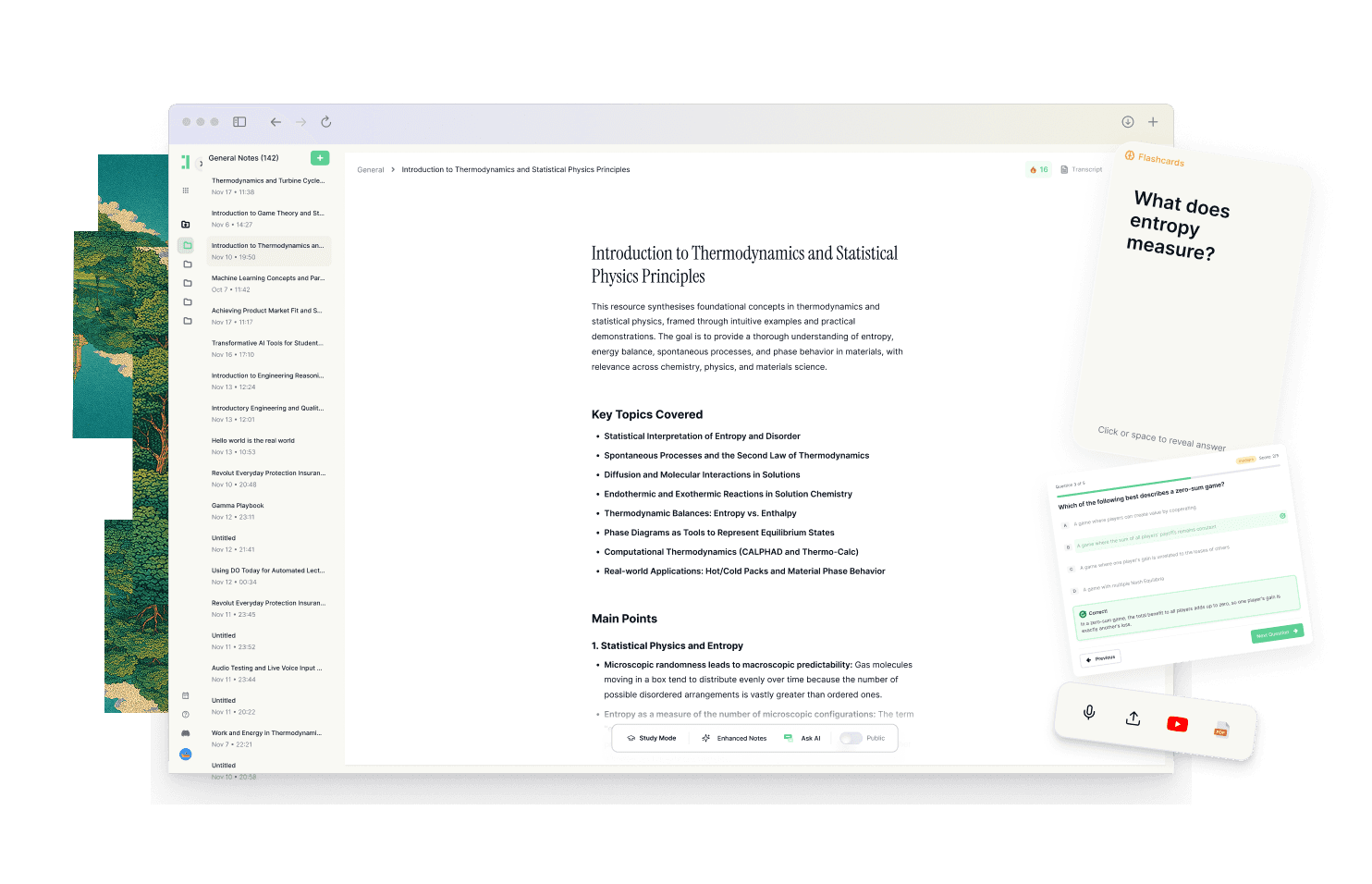
Duetoday functions as a unified learning workspace that starts where transcription ends. It is designed to be one place that holds everything you learn, including lectures, PDFs, YouTube videos, and websites. Instead of just giving you a wall of text, Duetoday allows you to upload lecture recordings, provides high-quality transcription, and immediately integrates that text into a larger "AI Brain." This ensures that your raw content is never isolated; it is always connected to the source materials and your other research, creating a cohesive context for your entire semester.
Once the audio is transcribed, Duetoday turns that raw content into structured study outputs. It can automatically generate summaries, cheatsheets, and study guides that highlight the most critical information. For those focused on active recall, the system generates flashcards and quizzes directly from the transcript. You can also interact with your materials via an AI tutor chat that is grounded strictly in your uploaded data. This means if you ask a question about a specific lecture point, the AI answers based on what your professor actually said, rather than providing generic internet information.
Beyond content creation, Duetoday manages the execution of your studies. It connects with Google Calendar to align your study plans with real-world deadlines, making the next right action obvious. By bringing learning inputs and outputs into one workflow, it reduces the need to jump between Notion, flashcard apps, and PDF readers. This support for mixed-media learning ensures that whether you are watching a video or reading a research paper, your notes and retention tools remain in one synchronized ecosystem.
How the Duetoday workflow feels in real life
Imagine it is Monday afternoon and you just finished a complex biology lecture. Instead of spending an hour manually typing notes or wrestling with a transcription script, you simply upload the audio recording to Duetoday. By the time you’ve finished your coffee, Duetoday has not only transcribed the lecture but also generated a concise summary and a set of practice quizzes. You spend twenty minutes reviewing the summary and answering the AI-generated questions to solidify the concepts while they are fresh.
As the week progresses, you add a relevant PDF chapter and a YouTube tutorial to the same workspace. On Friday, when you sit down for a weekly review, you ask the AI tutor to explain the connection between the Monday lecture and the Friday reading. The system provides a grounded answer that links both sources. Before the exam, you use the generated study guides and flashcards to test your knowledge, knowing that every practice question is directly mapped to the material covered in class. You aren't searching for files; you are just studying.
Duetoday vs Whisper (OpenAI) in plain English
The comparison between Duetoday and Whisper comes down to the difference between a raw ingredient and a finished meal. Whisper is the raw ingredient; it provides the text but leaves the preparation, organization, and consumption entirely up to you. The setup time for Whisper can be significant, especially if you want to run it locally or find a user-friendly interface. Duetoday, on the other hand, is a ready-to-use environment where transcription is just the first step in a larger sequence designed for academic success.
In terms of daily routine, Whisper requires you to be a pro-active organizer. You must manually move text into other tools to make it useful. Duetoday is built for consistency, providing a clear path from a recording to a scheduled study task. While Whisper is excellent for pure transcription accuracy and privacy, it lacks the mixed-media support and retention tools—like quizzes and calendar integration—that are necessary for a student to keep up with a fast-paced curriculum. Duetoday focuses on the output: what you actually remember when you sit down to take the test.
Who should choose Duetoday
Duetoday is the ideal choice for university students and self-learners who are dealing with a high volume of lecture material and tight deadlines. If you find yourself overwhelmed by the amount of information you need to process and feel that your current notes are scattered across different platforms, Duetoday will provide the structure you need. It is specifically for those who value retention over just storage and want a system that helps them move from "having the information" to "knowing the information."
Who should still choose Whisper (OpenAI)
Whisper remains the better option for researchers or developers who need highly customizable, local-first transcription. If you are a privacy advocate who does not want your data in the cloud, or if you are building your own custom software and just need an API for speech-to-text, Whisper is the gold standard. It is for the tinkerer who enjoys building their own knowledge vault from scratch and doesn't mind the manual labor involved in connecting various tools together.
Verdict
The choice between these two tools is a choice between a knowledge vault and a study system. Whisper is a powerful way to store what was said, but Duetoday is a comprehensive way to learn it. If you want to stop managing files and start mastering your subject through a unified workflow that prioritizes active recall and exam readiness, Duetoday is the clear alternative.
FAQ
Is Duetoday only flashcards and quizzes?
No, Duetoday is a full learning workspace that includes transcription, document organization, and AI-driven summaries. While flashcards and quizzes are core features for retention, the platform also provides a centralized place for all your lecture recordings, PDFs, and web research.
Does Duetoday work for lectures and YouTube?
Yes, it is designed to handle both. You can upload audio files from live lectures for transcription or paste YouTube links to have the system process the video content, allowing you to study from both sources in one place.
Will it help reduce cramming?
By integrating with your Google Calendar and generating bite-sized study tasks, Duetoday encourages consistent review rather than last-minute sessions. The goal is to make the material easy to digest through regular practice questions and structured notes.
Can I still use Notion or Google Calendar?
Absolutely. Duetoday is built to work alongside your existing tools, allowing you to import content from Notion and sync your study schedule with Google Calendar to ensure you have time allocated for your tasks.
Who is Whisper (OpenAI) still best for?
Whisper is still the best fit for power users and developers who need high-precision, raw transcription for large-scale data projects. It is ideal for those who prefer local-first tools and have the technical skills to build their own custom workflows around the transcribed text.
Building a study system is about more than just having the text; it is about how you use that text to master your future.
Read More Alternative To Comparison
Turn lectures, PDFs, and notes into AI-Powered summaries, bite-sized
courses, flashcards, quizzes, and study plans.