Best tl;dv Alternatives in 2026 [For Lecture Transcription]
Looking for a tl;dv alternative? Discover why Duetoday is the superior choice for students needing a unified study system for lectures, PDFs, and YouTube.
Why people look for a tl;dv alternative
Many university students and self-learners initially turn to tl;dv because they are drowning in digital meetings and lectures. They need a way to capture what was said without losing their focus on the speaker. While tl;dv is an excellent tool for recording and timestamping video calls, it often leaves a gap for those who need more than just a transcript. Students frequently find that while they have a library of recorded sessions, they still lack a cohesive way to turn those words into usable knowledge for an upcoming exam or research project.
The search for an alternative usually begins when the novelty of recording wears off and the reality of a massive backlog sets in. A recording is only useful if it is integrated into a broader study workflow. For learners who deal with various types of media, having a tool that only focuses on meeting software can feel limiting. They find themselves jumping between a transcription tool, a PDF annotator, a note-taking app, and a flashcard generator. This fragmentation creates a mental load that many students are desperate to eliminate in favor of a more unified system.
Quick verdict
At-a-glance:
Best for building a knowledge vault: tl;dv
Best for a real study system: Duetoday
Best if you want both: Use tl;dv for recording group seminars, Duetoday for retention and planning
What tl;dv is great at
tl;dv is truly impressive when it comes to the logistics of recording digital interactions. Its primary strength lies in its seamless integration with platforms like Zoom, Google Meet, and Microsoft Teams. It allows users to highlight key moments during a live session, making it incredibly easy to find specific segments later on. For a student attending a synchronous online seminar, the ability to timestamp a professor’s explanation in real-time is a significant mechanical advantage.
Furthermore, the platform excels at making transcripts accessible and searchable. It serves as a high-quality repository for verbal communication, ensuring that no detail from a meeting is lost to memory. The user interface is clean, and the ability to share specific clips of a recording makes it a favorite for collaborative projects where peer-to-peer communication is essential. It is a robust tool for anyone whose primary learning input is live, digital video conferencing.
Where tl;dv breaks for students on deadlines
The limitation of tl;dv for a student on a tight deadline is that it often leads to productive procrastination. A student might feel productive because they have recorded ten hours of lectures, but they are no closer to actually knowing the material for an exam. The platform provides the raw data, but it does not provide the bridge to retention. It is a vault for recordings, not a system for mastery. When an exam is forty-eight hours away, looking at a long list of video transcripts can feel more overwhelming than helpful.
Moreover, modern learning is rarely restricted to just video calls. A typical student needs to synthesize information from a lecture recording, a thirty-page PDF, a YouTube tutorial, and several web articles. tl;dv is not built to handle this mix of media. It does not allow you to upload a textbook chapter or a website link and treat it with the same priority as a meeting recording. This leads to a fragmented workflow where the transcript lives in one tab and the actual study materials live in another, preventing the deep connection of concepts required for high-level academic success.
What Duetoday does instead
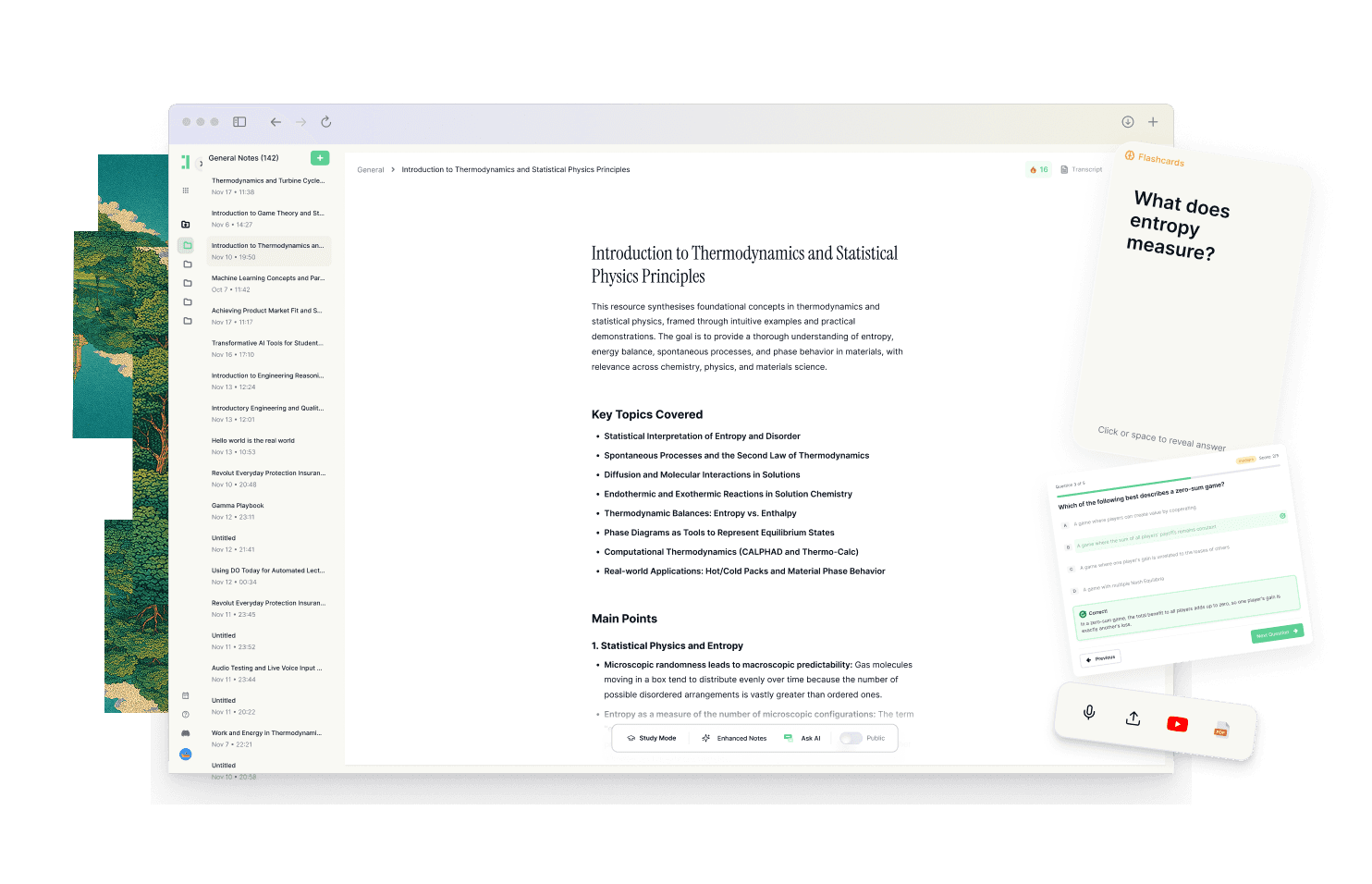
Duetoday functions as a unified learning workspace designed specifically to close the gap between information input and long-term retention. Unlike tools that focus solely on transcription, Duetoday is built to hold everything you learn in one place. You can upload lecture recordings and get high-accuracy transcriptions, but you can also import PDFs, YouTube links, and websites. This creates a single source of truth for your entire course, ensuring that your study materials are never disconnected from your source content.
Once your materials are in the system, Duetoday transforms them into structured study outputs. Instead of just giving you a wall of text from a transcript, it generates summaries, cheatsheets, and comprehensive study guides tailored to your specific materials. It takes the manual labor out of note-taking by extracting key points and organizing them into clean, structured formats. This ensures that you aren't just storing information, but actively processing it into a form that is easier for the brain to digest.
The system goes further by integrating active recall tools directly into the workflow. Duetoday can automatically generate flashcards and quizzes from your uploaded lectures and PDFs. It features an AI tutor chat that is grounded in your specific data, meaning it answers questions based on your professor's actual lecture rather than generic internet information. By connecting to Google Calendar, Duetoday ensures that your study tasks and deadlines align with your real-world schedule, making the next right action obvious and repeatable.
How the Duetoday workflow feels in real life
Imagine it is Monday afternoon and you have just finished a difficult lecture. Instead of just letting the recording sit in a folder, you upload it to Duetoday. While you grab a coffee, the system transcribes the audio and generates a summary of the three main concepts covered. By Tuesday, you have added the required reading PDF to the same workspace. You use the AI chat to ask how the Monday lecture relates to the PDF, and it gives you a grounded answer that connects both sources.
As the exam approaches, you don't need to manually create materials. You click a button to generate a set of flashcards based on the most difficult parts of the transcript. Your Google Calendar shows you a study block, and Duetoday has already prepared a practice quiz for that session. By the time Friday arrives, you haven't just stored a recording; you have interacted with it, questioned it, and tested yourself on it. The transition from hearing a lecture to knowing the material feels like a steady, automated progression rather than a frantic scramble.
Duetoday vs tl;dv in plain English
The fundamental difference between these two tools is the purpose of the output. tl;dv is designed to record and recall what happened in a meeting. It is a powerful administrative tool for ensuring verbal information is captured. However, for a student, capturing information is only ten percent of the job. The remaining ninety percent is understanding, connecting, and remembering that information. Duetoday is designed for that entire journey, moving beyond simple transcription to provide a full retention loop.
In terms of setup, tl;dv is very quick for digital meetings but offers limited utility for other study forms. Duetoday requires a similar amount of effort to upload a file, but the payoff is significantly higher for exam preparation. While tl;dv excels in a synchronous video environment, Duetoday supports the mixed-media reality of modern education. It brings together your Notion notes, your lecture audio, and your YouTube research into a single workspace where the AI understands the context of all of them combined.
Who should choose Duetoday
Duetoday is the ideal choice for university students who feel overwhelmed by the sheer volume of different formats they have to study. If you have lectures in audio format, thick PDF textbooks, and supplemental YouTube videos, you need a system that treats them as parts of a whole. It is for the learner who is tired of 'collecting' information and wants a tool that helps them actually learn it through active recall and structured outputs.
It is also perfect for those who are deadline-driven and need to see a clear path from a raw lecture to exam readiness. If you value having your study schedule integrated with your calendar and want your notes transformed into practice tools automatically, Duetoday provides the structure you are currently missing. It is for anyone who wants to stop jumping between five different tabs to understand a single topic.
Who should still choose tl;dv
tl;dv remains a strong choice for users whose primary need is the archival of live digital meetings. If you are a student worker or a researcher who spends all day in Zoom or Google Meet and simply needs a way to timestamp conversations for later reference, tl;dv is excellent. It is also the right tool for those who prefer a local-first feeling and are primarily focused on the recording aspect rather than building a comprehensive study system around those recordings.
Verdict
The choice between these two platforms comes down to whether you need a vault or a system. tl;dv is a high-quality vault for your digital video recordings, ensuring you never lose a word of a meeting. Duetoday is a comprehensive study system that takes those words—along with your PDFs and notes—and systematically helps you move them into your long-term memory. For the student who needs to turn information into grades, a unified workflow that prioritizes retention over mere storage is the clear winner.
FAQ
Is Duetoday only flashcards and quizzes?
No, Duetoday is a full learning workspace that handles everything from transcription and summaries to structured notes and AI-guided tutoring. While it excels at generating active recall tools, it also acts as a central hub for all your learning materials including PDFs and websites.
Does Duetoday work for lectures and YouTube?
Yes, you can upload lecture recordings for transcription and paste YouTube links directly into the system. Duetoday processes these mixed-media inputs so you can chat with them, summarize them, and create study materials from them in one place.
Will it help reduce cramming?
Yes, by integrating with your Google Calendar and breaking down your materials into actionable tasks and bite-sized lessons, Duetoday encourages consistent review. The automated generation of study guides and quizzes makes it easier to start studying early rather than waiting until the last minute.
Can I still use Notion or Google Calendar?
Absolutely, Duetoday is designed to work alongside your existing tools. You can import content from Notion to use as a source for your AI brain, and the Google Calendar integration ensures your study plans are synced with your actual daily schedule.
Who is tl;dv still best for?
tl;dv is best for users who primarily need to record and timestamp live video calls on platforms like Zoom or Google Meet. If your main goal is to create a searchable archive of digital meetings without the need for additional study features or PDF integration, it is a great tool.
Choosing the right tool is the first step toward reclaiming your time and achieving academic clarity.
Read More Alternative To Comparison
Turn lectures, PDFs, and notes into AI-Powered summaries, bite-sized
courses, flashcards, quizzes, and study plans.