Best Tana Alternatives in 2026 [For Students]
Discover why Duetoday is the top Tana alternative for students. Compare features for lecture notes, flashcards, and exam preparation in this detailed guide.
Why people look for a Tana alternative
Tana has gained a reputation as a powerful tool for knowledge graphs and networked thought, attracting many users who want to organize complex information. However, students often find themselves searching for an alternative because the sheer flexibility of Tana can become a burden. While the platform is incredible for data architecture and custom tags, university students usually need something more focused. They find themselves spending hours building the perfect dashboard or configuring supertags rather than actually learning the material for their upcoming exams.
Another common reason for seeking an alternative is the lack of native support for mixed-media study workflows. Students today deal with a frantic mix of lecture recordings, YouTube tutorials, and massive PDF slide decks. Trying to force these diverse inputs into a rigid, outliner-based workspace often feels clunky. When a deadline is approaching, the time spent managing the tool often exceeds the time spent studying, leading to a feeling of fragmentation and digital clutter that Tana’s complex interface struggles to solve for those who just want to pass their classes.
Quick verdict
Best for building a knowledge vault: Tana
Best for a real study system: Duetoday
Best if you want both: Use Tana for long-term research and data tagging, use Duetoday for active learning, lecture processing, and exam readiness.
What Tana is great at
Tana is truly a pioneer in the world of structured data. It treats every piece of information as a 'node' that can be tagged, linked, and filtered in sophisticated ways. For many, its greatest strength lies in 'Supertags,' which allow users to define what a piece of information is—such as a person, a project, or a book—and automatically provide a set of fields to fill out. This creates a remarkably organized environment where information is never lost and always lives within a broader context.
The tool is also excellent for people who enjoy building their own productivity systems from the ground up. It offers a level of customization that few other apps can match, making it a favorite for researchers and knowledge workers who need to track thousands of moving parts across long-term projects. Tana’s ability to turn a simple list into a powerful database is impressive, providing a sense of order that appeals to those who think in systems and hierarchies.
Where Tana breaks for students on deadlines
For a student facing a mid-term exam in three days, Tana’s greatest strength becomes its greatest weakness. The phenomenon of productive procrastination is rampant here; instead of reviewing biology notes, a student might spend two hours refining their 'Biology' supertag. This creates a beautiful vault of information but does very little to ensure the student actually knows the material. Tana is a storage engine, not a retention engine. It helps you keep notes, but it doesn't necessarily help you move those notes from the computer screen into your brain.
Furthermore, Tana is primarily text-based and outliner-focused. This creates friction when a student needs to transcribe a sixty-minute lecture recording, highlight a complex PDF diagram, or synthesize a YouTube tutorial. Moving between these different formats in Tana requires significant manual effort and external tools. When you are on a deadline, you do not have time to be a systems architect. You need a tool that handles the heavy lifting of summarization and practice so you can focus on comprehension and recall.
What Duetoday does instead
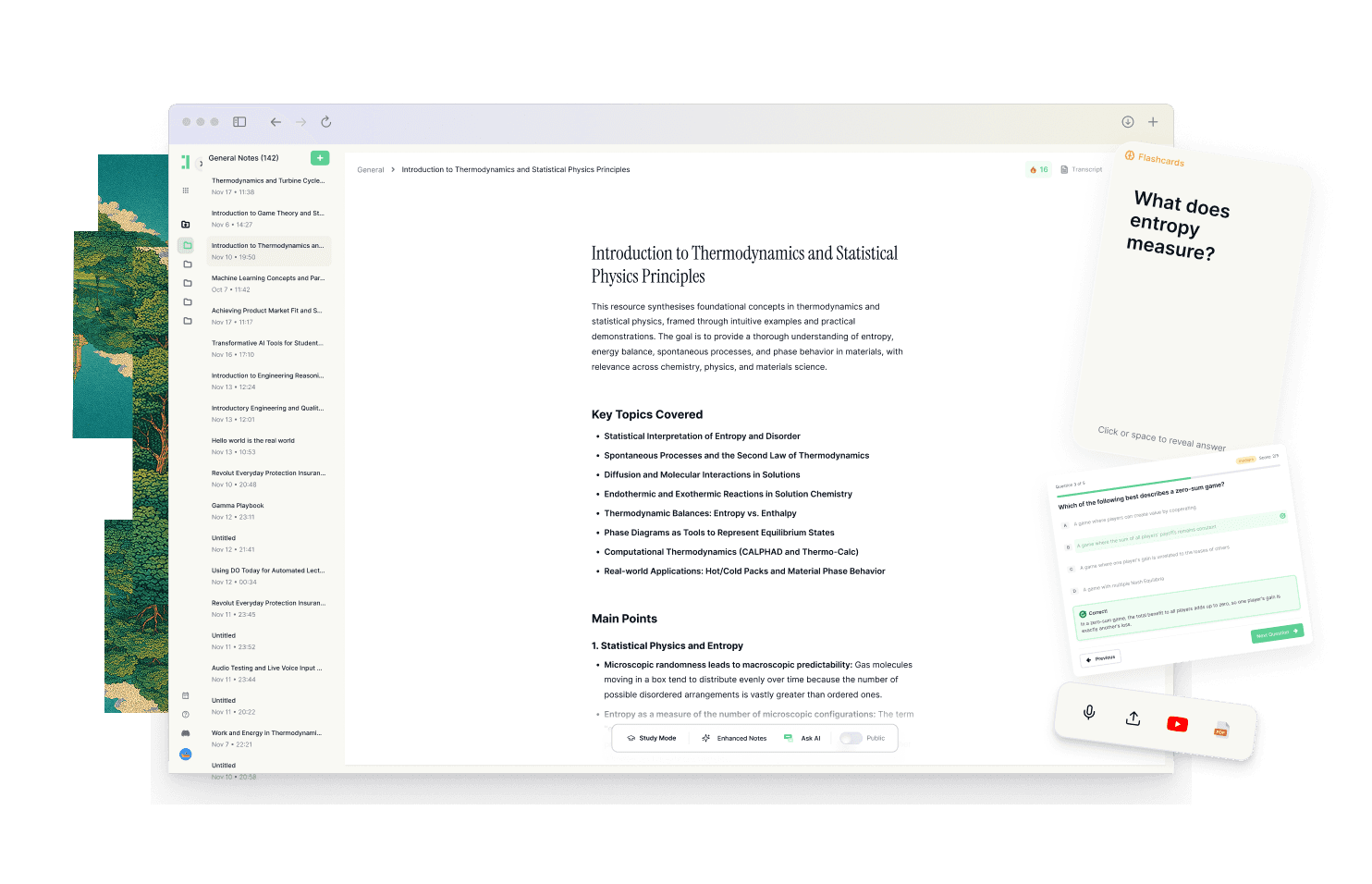
Duetoday is designed as a unified learning workspace that prioritizes retention over mere record-keeping. Unlike a general-purpose knowledge graph, Duetoday is built specifically to handle the modern student's workflow. It serves as one place that holds everything you learn, from lecture recordings and PDFs to YouTube links and website research. You can upload lecture recordings directly and receive an instant transcription, effectively turning audio into searchable, actionable text without leaving your workspace.
The system goes beyond simple storage by turning raw content into structured study outputs. Duetoday automatically generates summaries, cheatsheets, and comprehensive study guides from your inputs. To ensure you actually learn the material, it creates active recall tools such as flashcards and quizzes. You can also interact with an AI tutor through a chat interface that is grounded specifically in your uploaded materials. This means the AI answers based on your professor's actual lecture, rather than giving generic information found on the internet. It maintains the connection between your notes and the original source, ensuring your study sessions are never disconnected from the primary material.
Efficiency is further enhanced through deep integrations and a focused execution layer. Duetoday works alongside tools you already use, like Notion, and connects directly with Google Calendar. This allows your study plans and deadlines to align with your real-life schedule. By bringing all learning inputs and outputs into one workflow, Duetoday reduces the fragmentation that often plagues students. It makes the next right action obvious, whether that is finishing a quiz or reviewing a summary, turning studying into a repeatable and predictable process.
How the Duetoday workflow feels in real life
Imagine it is Monday afternoon and you just finished a complex lecture on organic chemistry. Instead of spending an hour manually typing out notes into a complex hierarchy, you simply upload the lecture recording and the PDF slides into Duetoday. By the time you’ve grabbed a coffee, the system has transcribed the audio and generated a concise summary of the key concepts. You quickly glance at the AI-generated cheatsheet to ensure you understood the main mechanisms discussed in class.
As the week progresses, you use the AI tutor to ask specific questions about the reactions mentioned in the slides. Before the Friday quiz, you don't 're-read' your notes; instead, you engage with the flashcards and practice questions Duetoday created automatically from your lecture. Your Google Calendar has already blocked out twenty minutes for this review, and when you finish the tasks, a burst of confetti signals that you are prepared. The anxiety of 'not knowing what to study' is replaced by a clear path of action, allowing you to walk into the exam room with genuine confidence in your retention.
Duetoday vs Tana in plain English
When comparing Duetoday and Tana, the primary difference lies in the setup time and the end goal. Tana requires a significant learning curve; you must learn the logic of nodes, supertags, and live searches before the tool becomes truly useful. It is a 'build-it-yourself' kit. Duetoday, on the other hand, is a 'ready-to-use' system. You drop your files in, and the system immediately starts helping you study. For a student who needs to be productive within ten minutes of opening the app, the difference is night and day.
Another major distinction is how they handle mixed media. Tana is excellent for structured text data, but it isn't designed to be a media player or a PDF annotator. Duetoday is built for the reality of modern education, where information comes from video and audio just as much as text. While Tana focuses on building a long-term library, Duetoday focuses on the immediate cycle of learning: input, process, and recall. Duetoday manages your daily routine and consistency by linking your study tasks to your calendar, something that requires complex manual setup in Tana.
Who should choose Duetoday
Duetoday is the ideal choice for students who are drowning in lecture recordings, PDFs, and YouTube videos. If you are deadline-driven and feel like you spend more time 'organizing' your life than actually learning for your exams, this tool is designed for you. It appeals to those who want a structured, automated path to retention without needing to become a productivity software expert. If you need your study system to tell you what to do next based on your actual school materials, Duetoday is the better fit.
Who should still choose Tana
Tana remains the superior choice for researchers, long-term project managers, and users who prioritize data privacy and local-first mentalities. If you enjoy the process of building the perfect digital architecture and you want a single place to map out every thought you've had for the next decade, Tana’s flexibility is unmatched. It is a tool for builders and tinkerers who have the time to invest in a steep learning curve to create a truly bespoke knowledge vault.
Verdict
The choice between Duetoday and Tana comes down to whether you need a knowledge vault or a study system. Tana excels at storing and connecting data over the long term through complex tagging. Duetoday excels at taking disorganized school materials and turning them into immediate retention through AI-driven summaries and active recall. For the student who needs to pass an exam next week, a unified workflow that prioritizes recall over storage will always be the more effective path.
FAQ
Is Duetoday only flashcards and quizzes?
No, Duetoday is a full learning workspace that handles everything from transcription and summarization to AI-assisted tutoring. While flashcards and quizzes are core features for retention, the platform also provides structured notes, study guides, and a centralized library for all your learning materials.
Does Duetoday work for lectures and YouTube?
Yes, it is specifically designed to handle these inputs by providing audio transcription for lecture recordings and processing tools for YouTube links. This allows you to turn video and audio content into text-based notes and practice tools automatically.
Will it help reduce cramming?
By integrating with your Google Calendar and breaking down your materials into bite-sized summaries and practice sets, Duetoday helps you study consistently over time. It makes the next right action obvious, which helps prevent the overwhelm that usually leads to last-minute cramming.
Can I still use Notion or Google Calendar?
Yes, Duetoday is built to work alongside your existing tools. You can import content from Notion to use as a source for your learning brain and connect your Google Calendar to align your study sessions with your real-world schedule.
Who is Tana still best for?
Tana remains the best option for people who want to build a highly customized, tag-heavy knowledge graph for long-term research. It is better suited for users who have the time to configure a complex system and want to track non-academic data over many years.
Both tools offer unique ways to manage information, but your choice should depend on whether you prioritize the architecture of your notes or the retention of the material within them.
Read More Alternative To Comparison
Turn lectures, PDFs, and notes into AI-Powered summaries, bite-sized
courses, flashcards, quizzes, and study plans.