Best SuperMemo Alternatives in 2026 [For Students]
Frustrated with the steep learning curve of SuperMemo? Discover why Duetoday is the best alternative for students who need a unified, AI-powered study system.
Why people look for a SuperMemo alternative
SuperMemo is legendary in the world of spaced repetition systems. It pioneered the algorithms we use today to combat the forgetting curve. However, for the modern university student or self-learner, it often feels like a relic from a different era. The primary reason users seek an alternative is the immense friction required to actually start learning. SuperMemo demands that you spend hours manualizing your knowledge into tiny, atomic pieces before you can even begin the process of review. It is a tool built for lifelong knowledge enthusiasts who have the time to master complex incremental reading workflows, but for students facing a midterm next week, it is often too slow and too rigid.
Another common pain point is the technical barrier. SuperMemo is notoriously difficult to set up, lacks native cross-platform flexibility, and feels disconnected from the modern web. Students today are juggling lecture recordings, YouTube explainers, massive PDF textbooks, and collaborative Notion pages. Trying to force these diverse, mixed-media inputs into SuperMemo feels like trying to run modern software on an ancient operating system. People look for an alternative because they want the benefits of scientific retention without the overhead of becoming a software expert just to pass a class.
Quick verdict
At-a-glance:
Best for building a knowledge vault: SuperMemo
Best for a real study system: Duetoday
Best if you want both: Use SuperMemo for long-term lifelong facts, use Duetoday for active learning, exam preparation, and organizing complex course materials.
What SuperMemo is great at
SuperMemo is unrivaled when it comes to the pure science of memory. Its proprietary algorithms are arguably the most sophisticated in the world for determining exactly when you are about to forget a piece of information. For users who are committed to a "knowledge for life" philosophy, SuperMemo provides a powerful framework known as incremental reading. This allows a user to break down massive books and articles into manageable chunks over years, ensuring that every piece of information is eventually internalized and reviewed.
It is also a tool that appeals to those who value data and privacy. Because it is primarily a local-first application, users have complete control over their database. The level of customization available for those willing to climb the learning curve is nearly infinite. If you enjoy tinkering with the underlying mechanics of your study process and you view learning as a decades-long project rather than a series of immediate deadlines, SuperMemo offers a depth that few other tools can match. It respects the complexity of the human mind and provides a rigorous, if difficult, path to mastery.
Where SuperMemo breaks for students on deadlines
The biggest challenge with SuperMemo for a student is the trap of productive procrastination. It is very easy to spend three hours "optimizing" your collection or learning the nuances of the interface without actually learning the material for your lecture. When you have three weeks until a final exam, you don't have time to master incremental reading. You need a system that can take a two-hour lecture recording and turn it into actionable study materials immediately. SuperMemo is built for storage and long-term maintenance, not for the high-velocity, mixed-media environment of modern higher education.
Furthermore, SuperMemo struggles with fragmentation. It lives in its own ecosystem, away from your calendar, your PDFs, and your video tutorials. Students often find themselves jumping between five different tabs and then manually copying text into SuperMemo to create cards. This manual labor creates a bottleneck. If you have a hundred pages of reading and four hours of video content to get through, the manual overhead of SuperMemo becomes a barrier to entry rather than a bridge to retention. It lacks the ability to ground your questions in your specific materials, leaving you to search through your vault manually every time you need context.
What Duetoday does instead
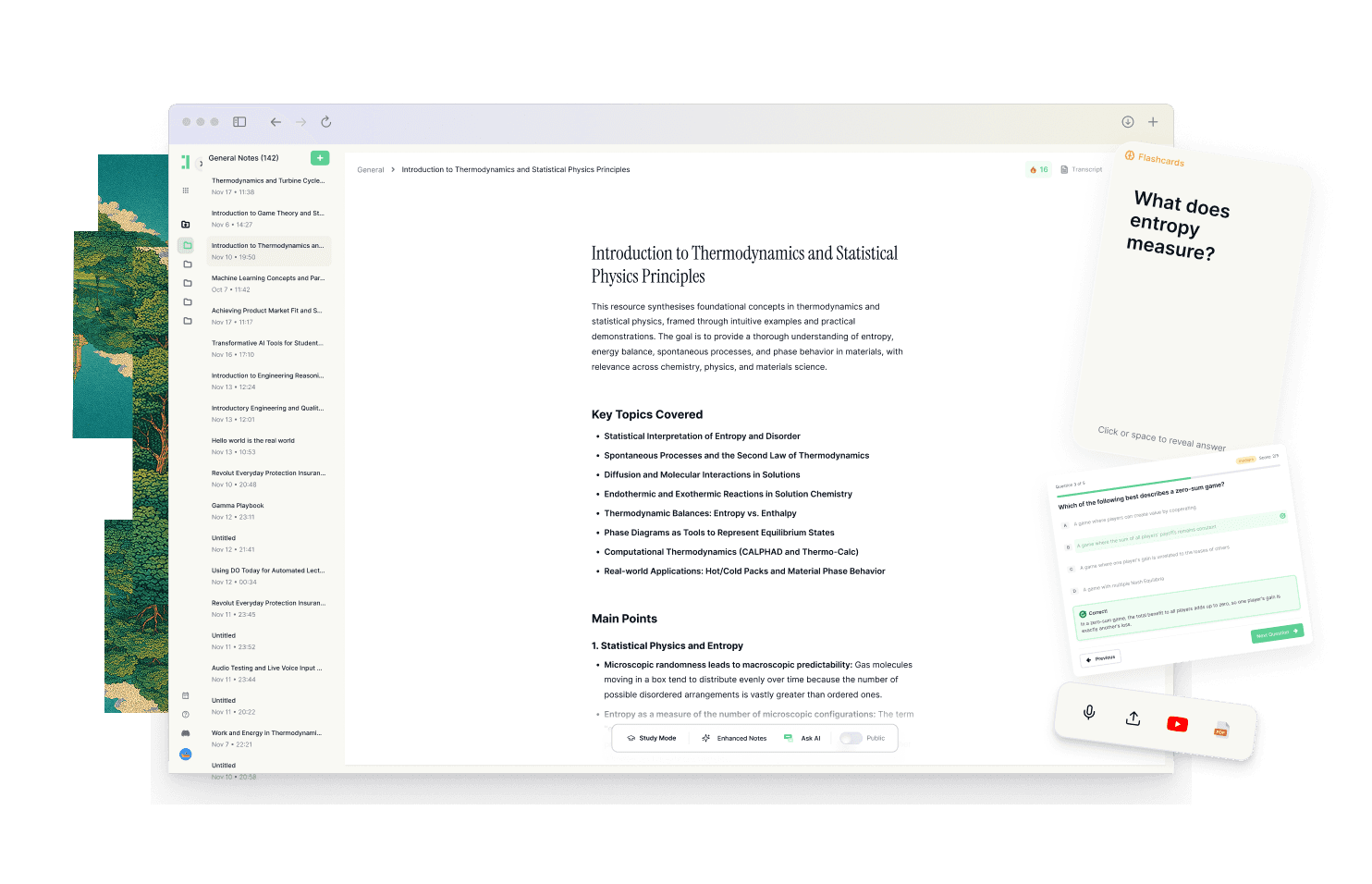
Duetoday is designed as a unified learning workspace that bridges the gap between receiving information and actually remembering it. Instead of forcing you to manually input data, Duetoday allows you to upload everything you learn in one place. You can drop in lecture recordings, PDFs, YouTube links, and even sync your Notion pages. The system then acts as a central brain that transcribes audio, parses documents, and connects all your materials together. This means your studying is never disconnected from the source; if you are reviewing a flashcard and need more context, you can see exactly which part of the lecture it came from.
The core of Duetoday is its ability to turn raw content into structured outputs without the manual labor. It uses AI to generate summaries, cheatsheets, and study guides instantly. Most importantly for retention, it creates active recall tools like flashcards and quizzes directly from your uploaded materials. You also have access to an AI tutor chat that is grounded in your specific files, not just generic web data. This reduces fragmentation by bringing your inputs and your practice tools into a single, repeatable workflow that aligns with your real-university schedule through Google Calendar integration.
How the Duetoday workflow feels in real life
Imagine it is Monday afternoon and you just finished a complex biology lecture. Instead of spending your evening manually drafting cards, you upload the recording to Duetoday. While you grab a coffee, the system transcribes the audio and generates a structured set of notes and a summary of the key concepts. On Tuesday, you open your study guide on Duetoday and use the AI chat to clarify a specific point about cellular respiration that you didn't quite catch in class. Since Duetoday is connected to your calendar, it suggests a quick practice session for Wednesday morning.
As your exam approaches on Friday, the workflow shifts from gathering to testing. You dive into the AI-generated quizzes and flashcards that were born from your actual lecture notes. Because everything is connected, you aren't just memorizing isolated facts; you are interacting with the context of the entire course. When you finish your study tasks, the system checks off your items and gives you a clear signal that you are prepared. The process feels like an automated loop where the distance between "seeing it for the first time" and "mastering it for the exam" is minimized.
Duetoday vs SuperMemo in plain English
Comparing Duetoday and SuperMemo is essentially a choice between a complex knowledge vault and a streamlined study system. SuperMemo requires a massive upfront investment in time and effort to learn the software itself before you can start learning your course material. It is a high-skill tool for people who want to manage a lifelong database of facts. Duetoday, by contrast, has almost no setup time. You can start uploading your materials and generating study tools within minutes, making it much more suitable for the fast-paced nature of a university semester.
In terms of media support, Duetoday handles the modern web and video-first world far more naturally. While SuperMemo is heavily focused on text-based incremental reading, Duetoday treats a YouTube video or a lecture transcript as a first-class citizen. It provides the outputs you need for exam readiness—like practice questions and summaries—effortlessly. While SuperMemo excels at long-term recall over decades, Duetoday excels at keeping you consistent with your daily routine and ensuring you are ready for your next deadline without the anxiety of a fragmented workflow.
Who should choose Duetoday
Duetoday is the ideal choice for any student or learner who feels buried under a mountain of different files, videos, and notes. If your primary goal is to pass exams and truly understand complex topics without spending hours on software maintenance, Duetoday is built for you. It serves the lecture-heavy and deadline-driven individual who needs structure and immediate retention tools. It is for those who want their study system to do the heavy lifting of organization so they can focus on the actual act of learning.
Who should still choose SuperMemo
SuperMemo remains the right tool for the "power learner" who is obsessed with the mechanics of memory and wants to build a local, private knowledge base that lasts for the next fifty years. If you are a researcher or a hobbyist who values technical control over ease of use, and if you have the patience to master the steep learning curve of incremental reading, SuperMemo provides a level of depth that modern AI tools do not yet replicate for long-term text processing.
Verdict
The difference comes down to whether you need a vault or a system. SuperMemo is a powerful vault for storing and reviewing information over the long haul, but it lacks the speed and integration required for modern student life. Duetoday is a unified study system that handles everything from the first lecture recording to the final practice quiz, reducing fragmentation and ensuring you are actually ready when the deadline hits.
FAQ
Is Duetoday only flashcards and quizzes?
No, Duetoday is a full-scale learning workspace. It handles transcription, summarization, study guide creation, and features an AI tutor that can answer questions based on your specific course materials alongside its active recall tools.
Does Duetoday work for lectures and YouTube?
Yes, it is designed specifically for mixed-media. You can upload lecture recordings for transcription or paste YouTube links, and the AI will process them into notes, summaries, and flashcards just like it would for a PDF.
Will it help reduce cramming?
By integrating with your Google Calendar and breaking down your materials into clear action items, Duetoday helps you stay on top of your work throughout the semester. It creates a repeatable study loop that makes consistent review much easier than late-night cram sessions.
Can I still use Notion or Google Calendar?
Absolutely. Duetoday is designed to reduce fragmentation by connecting with the tools you already use. You can sync content from Notion and use Google Calendar to align your study blocks with your actual life schedule.
Who is SuperMemo still best for?
SuperMemo is still the best option for users who want a local-first, highly technical tool for long-term lifelong learning and who are willing to invest weeks into learning the software to master the incremental reading process.
Choosing the right tool is the first step toward reclaiming your time and achieving academic success.
Read More Alternative To Comparison
Turn lectures, PDFs, and notes into AI-Powered summaries, bite-sized
courses, flashcards, quizzes, and study plans.