Best StudyFetch Alternatives in 2026 [For Students]
Frustrated with fragmented AI study tools? Discover why Duetoday is the superior StudyFetch alternative for students who need a unified system for lectures, PDFs, and planning.
Why people look for a StudyFetch alternative
Many students start using StudyFetch because they are drawn to the promise of turning lectures into notes quickly. However, over time, the limitations of a tool that focuses primarily on generating isolated study sets become clear. Users often find themselves with a collection of flashcards and summaries that live in a vacuum. While the initial generation of content is fast, there is often a lack of cohesion between the original source material and the study outputs. This leads to a fragmented experience where a student has their lecture recordings in one place, their actual research PDFs in another, and their AI-generated quizzes in StudyFetch.
As deadlines approach, the need for a more integrated system becomes urgent. Students look for alternatives because they realize that simply having flashcards isn't the same as having a structured study workflow. They want a workspace where the transition from a live lecture to a completed study session is seamless. When the cost of multiple subscriptions starts to add up and the AI outputs feel generic rather than deeply grounded in their specific course materials, the search for a comprehensive learning engine like Duetoday begins.
Quick verdict
At-a-glance:
Best for building a knowledge vault: StudyFetch
Best for a real study system: Duetoday
Best if you want both: Use StudyFetch for quick document scanning and Duetoday for long-term retention and scheduling.
What StudyFetch is great at
StudyFetch has earned its reputation by making the initial intake of information extremely fast. It excels at taking a single document or a link and instantly producing a study set. For a student who needs a quick set of flashcards twenty minutes before a quiz, it provides a low-friction entry point. The interface is designed to be approachable and colorful, which lowers the mental barrier to starting a study session. It is particularly effective for those who want a gamified experience and frequent rewards for completing small tasks.
The platform is also adept at handling various file formats and providing a straightforward AI tutor experience. It focuses on the 'fetch' aspect of learning—retrieving information and turning it into a digestible format. For learners who prefer a lighter, more mobile-oriented approach to casual reviews, it serves as a helpful companion. It respects the need for speed and simplicity, ensuring that users spend less time configuring software and more time looking at their materials.
Where StudyFetch breaks for students on deadlines
The primary issue students face with StudyFetch during intense exam periods is the feeling of productive procrastination. It is easy to spend hours 'generating' sets without actually synthesizing the information. Because the tool often treats each upload as a separate entity, it is difficult to see the connections between a Monday lecture, a Wednesday reading, and a Friday lab report. This fragmentation forces the student to do the heavy lifting of organization manually, which is the last thing anyone wants to do during finals week.
Furthermore, StudyFetch often lacks the deep integration with a student's actual life. It doesn't know about your Google Calendar or the specific deadlines you are facing. This means it can't help you prioritize which topic to study next based on how much time you have left. When you are dealing with mixed-media learning—switching between a YouTube tutorial, a heavy PDF, and your own handwritten notes—StudyFetch can feel like a series of disconnected tabs rather than a unified brain. The lack of a clear 'next right action' leaves many students feeling busy but not necessarily prepared.
What Duetoday does instead
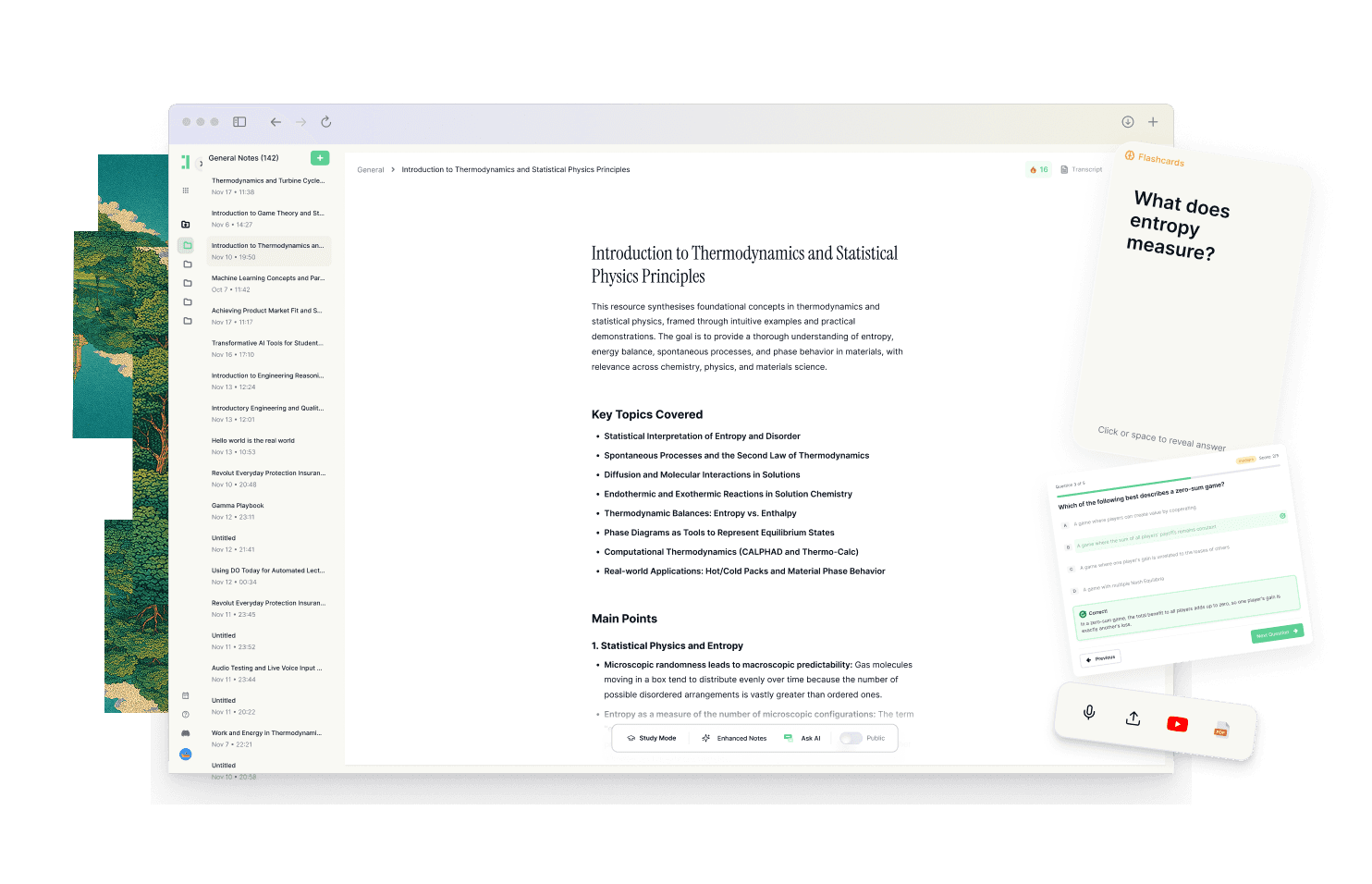
Duetoday is built as a unified learning workspace designed to close the loop between receiving information and mastering it. It acts as a single home for every piece of content you encounter. You can upload lecture recordings and get high-quality transcriptions, import PDFs, process YouTube links, and sync your Notion pages. Instead of having isolated study sets, Duetoday creates a connected 'AI Brain' where all your materials live together. This allows the AI to answer questions based on the full context of your semester, not just one file.
Beyond just storing information, Duetoday focuses on active retention and execution. It takes your raw inputs and transforms them into structured outputs like summaries, cheatsheets, and study guides that remain linked to the original source. If you are confused by a flashcard, you can jump directly back to the exact moment in the lecture or the specific page in the PDF where that concept was discussed. This eliminates the disconnect between study tools and source material. With integrated Google Calendar support and AI-generated action items, Duetoday turns your study goals into a concrete plan, ensuring that your learning is aligned with your real-world schedule.
How the Duetoday workflow feels in real life
Imagine it is Monday afternoon. You just finished a complex biology lecture. You record the session and upload it directly to Duetoday while grabbing a coffee. By the time you sit down, Duetoday has already transcribed the audio, extracted the key points into a summary, and generated a set of practice questions. You don't have to decide 'how' to study; you simply look at your workspace and see the generated tasks. You spend twenty minutes reviewing the AI-suggested notes and checking off the action items.
As the exam nears on Thursday, you don't panic or hunt through folders. You open your Duetoday campus and ask the AI tutor to explain a specific concept using both the lecture transcript and your uploaded textbook chapters as references. The AI provides a grounded answer, and you instantly generate a mindmap to visualize the connections. Because Duetoday is synced with your Google Calendar, it has already blocked out time for your final review. You go into the exam feeling calm because your study process was a continuous stream rather than a series of fragmented sprints.
Duetoday vs StudyFetch in plain English
The difference between Duetoday and StudyFetch comes down to the difference between a tool and a system. StudyFetch is a specialized tool for creating study materials from individual files. It works well if you have a single PDF and you want some quick flashcards. However, the learning curve for managing an entire semester's worth of interconnected data is much higher in StudyFetch because the platform isn't designed to be a central repository. Duetoday, on the other hand, is built to be your entire study headquarters from day one.
Duetoday handles mixed-media much more natively. While StudyFetch can process links, Duetoday integrates them into a broader context. The ability to see your calendar deadlines alongside your lecture notes means Duetoday helps you manage your time, not just your content. For a student who needs to move beyond simple memorization and into deep understanding, the connected nature of Duetoday’s AI Brain provides a level of search and recall that isolated study sets cannot match. It’s the difference between having a drawer full of flashcards and having a personal tutor who remembers everything you’ve ever read.
Who should choose Duetoday
Duetoday is the ideal choice for university students who are dealing with a high volume of diverse information. If your courses involve a mix of live lectures, heavy reading assignments, and external video resources, you need a system that can unify these inputs. It is for the student who feels overwhelmed by having notes scattered across multiple apps and wants a single, cohesive workflow that manages both the information and the time required to learn it.
It is also perfect for those who prioritize active recall but want those tools to be deeply grounded in their specific course content. If you want your study guides and quizzes to feel like they were written specifically for your professor's unique teaching style, Duetoday’s context-aware AI is the right fit. It appeals to the deadline-driven learner who needs the software to tell them the 'next right action' so they can stop planning and start studying.
Who should still choose StudyFetch
StudyFetch remains a strong option for students who prefer a very simple, document-by-document approach. If you are someone who enjoys a more gamified, colorful interface and you don't mind having your study materials separated from your primary note-taking or planning tools, it serves that purpose well. It is also suitable for younger students or those in less complex courses where the need to connect information across multiple sources is not as critical for success.
Verdict
While StudyFetch is a capable tool for generating quick study aids, Duetoday offers a more robust system for long-term academic success. The choice between them depends on whether you want a vault to store and quiz yourself on individual files or a unified workspace that manages your entire learning lifecycle. For students who want to eliminate fragmentation and build a reliable routine for retention and exam readiness, Duetoday is the more comprehensive solution.
FAQ
Is Duetoday only flashcards and quizzes?
No, Duetoday is a full learning workspace that includes transcription, document organization, and planning. While it generates excellent active recall tools, its core strength lies in connecting all your materials into a centralized AI brain. It helps you manage the entire process from first lecture to final exam.
Does Duetoday work for lectures and YouTube?
Yes, Duetoday is designed specifically to handle mixed media. You can upload audio recordings of lectures for transcription and import YouTube links to be processed into notes. This ensures that all your different learning sources are stored and analyzed in one place.
Will it help reduce cramming?
By integrating with your Google Calendar and generating clear action items, Duetoday helps you distribute your workload over time. It makes the next step in your study process obvious, which reduces the friction that often leads to procrastination and last-minute cramming.
Can I still use Notion or Google Calendar?
Absolutely, Duetoday is built to work alongside your existing productivity stack. You can import content from Notion to use as a source for your AI brain and connect your Google Calendar to align your study sessions with your actual availability.
Who is StudyFetch still best for?
StudyFetch is still a great choice for students who want a very fast, simple, and gamified way to turn a single document into a study set. It is ideal for casual learners or those who do not require a deeply integrated system for managing multiple complex sources across a whole semester.
Choosing a study system is about finding the right balance between simple tools and a comprehensive workflow that supports your long-term success.
Read More Alternative To Comparison
Turn lectures, PDFs, and notes into AI-Powered summaries, bite-sized
courses, flashcards, quizzes, and study plans.