Best Studley Alternatives in 2026 [For Students]
Looking for a Studley alternative? Compare Duetoday vs Studley to see which study system helps you manage lectures, PDFs, and active recall more effectively.
Why people look for a Studley alternative
Many students start using Studley because they need a way to organize their academic life, but they often find themselves hitting a wall when it's time to actually retain information. While Studley offers a clean interface for basic organization, it frequently falls short for students dealing with complex, multi-media curricula. Users often search for an alternative because they realize that simply having a place to put things is not the same as having a system that helps them learn. The friction of moving between different browser tabs, PDF readers, and flashcard apps creates a fragmented experience that eats away at precious study time.
The search for a Studley alternative usually begins when the workload increases. When you have hundreds of lecture hours, dozens of research papers, and a constant stream of YouTube tutorials to get through, a basic dashboard isn't enough. Students want a workspace that doesn't just store their materials but actually processes them. They are looking for a tool that closes the loop between receiving information and proving they understand it, without requiring them to manually bridge the gap between their notes and their practice tools.
Quick verdict
At-a-glance:
Best for building a knowledge vault: Studley
Best for a real study system: Duetoday
Best if you want both: Use Studley for high-level organization and Duetoday for active retention and exam preparation.
What Studley is great at
Studley excels at providing a structured environment for the administrative side of being a student. It is designed to help users feel organized from the moment they log in, offering a visual layout that can make a chaotic semester feel more manageable. The platform is particularly strong at acting as a central hub for tasks and basic note-taking, making it a solid choice for those who primarily need a digital planner that can also hold some text-based information. It respects the user's need for a clean aesthetic, which can reduce the initial anxiety of starting a new project or semester.
The tool is also appreciated for its simplicity in handling standard student workflows. It doesn't overwhelm the user with overly complex database structures, which is a common complaint with more industrial-strength tools. For a student who just wants a straightforward place to list their courses and keep track of general deadlines, Studley provides a low-friction entry point. It creates a sense of order that is valuable during the early stages of information gathering, ensuring that nothing important falls through the cracks of a busy schedule.
Where Studley breaks for students on deadlines
The primary issue with Studley arises when the pressure of exam season begins. It often leads students into a trap of productive procrastination, where they spend more time organizing their dashboard and color-coding their categories than actually engaging with the material. Because the tool focuses heavily on storage and organization, it doesn't naturally facilitate deep learning. A student can have a perfectly organized vault of notes in Studley and still feel completely unprepared for a technical exam because the tool doesn't bridge the gap between reading and recalling.
Furthermore, Studley often struggles with mixed-media learning. Modern university education isn't just text; it involves long lecture recordings, complex PDFs, and educational videos. When a student is on a deadline, they don't have time to manually transcribe a sixty-minute lecture or copy-paste highlights from a research paper into a separate note-taker. This fragmentation forces the student to bounce between several different tools, breaking their focus and making it harder to see the connections between different topics. Without a built-in feedback loop for active recall, Studley remains a place where information goes to rest, rather than a place where it is mastered.
What Duetoday does instead
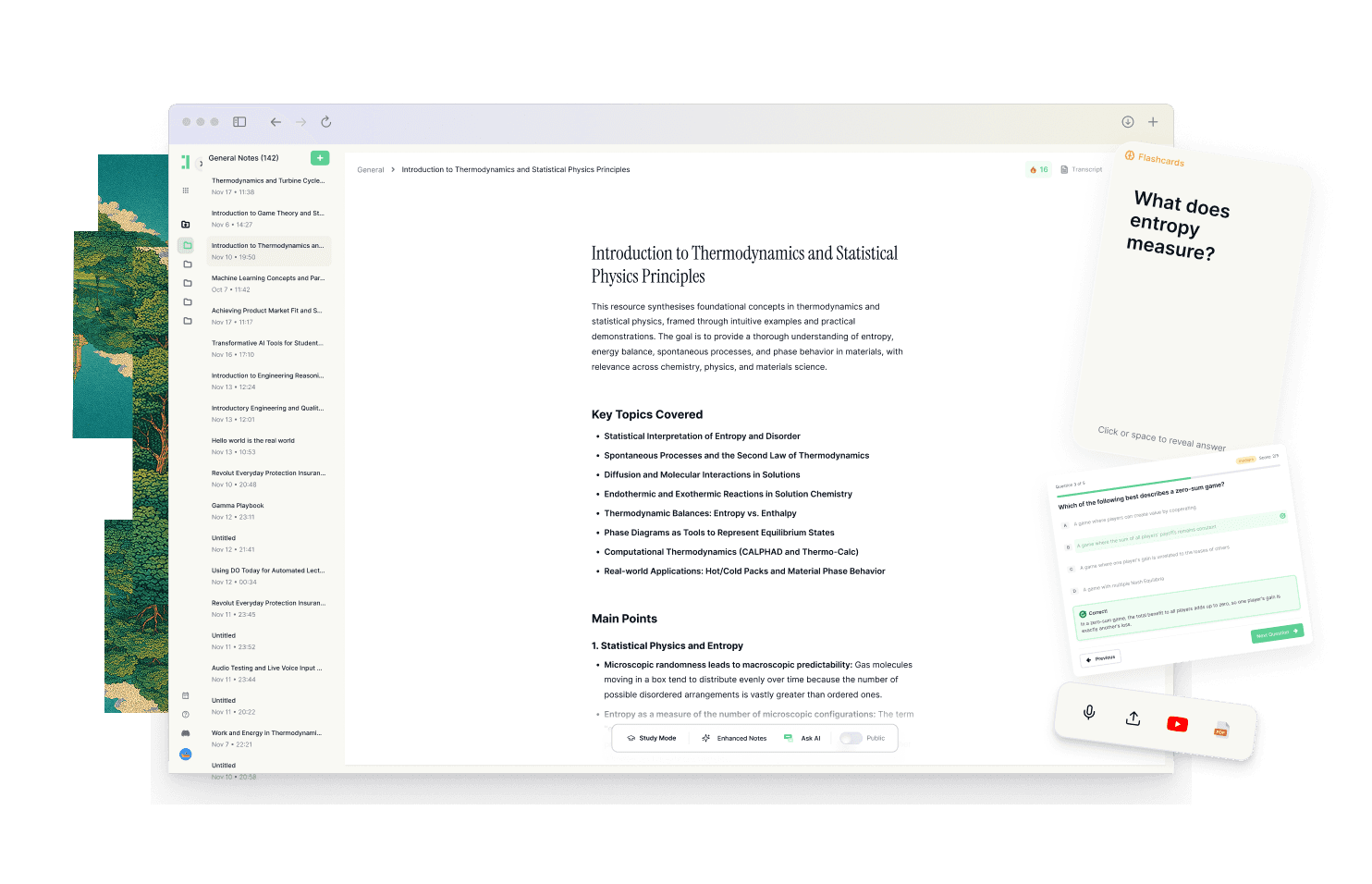
Duetoday is built as a unified learning workspace designed to eliminate the fragmentation that plagues modern students. Instead of being just a storage folder, Duetoday acts as a retention loop. It allows you to bring everything you learn into one place, whether it is a lecture recording, a PDF, a YouTube video, or a website. You can upload lecture recordings directly and receive an accurate transcription, which is then connected to your other materials. This unified library ensures that your study experience is never disconnected from the source material, allowing you to move from a high-level summary back to the specific moment in a lecture with a single click.
The core of the Duetoday system is its ability to turn raw content into structured study outputs. Once your materials are in the system, you can generate summaries, cheatsheets, and comprehensive study guides automatically. More importantly, it bridges the gap to active recall by generating flashcards and quizzes based directly on your specific uploads. If you have a question, you can use the grounded AI chat to get answers based on your own files, not generic internet data. With integrations for Notion and Google Calendar, Duetoday aligns your study plan with your real-world schedule, making it obvious what the next right action is every time you sit down to work.
How the Duetoday workflow feels in real life
Imagine it is Monday afternoon and you just finished a heavy biology lecture. Instead of dreading the process of organizing your notes, you simply upload the audio recording and the professor's slide deck to Duetoday. By the time you’ve grabbed a coffee, the system has transcribed the lecture and generated a concise summary of the key points. You spend ten minutes reviewing the summary and use the AI chat to clarify a complex concept about cellular respiration that you missed in class. The system automatically creates a set of practice questions based on that specific lecture, which you decide to tackle later in the week.
As the exam approaches, you don't need to scramble through folders or different apps. You open your exam study guide in Duetoday, which now links your lecture transcripts, related YouTube videos you watched, and the practice quizzes you've been taking. Because Duetoday is connected to your Google Calendar, it shows you exactly which study blocks you have available before the test. You spend your final hours doing active recall with the generated flashcards rather than re-reading highlighted text. By the time the exam starts, you aren't just organized; you are prepared because you've spent your time practicing rather than just moving files around.
Duetoday vs Studley in plain English
When comparing Duetoday and Studley, the difference lies in the goal of the software. Studley is a digital filling cabinet. It is where you put things so you know where they are later. It requires the student to do the heavy lifting of summarizing, creating practice materials, and connecting different types of media. The setup is relatively quick, but the manual workload remains high throughout the semester. It is a tool for organization, but it does not necessarily improve the speed or quality of your learning.
Duetoday is a learning engine. It takes the heavy lifting of transcription, summarization, and quiz generation off your plate, allowing you to focus entirely on comprehension and retention. While Studley works well for text, Duetoday is built for the mixed-media reality of modern education, handling audio and video just as easily as PDFs. Duetoday reduces the learning curve for complex subjects by providing an AI tutor that knows your specific curriculum. In short, Studley helps you stay organized, but Duetoday helps you pass the exam by turning your notes into a repeatable system for mastery.
Who should choose Duetoday
Duetoday is the ideal choice for university students and self-learners who are overwhelmed by the sheer volume of information they need to process. If your courses rely heavily on lectures, long PDF readings, and various online resources, you need a tool that can unify these inputs. It is perfect for those who are deadline-driven and need to move from "new information" to "exam-ready" as quickly as possible without getting lost in the weeds of manual note organization.
If you value structure and want a system that tells you exactly what to do next, Duetoday is built for you. It appeals to the student who wants to spend less time managing their tools and more time actually learning the material. Whether you are in medical school, law school, or a technical bootcamp, the ability to generate active recall tools instantly from your specific material is a significant competitive advantage that saves hours of manual work every week.
Who should still choose Studley
Studley remains a strong option for students who prefer a minimalist, manual approach to their organization. If you are someone who enjoys the process of building a knowledge vault from scratch and prefers to write every note and create every flashcard by hand, Studley provides a clean canvas to do so. It is also suitable for those who have very light workloads consisting mostly of simple text notes and don't require AI-assisted transcription or complex multi-media integration. It is a tool for the digital archivist who prioritizes a beautiful interface over automated learning workflows.
Verdict
The choice between Duetoday and Studley comes down to whether you need a vault or a system. Studley is a reliable vault for storing information, but it leaves the hard work of learning entirely up to you. Duetoday provides a complete study system that automates the transition from raw content to long-term retention, reducing fragmentation and ensuring that every minute you spend at your desk actually contributes to your results. For the student on a deadline, the unified workflow and automated practice tools of Duetoday offer a clear path to academic success that a simple organization tool cannot match.
FAQ
Is Duetoday only flashcards and quizzes?
No, Duetoday is a full learning workspace that handles everything from transcription and summarization to document storage and task management. While it excels at generating active recall tools, it also serves as your primary brain for reading PDFs, watching lectures, and organizing all your research materials in one place.
Does Duetoday work for lectures and YouTube?
Yes, Duetoday is specifically designed to handle audio and video inputs. You can upload lecture recordings directly for transcription or paste YouTube links to have the AI process the video content, allowing you to treat multi-media sources just like any other text-based note.
Will it help reduce cramming?
Duetoday helps reduce cramming by making consistent study much easier. By automatically generating study guides and practice tools as soon as you upload a lecture, it allows you to engage with the material immediately and consistently throughout the semester rather than waiting until the week before the exam.
Can I still use Notion or Google Calendar?
Yes, Duetoday is built to work alongside your existing workflow. You can import content from Notion to use as a source for your AI brain, and the Google Calendar integration ensures that your study tasks and deadlines and synced with your real-life schedule.
Who is Studley still best for?
Studley remains a good choice for people who want a simple, lightweight organization tool for text-based notes. If you do not need AI transcription, video processing, or automated quiz generation, and you simply want a clean place to list your assignments and basic notes, Studley is a functional option.
Choosing the right tool is the first step toward transforming your study habits from chaotic to consistent.
Read More Alternative To Comparison
Turn lectures, PDFs, and notes into AI-Powered summaries, bite-sized
courses, flashcards, quizzes, and study plans.