Best Roam Research Alternatives in 2026 [For Students]
Frustrated with building a Roam Research vault that doesn't help you study? Compare Duetoday vs Roam Research to find the best workflow for university students.
Why people look for a Roam Research alternative
Roam Research introduced many learners to the power of networked thought and bi-directional linking. For a long time, it was the gold standard for creating a digital garden where ideas could intersect naturally. However, many university students and self-learners find that while Roam is excellent for collecting thoughts, it often fails to bridge the gap between storage and active learning. The friction of setting up complex queries and maintaining a messy graph of nodes can lead to what many call productive procrastination. Students often spend more time organizing their knowledge than actually mastering the material for an exam.
As academic workloads increase, the need for a system that actively helps you process information becomes more urgent. Roam requires the user to do the heavy lifting of summarization, flashcard creation, and schedule alignment manually or through complicated community plugins. For someone balancing lectures, PDFs, and tight deadlines, the manual overhead of Roam can become a burden. People look for alternatives because they need a tool that doesn't just store information but proactively helps them understand and retain it.
Quick verdict
Best for building a knowledge vault: Roam Research
Best for a real study system: Duetoday
Best if you want both: Use Roam Research for long-term research and personal journaling, and use Duetoday for active exam preparation and managing current academic materials.
What Roam Research is great at
Roam Research is a pioneer in the space of non-linear note-taking. Its greatest strength lies in its ability to connect disparate ideas through bi-directional links and block-level referencing. This makes it an incredible tool for long-form research, synthesis, and deep thinking. The daily notes feature provides a frictionless starting point for capturing thoughts without worrying about where they belong, which is perfect for creative brainstorming or keeping a personal log. If you are a "builder" who enjoys creating a personalized architecture for your knowledge, Roam offers unparalleled flexibility.
The community surrounding Roam is also highly dedicated, producing various CSS themes and plugins that allow power users to customize their experience extensively. For those who prioritize privacy and local-first mentalities, Roam offers an environment that feels like a true extension of one's own mind. It excels at being a second brain where you can store every thought you have ever had with the confidence that you can find it later through its powerful search and graph visualization tools.
Where Roam Research breaks for students on deadlines
The primary issue for students using Roam is that it often becomes a bottomless pit of information rather than a focused study tool. When you have a midterm in three days, seeing a graph of 500 connected notes is less helpful than having a structured study guide. Roam lacks native features for active recall, meaning students must manually create their own spaced repetition systems or rely on third-party integrations that often break or require significant setup time. This leads to a fragmentation of the learning process across multiple apps.
Furthermore, Roam is primarily a text-based, markdown-first tool. Modern learning involves a heavy mix of media, including lecture recordings, hour-long YouTube tutorials, and complex PDFs. Roam does not handle these media types as cohesive units of study. It is difficult to transcribe a lecture or extract a structured summary from a website directly within the Roam interface without significant manual effort. For a student on a deadline, the time spent formatting blocks and tagging synonyms is time taken away from actually practicing the material.
What Duetoday does instead
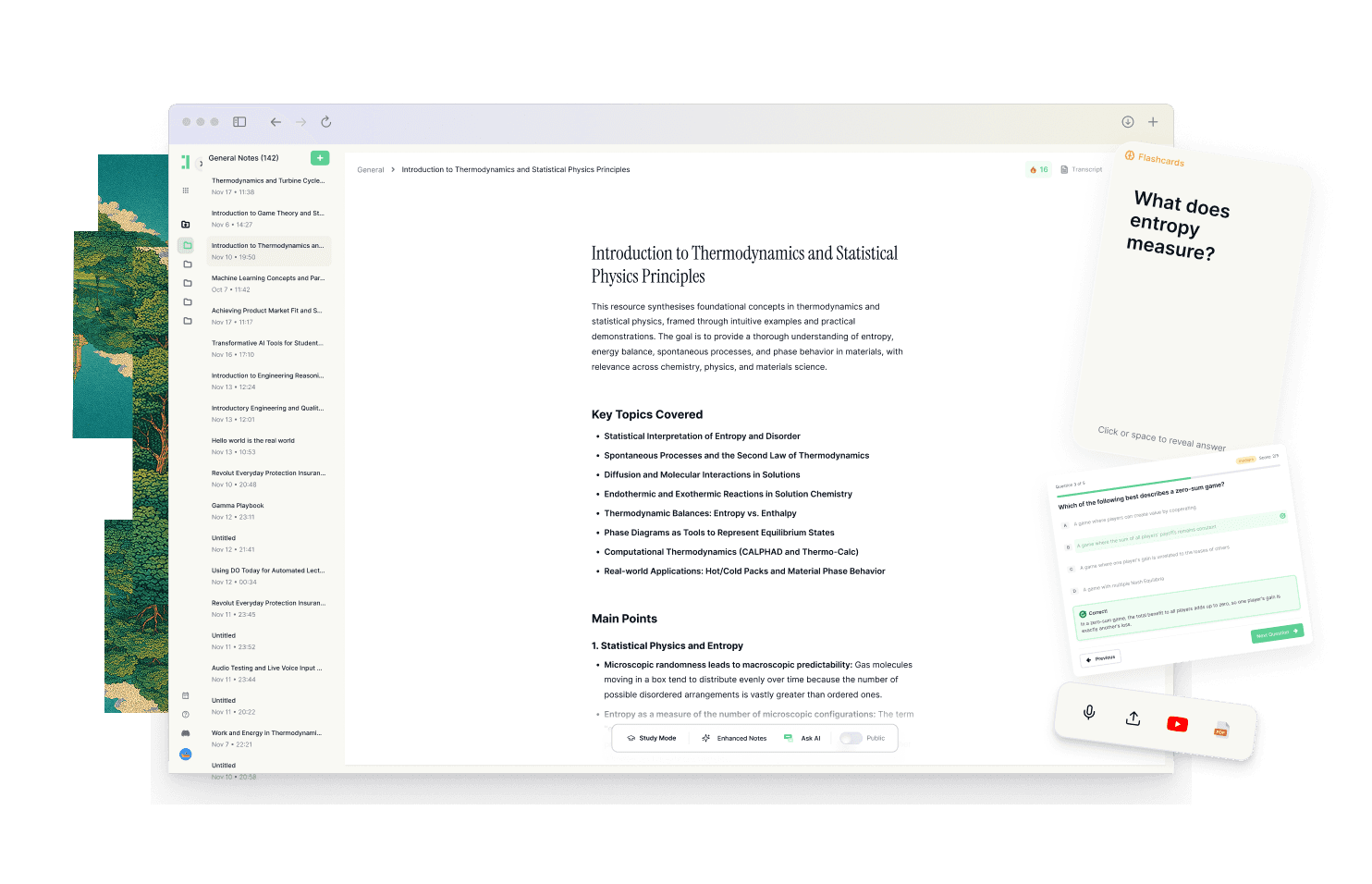
Duetoday is designed as a unified learning workspace that prioritizes retention over mere storage. Instead of just being a place to park text, it serves as a central hub for everything you learn, including lectures, PDFs, YouTube videos, and websites. You can upload a lecture recording directly and receive an instant transcription, which is then connected to all your other study materials. This ensures that your research is never disconnected from the original source, making it easier to verify facts and revisit complex explanations.
The core of Duetoday is its ability to turn raw content into structured outputs automatically. It can generate summaries, cheatsheets, and study guides from your inputs, saving you hours of manual note-taking. Beyond simple summaries, Duetoday builds a retention loop by generating active recall tools like flashcards and quizzes directly from your materials. You can interact with an AI tutor that is grounded specifically in your uploaded content, ensuring that the answers you get are relevant to your specific curriculum rather than being generic AI responses.
To solve the problem of fragmentation, Duetoday integrates with the tools students already use. It connects with Google Calendar to align your study plans with your real-world schedule and allows you to pull content from Notion. This means your deadlines, notes, and study materials exist in one cohesive environment. The execution layer includes AI-generated task lists that make the next right action obvious, helping you move from passive reading to active practicing without the need for complex personal organization systems.
How the Duetoday workflow feels in real life
Imagine it is Monday morning and you have just finished a difficult biology lecture. Instead of spending an hour manually typing up notes into a blank page, you upload the audio recording and the professor’s slide deck to Duetoday. By the time you finish your coffee, the system has transcribed the lecture and generated a concise summary. You spend twenty minutes reviewing the summary and then use the AI tutor to ask questions about the most confusing parts of the lecture. The tutor explains the concepts using the context of both the slides and the transcript.
As the week progresses, you add a relevant YouTube video and a research paper to the same workspace project. Duetoday connects these pieces, and by Thursday, you tap a button to generate a set of flashcards and a practice quiz for your upcoming exam. On Sunday, you look at your Google Calendar, see your study block, and open Duetoday to find a ready-made checklist of tasks based on your progress. You aren't searching for what to do next; the system has already prepared the practice materials you need to reach exam readiness.
Duetoday vs Roam Research in plain English
The difference between these two tools comes down to their fundamental purpose. Roam Research is a tool for thought, while Duetoday is a tool for learning and retention. Roam has a steep learning curve and requires you to build your own workflows from scratch. You have to decide how to tag, how to link, and how to organize. Duetoday, on the other hand, provides a structured system from day one. It is designed to get you from raw information to mastery as quickly as possible with minimal setup time.
In terms of media support, Roam is a text-heavy environment that requires plugins for advanced functionality with video or audio. Duetoday is inherently mixed-media, treating a YouTube video or a PDF with the same importance as a text note. While Roam is excellent for the deep work of a researcher who has months to synthesize a topic, Duetoday is built for the student who needs to master a subject in weeks or days. Duetoday emphasizes the daily routine of practicing and checking off tasks, whereas Roam emphasizes the long-term growth of a knowledge graph.
Who should choose Duetoday
Duetoday is the ideal choice for university students or professional learners who are overwhelmed by the volume of information they need to process. If you find yourself with dozens of open tabs, messy Notion pages, and a sense of dread about exams, Duetoday provides the structure you need. It is for the person who wants to spend more time learning and less time organizing. If you rely on lectures, videos, and PDFs and need a way to turn those into actionable study materials automatically, Duetoday is built for you.
Who should still choose Roam Research
Roam Research remains the best option for users who prioritize privacy and want a permanent, long-term vault for their thoughts. If you are a researcher or creator who enjoys the process of building a complex, personalized system, you will appreciate the flexibility Roam offers. It is perfect for those who do not have strict deadlines and prefer an open-ended, non-linear environment where the primary goal is emergent thinking rather than meeting specific academic milestones.
Verdict
The choice depends on whether you need a library or a laboratory. Roam Research is a beautiful library where you can store and link every thought for the long term. Duetoday is a high-performance laboratory where you bring in raw materials and systematically turn them into knowledge you can recall under pressure. For students facing deadlines and mixed-media lectures, the unified workflow and retention tools of Duetoday offer a more practical path to success than the fragmented experience of a manual knowledge vault.
FAQ
Is Duetoday only flashcards and quizzes?
No, Duetoday is a complete learning workspace that handles everything from initial content capture to final review. It includes transcriptions, AI-generated summaries, study guides, a context-aware AI tutor, and task management alongside its active recall tools like flashcards.
Does Duetoday work for lectures and YouTube?
Yes, Duetoday is specifically designed to handle mixed-media learning. You can upload lecture recordings for transcription or paste YouTube links to have the system process the video content, allowing you to summarize and chat with the information directly.
Will it help reduce cramming?
Duetoday helps reduce cramming by creating a structured path to retention throughout the semester. By turning your lectures into bite-sized practice tasks and flashcards early on, you can engage in spaced repetition instead of trying to memorize everything the night before an exam.
Can I still use Notion or Google Calendar?
Absolutely, Duetoday is designed to complement your existing tools. You can pull content from Notion into your study brain and connect your Google Calendar so that your study tasks and deadlines are synchronized with your actual schedule.
Who is Roam Research still best for?
Roam Research is still the top choice for users who want a local-first, highly customizable notes vault for long-term knowledge synthesis. It remains ideal for those who prefer an unstructured, non-linear way of connecting personal ideas over many years.
Finalizing your study system is the difference between simply collecting information and truly mastering a subject.
Read More Alternative To Comparison
Turn lectures, PDFs, and notes into AI-Powered summaries, bite-sized
courses, flashcards, quizzes, and study plans.