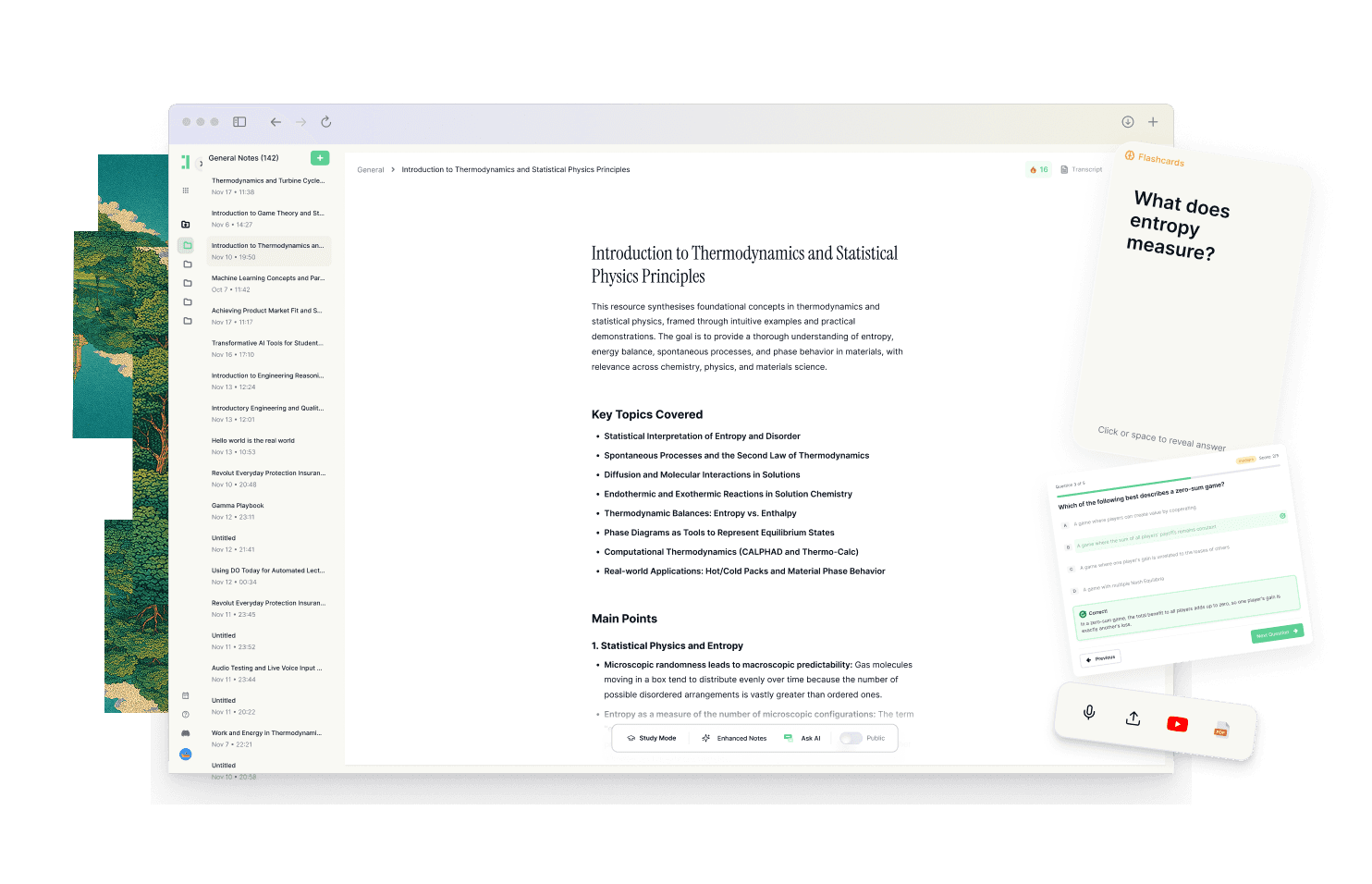
Best Quizlet Alternatives in 2026 [For Flashcards]
Looking for a Quizlet alternative? Compare Duetoday vs Quizlet to see how a unified study system handles lectures, PDFs, and YouTube better than basic flashcards.
Why people look for a Quizlet alternative
Many students start their academic journey with Quizlet because it is the most recognizable name in digital flashcards. However, as coursework becomes more complex, the limitations of a simple flashcard app become apparent. Users often find themselves manually copying and pasting information from lecture slides, textbooks, and PDFs into individual cards, which is a repetitive and time-consuming process. This manual overhead often leads to productive procrastination, where the student spends more time ‘making’ the study materials than actually learning the concepts. Eventually, the friction of managing thousands of disconnected decks across different subjects makes it difficult to maintain a consistent study routine.
Another common reason for seeking an alternative is the shift in Quizlet’s features and accessibility. Students are increasingly looking for a platform that does more than just rote memorization. They need a system that can handle the raw inputs of university life, such as long-form lecture recordings, complex YouTube tutorials, and dense research papers. When the goal is deep understanding rather than just memorizing terms for a vocabulary test, a simple flashcard tool often feels like an incomplete solution for a modern degree.
Quick verdict
At-a-glance:
Best for building a knowledge vault: Quizlet
Best for a real study system: Duetoday
Best if you want both: Use Quizlet for quick terminology drills, but use Duetoday for retention, planning, and synthesizing lecture materials.
What Quizlet is great at
Quizlet remains a powerhouse for high-volume, low-complexity memorization. Its primary strength lies in its massive user-generated library, which allows students to find pre-made decks for almost any subject or standardized test. For students who need to drill vocabulary, chemical elements, or historical dates on the go, the mobile experience is polished and intuitive. The gamified study modes, such as Match and Gravity, provide a low-barrier way to engage with materials when focus levels are low. It is a reliable tool for the specific task of testing yourself on discrete fragments of information that you have already organized elsewhere.
Where Quizlet breaks for students on deadlines
The biggest challenge with Quizlet occurs when a student is faced with a mountain of unorganized material and a looming exam. Quizlet requires you to have already synthesized your notes before you can create cards. This creates a fragmentation problem where your actual source material—the PDFs, the lecture recordings, and the YouTube videos—lives in one place, while your study tools live in another. When you are on a tight deadline, the manual labor of converting a sixty-slide PowerPoint into a flashcard deck is a luxury you cannot afford. This often results in students having beautiful card decks for the first two weeks of class, but nothing prepared for the final weeks when the workload peaks.
Furthermore, Quizlet is fundamentally a text-first platform. It struggles to help students who learn through mixed media. If your understanding of a concept is tied to a specific diagram in a PDF or a specific explanation in a YouTube video, that context is lost once the information is boiled down into a front-and-back flashcard. This lack of grounded context means that when you get a question wrong, you often have to go hunting through your original files to understand why, breaking your flow and wasting valuable time.
What Duetoday does instead
Duetoday is designed as a unified learning workspace that bridges the gap between receiving information and mastering it. Instead of forcing you to manually create cards, Duetoday allows you to upload everything you learn in its raw form. You can drop in lecture recordings, PDFs, YouTube links, and website articles into one central brain. The system then transcribes audio and parses documents to understand the full context of your curriculum. This eliminates the fragmentation that occurs when your notes and your study tools are separated, ensuring that every piece of information is connected to its original source.
Once your materials are in the system, Duetoday acts as a retention loop. It doesn't just store your files; it transforms them into structured study outputs. With a few clicks, you can generate comprehensive summaries, cheatsheets, and study guides directly from your lecture transcripts or uploaded PDFs.
For active recall, the system automatically generates flashcards and quizzes based on the specific content you provided. If a concept remains unclear, you can engage with an AI tutor that answers questions based strictly on your uploaded materials, preventing the generic or hallucinated answers often found in standalone AI tools. This workflow ensures that you spend your time practicing and understanding, rather than formatting and copying.
Beyond just content, Duetoday integrates with your actual life. By connecting with Google Calendar and tools like Notion, it aligns your study tasks with your real-world deadlines. It helps you identify the next right action, turning an overwhelming pile of lectures into a clear, repeatable checklist. This execution layer ensures that you aren't just collecting information, but actually moving through a structured plan that leads to exam readiness.
How the Duetoday workflow feels in real life
On a typical Monday, a student might finish a biology lecture and immediately upload the audio recording and the professor’s slide deck to Duetoday. While the student grabs lunch, the system transcribes the lecture and identifies key concepts. On Tuesday, the student opens the workspace to find a generated summary and a set of practice questions waiting for them. Instead of spending two hours writing out notes, they spend twenty minutes reviewing the summary and testing themselves with the AI-generated quiz.
As the exam approaches on Friday, the student doesn't panic or scramble to find their notes. They use the AI chat to ask specific questions about the confusing parts of Wednesday's lecture, receiving answers that reference the exact minute in the recording where the professor explained the topic. They review the automated study guide and complete the remaining action items on their checklist. The transition from hearing a lecture to being ready for a test becomes a streamlined, friction-free process where the next step is always obvious.
Duetoday vs Quizlet in plain English
The fundamental difference between the two tools is the starting point of your study session. With Quizlet, your session starts with work—you have to type, organize, and create before you can learn. With Duetoday, your session starts with learning. Because the system handles the ingestion and transformation of your lectures and PDFs, you skip the administrative overhead and go straight to active recall. This significantly reduces the learning curve and the setup time required for each new chapter or module.
In terms of mixed-media support, Quizlet treats images and audio as add-ons to a text card. Duetoday treats them as the foundation. Whether you are learning from a 20-minute YouTube video or a 50-page research paper, Duetoday keeps the outputs connected to those sources. This makes search and recall far more powerful; you aren't just searching for a keyword in a deck, you are searching across your entire academic brain. For daily routine consistency, Duetoday wins by making the path of least resistance the most productive one.
Who should choose Duetoday
Duetoday is the ideal choice for university students and self-learners who are dealing with a high volume of complex information. If your studies involve long lectures, dense readings, and diverse sources like YouTube or academic journals, you need a system that can unify these inputs. It is for the student who is tired of ‘preparing to study’ and wants to spend their limited time actually building retention and preparing for exams through a structured, AI-assisted workflow.
Who should still choose Quizlet
Quizlet is still the right choice for learners who need a lightweight, community-driven tool for simple memorization. If you are learning a new language and want to leverage thousands of existing vocabulary decks, or if you are a hobbyist who doesn't have complex source documents to manage, Quizlet’s simplicity is an advantage. It remains the better option for those who prefer a purely local-first or manual approach to building flashcards without the need for an integrated AI system.
Verdict
The choice between Duetoday and Quizlet comes down to whether you need a storage vault or a study system. Quizlet is an excellent vault for storing and drilling micro-facts, but it often leaves the student to handle the heavy lifting of organization and synthesis. Duetoday offers a unified workflow that takes you from raw lecture to total recall, reducing fragmentation and ensuring that your study habits are driven by retention rather than just storage.
FAQ
Is Duetoday only flashcards and quizzes?
No, Duetoday is a full learning workspace that includes transcription, AI-powered summaries, study guides, and an AI tutor. While it generates flashcards and quizzes for active recall, its primary goal is to help you understand and organize all your study materials in one place.
Does Duetoday work for lectures and YouTube?
Yes, Duetoday is specifically designed to handle mixed media by allowing you to upload lecture recordings for transcription and import YouTube links. It processes these inputs so you can chat with the content, summarize it, and create practice tools directly from the video or audio source.
Will it help reduce cramming?
Duetoday helps reduce cramming by making it easier to study consistently throughout the semester. By automating the creation of study materials, you can engage with the content immediately after a lecture rather than waiting until the week of the exam to organize your notes.
Can I still use Notion or Google Calendar?
Yes, Duetoday integrates with both Notion and Google Calendar. You can pull content from Notion into your learning brain and sync your study blocks with your calendar to ensure your plan fits your actual schedule.
Who is Quizlet still best for?
Quizlet remains the best option for students who primarily need access to a massive library of pre-made, community-sourced flashcards for standardized testing or basic vocabulary drills where no complex source material is involved.
The most effective way to learn is to spend more time practicing and less time organizing.
Read More Alternative To Comparison
Turn lectures, PDFs, and notes into AI-Powered summaries, bite-sized
courses, flashcards, quizzes, and study plans.