Perplexity Alternatives in 2026 [For Studying]
Compare Duetoday and Perplexity to find the best AI tool for students. Learn why Duetoday's unified study system is the ideal alternative for academic success.
Why people look for a Perplexity alternative
Perplexity has gained massive popularity as an AI search engine that provides cited answers, often replacing the traditional Google search for many students. However, university students frequently find that while Perplexity is excellent for finding facts, it lacks the infrastructure needed to actually learn the material. Users often look for an alternative when they realize that having an answer is not the same as understanding a concept. The fragmentation between searching on Perplexity and then having to manually move those findings into a study guide or flashcard app creates a friction that slows down the learning process.
Students also seek alternatives because Perplexity is primarily an external-facing tool. It scans the web efficiently, but it doesn't effectively "know" your specific lecture recordings, your professor's specific PDF handouts, or your personal class notes. When exams approach, students need a system that synthesizes their specific curriculum rather than just pulling general information from the open web. This gap between general information gathering and personalized academic retention is the primary reason learners are migrating toward more integrated study systems.
Quick verdict
In this section, we provide a high-level overview of which tool suits your specific workflow best.
Best for building a knowledge vault: Perplexity
Best for a real study system: Duetoday
Best if you want both: Use Perplexity for initial external research, and Duetoday for internalizing your syllabus and preparing for exams.
What Perplexity is great at
Perplexity excels at being a real-time information discovery engine. Its strength lies in its ability to parse the internet and provide structured, cited answers to complex questions. For a student starting a research paper or trying to understand a broad topic, Perplexity is an invaluable companion. It removes the need to click through ten different blue links on a search results page, instead offering a cohesive summary of the web’s current knowledge on a topic. It is fast, intuitive, and the citations provide a level of transparency that standard LLMs often lack.
The platform is also highly capable at sourcing recent news and academic papers that are publicly available. It acts as a bridge between a search engine and a chatbot, making it perfect for the "discovery" phase of learning. If you need to know the current state of a political event or a quick definition of a scientific term with sources to back it up, Perplexity is the gold standard for that specific interaction.
Where Perplexity breaks for students on deadlines
The main issue for students using Perplexity is what can be called "productive procrastination." It is very easy to spend hours falling down rabbit holes of interconnected searches without ever actually committing information to memory. Perplexity provides the answer, but it doesn't provide the practice. When a deadline is approaching, a student doesn't just need to find information; they need to master it. Perplexity’s interface isn't designed for long-term retention or systematic review, leaving students with a "vault" of saved searches but no actual readiness for a proctored exam.
Furthermore, Perplexity struggles with the mixed-media reality of modern university life. It isn't built to ingest an hour-long lecture recording, sync it with a professor’s slide deck, and then compare that to a YouTube tutorial you found helpful. Because it is optimized for web search, it often fails to prioritize the user's specific, private academic materials. This results in a fragmented workflow where the student has their sources in one place, their search results in another, and their actual study tools like flashcards in a third, making it difficult to find the "next right action" during a late-night study session.
What Duetoday does instead
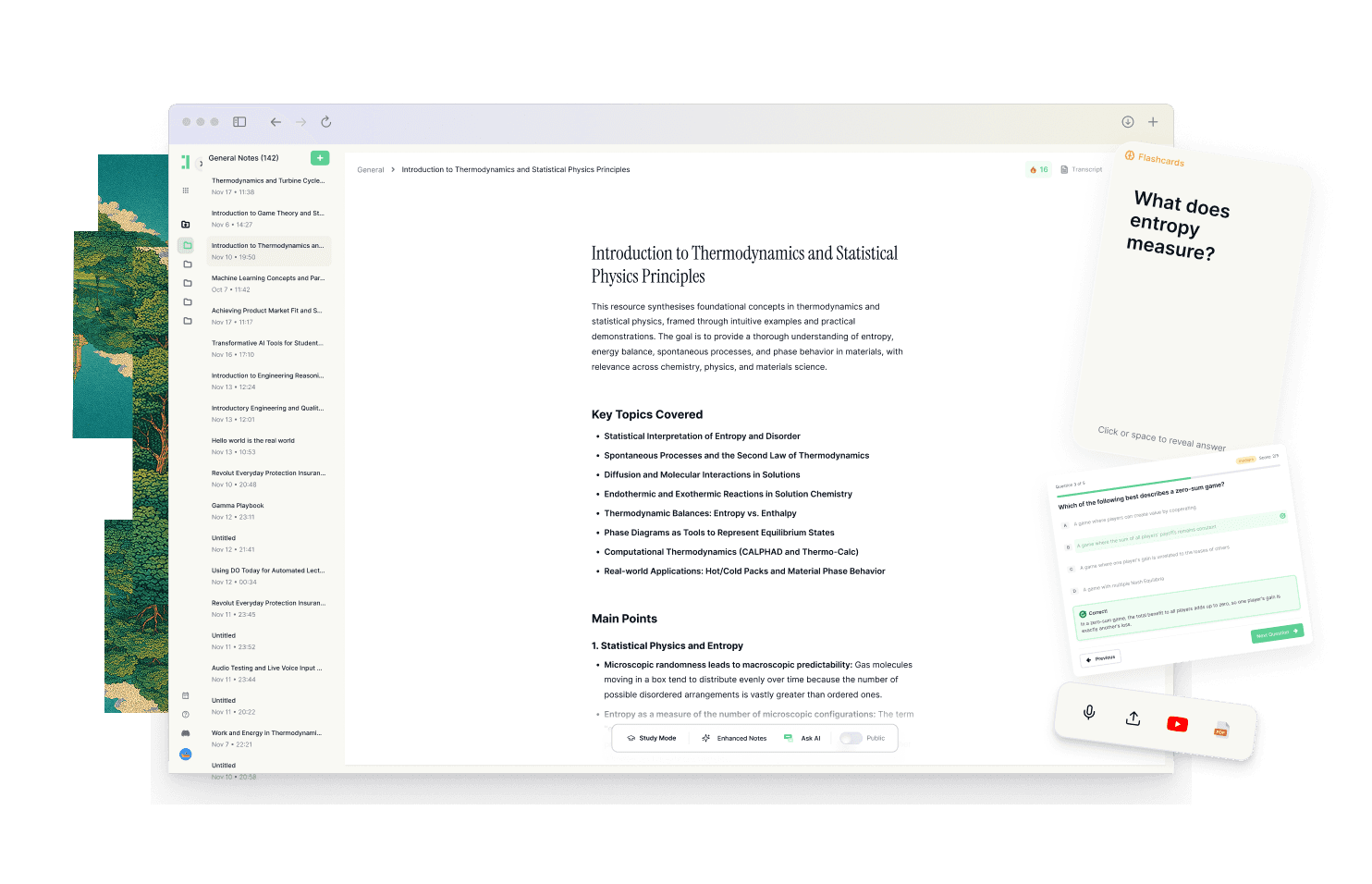
Duetoday is designed as a unified learning workspace that focuses on the entire lifecycle of a piece of information, from the first time you hear it in a lecture to the moment you recall it during an exam. Unlike a search engine, Duetoday acts as your personal AI brain. You can upload lecture recordings and get instant transcriptions, upload PDFs, and import YouTube links or Notion pages. This creates one place that holds everything you learn, ensuring your study sessions are grounded in your actual curriculum rather than generic web data.
Once your materials are in the system, Duetoday turns that raw content into structured study outputs. Instead of just giving you an answer, it helps you generate summaries, cheatsheets, and comprehensive study guides. It bridges the gap between passive reading and active recall by automatically generating flashcards and quizzes directly from your sources. If you have a question, the built-in AI tutor answers based specifically on what you have uploaded, keeping your materials connected to the source so your studying never feels disconnected from the lecture or reading.
Beyond just organizing content, Duetoday functions as an execution layer. It connects with Google Calendar to align your study plans with your real-world deadlines and schedule. It essentially reduces fragmentation by bringing learning inputs and study outputs into one cohesive workflow. Features like the AI-generated task list and the ability to see exactly where an answer came from in your transcript make the path to mastery clear. It is a system built for mixed-media learning that helps make the next right action obvious every time you sit down to work.
How the Duetoday workflow feels in real life
Imagine it is Monday afternoon and you just finished a complex biology lecture. Instead of letting that recording sit in your phone, you upload it to Duetoday. By the time you’ve walked to the library, the audio is transcribed and a structured set of notes is waiting for you. You realize you didn't quite catch a detail about cellular respiration, so you ask the AI tutor to explain it using only the professor's slides and the lecture transcript. The answer is precise and includes a reference to the exact minute in the audio where it was discussed.
As the weekend approaches, you don't have to start from scratch to prepare for your Monday quiz. You click a button to generate twenty flashcards based on that specific lecture. On Sunday night, you check your integrated Google Calendar, and Duetoday shows you exactly which topics you haven't reviewed yet. You spend thirty minutes on a practice quiz, see your progress, and go to bed knowing exactly where your knowledge gaps are. The entire process—from hearing the lecture to passing the quiz—happens in one workspace without ever losing the context of your original materials.
Duetoday vs Perplexity in plain English
The difference between the two tools comes down to their fundamental purpose. Perplexity is a tool for finding; Duetoday is a tool for knowing. Perplexity has a very low setup time because you just type a question and get an answer, much like using a better version of Google. However, this ease of use comes with a shallow learning curve that doesn't actually lead to deep retention. Duetoday requires you to bring your own materials—your lectures, your PDFs—but in return, it provides a structured environment that is specifically tuned for academic success.
When it comes to exam preparation, the distinction is clear. Perplexity can help you research a topic for an essay, but it cannot help you memorize the three hundred terms you need for a medical board exam. Duetoday’s support for mixed-media, such as audio transcriptions and YouTube processing, makes it a much more robust partner for the modern student's daily routine. While Perplexity is excellent for the "what," Duetoday is built for the "how" and the "why" of consistent, long-term learning.
Who should choose Duetoday
Duetoday is the ideal choice for university students who are overwhelmed by the sheer volume of fragmented materials they have to manage. If your desktop is littered with PDFs, your phone is full of lecture recordings, and you have dozens of browser tabs open with YouTube tutorials, you need a system like Duetoday. It is for the learner who has a deadline-driven schedule and needs to ensure that every hour spent studying actually translates into retention and exam readiness.
It is also perfect for those who want a structured path. If you struggle with knowing what to study next, Duetoday’s ability to turn materials into actionable tasks and align them with a calendar makes the workflow repeatable and reliable. It is for the student who wants their AI to be a tutor that understands their specific syllabus, not just a search engine that knows the public internet.
Who should still choose Perplexity
Perplexity remains the superior choice for researchers and generalists who need to pull information from a wide variety of public sources quickly. If you are a "builder" or a long-term research vault creator who values the ability to browse the latest global data with citations, Perplexity’s search capabilities are hard to beat. It is also the better tool for users who prioritize privacy-focused, local-first search experiences over integrated study workflows and do not need flashcard generation or lecture transcription tools.
Verdict
The choice between these two platforms is a choice between a storage vault and a study system. Perplexity is a brilliant engine for discovery and information storage, but Duetoday is a unified workspace designed to solve the fragmentation of modern learning. If your goal is to bridge the gap between having a pile of notes and actually mastering the material for an exam, Duetoday provides the retention-first workflow that a generic AI search engine simply cannot match.
FAQ
Is Duetoday only flashcards and quizzes?
No, Duetoday is a full learning workspace that includes audio transcription, AI-powered summaries, and a context-aware tutor chat. While it generates flashcards and quizzes for active recall, it also serves as a central hub for all your lecture notes, PDFs, and research materials.
Does Duetoday work for lectures and YouTube?
Yes, Duetoday is specifically designed to handle mixed-media inputs like lecture recordings and YouTube links. It can transcribe audio and parse video content, allowing you to create study guides and ask questions based directly on those sources.
Will it help reduce cramming?
By integrating with your Google Calendar and breaking your materials down into actionable task lists, Duetoday helps you stay on top of your work throughout the semester. The system encourages consistent review and practice, which naturally leads to better retention and less reliance on last-minute cramming.
Can I still use Notion or Google Calendar?
Absolutely. Duetoday is built to work alongside your existing tools, allowing you to import content from Notion and sync your study schedule with Google Calendar. This ensures that your academic life is coordinated and that your study sessions fit into your real-world time constraints.
Who is Perplexity still best for?
Perplexity is still the best tool for students who need to perform broad, external web research or find quick, cited answers to general knowledge questions. It remains a powerful assistant for the initial stages of research papers where you need to discover new publicly available sources and data points.
Choosing the right tool depends on whether you need to find more information or finally master the information you already have.
Read More Alternative To Comparison
Turn lectures, PDFs, and notes into AI-Powered summaries, bite-sized
courses, flashcards, quizzes, and study plans.