Best Miro Alternatives in 2026 [For Students/Teachers]
Looking for a Miro alternative? Compare Duetoday vs Miro to see why students are switching from infinite whiteboards to a structured, AI-powered study system.
Why people look for a Miro alternative
Miro has become a staple in the academic world for its infinite canvas and collaborative whiteboard features. Many students initially turn to it to map out complex topics, visualize historical timelines, or brainstorm essay structures. However, the very thing that makes Miro powerful—its lack of boundaries—often becomes its biggest drawback for individual learners. Students find themselves spending hours perfecting the aesthetics of a board, meticulously aligning boxes and arrows, which can lead to productive procrastination. When exam season approaches, these learners realize that while they have a beautiful visual map, they don't actually have a system for retaining that information or practicing active recall.
Quick verdict
At-a-glance:
Best for building a knowledge vault: Miro
Best for a real study system: Duetoday
Best if you want both: Use Miro for creative brainstorming, Duetoday for retention and planning
What Miro is great at
Miro is an exceptional tool for visual thinkers who need to see the big picture. It excels at collaboration, allowing multiple users to brainstorm in real-time on a digital whiteboard that never runs out of space. For students, it is great for high-level planning, creating complex mind maps, and organizing visual research. The platform offers a vast array of templates that make it easy to start a project, and the drag-and-drop interface is intuitive for anyone who has used a physical whiteboard. It is a world-class choice for design thinking and creative projects where the relationship between ideas is best expressed through spatial arrangement and visual cues.
Where Miro breaks for students on deadlines
The challenge with Miro arises when the focus shifts from exploration to examination readiness. Students often fall into the trap of the "infinite canvas rabbit hole," spending more time on the layout of their notes than on actual cognitive processing. Because Miro is primarily a visual vector tool, it often struggles to handle fragmented study materials like hour-long lecture recordings, multi-page PDFs, and YouTube tutorials in a way that leads to direct learning. There is a significant disconnect between a visual map and the daily grind of memorizing facts or practicing problem-solving. When a deadline is forty-eight hours away, a giant whiteboard of colorful sticky notes doesn't offer a structured path to mastery; it often adds to the feeling of being overwhelmed by the sheer volume of unstructured information.
What Duetoday does instead
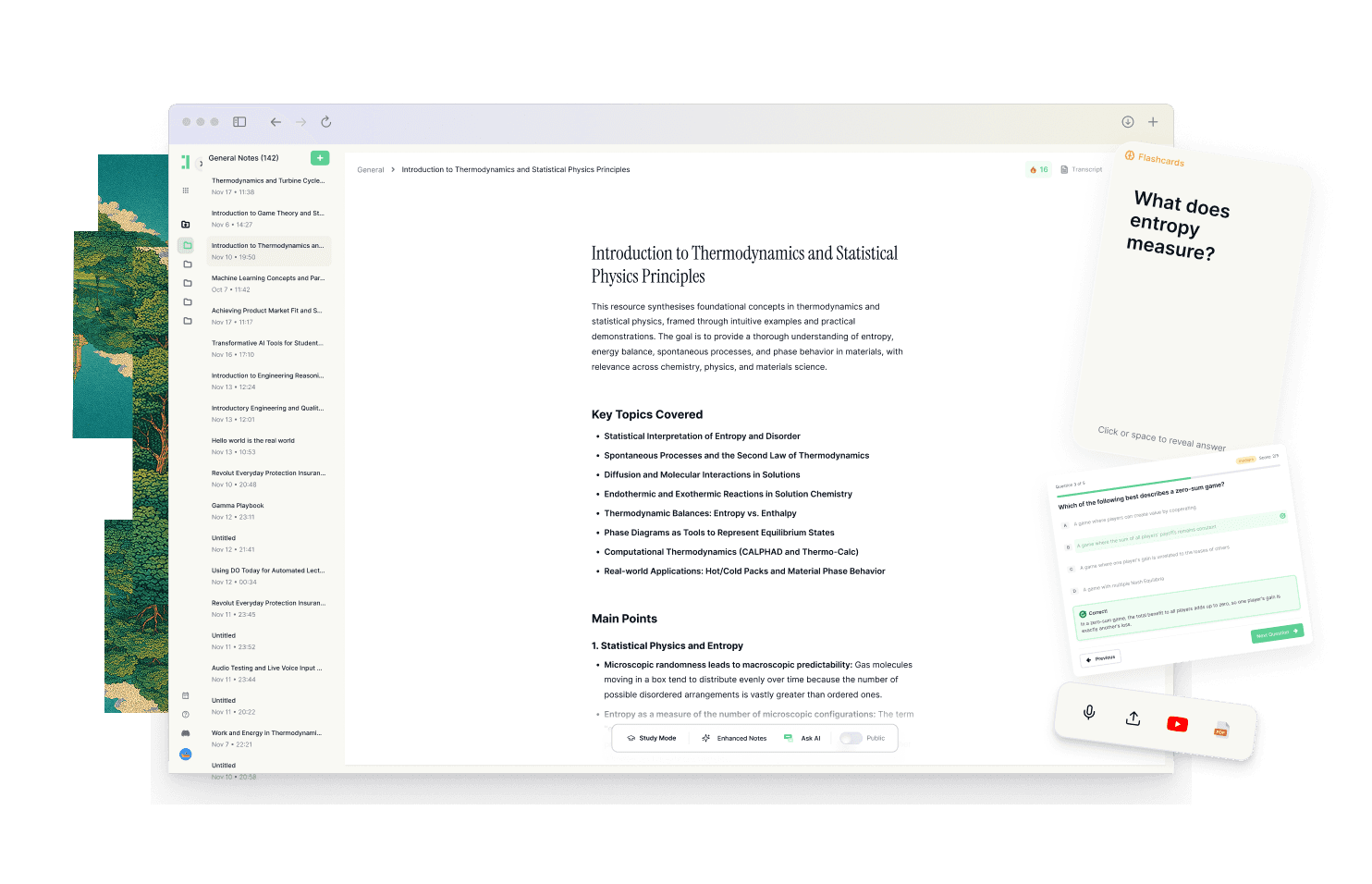
Duetoday approaches learning not as a visual design project, but as a unified system designed for retention and execution. Instead of an empty canvas, it provides a centralized workspace where all your inputs—lectures, PDFs, YouTube videos, and websites—live together. You can upload lecture recordings to get instant transcriptions and then turn that raw data into structured study outputs like summaries and cheatsheets. The system is designed to convert information into action, bridging the gap between "having the notes" and "knowing the material."
The core of Duetoday is its ability to generate active recall tools directly from your content. It uses AI to create flashcards and quizzes grounded in your specific materials, ensuring that your study sessions are high-impact. Unlike generic AI, the Duetoday AI chat answers questions based on the context of your uploaded files, so it understands exactly what your professor emphasized. It integrates with Google Calendar to align your study blocks with your actual life, ensuring that your to-do lists are realistic and tied to your deadlines. It is a system built to make the next right action obvious, taking the guesswork out of what to study next.
How the Duetoday workflow feels in real life
Imagine it is Monday afternoon and you just finished a heavy lecture. Instead of manually drawing a mind map, you upload the recording and your professor's PDF slides into Duetoday. By the time you’ve grabbed a coffee, the system has transcribed the audio and generated a structured set of notes. You spend twenty minutes reviewing the AI-generated summary and asking the tutor chat to explain a specific difficult concept. On Wednesday, you use the auto-generated flashcards to test yourself between classes. As the exam approaches on Friday, you don't panic. Your Google Calendar shows your study blocks, and Duetoday has already prepared a practice quiz based on the week’s materials. You aren't hunting for information; you are simply executing a plan that was built for you automatically.
Duetoday vs Miro in plain English
Miro is built for the "build" phase of learning—where you are trying to see how things connect. However, the setup time can be significant, and the learning curve for advanced features can distract from the actual subject matter. Duetoday is built for the "retention" phase. It requires almost zero setup time because it automates the organization of your materials. While Miro handles text and images well, Duetoday is significantly better at managing mixed-media like audio and video, turning them into readable and searchable data instantly.
In a daily routine, Miro acts as a storage vault that requires manual maintenance. Duetoday acts as an engine that drives you forward. If you have a massive amount of fragmented information and a strict deadline, Duetoday’s ability to generate study guides and action items provides a level of clarity that an infinite whiteboard simply cannot match. Miro helps you see the information; Duetoday helps you own it.
Who should choose Duetoday
Duetoday is the ideal choice for university students who are lecture-heavy and deadline-driven. If you find yourself overwhelmed by PDFs, YouTube links, and scattered notes, and you need a way to consolidate them quickly, this tool is for you. It is for the learner who values structure over creative freedom and who wants to spend their time practicing active recall rather than formatting arrows and boxes. If you need your study system to tell you exactly what to do next to prepare for an exam, Duetoday is the better fit.
Who should still choose Miro
Miro remains the superior choice for students involved in long-term research projects, group brainstorming, or design-heavy disciplines like architecture or UX design. If you are a "builder" who enjoys the process of mapping out complex relationships and you don't mind the time it takes to organize a visual vault, Miro offers a level of creative flexibility that a structured system does not. It is also the go-to for privacy-focused users who want a simple, local-first style of visual organization.
Verdict
The choice between Miro and Duetoday comes down to whether you need a library or a coach. Miro is a beautiful, infinite library where you can store and map information, but it leaves the heavy lifting of memorization and planning to you. Duetoday is a unified study system that takes your materials and transforms them into a repeatable retention loop, ensuring you move from fragmentation to exam readiness without the friction of manual organization.
FAQ
Is Duetoday only flashcards and quizzes? No, it is a complete learning workspace. While it generates flashcards and quizzes for active recall, it also handles lecture transcription, PDF organization, and AI-powered tutoring based on your specific study materials.
Does Duetoday work for lectures and YouTube? Yes, it is designed specifically for mixed media. You can upload lecture recordings for transcription or paste YouTube links to have the AI process the content and integrate it into your study brain.
Will it help reduce cramming? Yes, by integrating with your Google Calendar and generating bite-sized study tasks, Duetoday helps you spread your learning out. The action items and study modes are designed for consistent, daily retention rather than last-minute sessions.
Can I still use Notion or Google Calendar? Absolutely. Duetoday integrates with Notion as a content source and connects to Google Calendar so your study plan respects your real-world schedule and deadlines.
Who is Miro still best for? Miro is still the best tool for collaborative brainstorming and visual thinkers who need an infinite canvas for long-term research projects or creative design work where spatial organization is a priority.
Final closing line. Choosing the right tool ensures your study time is spent learning the material rather than just managing the notes.
Read More Alternative To Comparison
Turn lectures, PDFs, and notes into AI-Powered summaries, bite-sized
courses, flashcards, quizzes, and study plans.