Best MindMeister Alternatives in 2026 [For Students]
Searching for a MindMeister alternative? Learn why Duetoday is the better choice for students who need a unified study system rather than just a mind map tool.
Why people look for a MindMeister alternative
Many students and lifelong learners start using MindMeister to visualize complex topics and organize their thoughts during lectures. It is a powerful tool for brainstorming and seeing the big picture. However, as the semester progresses, the limitations of a pure mind-mapping tool become apparent. Students often find themselves with beautiful diagrams that exist in a vacuum, disconnected from their actual lecture recordings, PDFs, and exam preparation workflows.
The search for an alternative usually stems from the need for more than just a canvas. While mind maps help with the initial understanding of a topic, they do not automatically handle the heavy lifting of active recall or scheduling. When users realize they are spending more time formatting nodes and colors than actually committing information to memory, they begin looking for a system that integrates their learning materials with actionable outputs.
Quick verdict
At-a-glance:
Best for building a knowledge vault: MindMeister
Best for a real study system: Duetoday
Best if you want both: Use MindMeister for initial brainstorming, Duetoday for retention and planning
What MindMeister is great at
MindMeister excels at its core promise: collaborative mind mapping. It provides an intuitive, web-based interface that allows users to create fluid, hierarchical diagrams easily. This is incredibly useful for the early stages of a project or the beginning of a complex course where you need to see how various sub-topics relate to one another. The visual nature of the tool helps in breaking down a massive subject into manageable branches, making the information feel less intimidating.
The platform is also highly effective for group work. Multiple users can contribute to a single map in real-time, which is a significant advantage for collaborative study groups or team-based academic projects. Its integration with other task management tools and its clean aesthetic make it a top-tier choice for those who think purely in spatial and visual terms. For many, it serves as a reliable digital whiteboard where ideas can grow without the constraints of a standard document format.
Where MindMeister breaks for students on deadlines
The primary issue for students is that MindMeister often leads to productive procrastination. It is easy to spend hours perfecting the layout of a mind map while the actual exam material remains unlearned. When a deadline is approaching, a visual map does not necessarily translate into exam readiness. It requires the student to manually convert those ideas into study notes or flashcards, adding another layer of friction to an already stressful period.
MindMeister also struggles with modern, mixed-media learning workflows. Most students today deal with a fragmented ecosystem of lecture recordings, long PDFs, YouTube tutorials, and web articles. MindMeister is not designed to ingest a two-hour lecture recording or a fifty-page research paper and turn it into something useful. It remains a place where you store thoughts you have already processed, rather than a system that helps you process the raw information in the first place. When time is tight, the manual effort required to bridge the gap between a map and a memorized concept is often too high.
What Duetoday does instead
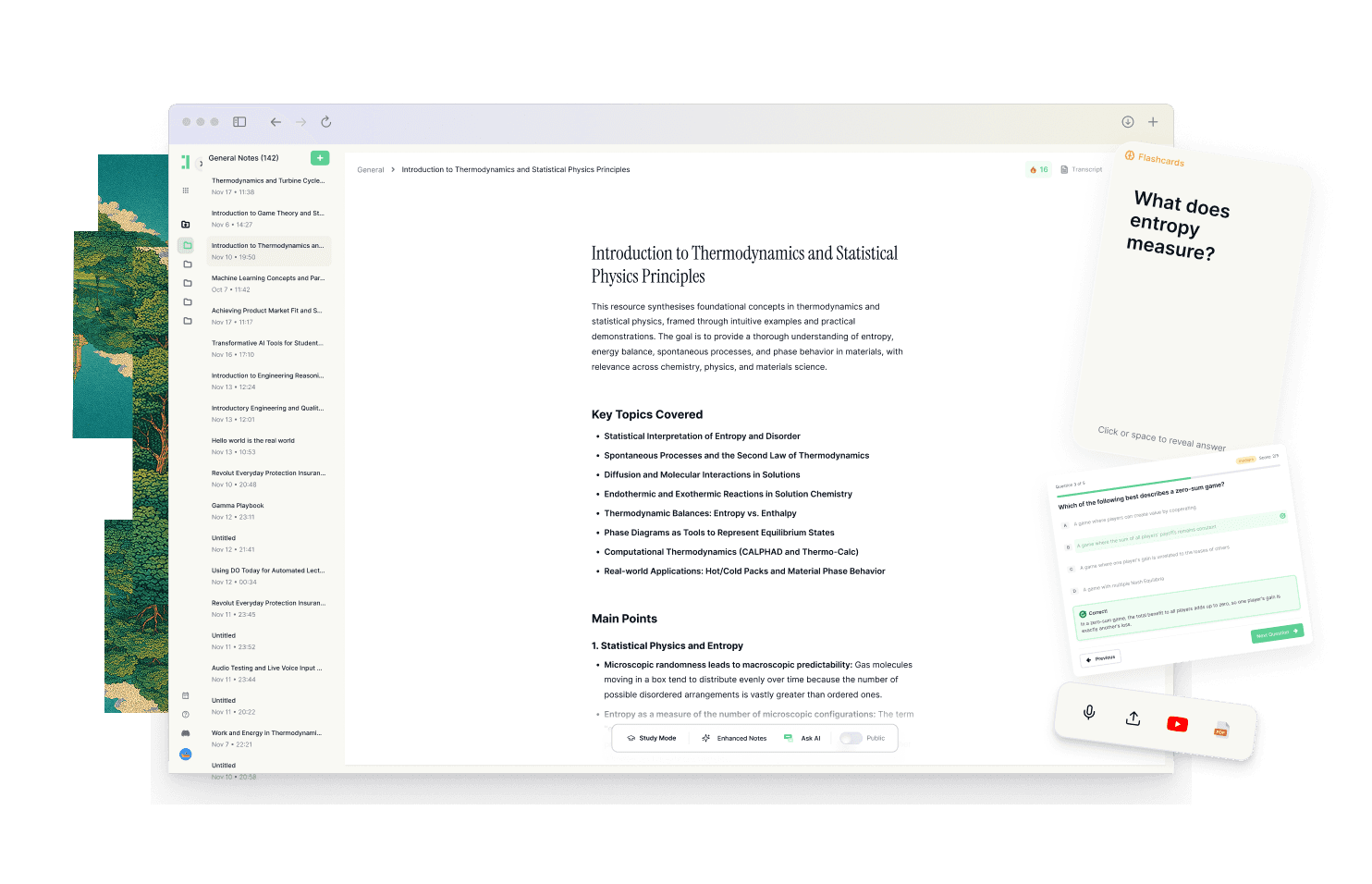
Duetoday approaches learning as a unified workflow rather than a static visual exercise. It acts as a single location for everything you learn, whether that is a recorded lecture, a PDF textbook, a YouTube video, or a set of notes from Notion. Instead of starting with a blank canvas and manual input, you can upload your source material directly. Duetoday can transcribe lecture recordings and parse complex PDFs, ensuring your study materials are grounded in the actual content provided by your instructors.
The system transforms this raw content into structured outputs like summaries, cheatsheets, and study guides. While it can generate mind maps to help you visualize hierarchies, it goes further by creating active recall tools such as flashcards and quizzes directly from your sources. The AI tutor is context-aware, meaning you can ask questions about a specific lecture or paper and get answers based on those materials, not generic web data. This keeps the learning process connected to the source, reducing the fragmentation that usually happens when switching between a mapping tool and a textbook.
Beyond content processing, Duetoday integrates with your actual life. It connects with Google Calendar to align your study blocks with your real deadlines. By bringing learning inputs and retention outputs into one environment, it makes the next right action obvious. You aren't just looking at a map of what you need to know; you are engaging with a system that tells you what to practice and when, ensuring that your study time actually leads to long-term retention.
How the Duetoday workflow feels in real life
On a typical Monday after a heavy lecture, a student might upload the audio recording and the professor's slide deck into Duetoday. While they grab a coffee, the system transcribes the lecture and generates a concise summary and a set of practice questions. Instead of spending two hours manually drawing a mind map of the lesson, the student reviews the AI-generated version to check their understanding. Before an exam, they use the generated flashcards to test their recall, with the AI tutor available to explain difficult concepts in simpler steps. This turns a week of chaotic note-taking into a repeatable process where the path from first exposure to mastery is clear and automated.
Duetoday vs MindMeister in plain English
The fundamental difference between these two tools lies in their purpose. MindMeister is a creative tool for visualization, while Duetoday is a productivity tool for retention. MindMeister requires a significant amount of manual setup and artistic effort to make a map useful. Duetoday, on the other hand, prioritizes speed and utility by automating the conversion of raw materials into study-ready formats. For a student on a deadline, the learning curve of mastering a complex mapping tool is often an obstacle, whereas Duetoday is built to be used immediately.
When it comes to mixed-media support, MindMeister is primarily text-based with some ability to attach files. Duetoday is built from the ground up to handle video, audio, and large documents as primary citizens. This makes a massive difference when you are trying to study for a course that relies heavily on YouTube tutorials or recorded seminars. While MindMeister is excellent for long-term research vaults where you have the time to curate every connection, Duetoday is designed for the high-velocity environment of university life where information needs to be processed and memorized quickly.
Who should choose Duetoday
Duetoday is the ideal choice for university students and self-learners who face a constant stream of new information and strict deadlines. If your study material is spread across different formats like PDFs and videos, and you feel overwhelmed by the task of organizing it all, Duetoday provides the structure you need. It is for the person who wants to spend less time organizing and more time learning, ensuring that the work they do today actually stays in their head for the exam.
Who should still choose MindMeister
MindMeister remains the better option for professional designers, project managers, or researchers who need a high degree of control over the visual aesthetics of their knowledge maps. If your primary goal is brainstorming new ideas from scratch or collaborating on a broad visual strategy with a team, the flexibility of a dedicated mind-mapping tool is hard to beat. It is for those who prioritize the spatial relationship of ideas over the automated generation of study materials.
Verdict
The choice between these tools comes down to whether you need a knowledge vault or a study system. MindMeister is a beautiful way to store and visualize what you already know, but Duetoday is a unified workspace designed to help you master what you don't know yet through automation and active recall.
FAQ
Is Duetoday only flashcards and quizzes?
No, Duetoday is a complete learning workspace that handles your entire workflow from raw input to mastery. While it generates flashcards and quizzes for retention, it also provides transcriptions, summaries, AI tutoring, and task management to keep your studies organized.
Does Duetoday work for lectures and YouTube?
Yes, Duetoday is designed specifically to handle mixed media by allowing you to upload lecture recordings or paste YouTube links. It then processes these inputs into transcripts and study notes so you can learn from video and audio as easily as from text.
Will it help reduce cramming?
Duetoday helps reduce cramming by creating a consistent study loop and integrating with your calendar. By breaking down large materials into manageable study outputs and scheduling review sessions, it encourages steady progress rather than last-minute sessions.
Can I still use Notion or Google Calendar?
Yes, Duetoday is designed to work alongside your existing tools rather than forcing you to abandon them. You can import content from Notion to use as a source for your AI brain, and connect Google Calendar to align your study tasks with your real-world schedule.
Who is MindMeister still best for?
MindMeister is still the best choice for users who need advanced visual brainstorming and real-time collaborative map building. It remains a top-tier tool for people who want to manually curate complex diagrams and prioritize spatial organization over automated study features.
Choosing the right tool is about finding the balance between how you think and how you need to perform.
Read More Alternative To Comparison
Turn lectures, PDFs, and notes into AI-Powered summaries, bite-sized
courses, flashcards, quizzes, and study plans.