
Best Logseq Alternatives in 2026 [For Students]
Frustrated with Logseq's complexity? Discover why Duetoday is the best alternative for students who need a unified study system for lectures, PDFs, and YouTube.
Why people look for a Logseq alternative
Logseq is a powerful tool for networked thought, but many university students find themselves hitting a wall when the semester gets intense. While the local-first, privacy-focused nature of Logseq is appealing, the friction of setting up the perfect workflow often leads to productive procrastination. Students spend hours tweaking plugins, learning advanced queries, and organizing backlinked nodes instead of actually studying the material. When deadlines approach, the time spent maintaining a graph of notes doesn't always translate into exam readiness or information retention.
Another common pain point is the fragmentation of materials. Logseq is primarily a text-based outliner. For a student juggling lecture recordings, massive PDF textbooks, and YouTube tutorials, Logseq requires a lot of manual heavy lifting to integrate these media types. Users often find themselves searching for a tool that moves beyond mere storage and graph-view aesthetics. They need a system that actively helps them process information and prepares them for the pressure of a real-world testing environment without the steep learning curve of a developer-centric tool.
Quick verdict
Best for building a knowledge vault: Logseq
Best for a real study system: Duetoday
Best if you want both: Use Logseq for long-term research and personal archives, and use Duetoday for active course retention and exam planning.
What Logseq is great at
Logseq excels as a privacy-first, open-source knowledge management tool. Its core strength lies in its block-based outliner structure, which allows users to create deeply nested thoughts that are automatically linked through bidirectional references. This makes it an incredible choice for users who want to see the hidden connections between disparate ideas over a long period. Since it stores files locally in Markdown, users have full ownership of their data, ensuring that their intellectual property remains offline and secure.
The community-driven ecosystem is another highlight. Logseq has a dedicated following that builds plugins for everything from flashcards to specialized PDF annotation. For the tinkerer who enjoys building their own personalized productivity environment from the ground up, Logseq offers a level of flexibility that few other tools can match. It is a fantastic home for researchers and writers who need a digital garden where ideas can grow slowly and organically without the distractions of a traditional folder structure.
Where Logseq breaks for students on deadlines
The primary issue for students is that Logseq can become a rabbit hole of organization. While the graph view looks beautiful, it doesn't necessarily mean you understand the content well enough to pass an exam. Students often fall into the trap of "digital hoarding," where they link hundreds of blocks but never engage in the active recall necessary for learning. When a deadline is forty-eight hours away, the manual process of creating queries or organizing links feels like a luxury that busy students simply do not have.
Furthermore, Logseq’s focus on text-based outlining struggles with the mixed-media reality of modern education. Transcribing a lecture recording or extracting key insights from a 50-page PDF requires third-party plugins or external tools, creating a fragmented workflow. Moving between a video player, a PDF reader, and a Markdown editor breaks focus. For students who need to move from raw lecture data to a structured study guide in one sitting, the friction of Logseq’s manual architecture becomes a significant hurdle to efficiency.
What Duetoday does instead
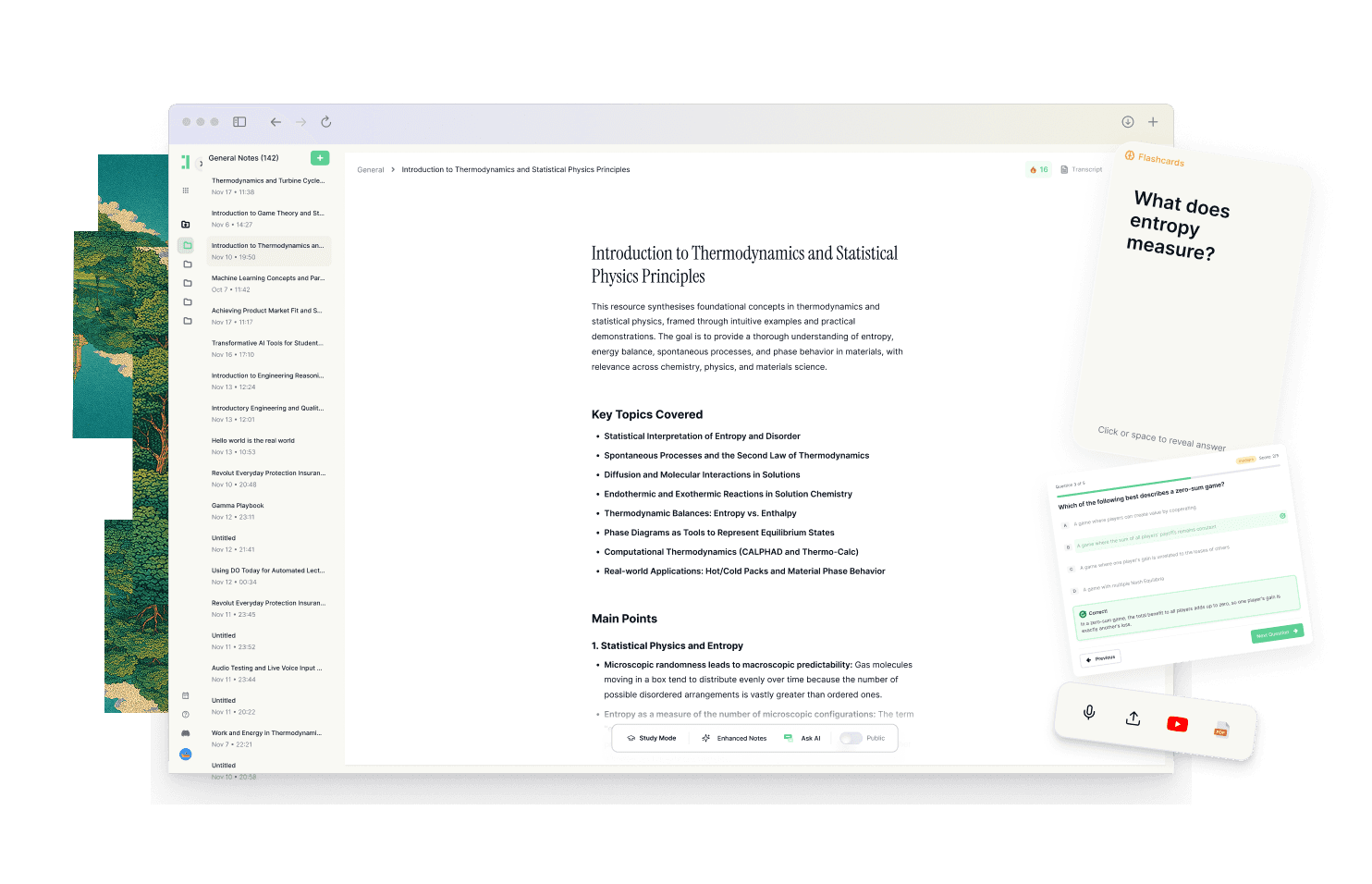
Duetoday is designed as a unified learning workspace that prioritizes retention over mere note storage. Instead of requiring you to build the system, Duetoday provides a structured environment where one place holds everything you learn. You can upload lecture recordings and receive instant transcriptions, or import PDFs, YouTube links, and websites directly into your library. This brings all your fragmented learning inputs into a single workflow, keeping your study materials connected to their original sources so your notes never lose their context.
Once your content is in the system, Duetoday turns raw information into structured study outputs. It can generate summaries, cheatsheets, and comprehensive study guides automatically. To ensure you actually remember what you read, the platform generates active recall tools like flashcards and quizzes based strictly on your uploaded materials. If you find a concept confusing, you can converse with an AI tutor that answers questions using your specific course content rather than generic internet data. This reduces the cognitive load of organizing and lets you focus entirely on mastery.
The execution layer of Duetoday is built for the reality of student life. It connects with Google Calendar to align your study plans with your actual deadlines and scheduled blocks. This makes the next right action obvious, turning a mountain of lectures into a repeatable routine. By integrating with tools like Notion and supporting mixed-media learning, Duetoday bridges the gap between having the information and actually knowing it. It transforms your lecture notes from a static archive into a dynamic, interactive study loop.
How the Duetoday workflow feels in real life
Imagine it is Monday afternoon and you have just finished a complex biology lecture. Instead of spending an hour formatting an outline, you simply upload the audio recording and the professor’s slide deck to Duetoday. By the time you have finished your coffee, the system has transcribed the audio and connected it to the PDF. You ask the AI tutor to explain the most difficult concept mentioned at the twenty-minute mark, and it gives you a simplified breakdown grounded in the professor's own words. The system then prompts you with a set of practice questions to test your initial understanding.
As the weekend approaches, you don't need to hunt through folders to see what you need to review. Your Google Calendar syncs with your tasks, showing you exactly which subjects need attention. You spend thirty minutes going through AI-generated flashcards that were culled directly from your week’s lectures. By the time the mid-term exam arrives, you aren't staring at a massive graph of interconnected notes wondering where to start. You have already engaged with the material through quizzes and summaries, meaning your study time was spent practicing rather than just organizing.
Duetoday vs Logseq in plain English
The difference between the two tools comes down to the intended outcome. Logseq is built for the long-term builder who wants to map out their brain over several years. It requires a significant setup time and a willingness to learn a specific syntax to get the most out of it. It is a brilliant tool if the goal is to store information for a lifetime, but it often lacks the urgency and structured output required for a fast-paced academic semester.
Duetoday, by contrast, is a retention-first system that minimizes setup time so you can start learning immediately. It handles mixed-media—like video and audio—much more natively than Logseq’s markdown-heavy environment. While Logseq expects you to find the connections yourself, Duetoday uses AI to help surface those connections and turn them into practice tools. For a student, this means less time spent "working on the tool" and more time spent actually preparing for exams.
Who should choose Duetoday
Duetoday is the ideal choice for university students and self-learners who are overwhelmed by the volume of information they need to process. If your learning involves a mix of lecture recordings, long PDFs, and YouTube tutorials, you will benefit from the unified workspace that brings these inputs together. It is for the person who wants a clear, actionable path toward exam readiness and values active recall over aesthetic note-taking.
This platform also serves those who need help with execution and planning. If you struggle with knowing what to study next or how to break down a large syllabus, Duetoday’s integration with your calendar and its ability to generate task lists will provide the structure you need. It is for the learner who wants to spend their energy on understanding concepts rather than managing a complex database.
Who should still choose Logseq
Logseq remains the superior choice for users who prioritize total data privacy and local-first storage. If you are a researcher or a hobbyist who enjoys the process of building a knowledge graph and wants to maintain a permanent archive of your thoughts in Markdown, Logseq is unmatched. It is perfect for those who have the time to tinker with plugins and prefer a text-only, outliner-focused workflow without the intervention of built-in AI tools.
Verdict
The choice is between a knowledge vault and a study system. Logseq is a world-class vault for storing and linking ideas over time, but it requires the user to do the heavy lifting of organization and retention. Duetoday is a unified study system that automates the transition from raw content to remembered knowledge, replacing fragmented tools and manual workflows with a single, retention-focused loop that is tailor-made for students with deadlines.
FAQ
Is Duetoday only flashcards and quizzes? No, Duetoday is a complete learning workspace. While it creates flashcards and quizzes to help with retention, it also provides transcription, summarizes large documents, offers an AI tutor for complex questions, and integrates with your calendar for total task management.
Does Duetoday work for lectures and YouTube? Yes, it is built specifically to handle these formats. You can upload audio or video recordings of lectures for transcription and import YouTube links to be processed alongside your other notes and PDFs.
Will it help reduce cramming? By transforming your notes into bite-sized practice tools and syncing with your calendar, Duetoday encourages consistent, daily review. This builds long-term memory and makes the "next right action" obvious, which naturally replaces the need for last-minute cramming sessions.
Can I still use Notion or Google Calendar? Yes, Duetoday is designed to complement these tools. You can use Notion as a source for your materials and connect Google Calendar to ensure your study tasks are aligned with your actual daily schedule.
Who is Logseq still best for? Logseq is still the best option for privacy-conscious users who want a localized, permanent archive of their thoughts. It is ideal for long-term researchers who prefer an outliner interface and enjoy the process of manually building a networked database.
Duetoday provides the structured workflow and active recall tools needed to turn fragmented notes into actual knowledge mastery.
Read More Alternative To Comparison
Turn lectures, PDFs, and notes into AI-Powered summaries, bite-sized
courses, flashcards, quizzes, and study plans.