Best Knowt Alternatives in 2026 [For Students]
Discover why Duetoday is the top alternative to Knowt for students who need a unified study system. Learn how to transform lectures and PDFs into active recall tools.
Why people look for a Knowt alternative
Many students initially turn to Knowt because it offers a modern take on digital flashcards and easy imports from Quizlet. However, as the semester progresses and the volume of information increases, common frustrations begin to surface. Users often find themselves managing a fragmented workflow where their primary learning materials, like lecture recordings and research PDFs, exist in one place while their study tools live in another. This disconnect forces students into a cycle of manual copying and pasting, which consumes valuable time that should be spent actually learning. People search for an alternative because they realize that having digital flashcards is only one small part of the academic success equation.
Another reason for seeking an alternative is the desire for a more integrated experience that handles complex media. While Knowt is efficient for text-based flashcards, it often struggles to bridge the gap between a raw ninety-minute lecture recording and the final exam preparation phase. Students feel overwhelmed by the need to juggle multiple tabs for YouTube, PDF readers, and note-taking apps. They eventually look for a solution that does not just store facts but actively helps them synthesize those facts into a coherent understanding of the subject matter. They want a system that moves as fast as their curriculum does.
Quick verdict
At-a-glance:
Best for building a knowledge vault: Knowt
Best for a real study system: Duetoday
Best if you want both: Use Knowt for quick vocab drilling, Duetoday for deep retention and lecture-to-exam planning
What Knowt is great at
Knowt has earned its reputation as a powerful tool for students who prioritize active recall through testing. One of its greatest strengths is its ability to turn formatted notes into practice questions almost instantly. It bridges the gap for users moving away from older platforms by providing a familiar interface and a seamless way to import existing study sets. For students who already have a well-organized set of notes, Knowt acts as an excellent finishing school where those notes are converted into a library of flashcards and practice exams.
The platform is also highly regarded for its accessibility and gamified feel, which helps lower the barrier to starting a study session. By focusing heavily on the testing phase of studying, it ensures that students aren't just passively reading their highlights. It provides a structured environment for self-assessment, making it a reliable companion for subjects that require heavy memorization, such as vocabulary, anatomy, or basic law concepts. It is a focused tool that knows exactly what it wants to be: a better way to test yourself on what you have already written down.
Where Knowt breaks for students on deadlines
The primary breakdown occurs when a student is faced with a mountain of unorganized source material and a deadline that is only days away. Knowt relies heavily on the student having already processed their information into a note-like format. When you have three weeks of recorded lectures, ten unread PDFs, and several YouTube tutorials to get through, the manual overhead of getting that data into Knowt becomes a bottleneck. Students often fall into the trap of productive procrastination, spending hours formatting notes just so the flashcard generator works correctly, rather than actually engaging with the concepts.
Furthermore, Knowt can feel fragmented when your study process involves mixed media. If you are learning from a complex technical lecture or a data-heavy research paper, a simple flashcard deck might not be enough to grasp the underlying logic. The platform doesn't inherently connect your practice questions back to the specific moment in a video or the specific paragraph in a PDF where that information originated. This lack of context makes it difficult to clear up confusion when you get a practice question wrong. Deep learning requires a loop of theory and practice, and when those two are separated, the system breaks under the pressure of a looming exam.
What Duetoday does instead
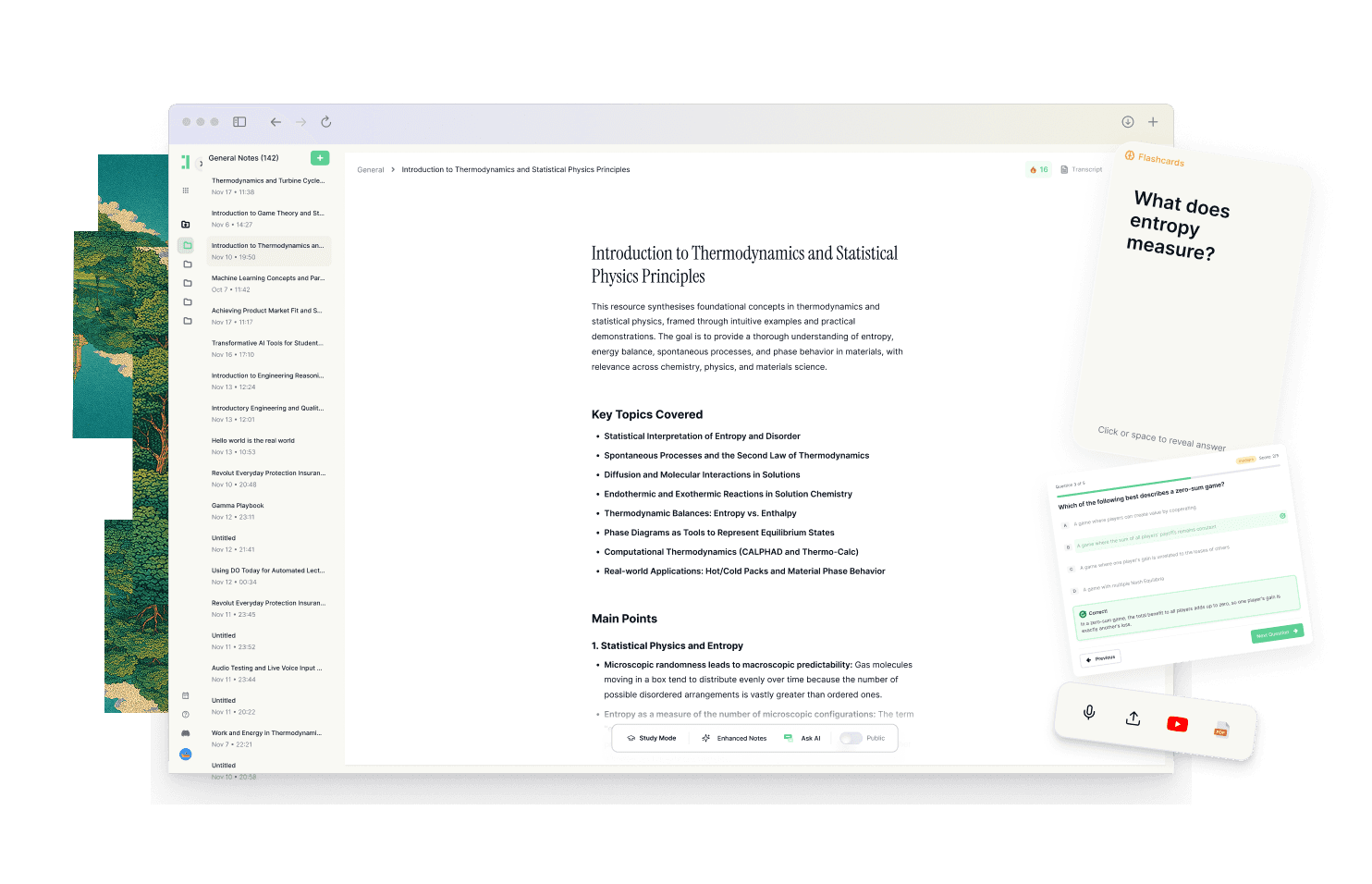
Duetoday functions as a unified learning workspace designed to eliminate the friction between receiving information and mastering it. Instead of being a secondary destination where you go after you’ve taken notes, Duetoday is where the entire learning process happens. It acts as a single place that holds everything you learn, including lectures, PDFs, YouTube videos, and websites. By uploading a lecture recording, you get a full transcription and can immediately start working with the content. This approach ensures that your studying is never disconnected from the original source, allowing you to bridge the gap between raw input and exam readiness.
The workspace uses an AI-driven engine to turn these raw materials into structured study outputs like summaries, cheatsheets, and comprehensive study guides. Rather than just creating flashcards, Duetoday builds a retention loop where you can generate quizzes, ask specific questions to an AI chat grounded in your materials, and view mindmaps of complex topics. It supports mixed-media learning natively, meaning your YouTube transcripts and PDF annotations live alongside your active recall tools. This reduces fragmentation, bringing your learning inputs and your study outputs into one seamless workflow that adapts to how you actually consume information.
Beyond just organization, Duetoday integrates with your existing productivity stack. It works alongside tools like Notion and connects directly with your Google Calendar. This means your study plans are not just theoretical lists; they are aligned with your real-world deadlines and available time blocks. By making the next right action obvious, Duetoday turns a chaotic pile of materials into a repeatable study system. It helps you transition from 'I have so much to read' to 'I know exactly what to practice next' without the need to jump between five different apps.
How the Duetoday workflow feels in real life
Imagine it is Monday afternoon and you have just finished a complex two-hour biology lecture. Instead of dreading the hours of manual note-taking ahead, you simply upload the recording and the professor’s slide deck to Duetoday. While you grab a coffee, the system transcribes the audio and links the key concepts to the slides. You spend twenty minutes reviewing the AI-generated summary and use the grounded chat to clarify a specific point about cellular respiration that you missed in person. By Monday evening, you aren't just 'done' with the lecture; you have a set of generated flashcards and a practice quiz ready for your first review session.
As the exam approaches on Friday, your workflow shifts from input to execution. You open your Duetoday dashboard and see your study blocks synced from Google Calendar, showing you exactly how much time you have. You run through a mock exam generated from your collective materials—the lecture, the textbook PDF, and a supplemental YouTube video you watched earlier in the week. Because everything is connected, when you miss a question about metabolic pathways, you click a link that takes you directly to the relevant timestamp in the lecture video. You move into the weekend feeling confident because your study system worked as a continuous loop, not a series of disconnected tasks.
Duetoday vs Knowt in plain English
When comparing these two, the difference lies in the breadth of the workflow. Knowt is a specialized tool for the final stage of studying: the self-testing phase. It is excellent if you already have clean notes and want to turn them into digital cards. However, the setup time can be significant because you must curate the content yourself before the tool can help you. The learning curve is low if you are familiar with Quizlet, but the utility is limited when you are dealing with raw, unorganized data like hours of video or dozens of research papers.
Duetoday handles the entire lifecycle of a student's workload. It manages the transcription of lectures, the parsing of PDFs, and the organization of tasks. While Knowt is a flashcard app, Duetoday is a retention-first workspace. It supports mixed-media much more natively, allowing you to learn from audio and video as easily as from text. Regarding exam preparation, Duetoday provides a more holistic approach by linking your practice sessions to your real-world calendar, ensuring that you actually have time to complete the work before the deadline arrives.
Who should choose Duetoday
Duetoday is built for the student who feels buried under various formats of information. If your typical week involves attending multiple lectures, reading several chapters of a textbook, and watching supplemental videos, you need a system that can unify those inputs. It is the ideal choice for deadline-driven learners who cannot afford to waste hours on manual organization. If you want a tool that not only tests your knowledge but also helps you build that knowledge from scratch using AI-assisted summaries and grounded chat, Duetoday is the right fit.
Who should still choose Knowt
Knowt remains a strong choice for students who are primarily focused on long-term memorization of static facts. If you are a 'builder' who enjoys meticulously crafting your own notes and you primarily work with text, Knowt provides a simple and effective way to practice. It is also suitable for those who have a massive library of existing Quizlet sets that they want to migrate to a more modern platform without changing their fundamental study habits.
Verdict
Ultimately, the choice comes down to whether you need a storage vault or a study system. Knowt is an excellent vault for testing yourself on notes you have already prepared. Duetoday is a comprehensive study system that takes you from the first minute of a lecture to the final minute of an exam, unifying your materials and automating the path to retention. For most university students facing heavy workloads and tight deadlines, a unified workflow that reduces fragmentation is the key to reducing stress and improving grades.
FAQ
Is Duetoday only flashcards and quizzes?
No, Duetoday is a full learning workspace that manages the entire process from input to mastery. It handles lecture transcriptions, PDF organization, AI-summarization, and grounded chat in addition to active recall tools like flashcards. It is designed to be the one place where you store, process, and practice your materials.
Does Duetoday work for lectures and YouTube?
Yes, Duetoday is specifically built to handle mixed media, including audio recordings of lectures and YouTube links. It provides transcriptions and allows you to generate study materials directly from these video and audio sources, keeping everything connected in one library.
Will it help reduce cramming?
By integrating with your Google Calendar and breaking your materials down into actionable study outputs, Duetoday helps you stay on top of your work throughout the semester. The clear visibility of your tasks and easy-to-use retention tools make it much easier to engage in spaced repetition rather than a final night of panic.
Can I still use Notion or Google Calendar?
Yes, Duetoday is designed to work alongside your existing productivity stack. You can import content from Notion to use as a source for your learning brain and connect your Google Calendar to turn your deadlines and study blocks into a structured plan.
Who is Knowt still best for?
Knowt is still a great option for students who strictly want a digital flashcard experience and have already completed their note-taking process elsewhere. It is ideal for those who prefer manual control over their study sets and are primarily focused on simple text-based memorization.
A unified system is the surest way to turn academic overwhelm into consistent success.
Read More Alternative To Comparison
Turn lectures, PDFs, and notes into AI-Powered summaries, bite-sized
courses, flashcards, quizzes, and study plans.