Best Kahoot Alternatives in 2026 [For Students]
Discover why Duetoday is the best Kahoot! alternative for students who need a deep study system for lectures and exams rather than just gamified quizzes.
Why people look for a Kahoot! alternative
Many students and self-learners start with tools like Kahoot! because they enjoy the gamified approach to learning. However, as academic workloads increase, the limitations of a quiz-only platform become apparent. Kahoot! is primarily designed for engagement and classroom competition, which is excellent for quick reviews but often falls short when you are trying to manage complex lecture notes, dense PDFs, and hours of video content. Users often find themselves searching for an alternative that can handle the heavy lifting of information organization and deep retention.
Students look for alternatives when they realize that creating manual quizzes for every single lecture is time-consuming and fragmented. If your study materials are spread across paper notes, browser tabs, and YouTube playlists, a standalone quiz app feels like just another chore on your to-do list. The need for a unified workspace that bridges the gap between receiving information and mastering it for an exam is the main driver behind the switch to more robust systems.
Quick verdict
At-a-glance:
Best for building a knowledge vault: Kahoot!
Best for a real study system: Duetoday
Best if you want both: Use Kahoot! for social group study, Duetoday for retention and planning
What Kahoot! is great at
Kahoot! excels at making learning social and high-energy. Its strength lies in its ability to turn a boring review session into a competitive game that actually feels fun. The platform is incredibly intuitive, allowing users to jump in and start answering questions with very little friction. For teachers and group leaders, it is the gold standard for checking the pulse of a room and ensuring everyone is paying attention through vibrant visuals and catchy music.
Beyond the classroom, Kahoot! provides a massive library of user-generated content. If you are studying a common topic, there is a high chance someone has already built a quiz for it. This makes it a great discovery tool for general knowledge and surface-level review. It captures the essence of gamification better than almost any other educational tool, turning the stress of testing into a low-stakes, interactive experience that encourages participation.
Where Kahoot! breaks for students on deadlines
The main issue with Kahoot! for serious university students is the effort required to align it with specific, high-level course material. When you are staring at a 50-page PDF or a 2-hour recorded lecture, the path to a Kahoot! quiz is paved with productive procrastination. You spend hours manually copying and pasting facts into a quiz format instead of actually learning the material. The tool is built for trivia-style snippets, but university exams require an understanding of complex relationships and nuanced details that don't always fit into a four-choice multiple-question format.
Furthermore, Kahoot! exists in a vacuum. It doesn't know about your upcoming deadlines, your YouTube bookmarks, or your Notion notes. This fragmentation means you are constantly jumping between tools, which breaks focus. For students on a tight deadline, the lack of a centralized "brain" means information gets lost. You might remember the answer to a specific quiz question, but without the context of the original lecture or the surrounding notes, that knowledge remains isolated and brittle, making it difficult to apply in an actual exam setting.
What Duetoday does instead
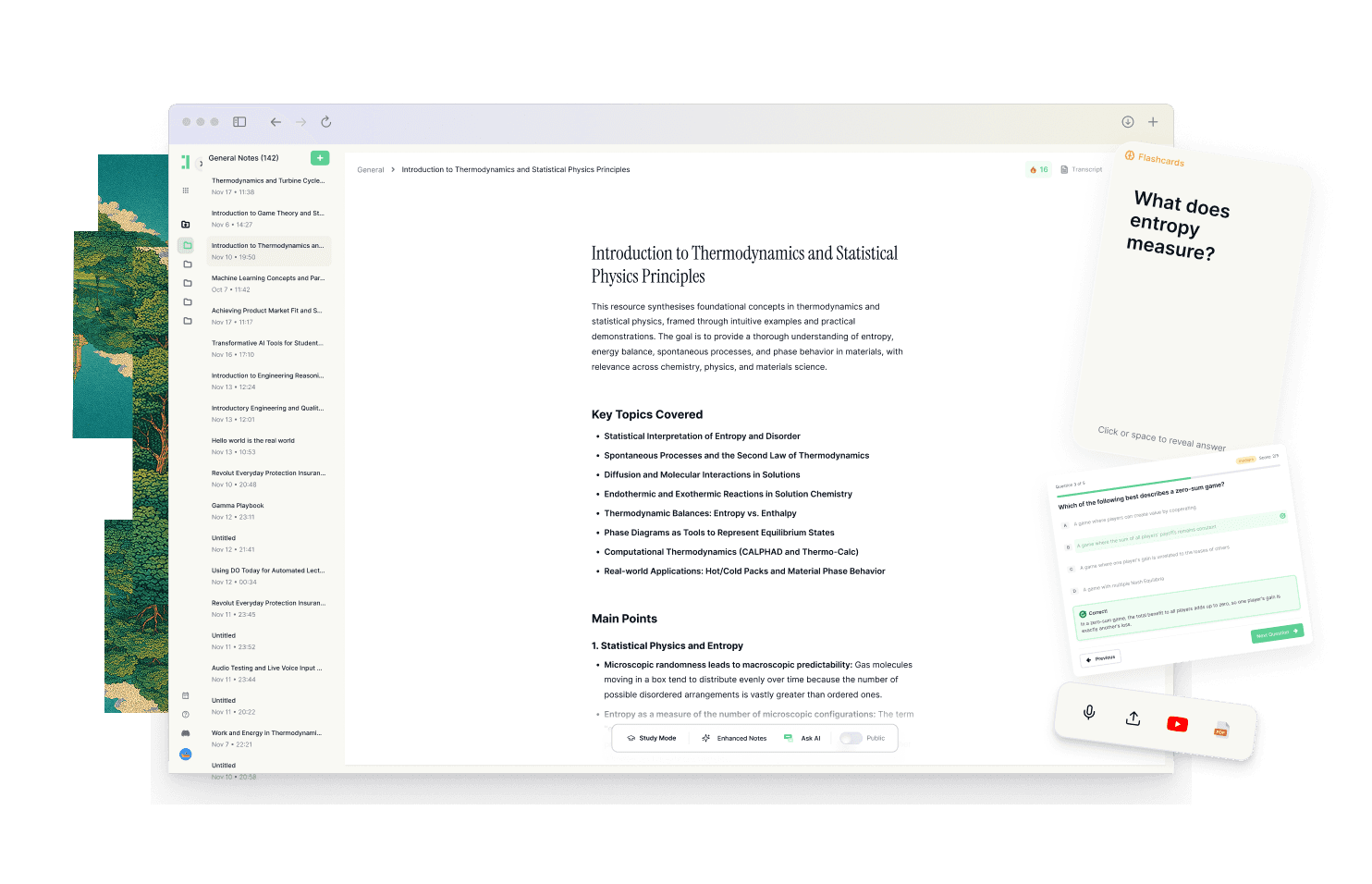
Duetoday approaches learning as a unified workflow rather than a series of disconnected games. It serves as one place that holds everything you learn, from lecture recordings and PDFs to YouTube videos and text notes. Instead of forcing you to manually create study materials, Duetoday allows you to upload lecture recordings to get instant transcriptions and then automatically turns that raw content into structured study outputs. You can generate summaries, cheatsheets, and comprehensive study guides with a single click, ensuring that your study materials are always grounded in the actual source content.
For retention, Duetoday goes beyond basic quizzes by generating active recall tools like flashcards and practice questions directly from your materials. This means your practice is never disconnected from the lecture or reading you just finished. If you get stuck, you can use the built-in AI tutor chat to ask questions. This AI brain is grounded specifically in what you uploaded, providing context-aware answers rather than generic internet facts. It supports mixed-media learning, allowing you to manage various inputs in one interface and reducing the friction of switching between different apps.
The system is also designed to help you execute your study plan. By integrating with Google Calendar, Duetoday aligns your study sessions with your real-life schedule. It helps make the next right action obvious, turning overwhelming deadlines into manageable tasks. By bringing your learning inputs and retention outputs into one ecosystem, it eliminates the fragmentation that usually leads to burnout and forgotten information.
How the Duetoday workflow feels in real life
On a typical Monday after a long lecture, a student simply uploads their voice recording and the professor's slides into Duetoday. While they grab a coffee, the system transcribes the audio and generates a structured set of notes. Instead of spending the evening rewriting what they just heard, the student reviews the AI-generated summary and uses the AI tutor to clarify a few complex points that didn't make sense during the lecture. They then click a button to generate a set of flashcards for a quick 10-minute review before bed.
As the exam approaches, the workflow shifts from gathering to practicing. The student uses the generated study guide to see the total scope of the material and jumps into the AI-generated quizzes to find their weak spots. Because every flashcard is linked back to the original source, they can quickly revisit the exact moment in a lecture or the specific page in a PDF when they get an answer wrong. By the time the weekend review rolls around, the student feels calm because their study plan is already synced with their Google Calendar, showing them exactly what to do and when to do it.
Duetoday vs Kahoot! in plain English
When comparing Duetoday and Kahoot!, the biggest difference is the intended outcome. Kahoot! is built for engagement and short-term excitement, which is great for a quick classroom break or a fun trivia night. It is a tool for testing what you might already know in a fast-paced environment. However, the setup time for creating high-quality, relevant quizzes for complex subjects is high, and the learning curve is focused more on how to use the game features rather than how to master the subject matter.
Duetoday is built for mastery and long-term retention. It handles mixed-media support far better, allowing you to synthesize information from a variety of sources that Kahoot! simply cannot process. While Kahoot! is excellent for surface-level recall, Duetoday focuses on the entire lifecycle of learning: from the first time you hear a concept to the moment you sit for the exam. It reduces the need for manual data entry, allowing the AI to handle the organization so you can focus on understanding.
For a student, the daily routine with Kahoot! is often disjointed, as it requires moving data from one place to another. Duetoday provides a consistent loop where your notes, your schedule, and your practice tools live together. This results in much higher exam readiness because you aren't just memorizing isolated facts for a game; you are building a deep, interconnected understanding of your entire course curriculum.
Who should choose Duetoday
Duetoday is the ideal choice for university students and self-learners who are dealing with heavy lecture loads and strict deadlines. If you find yourself overwhelmed by the sheer volume of PDFs, videos, and notes you need to process, Duetoday provides the structure you need. It is for the student who wants a system that does the heavy lifting of summarization and organization so they can spend their time on active recall and deep focus.
It is also perfect for those who use a variety of media to learn. If your study routine involves watching YouTube tutorials, reading research papers, and attending live lectures, you need a tool that can unify those inputs. Duetoday is built for the learner who wants to ensure that every minute spent studying contributes directly to exam readiness and long-term understanding, rather than just passing time on a gamified app.
Who should still choose Kahoot!
Kahoot! remains the best choice for teachers who want to increase classroom participation or for study groups that want a fun way to review basic facts together. It is perfect if you are looking for a social experience rather than a private, focused study system. If you prefer a platform where you can easily find pre-made quizzes on general topics like pop culture or basic history, Kahoot! is a great, low-pressure option for quick entertainment and light learning.
Verdict
The choice between these two platforms comes down to whether you need a high-energy vault of quizzes or a unified study system. Kahoot! is fantastic for isolated bursts of fun and basic fact-checking, but it often leads to fragmentation for serious students. Duetoday, on the other hand, solves the problem of productive procrastination by automating the creation of study materials and focusing on a continuous retention loop. For those who want to turn their messy lecture notes into a clear path toward exam success, Duetoday is the superior system.
FAQ
Is Duetoday only flashcards and quizzes?
No, Duetoday is a full learning workspace that includes transcription, document organization, AI-powered summaries, and study guides. While flashcards and quizzes are part of the retention loop, the platform also provides an AI tutor and a central hub for all your learning materials.
Does Duetoday work for lectures and YouTube?
Yes, you can upload audio recordings of lectures for transcription or paste YouTube links to have the AI process the video content. Duetoday treats these as primary sources, allowing you to generate summaries and practice questions directly from the media you consume.
Will it help reduce cramming?
By integrating with your Google Calendar and providing instant study outputs, Duetoday helps you build a consistent daily routine. This prevents the buildup of unorganized materials that usually leads to high-stress cramming sessions the night before an exam.
Can I still use Notion or Google Calendar?
Absolutely, Duetoday is designed to complement your existing tools by allowing you to import content from Notion and sync your study tasks with Google Calendar. This ensures your learning system is aligned with your overall organization and schedule.
Who is Kahoot! still best for?
Kahoot! is still the best tool for live, social group settings and classroom environments where the goal is high engagement and quick, competitive review. It remains a top choice for teachers and event organizers looking to gamify information for a large audience.
Finally, choosing the right tool depends on whether you value social gamification or a structured, automated system for personal academic mastery.
Read More Alternative To Comparison
Turn lectures, PDFs, and notes into AI-Powered summaries, bite-sized
courses, flashcards, quizzes, and study plans.