Best Heptabase Alternatives in 2026 [For Students]
Discover why Duetoday is the best Heptabase alternative for students. Compare features, study workflows, and retention tools in this deep dive comparison.
Why people look for a Heptabase alternative
Heptabase has gained a loyal following for its visual approach to knowledge management. By allowing users to lay out notes on a spatial canvas, it helps clarify complex relationships between ideas. However, many students and self-learners eventually find that while they are great at mapping out concepts, they aren't necessarily closer to mastering them for an exam or a professional deadline. The act of moving cards around a digital whiteboard can often feel like productive procrastination rather than active learning.
University students, in particular, face a specific kind of pressure that spatial whiteboards don't always address. They deal with a constant influx of varied media formats, from hour-long lecture recordings and dense PDFs to YouTube tutorials and Notion pages. When the goal is to move from understanding a concept to being able to recall it under pressure, a visual database can feel fragmented. Users often look for an alternative that focuses less on the aesthetic arrangement of notes and more on a unified system that automates the transition from raw input to long-term retention.
Quick verdict
Best for building a knowledge vault: Heptabase
Best for a real study system: Duetoday
Best if you want both: Use Heptabase for long-term research and visual mapping, and use Duetoday for active learning, exam preparation, and managing your daily study execution.
What Heptabase is great at
Heptabase excels at providing a sense of clarity through its spatial interface. It is built on the philosophy that the human brain handles information better when it can see where ideas sit in relation to one another. For researchers and deep thinkers, the ability to turn a note into a card and place it on a whiteboard is transformative. It allows for a non-linear way of thinking that traditional document-based apps simply cannot match.
The software is also highly praised for its speed and its local-first approach. It feels snappy and reliable, which is essential when you are in a deep flow state. The combination of a powerful PDF annotator and the ability to drag those annotations directly onto a map makes it a powerhouse for literature reviews and complex synthesis. It creates a beautiful, permanent home for your thoughts where you can see the big picture without losing sight of the details.
Where Heptabase breaks for students on deadlines
The primary challenge with Heptabase is the gap between "mapping" and "knowing." For a student on a deadline, spending three hours perfectly arranging cards on a whiteboard doesn't guarantee they will remember that information during a test. This often leads to a rabbit hole of organization where the user feels productive because the canvas looks impressive, but the actual cognitive work of active recall hasn't happened yet. The tool provides a vault for storage but lacks a built-in engine for testing your knowledge.
Furthermore, Heptabase can feel disconnected when dealing with mixed-media workflows. If you have a lecture recording, a YouTube video, and a set of Google Calendar deadlines, you have to manually bridge those gaps. It is fundamentally a text and PDF-first tool. Students today need to process audio and video just as frequently as text, and when these inputs are scattered across different apps, the cognitive load increases. Without a structured loop to turn these inputs into practice tools, the system remains a passive archive rather than an active study partner.
What Duetoday does instead
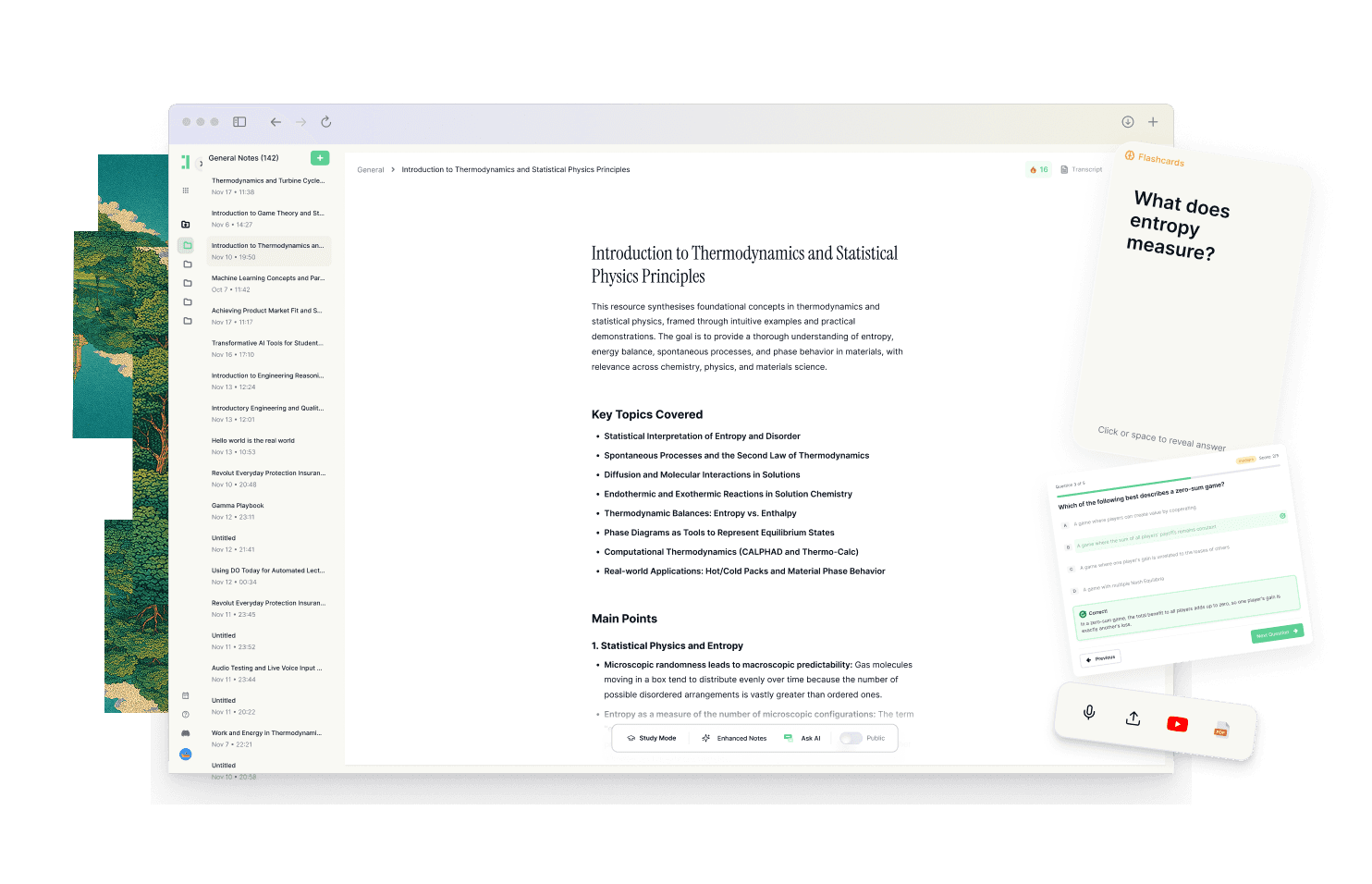
Duetoday is designed as a unified learning workspace that prioritizes retention over mere storage. Instead of just giving you a canvas to store notes, it creates a retention loop that handles everything from the moment you receive a lecture recording to the moment you walk into an exam. It serves as a single place that holds everything you learn, whether it is a lecture recording, a PDF, a YouTube link, or a website. By bringing these fragmented sources into one brain, Duetoday ensures your context is never lost.
The core of the Duetoday experience is transforming raw content into structured study outputs. You can upload lecture recordings and receive instant transcriptions, then turn that raw data into summaries, cheatsheets, and study guides. It goes beyond passive reading by automatically generating active recall tools such as flashcards and quizzes. If you are confused by a specific point, you can engage with an AI chat that is grounded entirely in your uploaded materials, ensuring the answers are relevant to your specific curriculum rather than being generic AI hallucinations.
Efficiency in Duetoday is driven by its execution layer. It connects directly with Google Calendar so your study plans align with your actual availability and deadlines. It doesn't just store your notes; it helps you decide what to do next. By integrating with tools like Notion and supporting mixed-media learning, Duetoday reduces the friction of moving between apps. It keeps your study materials connected to their original sources, making the transition from a lecture recording to a practice quiz a single, seamless workflow.
How the Duetoday workflow feels in real life
Imagine it is Monday afternoon and you just finished a heavy lecture. Instead of dreading the process of organizing your notes, you simply upload the audio recording and the professor's PDF slides into Duetoday. By the time you’ve grabbed a coffee, the system has transcribed the lecture and generated a clear summary of the key points. You check your integrated Google Calendar and see a free hour on Tuesday morning, so you use Duetoday to generate a set of flashcards based specifically on that day's content.
As the exam approaches, you aren't scrolling through endless folders or looking at a giant map of notes. You open your AI-generated study guide and take a practice quiz that challenges you on the exact topics your professor emphasized. If you get a question wrong, you ask the AI tutor to explain the concept simply, and it points you back to the exact timestamp in the lecture recording. Your preparation feels like a repeatable system rather than a chaotic scramble to review everything at once.
Duetoday vs Heptabase in plain English
The fundamental difference between these two tools is their primary goal. Heptabase is built for the "builder" who wants to organize every thought into a perfect visual structure. It has a steeper learning curve because you have to decide how to layout your information. Duetoday is built for the "learner" who needs to get from raw information to exam readiness as fast as possible. The setup time in Duetoday is minimal because the system does the heavy lifting of transcribing, summarizing, and creating practice materials for you.
While Heptabase offers a beautiful way to view your notes, Duetoday offers a more robust support system for mixed-media. If your study routine involves YouTube and lecture recordings, Duetoday treats these as first-class citizens, whereas Heptabase is more focused on text and PDF cards. For a student, the ability to jump from a quiz question back to the specific moment in a video where that concept was explained provides a level of search and recall that a spatial map cannot easily replicate.
In terms of daily routine, Heptabase requires you to be the architect of your own knowledge. Duetoday acts more like a tutor and manager. It uses your calendar and your materials to make the next right action obvious. If you struggle with consistency, Duetoday’s task-oriented approach and automated outputs are designed to keep you moving forward without getting stuck in the trap of over-organizing.
Who should choose Duetoday
Duetoday is the ideal choice for university students and self-learners who are lecture-heavy and deadline-driven. If you find yourself overwhelmed by the sheer volume of PDFs, videos, and recordings you need to process, Duetoday’s ability to centralize and automate these inputs is a game-changer. It is perfect for those who want a structured system that forces them into active recall rather than letting them settle for passive re-reading.
It is also the right fit for anyone who wants their learning tool to talk to the rest of their digital life. If you rely on Google Calendar to manage your time and want a study workspace that feels like a natural extension of your schedule, Duetoday provides that bridge. It is for the person who values execution and retention over the aesthetics of a note-taking vault.
Who should still choose Heptabase
Heptabase remains the superior choice for long-term researchers, writers, and individuals who prioritize local-first privacy. If your work involves connecting disparate ideas over years rather than preparing for a specific exam in three weeks, the spatial whiteboard is an invaluable tool. It is for the person who enjoys the process of building a complex knowledge system from the ground up and who wants total control over the visual organization of every single note.
Verdict
The choice between Duetoday and Heptabase comes down to whether you need a knowledge vault or a study system. Heptabase is a world-class vault for storing and mapping information visually to find connections. Duetoday is a unified study system designed to fight fragmentation, turn mixed-media into practice tools, and ensure that what you consume today is what you actually remember tomorrow. For the deadline-conscious student, the automated retention loop of Duetoday offers a more direct path to academic success.
FAQ
Is Duetoday only flashcards and quizzes?
No, Duetoday is a full learning workspace that handles everything from the initial lecture transcription to final execution. While it generates flashcards and quizzes for active recall, it also provides structured notes, AI-powered summaries, and a central brain for all your various study materials.
Does Duetoday work for lectures and YouTube?
Yes, Duetoday is designed specifically to handle mixed-media learning inputs. You can upload lecture recordings for transcription and import YouTube links to be processed alongside your PDFs and text notes, creating a single source of truth for your studies.
Will it help reduce cramming?
Duetoday helps reduce cramming by creating a repeatable study workflow and connecting with your calendar. By turning content into bite-sized practice tools immediately after you receive them, it encourages consistent review rather than a last-minute rush to organize notes.
Can I still use Notion or Google Calendar?
Absolutely, Duetoday is built to work alongside your existing tools. You can import content from Notion to use in your study brain, and the Google Calendar integration ensures your study tasks and deadlines stay synced with your real-world schedule.
Who is Heptabase still best for?
Heptabase is still the best choice for researchers and visual thinkers who want a local-first application for mapping out complex ideas. It is ideal for long-term projects where the primary goal is visual synthesis rather than preparing for immediate exams or deadlines.
Final closing line: Choosing the right system depends on whether you want to map your thoughts or master your curriculum.
Read More Alternative To Comparison
Turn lectures, PDFs, and notes into AI-Powered summaries, bite-sized
courses, flashcards, quizzes, and study plans.