Best Grain Alternatives in 2026 [For Students]
Discover why Duetoday is the top study-focused alternative to Grain. Compare features like lecture transcription, study guides, and active recall tools for students.
Why people look for a Grain alternative
Grain has established itself as a powerful tool for recording meetings and capturing highlights in a professional setting. However, university students and self-learners often find that while Grain excels at identifying snippets of conversation, it lacks the specialized infrastructure needed for academic success. Students frequently look for an alternative because their needs extend far beyond simply recording a session. They need a way to turn that raw audio into a comprehensive learning system that bridges the gap between a recorded lecture and a prepared mind. Grain is built for product teams and sales calls, which means it misses the pedagogical tools like flashcards, practice quizzes, and structured study guides that learners actually require to pass exams.
Another reason for the shift toward alternatives is the fragmentation of the study process. Using Grain requires students to then export those notes or transcripts into another tool to actually study them. This constant context switching creates a friction point where information is easily lost or forgotten. Students want a unified workspace where the recording is just the beginning of the workflow, not the final destination. They are looking for a system that understands the relationship between a PDF textbook, a YouTube tutorial, and a recorded lecture, providing a single source of truth for their entire curriculum.
Quick verdict
At-a-glance:
Best for building a knowledge vault: Grain
Best for a real study system: Duetoday
Best if you want both: Use Grain for professional meeting archives and Duetoday for academic retention and exam prep.
What Grain is great at
Grain is an exceptional tool for those who prioritize high-quality transcription and easy sharing of video highlights. Its core strength lies in its ability to clip specific moments from a recording and share them instantly with a team. For a student working on a collaborative project or a researcher conducting interviews, Grain provides a very polished experience. Its interface is clean, and its ability to search through transcripts for specific keywords is robust and reliable.
Furthermore, Grain offers seamless integrations with professional communication tools, making it a favorite for those who live in Slack or Zoom. It excels at taking the manual labor out of meeting minutes. If your primary goal is to maintain an archive of spoken conversations where you can quickly find who said what and when, Grain is a sophisticated and dependable choice. It respects the integrity of the original recording while making the text searchable and accessible for long-term storage.
Where Grain breaks for students on deadlines
The primary issue students face with Grain is the phenomenon of productive procrastination. It is easy to record hours of lectures and feel like you are being productive, but a transcript is not the same thing as knowledge. Grain does not provide the active recall tools necessary to move information from the screen into long-term memory. When a deadline is approaching, a student does not need a list of time-stamped highlights; they need a study guide, a set of practice questions, and a way to test their understanding of complex concepts.
Grain also struggles with the diverse range of inputs that define modern learning. Students do not just learn from live calls; they learn from dense PDFs, complex YouTube videos, and disparate web articles. Grain is a video-first tool, which means it does not naturally accommodate the mixed-media nature of a college course. This leads to a fragmented workflow where the lecture lives in Grain, the readings live in a PDF viewer, and the notes live in a separate document. When exam week arrives, this fragmentation makes it nearly impossible to see the big picture, leading to stress and inefficient revision sessions.
What Duetoday does instead
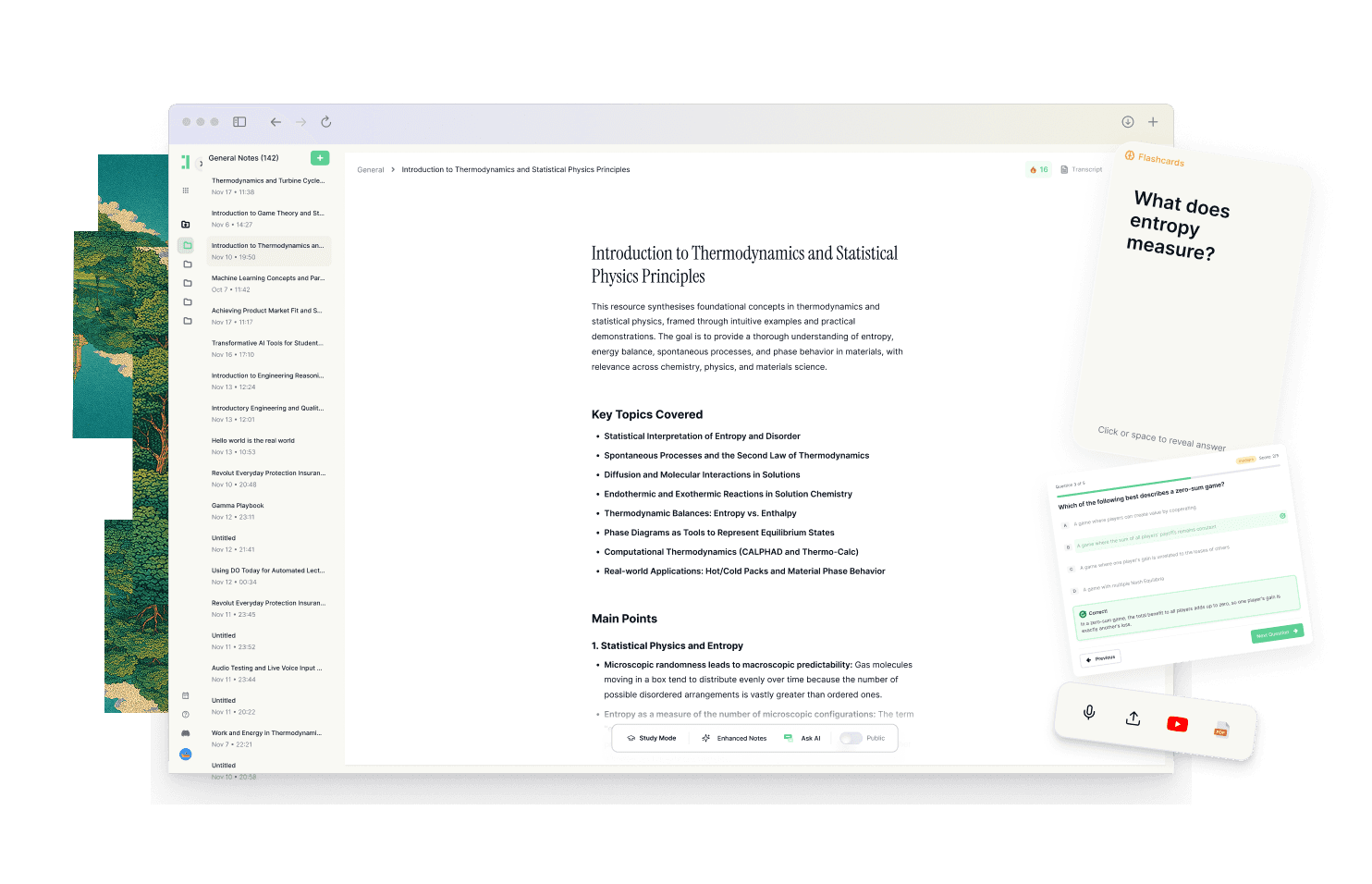
Duetoday acts as a unified learning workspace that manages the entire lifecycle of information, from the first lecture to the final exam. Instead of just recording audio, Duetoday serves as one place that holds everything you learn, including lectures, PDFs, YouTube videos, and your own personal notes. You can upload lecture recordings and get near-instant transcription, but that is only the first step. Duetoday then allows you to turn that raw content into structured study outputs such as summaries, cheatsheets, and comprehensive study guides that are tailored to your specific materials.
The platform is built on the philosophy of active recall. It automatically generates tools like flashcards and quizzes from your uploaded content, ensuring you are practicing rather than just rereading. If you are stuck on a difficult topic, you can ask questions with an AI chat that answers grounded in what you uploaded, rather than providing generic internet answers. Duetoday keeps all materials connected to the source, so your flashcards link back to the exact moment in the lecture or the specific page in the PDF. It supports mixed-media learning and reduces fragmentation by bringing every learning input into one cohesive workflow. Through integrations with tools like Notion and Google Calendar, Duetoday ensures that your study plans align with your real schedule, making the next right action obvious and repeatable.
How the Duetoday workflow feels in real life
On a typical Monday, a student might record a two-hour biology lecture. Instead of just letting that recording sit in a folder, they upload it to Duetoday. By the time they have walked back to their dorm, Duetoday has transcribed the audio and generated a structured summary and a set of practice flashcards. On Wednesday, when they are reading a related PDF chapter, they add it to the same workspace. Duetoday connects the concepts between the lecture and the reading. Before the midterm, the student doesn't scramble through folders; they open their AI-generated study guide and take a practice quiz based on the actual class content. Their Google Calendar shows them exactly when to review, and they spend their time mastering the material rather than organizing it.
Duetoday vs Grain in plain English
The choice between Duetoday and Grain comes down to your primary objective. Grain is a transcription tool designed to capture and share snippets of meetings. It has a steep focus on the archival of video content. Duetoday, conversely, is a retention system designed to help you master information. While Grain stops at the transcript, Duetoday uses that transcript as a foundation to build active learning tools like quizzes and mindmaps.
In terms of daily routine, Grain requires you to be the editor, finding the important parts yourself. Duetoday acts more like a teaching assistant, identifying key points and transforming them into study formats automatically. Duetoday also handles a much wider variety of file types, making it better suited for the messy reality of being a student. While Grain is excellent for professional documentation, Duetoday is built for the intensity of academic deadlines and the necessity of long-term retention.
Who should choose Duetoday
Duetoday is the ideal choice for university students and self-learners who deal with a high volume of lecture content and complex reading materials. It is designed for those who feel overwhelmed by having their information scattered across different apps and hard drives. If you have strict deadlines and need a system that tells you exactly what to study and how to study it, Duetoday provides the necessary structure.
It is also perfect for those who heavily rely on mixed-media, such as watching YouTube tutorials alongside reading academic papers. If you want a tool that doesn't just store what you've heard, but actually helps you understand and recall it through AI-generated practice tools, Duetoday is the right workspace for you.
Who should still choose Grain
Grain remains the superior choice for professional teams, sales representatives, and UX researchers who need a local-first feeling for their video archives. It is best for those who need to share specific video clips with colleagues or clients and who require deep integrations into corporate tech stacks. If your primary goal is project management and meeting documentation rather than academic learning and exam readiness, Grain is the tool for you.
Verdict
Ultimately, the difference is between a storage vault and a learning system. Grain is a fantastic vault for recording and retrieving spoken words in a professional context. Duetoday is a unified study system designed to turn those words, along with PDFs and videos, into active knowledge. For students who need to move beyond mere documentation and toward genuine retention, Duetoday offers the workflow necessary to end fragmentation and master their subjects.
FAQ
Is Duetoday only flashcards and quizzes?
No, Duetoday is a full-featured workspace that handles transcription, content organization, and AI-assisted tutoring. While flashcards and quizzes are core components for retention, the platform also provides structured notes, summaries, and a grounded AI chat to help you understand complex topics.
Does Duetoday work for lectures and YouTube?
Yes, Duetoday is specifically designed to handle audio from lecture recordings and video from YouTube links. It transcribes the audio and allows you to integrate these sources with your PDFs and notes for a holistic view of your course material.
Will it help reduce cramming?
Duetoday helps reduce cramming by organizing your study materials as soon as you upload them and integrating with your Google Calendar. By making study tools like practice questions available instantly, it encourages consistent, bite-sized learning throughout the semester.
Can I still use Notion or Google Calendar?
Yes, Duetoday is designed to work alongside your existing tools. You can import content from Notion and connect your Google Calendar so that your study tasks and deadlines are synced with your actual daily schedule.
Who is Grain still best for?
Grain is still the best option for professional teams and researchers who need a specialized tool for recording meetings and sharing video clips. It is optimized for collaborative business environments rather than individual academic study.
Ending your search for a fragmented study routine starts with choosing a system designed for retention over simple storage.
Read More Alternative To Comparison
Turn lectures, PDFs, and notes into AI-Powered summaries, bite-sized
courses, flashcards, quizzes, and study plans.