Best Glean Alternatives in 2026 [For Students]
Frustrated with fragmented notes? Discover why Duetoday is the best Glean alternative for students who need a unified system for lectures, PDFs, and active recall.
Why people look for a Glean alternative
Glean has long been a staple in the world of assistive technology and lecture capture, helping students record audio and tie it to slides. However, many university students find that audio recording is only one small piece of the academic puzzle. While Glean excels at capturing what happened in the room, it often leaves students with a library of recordings that still require hours of manual processing. As the semester picks up, the friction of managing separate tools for PDFs, YouTube research, and flashcards becomes overwhelming. Students begin looking for an alternative that doesn't just record the lecture, but actually helps them master the material.
Another common pain point is the passive nature of recording-focused tools. Capture is not the same as comprehension. Many students realize that having a transcript doesn't mean they are ready for an exam. They look for alternatives that can bridge the gap between sitting in a lecture hall and sitting in an exam room. They need a system that takes raw inputs and automatically structures them into study-ready formats like active recall sets and summaries, rather than just keeping a digital archive of audio files.
Quick verdict
Best for building a knowledge vault: Glean
Best for a real study system: Duetoday
Best if you want both: Use Glean for live lecture recording in the classroom and Duetoday for retention, planning, and exam preparation.
What Glean is great at
Glean is exceptionally well-designed for live lecture environments, particularly for students who struggle with the cognitive load of note-taking while listening. Its interface is built to allow users to mark important moments in real-time with a single click. This focus on accessibility makes it a powerful tool for ensuring that no piece of information is lost during a fast-paced presentation. By syncing audio directly to lecture slides, it provides a high-fidelity record of exactly what was said and when.
The platform is also highly respected for its clean, distraction-free environment. It doesn't try to be a social network or a complex database; it focuses on the capturing process. For many students, especially those with specific learning requirements, this simplicity is a major strength. It creates a reliable way to review lecture content at a personalized pace, ensuring that the spoken word is preserved alongside visual aids provided by the professor.
Where Glean breaks for students on deadlines
The primary breakdown occurs when the volume of content exceeds the student's time to review it. Glean is excellent at capturing, but it can lead to productive procrastination. A student might feel productive because they recorded every lecture, yet they still face a massive backlog of audio as finals approach. There is no built-in mechanism to transform that audio into active testing materials, meaning students must spend additional hours creating their own quizzes or flashcards in a separate app. This fragmentation leads to a disjointed workflow where the recording is in one place and the actual studying happens elsewhere.
Furthermore, university learning today is rarely limited to lectures. Students are navigating a messy mix of YouTube tutorials, complex PDFs, website articles, and Notion notes. Glean is not designed to be a central workspace for these disparate media types. When a student needs to synthesize a lecture recording with a research paper and a relevant YouTube video, Glean’s audio-centric model starts to feel restrictive. It lacks the unified structure needed to manage a modern, multi-source academic workload, often forcing students to jump between four or five different tabs just to complete a single study session.
What Duetoday does instead
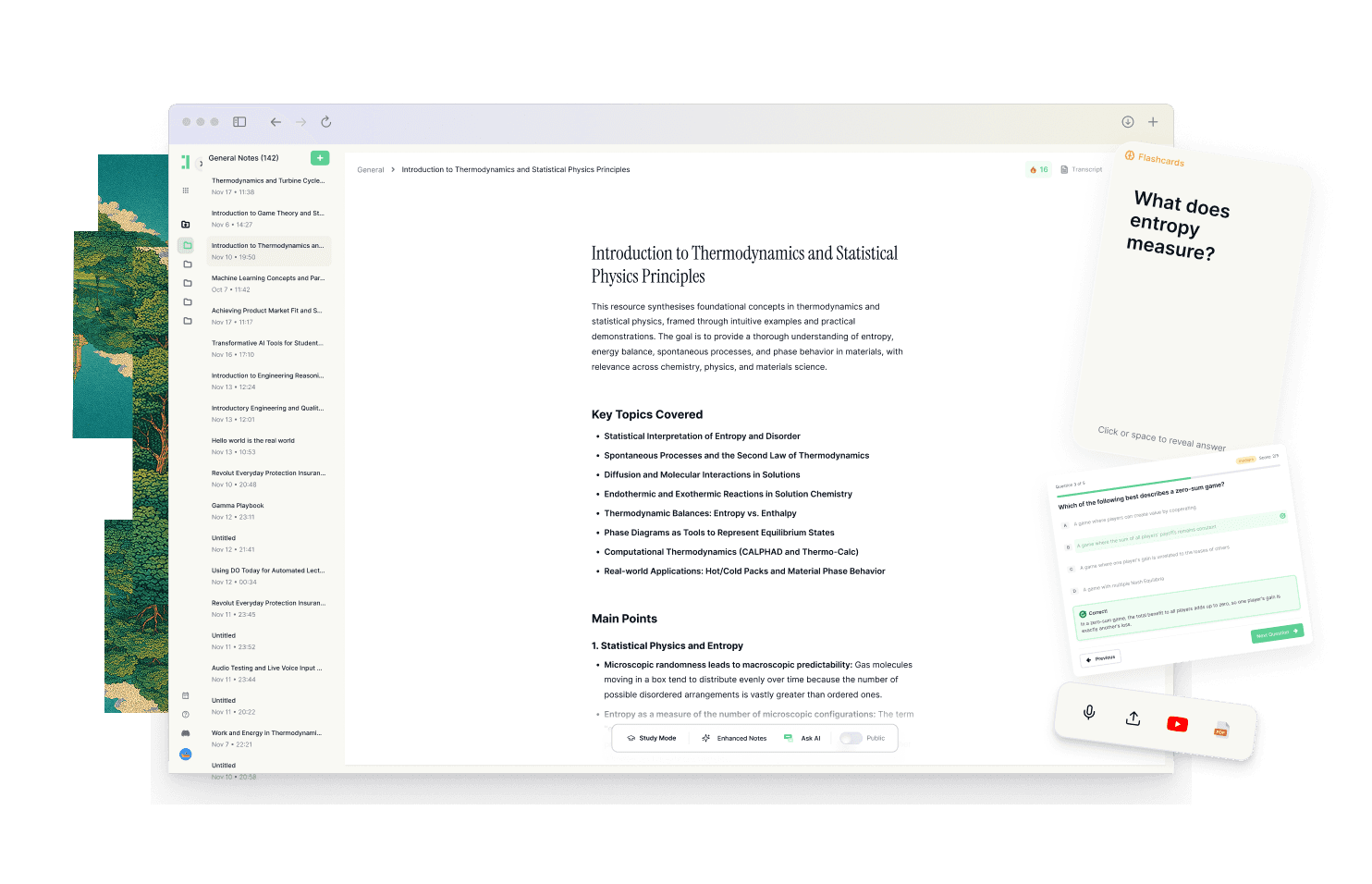
Duetoday acts as a unified learning workspace that prioritizes retention over mere collection. Instead of just recording a lecture, it serves as a central brain that holds everything you learn—lectures, PDFs, YouTube videos, and websites. You can upload your lecture recordings and receive instant transcriptions, but that is only the starting point. Duetoday takes that raw content and uses AI to turn it into structured study outputs like summaries, cheatsheets, and comprehensive study guides. It bridges the gap between raw data and usable knowledge.
Beyond just organizing information, Duetoday generates active recall tools such as flashcards and quizzes directly from your materials. This means you aren't just reading your notes; you are testing yourself on them. The platform includes a context-aware AI tutor that answers questions grounded specifically in your uploaded content. This ensures that when you ask for a clarification, the answer is based on your professor’s specific definitions and your assigned readings, not generic internet data. Everything remains connected to the source, so your study process never feels disconnected from the original lecture or textbook.
The execution layer of Duetoday is designed to reduce the mental load of planning. By connecting with tools like Notion and Google Calendar, it aligns your study materials with your actual schedule. It helps make the next right action obvious, turning a vague goal like "study for biology" into a concrete list of tasks. This integrated approach supports mixed-media learning and reduces the fragmentation that typically leads to burnout, ensuring that everything from transcription to final review happens in one cohesive loop.
How the Duetoday workflow feels in real life
On a typical Monday, a student might finish a lecture and immediately upload the recording and the professor’s PDF slides into Duetoday. Instead of manually transcribing or highlighting, they let the system generate a structured summary and a set of flashcards while they grab lunch. By Tuesday, those flashcards are already integrated into their daily review. If they find a difficult concept in the slides, they use the AI chat to ask for a step-by-step explanation based on the lecture text.
As the exam approaches, the student doesn't have to go hunting through folders for their materials. They open their unified canvas where the YouTube tutorials they saved, the lecture transcripts, and their Notion notes are all visible in one place. They generate a practice quiz that covers all these sources simultaneously. On the morning of the test, they review the AI-generated cheatsheet that highlights the key points identified across all their study sessions. The workflow is repeatable, predictable, and removes the panic of missing information.
Duetoday vs Glean in plain English
The primary difference between Duetoday and Glean is their ultimate goal: Glean is built for capture, while Duetoday is built for mastery. Glean has a very low setup time because you simply hit record. However, it has a higher "downstream" time requirement because you eventually have to do something with those recordings. Duetoday requires you to upload your materials, but it immediately starts doing the heavy lifting of organization and output generation, saving you hours of manual study prep later on.
In terms of media support, Glean is audio-first. If your study habits involve heavy PDF reading or watching technical YouTube videos, Glean will only be able to capture your thoughts about those things, not the source material itself. Duetoday treats a PDF or a video as a first-class citizen, allowing you to interact with the text and visuals directly. For exam preparation, Duetoday provides a clear path through active recall and self-testing, whereas Glean provides a high-quality review of the lecture but leaves the actual testing up to the student.
Who should choose Duetoday
Duetoday is the ideal choice for university students who are dealing with a high volume of diverse materials and feel the pressure of looming deadlines. If you find yourself overwhelmed by the number of PDFs, videos, and lectures you need to get through, Duetoday provides the structure you need. It is built for the student who wants to spend less time organizing and more time practicing, specifically those head-down learners who need a system that facilitates retention through quizzes and AI tutoring.
Who should still choose Glean
Glean remains the better option for students who primarily need assistance with the physical or cognitive act of taking notes in real-time. If your main challenge is just getting the words down in a lecture hall and you prefer a very simple, audio-centric interface, Glean is a specialized tool that performs that task exceptionally well. It is also the right choice for users who are provided the software through institutional disability services and require its specific accessibility features for live capture.
Verdict
The choice comes down to whether you need a capture tool or a retention system. Glean is a high-quality recording vault that preserves the lecture experience, but Duetoday is a unified study workspace that converts that experience into exam readiness. If you want to eliminate fragmentation and move from just "having" information to truly knowing it, Duetoday provides the more comprehensive workflow for modern students.
FAQ
Is Duetoday only flashcards and quizzes?
No, Duetoday is a complete workspace that handles everything from lecture transcription and PDF organization to AI-powered summaries and cheatsheets. While active recall tools like flashcards are a core part of the retention loop, the platform serves as your primary place to store and interact with all your learning materials.
Does Duetoday work for lectures and YouTube?
Yes, it is designed specifically to handle mixed media. You can upload audio recordings from your lectures for transcription and also paste YouTube links to have the video content processed and integrated into your study brain alongside your notes and documents.
Will it help reduce cramming?
By automatically generating study outputs as soon as you upload your materials, Duetoday encourages a consistent review cycle. Since your flashcards and quizzes are ready immediately after the lecture, you can engage in spaced repetition throughout the semester rather than trying to process months of recordings in the final week.
Can I still use Notion or Google Calendar?
Absolutely. Duetoday is built to reduce fragmentation by connecting with the tools you already use. You can pull content from Notion to use as a source for your AI tutor and sync with Google Calendar to ensure your study tasks align with your actual availability and deadlines.
Who is Glean still best for?
Glean is still the premier choice for students who need a dedicated tool for live, in-person lecture recording. It is specifically optimized for those who struggle with the mechanics of note-taking during a presentation and want a simple, focused way to mark audio moments against their slides.
Removing the friction between learning and doing makes the path to graduation much clearer.
Read More Alternative To Comparison
Turn lectures, PDFs, and notes into AI-Powered summaries, bite-sized
courses, flashcards, quizzes, and study plans.