Best Fathom Alternatives in 2026 [For Lecture Transcription]
Discover why Duetoday is the best Fathom alternative for students. Compare transcription, study tools, and retention systems to find your perfect learning workflow.
Why people look for a Fathom alternative
Many university students and self-learners initially turn to Fathom because it offers a reliable way to record and transcribe meetings or online lectures. While it serves as a powerful utility for capturing what was said, students often find themselves hitting a wall once the recording ends. Fathom is designed primarily for sales teams and professionals who need to sync meeting notes to a CRM, which leaves a significant gap for someone trying to pass an exam or master a complex subject. The transition from a raw transcript to actual knowledge remains a manual, exhausting process that Fathom was never built to solve.
The search for an alternative usually begins when the sheer volume of recordings becomes overwhelming. Having a library of transcripts is not the same as having a study system. Students realize that they are still spending hours highlighting text, manually creating flashcards, and trying to pull together fragmented information from PDFs and YouTube videos that live outside of their recording software. They need a tool that doesn't just record the lecture, but actually helps them learn the material through a unified retention loop.
Quick verdict
At-a-glance:
Best for building a knowledge vault: Fathom
Best for a real study system: Duetoday
Best if you want both: Use Fathom for external meetings, Duetoday for retention and planning
What Fathom is great at
Fathom excels at the mechanics of capture. It is a highly polished tool for anyone who spends their day in Zoom, Google Meet, or Microsoft Teams. Its primary strength lies in its ability to join a call, record high-quality audio and video, and provide a remarkably accurate transcript in real-time. For a student attending a synchronous online seminar, Fathom provides the peace of mind that no word will be missed, allowing them to focus on the conversation rather than frantic note-taking.
Beyond capture, Fathom is appreciated for its clean interface and seamless integration with professional workflows. It allows users to highlight moments during a live call which then show up as snippets in the summary. For those who need a faithful record of a conversation and a way to quickly share those clips with others, it is one of the most reliable tools on the market. It treats the conversation as the final product, ensuring that the dialogue is preserved and searchable for future reference.
Where Fathom breaks for students on deadlines
The limitation of Fathom for a student becomes clear the moment the lecture ends and the deadline approaches. Fathom creates a beautiful archive of what was said, but it offers almost nothing in terms of exam readiness. This leads to a form of productive procrastination where a student feels accomplished because they have recorded ten hours of lectures, yet they possess no functional study materials. The transcripts are long and linear, making it difficult to extract the core concepts needed for active recall without significant manual labor.
Furthermore, student learning is rarely confined to a single video call. A typical course involves PDFs, YouTube explainers, physical textbooks, and personal notes in Notion. Fathom exists in a vacuum; it cannot ingest a research paper or connect a recorded lecture to a related YouTube tutorial. This fragmentation forces students to jump across multiple tools, breaking their focus and making it nearly impossible to see the big picture. When you are on a deadline, you don't need a transcript library; you need a system that synthesizes all your sources into a practice-ready format.
What Duetoday does instead
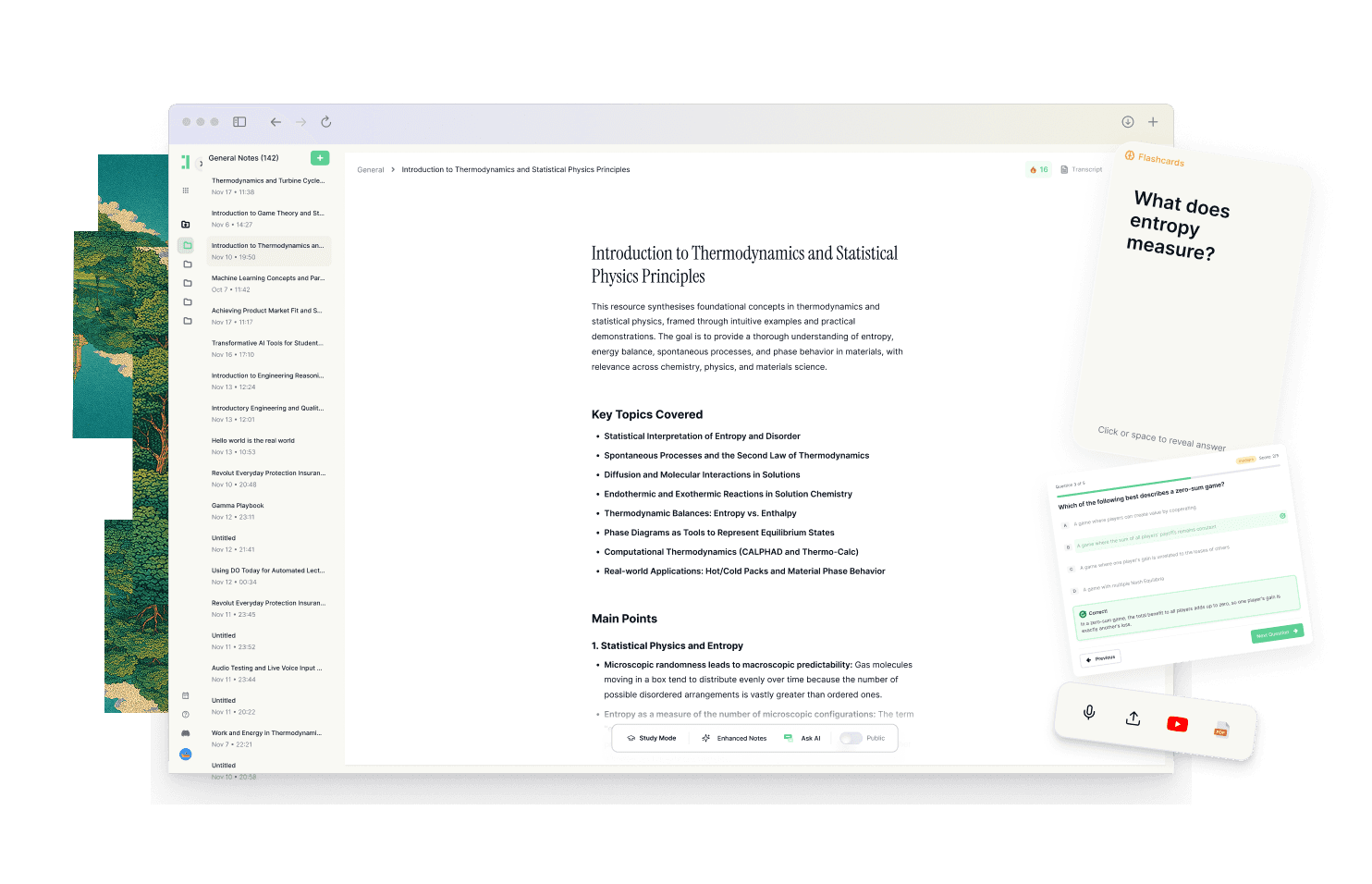
Duetoday is built as a unified learning workspace designed specifically to close the gap between capturing information and retaining it. Unlike a simple recording tool, Duetoday acts as a centralized brain for everything you learn. You can upload lecture recordings, share YouTube links, or import PDFs and research papers into one space. It doesn't just transcribe audio; it weaves that transcription into a larger context, connecting your lecture notes to your reading materials and external web sources. This eliminates the fragmentation that occurs when your learning inputs are scattered across different platforms.
Once your content is in Duetoday, the system turns raw data into structured study outputs. Instead of staring at a wall of text, you get instant summaries, cheatsheets, and comprehensive study guides tailored to your specific materials. Duetoday generates active recall tools like flashcards and quizzes directly from your transcripts and documents, ensuring that your study sessions are focused on testing your knowledge rather than just re-reading it. The AI tutor integrated into the workspace allows you to ask questions grounded directly in your uploaded materials, providing explanations that are relevant to your specific curriculum rather than generic internet search results.
The execution layer of Duetoday further distinguishes it by aligning your learning with your real-world schedule. By connecting with Google Calendar and Notion, Duetoday helps you turn deadlines into actionable study blocks. It generates task lists with checkboxes, making the next right action obvious so you can move through your material systematically. This integration ensures that your study plan isn't just a theoretical list, but a structured workflow that respects your time constraints and helps you maintain consistency in your daily routine.
How the Duetoday workflow feels in real life
Imagine it is Monday afternoon and you have just finished a heavy two-hour lecture. Instead of letting that recording sit in a folder, you upload it to Duetoday alongside the professor's slide deck and a related YouTube video you found. By the time you've finished your coffee, Duetoday has transcribed the audio, identified the key themes across all three sources, and generated a set of practice questions for you. You spend twenty minutes running through a quiz to see what actually stuck from the lecture, and the AI tutor helps clarify a specific concept from the slides that didn't make sense during the live session.
As the week progresses, you don't have to go hunting for your notes. When you open Duetoday on Thursday, your Google Calendar integration reminds you of your upcoming mid-term, and your study dashboard shows exactly which topics you haven't mastered yet. You generate a cheatsheet for a quick review before your final practice session. By the time the exam arrives, you aren't panic-scrolling through transcripts; you are reviewing a refined set of flashcards and summaries that you have been interacting with all week. The process feels less like a race against the clock and more like a steady, repeatable system.
Duetoday vs Fathom in plain English
The primary difference between these two tools is their endgame. Fathom is built for the record, while Duetoday is built for the result. Fathom requires almost zero setup to start recording a call, which is great for accessibility, but it leaves the heavy lifting of studying to the user. You are left with a raw transcript that requires hours of manual synthesis. Duetoday requires a more intentional input process, but it rewards that effort by immediately transforming those inputs into high-value study assets like quizzes and structured notes.
In terms of media support, Fathom is strictly limited to video conferencing. If your learning happens through a mix of PDFs, physical notes, and web articles, Fathom cannot help you organize that information. Duetoday handles this mixed-media reality comfortably, bringing every source into a single workspace. While Fathom is an expert at capturing a conversation, Duetoday is an expert at helping you master the subject matter within that conversation. For a student, the choice often comes down to whether they want a digital filing cabinet for recordings or a proactive partner in the learning process.
Who should choose Duetoday
Duetoday is the ideal choice for university students and self-learners who are overwhelmed by the density of their coursework. If you find yourself with dozens of open tabs, scattered PDFs, and lecture recordings you never actually revisit, Duetoday provides the structure you are missing. It is for the student who is tired of 'collecting' information and wants to start 'retaining' it. If your goal is to walk into an exam feeling prepared because you have already practiced the material through quizzes and active recall, this is the system for you.
Who should still choose Fathom
Fathom remains the better choice for professional meeting environments where the only requirement is a transcript and a sync to a CRM like Salesforce or HubSpot. It is also suitable for those who strictly need a high-quality video record of their calls and have no need for integrated study tools, flashcard generation, or mixed-media organization. If you are a builder who prefers to manually craft your own knowledge base from raw transcripts and you value local-first or privacy-centric professional tools, Fathom will meet your needs effectively.
Verdict
The choice between these platforms is a choice between a storage vault and a study system. Fathom is an excellent vault for capturing what was said in a meeting, but it lacks the features necessary to turn that dialogue into durable knowledge. Duetoday solves the problem of fragmentation by unifying all your learning materials into one workflow, shifting the focus from simple transcription to active retention and exam readiness. For the deadline-driven student, Duetoday provides the repeatable structure needed to stop cramming and start learning.
FAQ
Is Duetoday only flashcards and quizzes? No, Duetoday is a full learning workspace that handles everything from transcription and summarization to AI-guided tutoring. While flashcards and quizzes are core features for retention, the platform also provides structured notes, cheatsheets, and a centralized library for all your study materials.
Does Duetoday work for lectures and YouTube? Yes, Duetoday is designed to support mixed-media learning by allowing you to upload lecture recordings, transcribe audio, and import YouTube links. It treats these different inputs as a single set of knowledge, allowing you to search and chat across all of them simultaneously.
Will it help reduce cramming? By turning your materials into practice tools instantly, Duetoday encourages consistent, bite-sized learning throughout the semester. The integration with your calendar helps you plan study sessions in advance, making it easier to avoid the high-stress environment of last-minute cramming.
Can I still use Notion or Google Calendar? Duetoday is built to work alongside your existing workflow by integrating with Notion for content syncing and Google Calendar for scheduling. This ensures that your study materials and your deadlines are always in sync, helping you stay organized without leaving your favorite tools behind.
Who is Fathom still best for? Fathom is best for professionals and corporate teams who need a reliable tool to record meetings and sync transcripts to business software. It is a great utility for capture, whereas Duetoday is a comprehensive system for academic and self-directed learning.
Final line: Choosing the right tool depends on whether you need to record a conversation or master a subject.
Read More Alternative To Comparison
Turn lectures, PDFs, and notes into AI-Powered summaries, bite-sized
courses, flashcards, quizzes, and study plans.