Best Anki Alternatives in 2026 [For Flashcards]
Looking for an Anki alternative? Discover why Duetoday is the superior choice for students needing a unified study system rather than just a flashcard app.
Many university students and self-learners eventually find themselves searching for an Anki alternative when the friction of manual deck creation becomes a barrier to actual learning. While the principles of spaced repetition are scientifically sound, the process of maintaining a complex flashcard database often starts to feel like a second job. Students today are managing a fragmented landscape of lecture recordings, dense PDFs, YouTube tutorials, and Notion pages. When these materials remain disconnected from the testing tool, the cognitive load of organizing information often outweighs the benefits of the study session itself.
Why people look for an Anki alternative
The primary reason users seek an alternative is the high maintenance cost of the traditional flashcard workflow. Anki requires students to manually input every piece of data, which frequently leads to productive procrastination where more time is spent designing cards than understanding the material. Because it is a text-heavy, markdown-first tool at its core, it often struggles to handle the mixed-media nature of modern education. Students find it difficult to bridge the gap between a 60-minute recorded lecture and a set of discrete flashcards without a significant amount of manual transcription and formatting.
Furthermore, Anki functions as a silo. It is an excellent place to store and review facts, but it is not a place to learn them for the first time. There is no native way to host a PDF side-by-side with your study notes or to ask a question about a specific slide in a lecture. This fragmentation forces students to jump between their browser, their PDF reader, and their flashcard app, leading to a loss of focus and a lack of context. When exam deadlines approach, the sheer volume of overdue cards can become demotivating, especially when the tool provides no way to turn those cards back into a cohesive study guide or summary.
Quick verdict
Best for building a knowledge vault: Anki
Best for a real study system: Duetoday
Best if you want both: Use Anki for long-term lifelong facts; use Duetoday for active course retention and exam planning.
What Anki is great at
Anki is undeniably the gold standard for long-term factual retention. Its algorithm is robust and highly customizable, allowing users to fine-tune exactly how and when they see information. For students in high-stakes fields like medicine or linguistics where thousands of discrete facts must be memorized over several years, the reliability of Anki is unmatched. It is a local-first application, meaning your data is yours, and the massive community of users has created a library of plugins that can modify the interface to suit almost any aesthetic or functional preference.
The strength of Anki lies in its simplicity and its commitment to a single methodology: spaced repetition. It does not try to be a note-taker or a video player. By focusing entirely on the testing phase of learning, it provides a distraction-free environment for those who have already done the hard work of synthesizing their materials. For a specific type of learner who enjoys the technical side of personal knowledge management, the ability to write custom CSS for cards or use LaTeX for mathematical formulas makes it a powerful, albeit complex, companion.
Where Anki breaks for students on deadlines
The breakdown occurs when the volume of new information outpaces the time available for card creation. For a student with an exam in two weeks, spending three days formatting flashcards is a recipe for failure. Anki does not help you understand the lecture; it only helps you remember what you have already understood. This creates a dangerous gap in the learning process where students might be memorizing cards without actually grasping the underlying concepts, a problem often revealed only when a complex exam question requires a synthesis of ideas rather than a simple recall of a definition.
Additionally, Anki is poorly suited for mixed-media workflows. If you are learning from a YouTube video or a complex research paper, getting that information into Anki is a chore. You have to take screenshots, copy-paste text, and manually create prompts. There is no 'connective tissue' between your original source material and your study tools. When you get a card wrong, you cannot instantly jump back to the exact timestamp in a lecture or the specific page in a PDF where that concept was explained. This lack of grounded context makes it difficult to clear up confusion quickly.
What Duetoday does instead
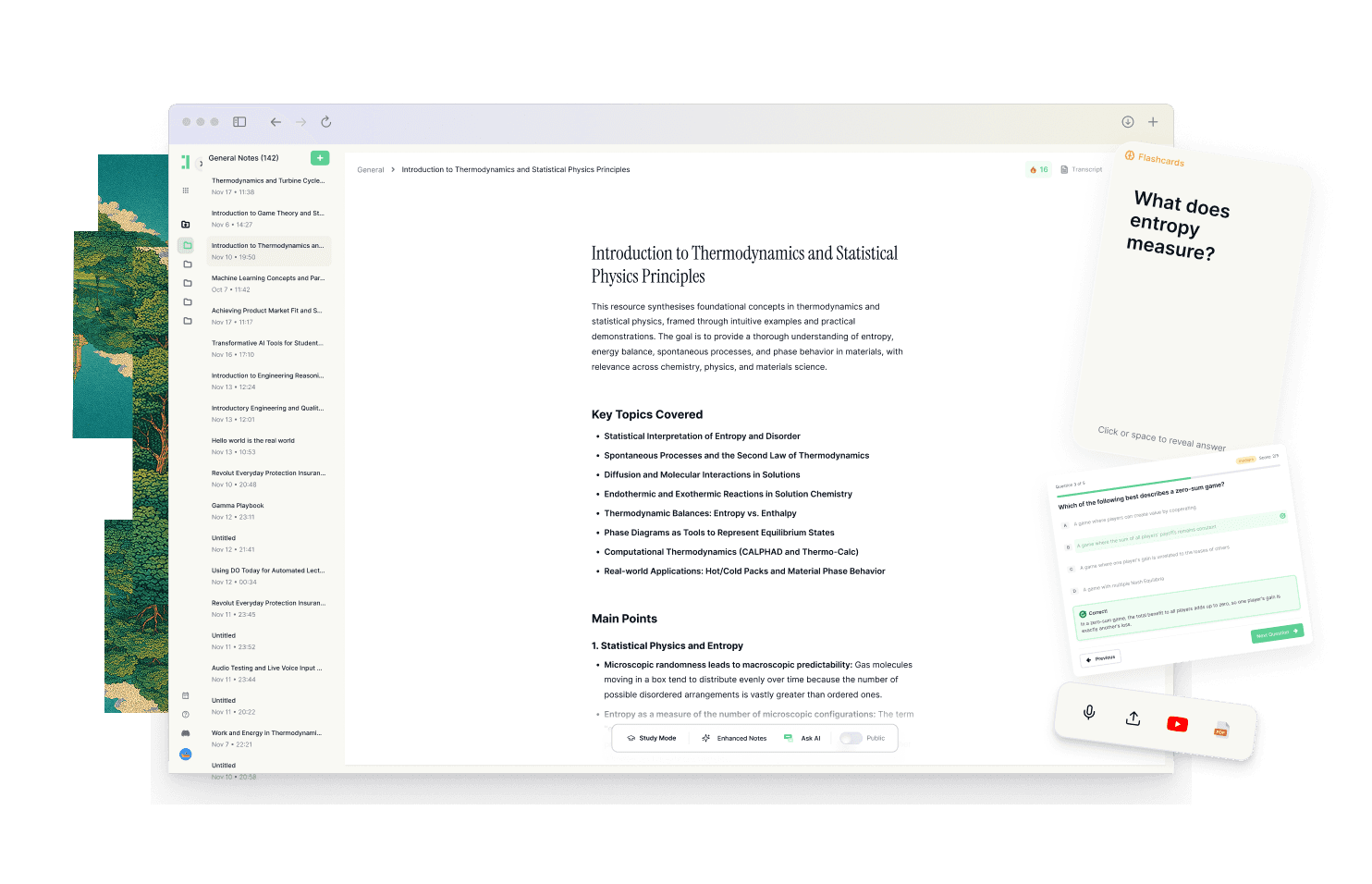
Duetoday approaches learning as a unified workflow rather than a collection of isolated tasks. It serves as a central workspace that holds everything you learn, including lecture recordings, PDFs, YouTube videos, and web articles. Instead of requiring you to manually build your study materials, Duetoday uses its AI brain to process your inputs. You can upload a lecture recording and receive a full transcription, then immediately turn that raw content into structured outputs like summaries, cheatsheets, and comprehensive study guides. This eliminates the 'blank page' problem and ensures that your study materials are directly derived from your actual curriculum.
Beyond simple storage, Duetoday builds a retention loop. It automatically generates active recall tools such as flashcards and quizzes from your uploaded files. Crucially, these materials remain connected to the source. If you are taking a quiz and hit a point of confusion, you can use the grounded AI chat to ask questions. The AI answers based specifically on your uploaded materials, not generic internet data, ensuring the explanation matches what your professor taught. By integrating with tools like Notion and Google Calendar, Duetoday also aligns your study sessions with your actual schedule, making it clear what you need to do next to meet your deadlines.
How the Duetoday workflow feels in real life
Imagine it is Monday afternoon and you just finished a complex biology lecture. Instead of dreading the hours of note-taking ahead, you simply upload the recording and the professor’s slide deck into Duetoday. By the time you’ve made a coffee, the system has transcribed the audio and generated a structured summary. You spend twenty minutes reviewing the summary and asking the AI tutor to clarify a specific pathway that didn't make sense in class. The system then generates a set of practice questions and flashcards based specifically on that day's content.
As the week progresses, these tasks appear on your execution layer, synced with your Google Calendar. You aren't just looking at a pile of 500 cards; you are following a structured plan. When the weekend review comes around, you use the 'teach me' mode to explain the concepts back to the AI. By the time the exam arrives, you haven't just memorized cards; you have engaged with the material through summaries, Q&A, and practice tests, all without ever leaving the workspace or manually formatting a single card.
Duetoday vs Anki in plain English
The fundamental difference between Duetoday and Anki is the starting point. Anki starts after the work is done. You must have the notes, you must understand them, and you must manually create the cards. It is a tool for the 'final mile' of memorization. Duetoday, however, starts the moment you receive your study materials. It assists in the transcription, the synthesis, and the comprehension phases before moving naturally into the retention and testing stages. This saves dozens of hours over the course of a semester that would otherwise be spent on administrative overhead.
In terms of usability, Duetoday offers a much flatter learning curve. There are no plugins to manage or complex deck settings to navigate. While Anki provides deep customization for those who want to tinker, Duetoday provides a ready-to-use system designed specifically for the pace of university life. Because Duetoday supports mixed-media and connects to your calendar, it feels like a personal teaching assistant that organises your life, whereas Anki feels like a very powerful but demanding filing cabinet.
Who should choose Duetoday
Duetoday is the ideal choice for university students who are overwhelmed by the sheer variety of learning inputs they have to manage. If your study materials are scattered across browser tabs, paper notebooks, and digital folders, Duetoday will provide the structure you need. It is specifically designed for those who face tight deadlines and need to move from 'new material' to 'exam ready' as efficiently as possible without getting lost in the weeds of tool setup.
It is also perfect for learners who prefer a multi-modal approach. If you find that just looking at flashcards isn't enough to help you understand a concept, the ability to toggle between summaries, AI-tutor chats, and practice quizzes within a single workspace will be a significant upgrade. If you want a system that tells you exactly what to do next based on your real-world schedule, Duetoday is the right fit.
Who should still choose Anki
You should stick with Anki if you are a long-term 'knowledge collector' who prioritizes local data privacy and total control over every aspect of the spaced repetition algorithm. If you are learning a language over many years or are in a medical residency where you intend to keep a single deck for a decade, Anki's permanence and community-driven longevity are major assets. It remains the best tool for those who enjoy the process of manual card creation as a primary way of engaging with their data.
Verdict
The choice between these two tools comes down to whether you need a storage vault or a study system. Anki is a world-class vault for storing facts you have already processed, but it offers little help in the actual process of learning. Duetoday is a unified study system that handles the transition from lecture to deep understanding, reducing fragmentation and ensuring that retention is built into every step of your workflow rather than being an afterthought.
FAQ
Is Duetoday only flashcards and quizzes?
No, Duetoday is a complete learning workspace that includes transcription, AI-powered summaries, cheatsheets, and a grounded AI tutor. While it generates flashcards and quizzes for retention, these are just one part of a larger system designed to help you understand and apply your course materials.
Does Duetoday work for lectures and YouTube?
Yes, you can upload lecture recordings directly for transcription or paste YouTube links to have the system process the video content. It treats these as primary sources, allowing you to generate notes and ask the AI questions about specific parts of the audio or video.
Will it help reduce cramming?
Duetoday helps reduce cramming by creating a structured execution layer that connects to your Google Calendar. By breaking down your materials into daily actions and bite-sized lessons, it makes consistent study more achievable than leaving everything for the week before an exam.
Can I still use Notion or Google Calendar?
Yes, Duetoday is designed to work alongside your existing tools. You can import content from Notion to use as a source for your AI brain, and the Google Calendar integration ensures your study plan respects your real-life appointments and deadlines.
Who is Anki still best for?
Anki remains the best choice for users who want a free, open-source, and local-first tool for long-term memorization. It is ideal for learners who have the time to manually build decks and want total control over the spaced repetition settings for years of continuous use.
Finding the right balance between collecting information and actually remembering it is the key to academic success.
Read More Alternative To Comparison
Turn lectures, PDFs, and notes into AI-Powered summaries, bite-sized
courses, flashcards, quizzes, and study plans.