
Free Templates for Students
Lab Report Template [Free Download]
Download a professional lab report template covering hypothesis, method, results, and discussion. Perfect for science students seeking structured reporting.
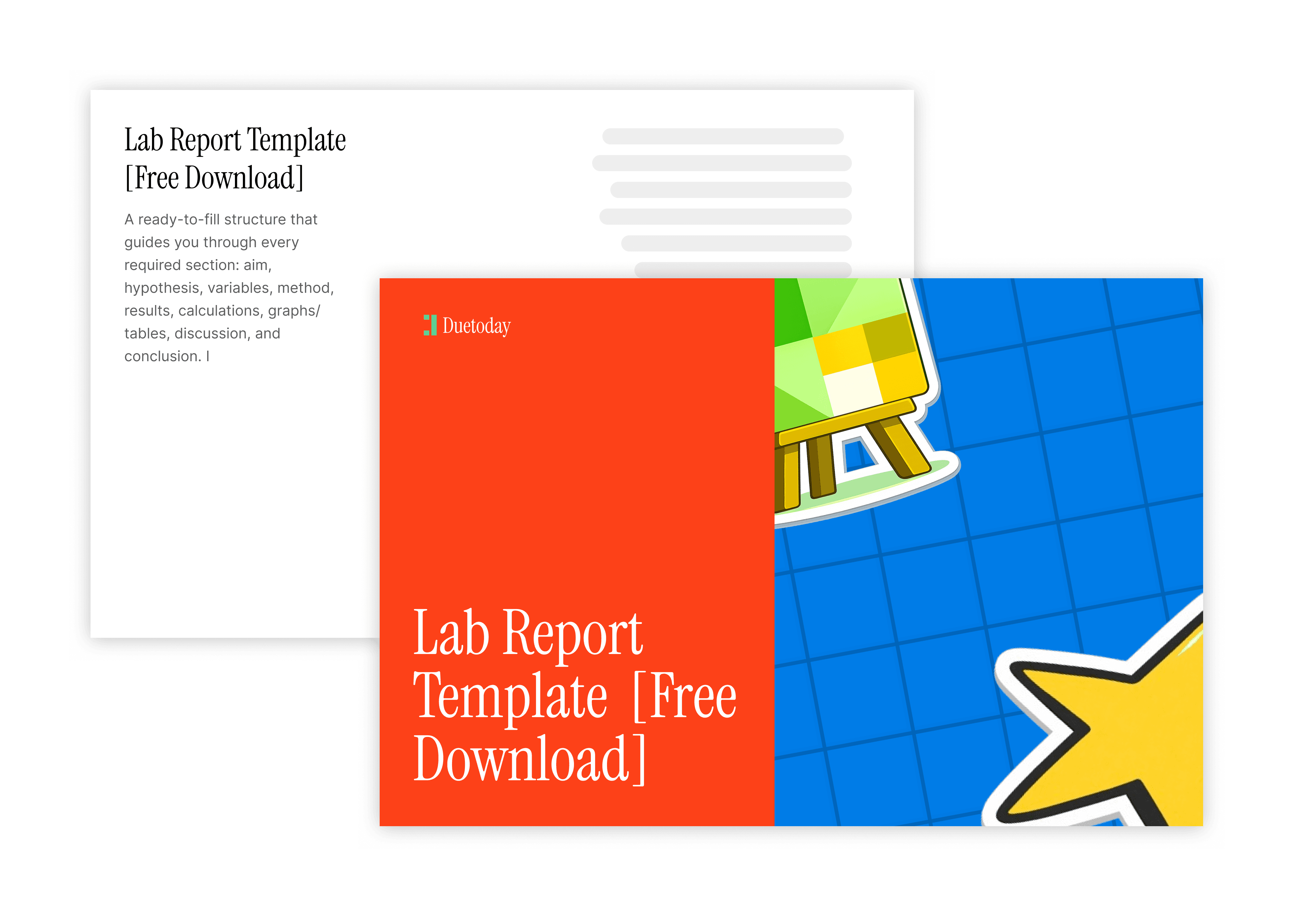
What’s inside? Exclusive insights into:
The importance of a structured scientific framework—from crafting a testable hypothesis to the final conclusion.
How to set yourself up for academic success using a printable or digital lab report template (so you’re not staring at a blank page for hours).
Everything you need to prepare across the sections: Introduction, Method, Results, and Discussion.
Looking to make your next science assignment less stressful? Here’s what you need to consider when structuring your lab report.
Lab Report Template: Here’s What You Need to Know
Anyone who has spent hours in a lab knows that the experiment is only half the battle. The real challenge starts when you sit down to write. A missing control variable, a messy data table, or a vague discussion can turn a brilliant experiment into a confusing report. That’s why science students learn quickly: structure isn’t just about following rules—it’s about clarity.
A simple Lab Report Template helps you streamline the chaos. It gives you a clear roadmap, removes last-minute guesswork, and makes sure you’re not relying on memory while trying to explain complex chemical reactions or biological processes at midnight. It also helps you avoid common mistakes like forgetting to label axes on a graph or failing to connect your results back to your original hypothesis.
Wait, are you struggling to keep up with lab briefings? Duetoday AI is designed for students who need to capture every detail. It transcribes lectures and lab instructions in real time, translates accents instantly, and turns your recordings or PDFs into clean notes, summaries, and even practice quizzes. It’s the ultimate tool for turning a fast-paced lab session into a high-quality report.
Set yourself up for a smoother writing process
A good experiment is great, but a clean report is what gets the grade. When you’re organized before you start writing, your logic feels predictable, your argument feels stronger, and you can focus on the actual science rather than the formatting. Even if you’re generally good at writing, a template protects you from the most human thing ever: forgetting to define your variables under pressure.

What your Lab Report Template should include
This template typically covers the primary sections required by most scientific journals and university departments:
1) Abstract & Introduction: A brief summary of the study followed by the background context and the purpose of your experiment.
2) The Hypothesis: A clear, testable statement predicting the outcome, usually in the "If... then..." format.
3) Materials and Methods: A detailed list of equipment and a step-by-step breakdown of your procedure so others can replicate your work.
4) Results & Data: Your raw findings presented through organized tables, charts, and graphs without interpretation.
5) Discussion: This is where you analyze the data. Did it support the hypothesis? Were there any errors? How does this relate to existing theory?
6) Conclusion & References: A final summary of findings and a properly formatted list of all sources cited.
Explore these related resources
How to Write a Hypothesis That Is Actually Testable
Common Errors in Lab Reporting (and how to avoid them)
Data Visualization 101: Creating Clear Charts for Science
How to Cite Scientific Sources in APA or MLA
Tips for Writing a Research Paper from Scratch
About Duetoday: Save hours every week on your studies. Duetoday transcribes lectures and lab discussions in real time, translates, summarizes, and organizes everything into structured notes and quick review tools like flashcards. From "I missed that" to "I’ve got this," Duetoday handles the heavy lifting of note-taking so you can focus on the science.
Lab Report Frequently Asked Questions
What should I do first before writing my lab report?
Start by organizing your raw data and ensuring your lab notes are complete. Review the rubric provided by your instructor to ensure you understand specific formatting requirements.
What is the difference between Results and Discussion?
The Results section is for objective data (what happened), while the Discussion section is for subjective interpretation (why it happened and what it means).
How do I write a strong hypothesis?
Make it specific, measurable, and falsifiable. Use the "If [independent variable changes], then [dependent variable will change]" structure as a baseline.
Should I write my lab report in the first person?
Traditionally, lab reports are written in the third-person passive voice (e.g., "The solution was heated") to maintain objectivity, but always check your department’s specific style guide.
Can I turn this template into a digital document?
Yes, you can easily copy these sections into Google Docs, Word, or Notion to create your own digital lab notebook.

Duetoday is an AI-powered learning OS that turns your study materials into personalised, bite-sized study guides, cheat sheets, and active learning flows.