Generate Flashcards for Respiratory System
Instantly turn your respiratory system notes or PDFs into flashcards. Try Duetoday for free today!
Generate Flashcards with AI Free
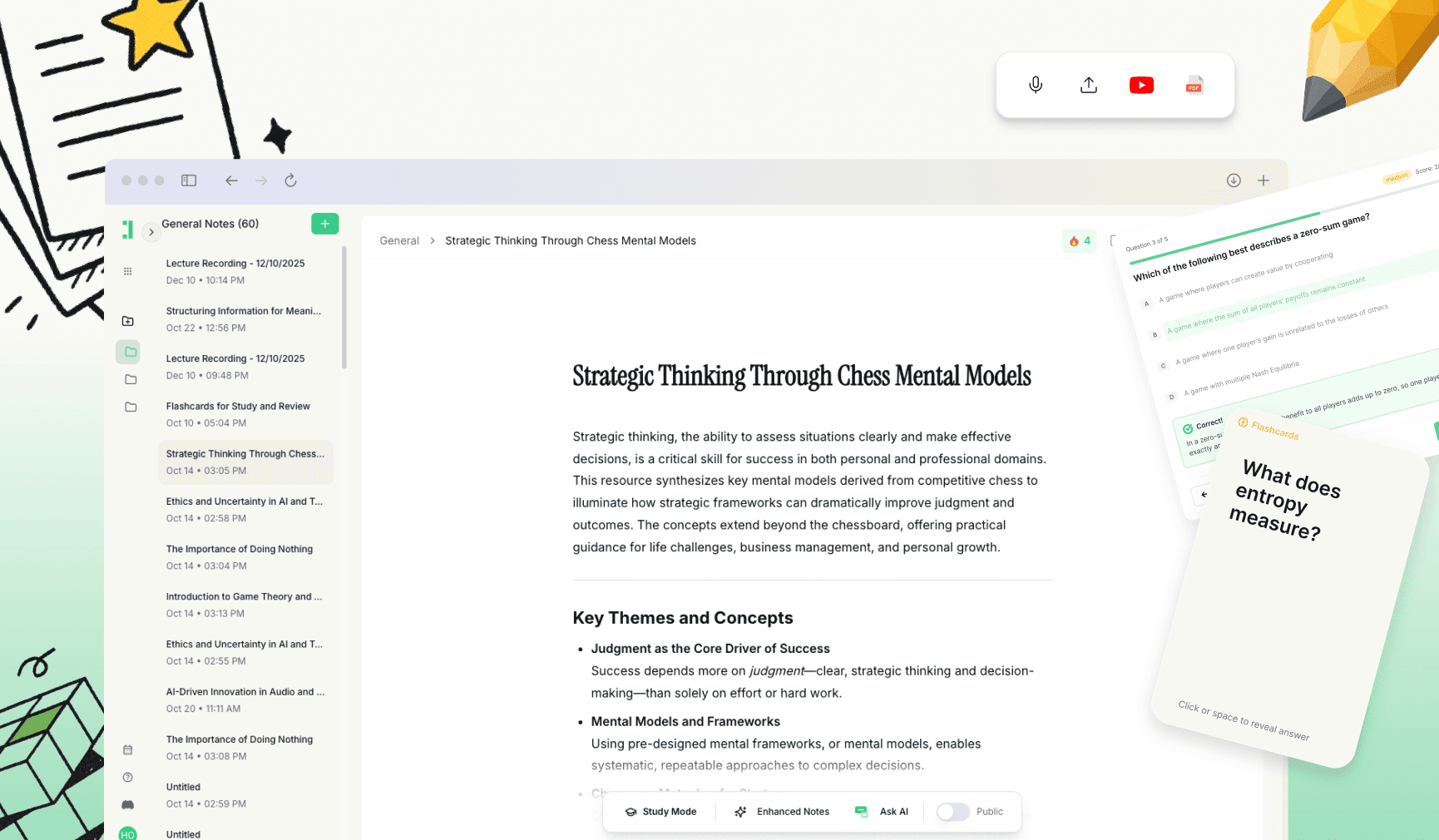
Generate Flashcards for Respiratory System
Turn your notes, PDFs, slides, or lectures into respiratory system flashcards so you can review faster and remember more. Whether you are studying anatomy, physiology, or clinical nursing, our AI helps you master the complexities of the human lungs and airway in minutes.
Generate Respiratory System FlashcardsUpload notes / paste text
In Duetoday, the process is simple: upload your materials, generate your cards, refine them with our AI, and start your study session. No more manual data entry; just better recall.
What are Respiratory System flashcards?
Respiratory system flashcards cover the anatomical structures and physiological processes involved in breathing. This includes everything from the upper respiratory tract (nose, pharynx) to the microscopic alveoli where gas exchange occurs. They break down complex cycles like Boyle's law, the hemoglobin-oxygen dissociation curve, and pulmonary ventilation into bite-sized, testable questions.
Instead of passively rereading a textbook chapter 40 pages long, these flashcards force you to actively retrieve information. If you already have notes, Duetoday can generate a clean deck in minutes, focusing on high-yield exam topics.
Why flashcards work for the Respiratory System
The respiratory system involves a mix of identification, sequential pathways, and physics-based rules. Flashcards are uniquely suited for these memory types because they allow you to isolate individual concepts like 'Tidal Volume' versus 'Vital Capacity' without getting overwhelmed.
Remember anatomical terms like bronchioles and alveoli without cramming.
Separate similar concepts such as external vs. internal respiration.
Learn the sequence of air flow through the respiratory tree step-by-step.
Practice applying gas laws and pressure gradients quickly.
What to include in your Respiratory System flashcards
The most effective respiratory flashcards follow the "one idea per card" rule. Use question-based prompts rather than long descriptions to trigger your memory effectively.
Definitions & key terms: "What is surfactant?" or "Define compliance in the lungs."
Processes & steps: "Which muscles contract during quiet inspiration?"
Comparisons: "How does the right lung differ from the left lung?"
Application: "What happens to intrapleural pressure during expiration?"
Example prompts for your deck:
- "Trace the path of an oxygen molecule from the nares to the alveoli."
- "List the factors that shift the oxygen-dissociation curve to the right."
- "What is the primary stimulus for breathing in a healthy individual?"
- "Identify the function of Type II alveolar cells."

How to study the Respiratory System with flashcards
We recommend a "two-pass" approach. First, generate your deck from your lecture slides and do a rapid pass to see what you know. Then, focus your energy on the physiological processes that are hardest to visualize.
Keep your sessions short (15-20 minutes) but frequent. Because the respiratory system involves many moving parts, repeating the tough cards daily for a week is better than a 5-hour marathon the night before the exam.
Make a deck from your notes or generate it from respiratory PDFs.
Do one quick round to find weak spots in gas exchange or volumes.
Review weak cards daily using spaced repetition.
Mix in a few harder cards, like clinical pathologies (COPD, asthma).
Do a final mixed review before your anatomy lab or lecture quiz.
Generate Respiratory System flashcards automatically
Making cards manually for anatomy is incredibly slow. You have to copy diagrams, type out definitions, and organize them into folders. Duetoday automates this so you can spend your time actually learning.
Positioning Duetoday as your study partner: simply upload your respiratory anatomy PDF or lecture transcript and let the AI extract the key facts.
Upload or paste your respiratory system material.
Click Generate Flashcards.
Review, edit, and start studying immediately.
Generate Respiratory System Flashcards in Duetoday
Start with your notes and get a deck you can actually use today.
Common Respiratory System flashcard mistakes
Most students make cards that are too wordy, leading to 'recognition' rather than 'recall.' If your card has a whole paragraph on the back, you aren't testing yourself properly.
Cards are too long: Break down 'The Mechanics of Breathing' into five separate cards.
Only memorizing definitions: Ensure you include 'how' and 'why' cards for gas exchange.
Confusing volumes: Create specific comparison cards for IRV, ERV, and TV.
Ignoring the diaphragm: Don't forget to include cards on the primary and accessory muscles.
Ready to generate your Respiratory System flashcards?
Stop rereading and start recalling. Turn those complex diagrams and dry textbook chapters into an interactive study tool that helps you ace your exams.
Start Generating Flashcards
Works with notes, PDFs, slides, and transcripts.
FAQ
How many flashcards do I need for the Respiratory System? A comprehensive deck usually ranges from 50 to 100 cards to cover anatomy, physiology, and respiratory volumes.
What’s the best format for Respiratory System flashcards? Question-and-answer format is best, often supplemented by image occlusion for anatomical structures.
How often should I review my cards? Daily reviews are recommended for the first week, then every few days as you master the concepts.
Should I make cards from a textbook or slides? Lecture slides usually contain the 'high-yield' material your professor will test, making them the best source.
How do I stop forgetting gas laws? Use flashcards that require you to explain the relationship between pressure and volume (Boyle's Law) in your own words.
What if my flashcards feel too easy? You may be making them too simple. Try adding 'Application' cards where you predict how the system reacts to changes like high altitude.
Can I generate respiratory flashcards from a PDF? Yes, Duetoday specializes in reading medical and science PDFs to extract key terms and concepts automatically.
Are digital flashcards better than paper? Digital cards allow for spaced repetition algorithms and quicker organization, which is essential for dense science topics.
How long does it take to make a full deck? With Duetoday, you can generate a full deck in under two minutes from your uploaded notes.
Can Duetoday organize my cards by sub-topic? Yes, you can generate and organize cards by specific sections like 'Upper Respiratory' or 'Gas Transport.'

Duetoday is an AI-powered learning OS that turns your study materials into personalised, bite-sized study guides, cheat sheets, and active learning flows.