Generate Flashcards for Nomenclature in Organic Chemistry
Try Duetoday to generate Organic Chemistry Nomenclature flashcards from your notes. Start for free!
Generate Flashcards with AI Free

Generate Flashcards for Nomenclature in Organic Chemistry
Turn your lecture notes, IUPAC guides, molecular diagrams, or structural slides into Nomenclature in Organic Chemistry flashcards so you can review faster and remember more.
Generate Nomenclature FlashcardsUpload notes / paste text
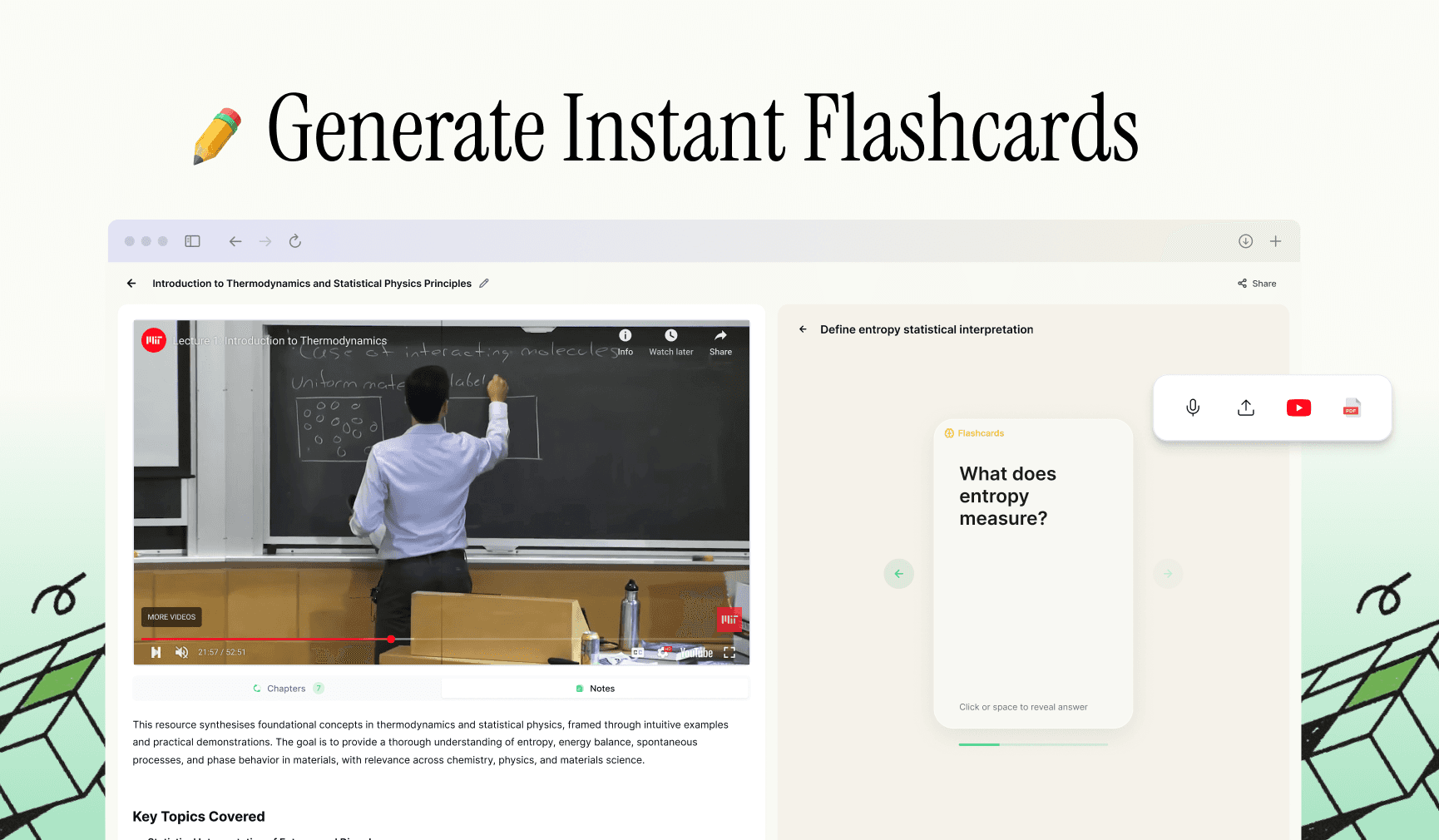
In Duetoday, simply upload your chemistry materials, and our AI will automatically generate a custom deck. You can review, edit, and start practicing active recall in under a minute.
What are Nomenclature in Organic Chemistry flashcards?
Nomenclature in Organic Chemistry flashcards are targeted study tools designed to help you master the systematic naming of organic compounds. They cover prefixes, suffixes, parent chain identification, numbering rules, and the prioritization of functional groups.
Instead of staring at a complex molecule and guessing its name, these flashcards force you to apply IUPAC rules step-by-step. By testing yourself on specific naming conventions and structural identifying features, you build the mental pathways needed for exam speed and accuracy. If you already have notes, Duetoday can generate a clean deck in minutes.
Why flashcards work for Nomenclature in Organic Chemistry
Nomenclature requires a mix of rote memorization (names of alkanes) and logical application (rule hierarchies). Flashcards are the perfect bridge between these two types of learning by utilizing active recall and spaced repetition.
Memorize functional group priorities (e.g., Carboxylic Acid vs. Alcohol)
Distinguish between similar isomers (e.g., ortho- vs. meta- substitution)
Master numbering rules for branched chains and cycles
Practice translating structures to names and names to structures
What to include in your Nomenclature flashcards
Effective organic chemistry flashcards follow the "atomic" rule: one specific rule or structure per card. Use a mix of visual structures and text-based questions to ensure you can think in both directions.
Definitions & key terms: "What is a locant?" "Define the IUPAC suffix for an amide."
Processes & steps: "What is the first step in naming a multicyclic alkane?"
Comparisons: "What is the difference between an -ate and an -oate ending?"
Application: "Name this structure (image attached)" or "Draw 3-ethyl-2-methylpentane."
How to study Nomenclature with flashcards
Studying organic chemistry is about pattern recognition. Start by building your deck from your textbook or lecture slides, then move into high-frequency review rounds. Focus on the molecules that look similar but have different naming rules.
Review your deck daily to keep the priority rules fresh. Use Duetoday to flag the structures you consistently misname, and repeat those daily until they become second nature. Before an exam, run a mixed review of all functional groups to ensure you don't confuse specific rules.
Generate Nomenclature flashcards automatically in Duetoday
Manual flashcard creation is the biggest bottleneck for chemistry students. Drawing structures by hand and writing out long IUPAC names takes hours you could be spending practicing. Duetoday simplifies the process by reading your PDFs and slides to build the deck for you.
Upload your Nomenclature chapter or lecture transcript
Click Generate Flashcards
Review, edit, and start studying instantly
Common Nomenclature flashcard mistakes
Too much info: Don't try to name a molecule with 5 functional groups on one card; break it down.
Ignoring priority: Forgetting to include priority rankings for multi-functional compounds.
Text-only cards: Nomenclature is visual; always ensure you are practice naming from actual structures.
Skipping the 'why': If you get a name wrong, add a card explaining why a specific numbering path was chosen.
FAQ
How many flashcards do I need for Nomenclature? Aim for 50-100 cards covering basic chains, common branches, and each major functional group.
What’s the best format for these cards? A mix of 'Structure to Name' and 'Name to Structure' cards is most effective.
Should I make cards from my textbook or slides? Use your lecture slides first, as professors often emphasize specific naming conventions they prefer to test.
Can I generate flashcards from a chemistry PDF? Yes, Duetoday can parse your organic chemistry PDFs to extract naming rules and structures.
How often should I review? Nomenclature is a 'use it or lose it' skill; review for 10 minutes every day leading up to your exam.

Duetoday is an AI-powered learning OS that turns your study materials into personalised, bite-sized study guides, cheat sheets, and active learning flows.