Generate Flashcards for Le Chatelier’s Principle
Generate Le Chatelier's Principle flashcards in seconds. Try out free AI-powered study tools today!
Generate Flashcards with AI Free
Generate Flashcards for Le Chatelier’s Principle
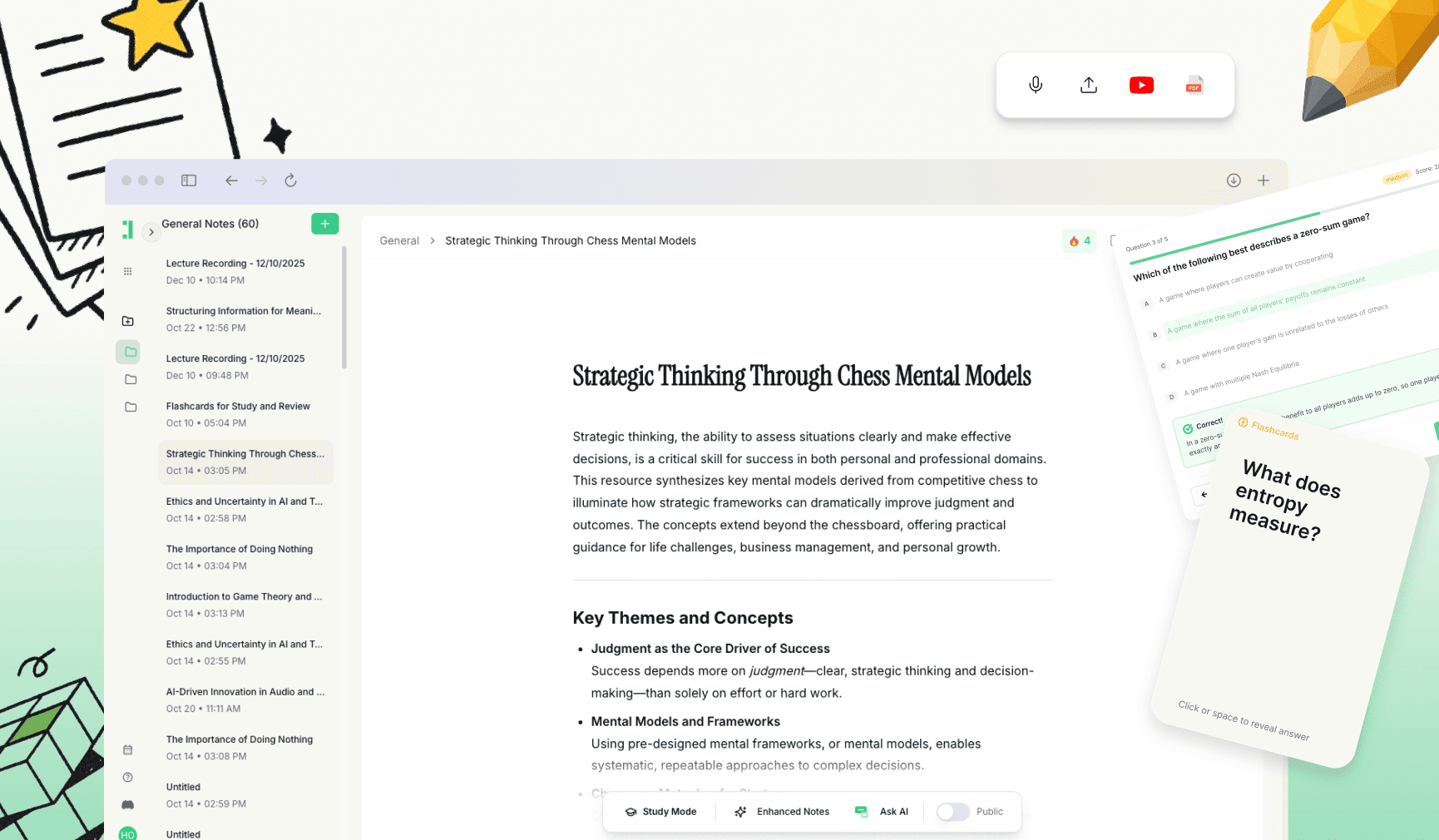
Turn your chemistry notes, PDFs, slides, or lecture transcripts into Le Chatelier’s Principle flashcards so you can review faster and remember more. Whether you are struggling with endothermic shifts or gas pressure changes, Duetoday helps you master equilibrium in minutes.
Generate Le Chatelier’s Principle FlashcardsUpload Study Material
Using Duetoday is simple: upload your chemistry materials, and our AI instantly identifies key concepts to generate high-quality flashcards. You can then edit, organize, and study your deck anywhere.
What are Le Chatelier’s Principle flashcards?
Le Chatelier’s Principle flashcards cover the fundamental rules governing chemical equilibrium. They focus on predicting how a system at equilibrium responds to external stresses, such as changes in concentration, temperature, pressure, or volume.
The outcome is simple: instead of passively rereading your textbook, you test your ability to predict shifts in real-time. This builds the active recall necessary for chemistry exams where you must apply rules to new reaction scenarios. If you already have notes, Duetoday can generate a clean deck in minutes.
Why flashcards work for Le Chatelier’s Principle
Le Chatelier’s Principle requires both memorization of rules and the ability to apply them to specific equations. Flashcards are perfect for this because they force you to commit to an answer before seeing the result.
Remember the direction of equilibrium shifts without cramming
Separate similar concepts like adding a catalyst vs. changing temperature
Learn multi-step processes for industrial chemical reactions
Practice applying the principle to complex gaseous systems
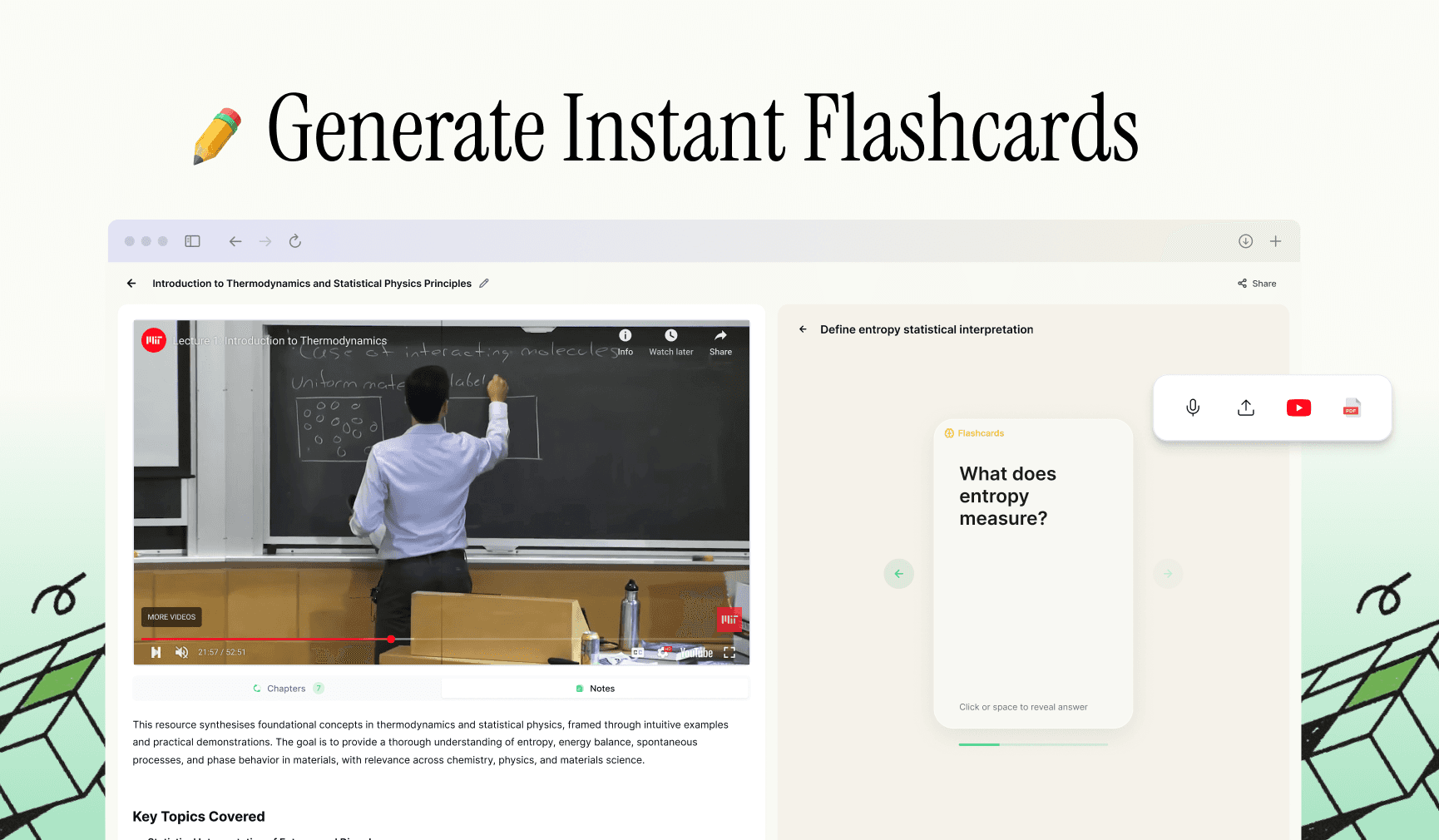
What to include in your Le Chatelier’s Principle flashcards
Good flashcards follow the "atomic" rule: one idea per card. Use question-based prompts to ensure you aren't just recognizing words but actually understanding the chemistry behind them.
Definitions: Explain what 'dynamic equilibrium' and 'stress' mean.
Processes: Describe what happens when a reactant is added or removed.
Comparisons: Contrast how temperature affects exothermic vs. endothermic reactions.
Application: Predict the shift for a specific chemical equation provided on the card.
Example prompts include: "What happens if volume decreases in a system with more gas moles on the left?", "How does an increase in temperature affect an exothermic reaction?", and "Does adding a catalyst change the equilibrium position?"
How to study Le Chatelier’s Principle with flashcards
To master this topic, use a two-pass approach. First, build your deck using Duetoday to ensure all your lecture material is covered. Then, review in rounds to identify which specific stressors (like pressure or heat) are confusing you.
Make a deck from your chemistry notes or textbook PDF.
Do a quick round to find weak spots in predicting gas shifts.
Review high-difficulty cards daily using spaced repetition.
Mix in calculation cards (like Q vs K) to see how shifts happen.
Perform a final review of all cards before your lab or exam.
Generate flashcards automatically in Duetoday
Making chemistry cards manually is slow and often results in cards that are too wordy or confusing. Duetoday automates the process so you can focus on the actual science.
Simply upload your PDF, slides, or even a recording of your chemistry lecture. Duetoday transcribes the content and generates accurate, concise flashcards for you to study instantly.
Upload your Le Chatelier’s material
Click 'Generate Flashcards'
Refine your deck and start your study session
Generate Le Chatelier’s Principle Flashcards in Duetoday
Start with your notes and get a deck you can actually use today.
Common Le Chatelier’s Principle mistakes
Many students make the mistake of creating cards that are too long. Keeping cards simple prevents you from memorizing a paragraph rather than the concept.
Cards are too long: Split complex reactions into individual cards for each stressor.
Ignoring states of matter: Ensure cards specify if a substance is a solid or a gas.
Confusing heat: Always label reactions as ΔH > 0 or ΔH < 0 on the card front.
No application practice: Move beyond definitions to 'If X happens, then Y shifts...' prompts.
Ready to generate your Le Chatelier’s Principle flashcards?
Stop rereading your chemistry textbook and start recalling the facts. Upload your notes to Duetoday, generate your flashcards, and use active recall to ace your next chemistry test.
Start Generating Flashcards
Works with notes, PDFs, slides, and transcripts.
FAQ
How many flashcards do I need for Le Chatelier’s Principle? Typically 20-30 cards are enough to cover the core stressors: concentration, temperature, pressure, and volume, plus common exceptions like catalysts.
What’s the best format for these flashcards? Use an 'If-Then' format. For example: 'If pressure increases, which way does the equilibrium shift?' This mimics exam questions.
How often should I review? Chemistry concepts fade fast. Review your deck daily for three days, then every other day until your exam to lock the principles into long-term memory.
Should I make cards from a textbook or notes? Both. Textbooks provide the theory, but lecture notes often contain specific examples your professor prefers, which are perfect for flashcards.
How do I stop forgetting the shifts after a few days? Use spaced repetition through Duetoday. It automatically resurfaces the cards you find difficult more frequently than the ones you know well.
What if my flashcards feel too easy? If you've mastered the basics, generate more complex cards that involve shifting equilibrium in reactions with varying moles of gas or multiple stressors.
Can I generate flashcards from a PDF automatically? Yes, Duetoday can scan your chemistry PDF and extract all the equilibrium rules and examples into a study-ready deck.
Are digital flashcards better than paper? For chemistry, digital is often better because you can easily include complex chemical equations and diagrams without manual drawing.
How long does it take to make a full deck? Manually, it takes an hour. With Duetoday’s AI, it takes less than a minute once your notes are uploaded.
Can Duetoday organize my cards by sub-topic? Yes, you can categorize your cards into groups like 'Temperature Shifts' and 'Pressure Changes' for targeted study.

Duetoday is an AI-powered learning OS that turns your study materials into personalised, bite-sized study guides, cheat sheets, and active learning flows.