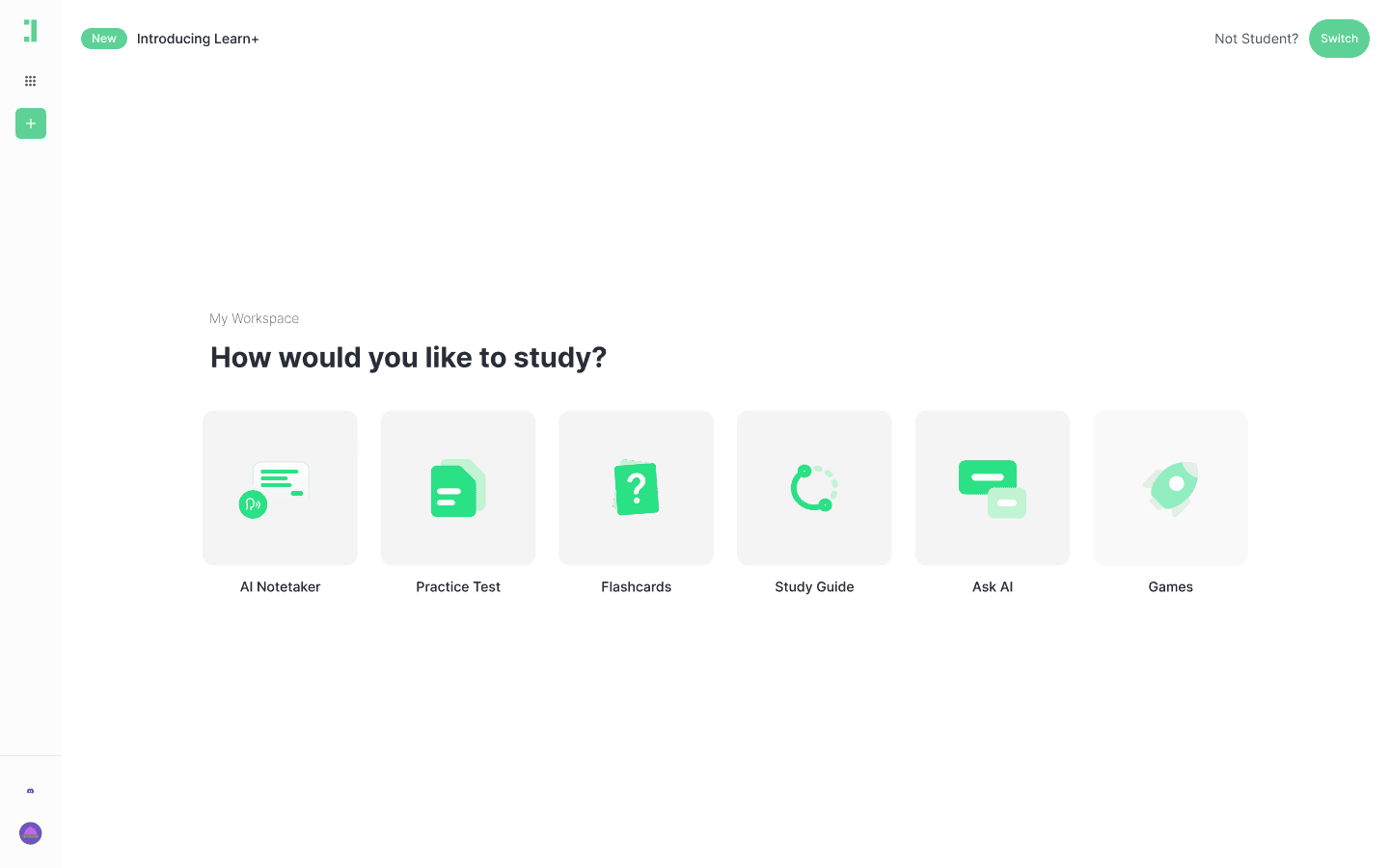
Generate Flashcards for Vector Calculus
Make Vector Calculus flashcards today. Generate study guides from your notes to master line integrals and vector fields.
Generate Flashcards with AI Free
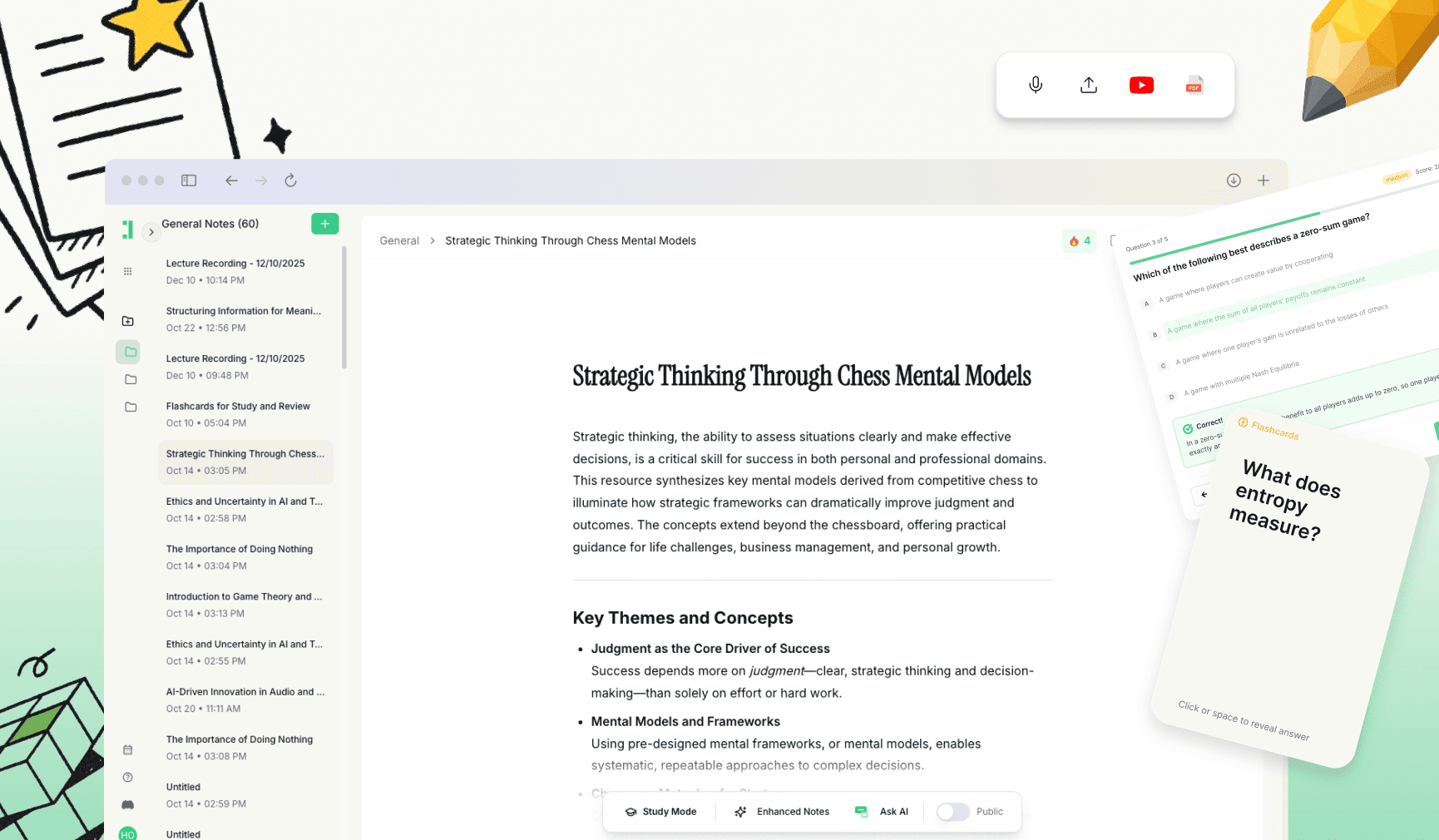
Generate Flashcards for Vector Calculus
Turn your complex multivariable notes, PDFs, slides, or lecture transcripts into Vector Calculus flashcards so you can review faster and remember more. Vector calculus is dense with formulas and 3D visualizations; stop wasting hours manually writing cards and start mastering the material.
Generate Vector Calculus FlashcardsUpload notes / paste text
In Duetoday, the process is simple: upload your study material, generate a custom deck, review or edit the results, and start your study session immediately.
What are Vector Calculus flashcards?
Vector Calculus flashcards are specialized study tools that cover the high-level concepts of multivariable mathematics, including vector fields, gradient vectors, conservative fields, and integral theorems. They transform dense mathematical theory into digestible questions that test your ability to identify patterns and apply formulas.
Instead of passively rereading your textbook, these flashcards force you to actively recall the definition of a line integral or the physical significance of the curl of a vector field. This active testing builds the neural pathways required for complex problem-solving. If you already have notes, Duetoday can generate a clean deck in minutes.
Why flashcards work for Vector Calculus
Vector Calculus requires a unique blend of spatial reasoning and algebraic precision. Flashcards are ideal for this subject because they help bridge the gap between theoretical definitions and practical application through spaced repetition.
Remember multivariable identities and formulas without cramming.
Separate similar concepts like Stoke's Theorem vs. the Divergence Theorem.
Learn multi-step derivation processes and integration pathways.
Practice identifying conservative vector fields at a glance.
Master the relationship between scalar fields and their gradients.
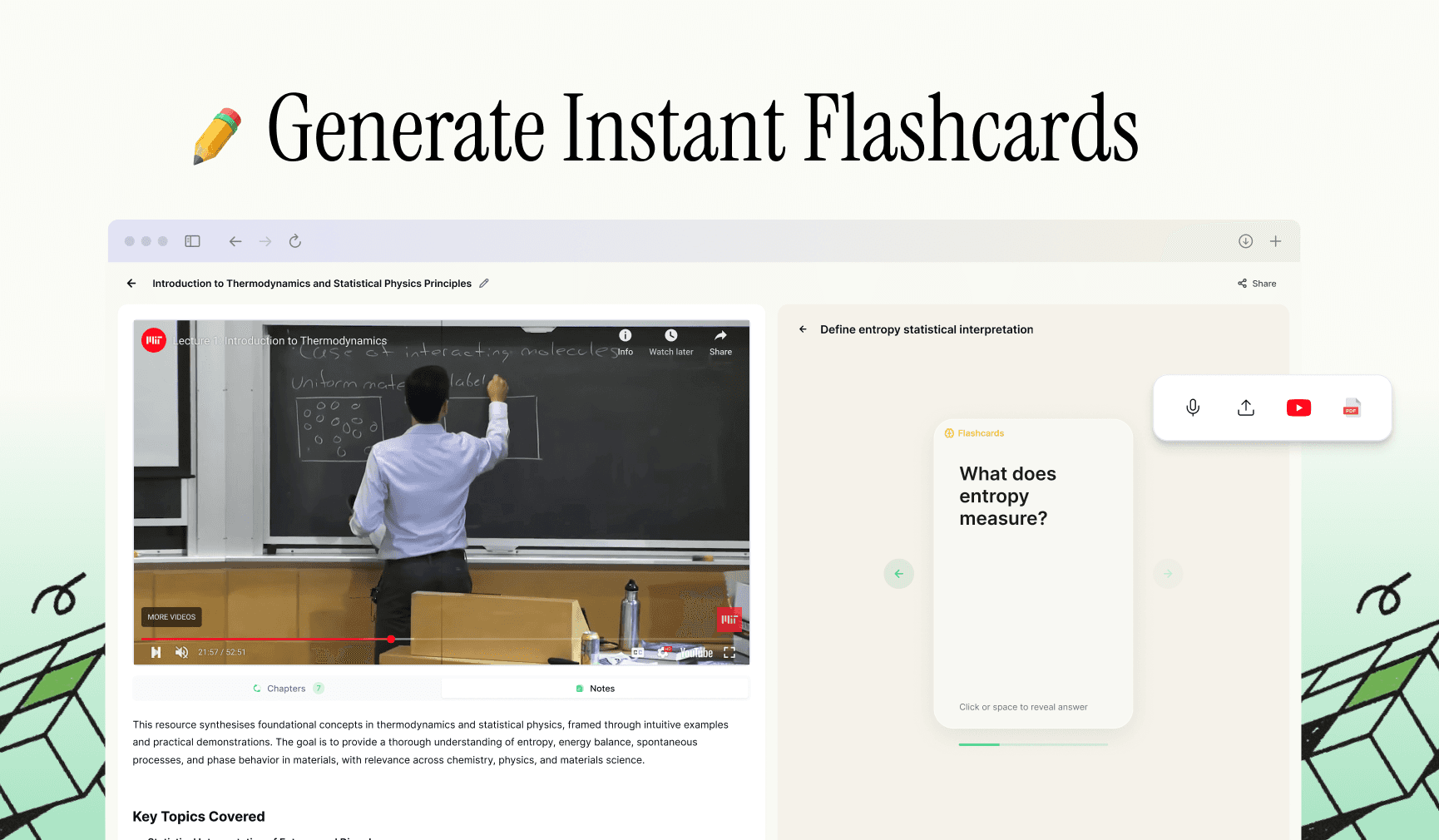
What to include in your Vector Calculus flashcards
Effective math flashcards follow the "one idea per card" rule. Use question-based prompts that focus on both the 'how' and the 'why' of the calculation. This ensures you aren't just memorizing symbols, but understanding the underlying geometry.
Definitions & Key Terms: "What is the geometric interpretation of the gradient?"
Processes & Steps: "What is the first step in evaluating a surface integral over a parameterized surface?"
Comparisons: "How does a line integral of a scalar function differ from a line integral of a vector field?"
Application: "When is the Fundamental Theorem of Line Integrals applicable?"
Example prompts include: "State the formula for the arc length of a space curve," "Define a solenoidal vector field," and "What does a zero divergence imply about a fluid flow?"
How to study Vector Calculus with flashcards
Mastering this subject requires a two-pass approach. First, use Duetoday to build your deck from your syllabus or lecture slides, then review in focused rounds to build speed and accuracy.
Make a deck from your notes or generate it directly from a textbook PDF.
Do one quick round to identify which theorems or formulas are tripping you up.
Review the cards for Green's Theorem and Stoke's Theorem daily until they are second nature.
Mix in harder application problems to avoid pattern-matching based on card order.
Complete a final mixed review of all operators (gradient, divergence, curl) before your exam.
Generate Vector Calculus flashcards automatically in Duetoday
Writing out LaTeX formulas and drawing vector diagrams by hand is slow and often leads to messy study habits. Duetoday positions you to win by automating the tedious parts of study prep.
Upload or paste your Vector Calculus material (Slides, PDFs, or Handwritten notes).
Click Generate Flashcards and let the AI extract the core concepts.
Review and customize your deck, then start studying instantly.
Generate Vector Calculus Flashcards in Duetoday
Start with your notes and get a deck you can actually use today to ace your multivariable exams.
Common Vector Calculus flashcard mistakes
Avoid the trap of making cards that are too long. If a card covers the entire proof of the Divergence Theorem, it’s too complex—break it into individual steps. Don't just memorize the symbols; add "explain the meaning" prompts to ensure you understand the physics behind the math. Finally, don't ignore the conditions (like continuity or simple connectedness) that make theorems valid.
FAQ
How many flashcards do I need for Vector Calculus? Usually, a comprehensive deck for a single unit contains 30-50 cards, focusing on formulas, theorems, and conceptual definitions.
What’s the best format for Vector Calculus flashcards? A mix of 'Prompt/Response' for formulas and 'Image/Interpretation' for vector field visualizations works best.
How often should I review Vector Calculus flashcards? Review new cards daily for the first week, then use spaced repetition to revisit them every few days until the exam.
Should I make cards from a textbook or slides? Use lecture slides for the core shortcuts your professor prefers, and the textbook for more rigorous definitions.
How do I stop forgetting formulas after a few days? Spaced repetition is key. Use Duetoday’s system to repeat difficult cards more frequently.
Can I generate Vector Calculus flashcards from a PDF automatically? Yes, Duetoday can scan your textbook or lecture PDFs and extract the key mathematical concepts into cards.
Are digital flashcards better than paper for math? Yes, because they allow for easy editing of complex formulas and better organization of multi-step processes.
How long does it take to make a full Vector Calculus deck? Manually it could take hours, but with Duetoday’s AI, you can generate a full deck in under one minute.
Can Duetoday handle LaTeX or mathematical symbols? Yes, Duetoday is designed to recognize and format mathematical notation for clear study sessions.

Duetoday is an AI-powered learning OS that turns your study materials into personalised, bite-sized study guides, cheat sheets, and active learning flows.