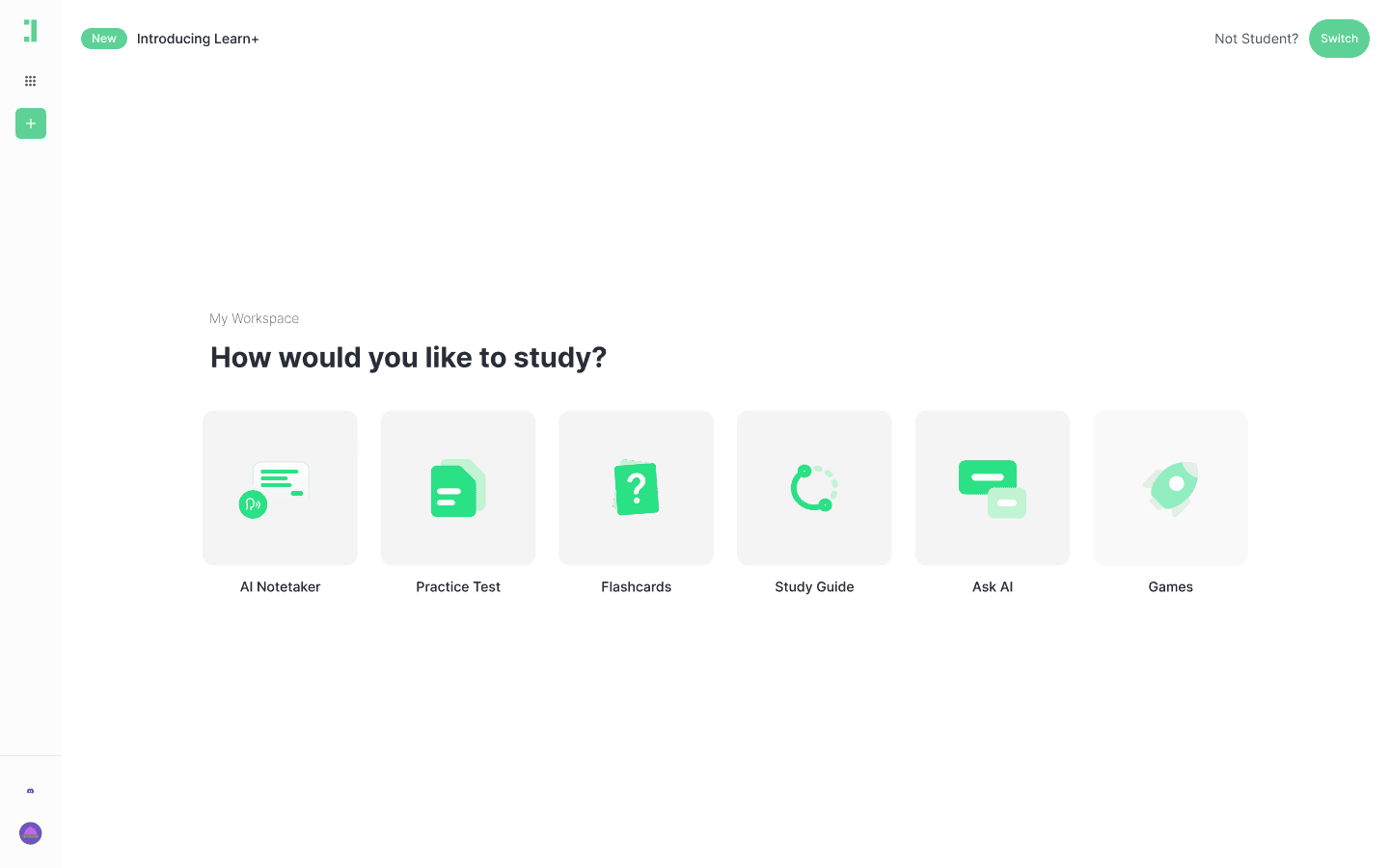
Generate Flashcards for Units and Measurement
Generate Units and Measurement flashcards in seconds with AI. Try out free and master SI units now.
Generate Flashcards with AI Free
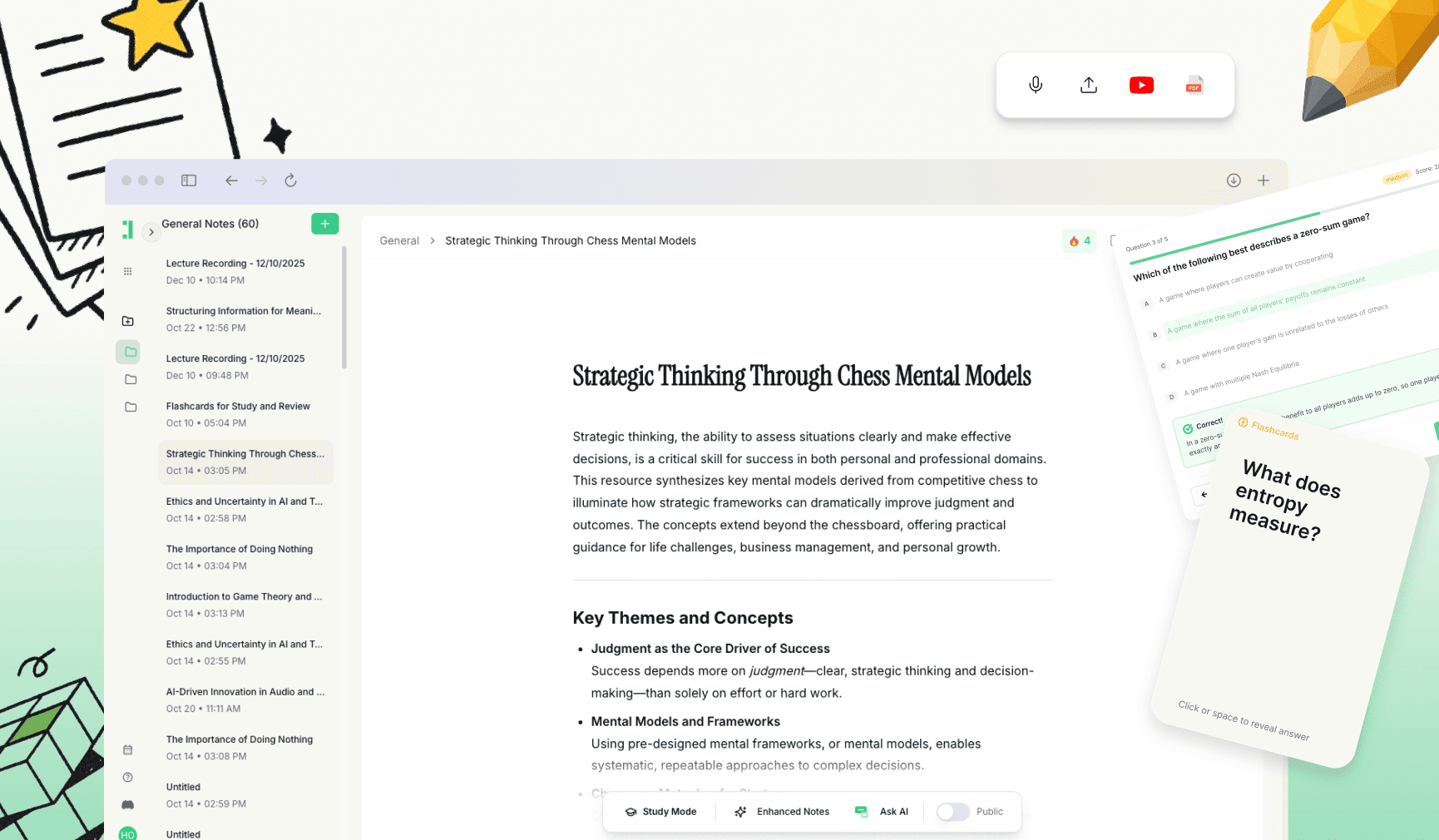
Generate Flashcards for Units and Measurement
Turn your notes, PDFs, slides, or lectures into Units and Measurement flashcards so you can review faster and remember more. Whether you are tackling physics fundamentals or chemistry basics, our AI helps you master conversions and significant figures effortlessly.
Generate Units and Measurement FlashcardsUpload notes / paste text
In Duetoday, the process is simple: upload your study material, generate your deck, review or edit the cards, and start studying with built-in active recall. No more manual typing or formatting.
What are Units and Measurement flashcards?
Units and Measurement flashcards cover the foundational language of science, including SI base units, derived units, dimensional analysis, and measurement uncertainty. These cards break down complex conversions and rules into bite-sized questions that test your knowledge of how we quantify the physical world.
Instead of passively rereading your textbook, these flashcards force you to retrieve information from memory. This builds stronger neural pathways and ensures you don't just recognize the terms, but can actually apply them in a lab or exam setting. If you already have notes, Duetoday can generate a clean deck in minutes.
Why flashcards work for Units and Measurement
Units and Measurement require a mix of rote memorization (like unit symbols) and logic-based application (like significant figure rules). Flashcards are the perfect bridge between these two styles of learning. By using active recall and spaced repetition, you ensure that basic conversion factors become second nature.
Remember SI prefixes and symbols without last-minute cramming.
Separate similar concepts like precision vs. accuracy.
Learn multi-step dimensional analysis pathways.
Practice applying rounding rules and scientific notation quickly.
What to include in your Units and Measurement flashcards
Effective flashcards follow the "atomic" rule: one idea per card. When studying measurements, focus on turning formulas and rules into specific questions. This prevents your brain from getting overwhelmed and ensures you truly understand each individual concept.
Definitions & key terms: "What is a derived unit?" "Define a parallax error."
Processes & steps: "What is the first step in dimensional analysis?"
Comparisons: "How does a systematic error differ from a random error?"
Application: "How many significant figures are in 0.0045?" "Convert 5km to mm."
Example prompts include: "What is the SI unit for luminous intensity?", "State the rule for adding significant figures," and "What does the prefix 'pico' represent in powers of ten?"
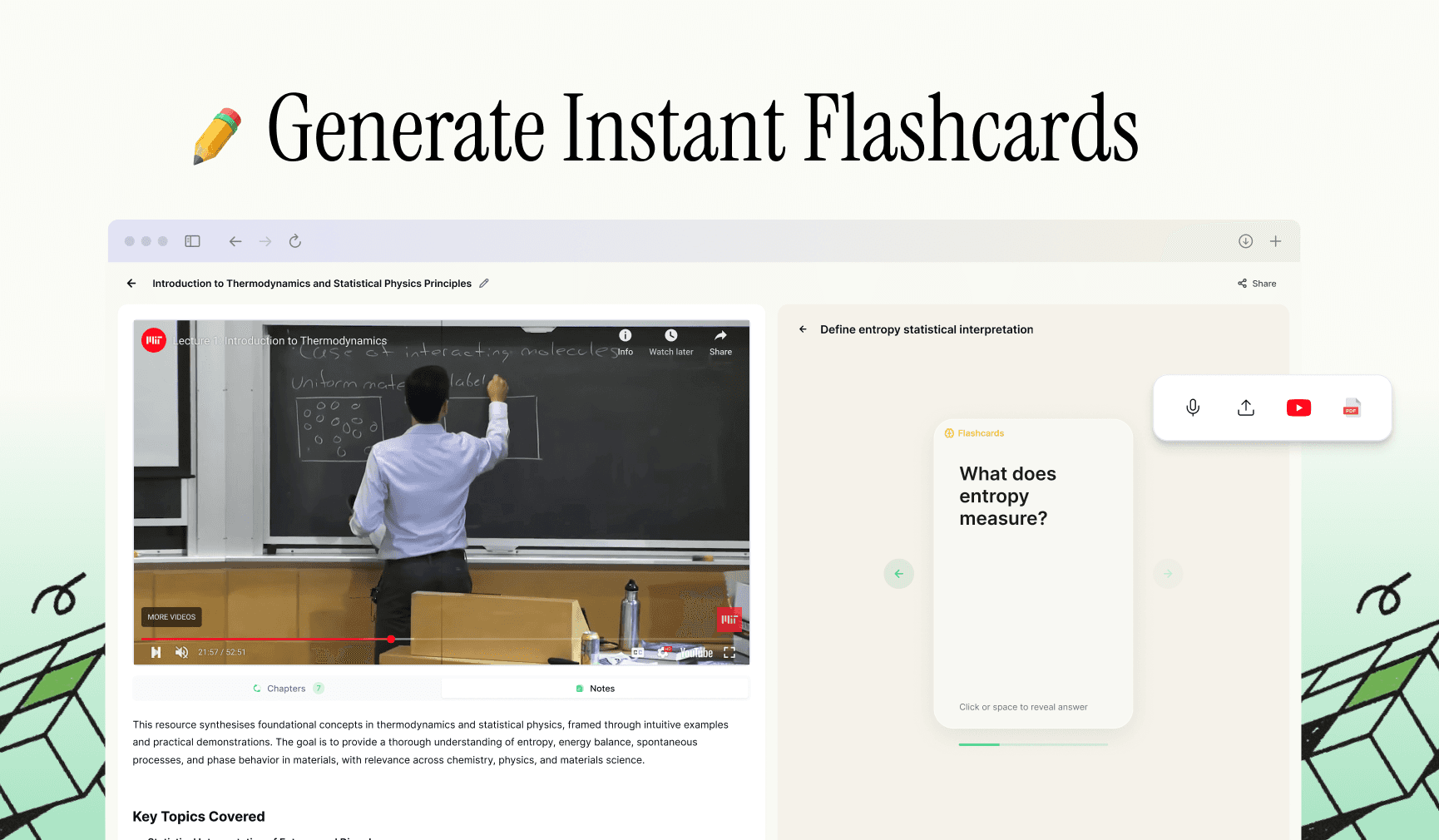
How to study Units and Measurement with flashcards
Success in measurement topics comes from a two-pass approach. First, generate your deck and do a high-speed pass to see which units or rules you already know. Then, focus your energy on the specific conversions or error types that trip you up.
Keep your sessions short but frequent. Reviewing your measurement cards for 15 minutes a day is far more effective than a three-hour marathon. As concepts like dimensional analysis become easier, move those cards to a 'weekly review' pile while keeping the harder formulas in your daily rotation.
Make a deck from your notes or generate it from your textbook PDF.
Do one quick round to find weak spots in unit conversions.
Review weak cards daily for a few days to build fluency.
Mix in harder dimensional analysis problems each session.
Do a final mixed review before your physics or chemistry exam.
Generate Units and Measurement flashcards automatically
Making flashcards by hand is a secondary task that steals time from actual studying. Typing out every unit conversion and definition is slow, messy, and often leads to bloated cards that are hard to memorize.
Duetoday transforms this workflow. Simply upload your lecture slides, PDFs, or handwritten notes, and our AI identifies the core concepts of Units and Measurement to create a professional study deck instantly. You spend your time learning, not formatting.
Upload or paste your Units and Measurement material.
Click Generate Flashcards.
Review, edit, and start studying immediately.
Generate Units and Measurement Flashcards in Duetoday
Start with your notes and get a deck you can actually use today.
Common Units and Measurement flashcard mistakes
Most students fail because their cards are too long. If a card asks for 'all SI units,' it is too broad. Instead, create seven individual cards for each base unit. Another mistake is ignoring the 'why'—don't just memorize the name of an error; include a card on how to fix it.
Cards are too long: split into one conversion or definition per card.
Only memorizing words: add 'solve this' prompts for significant figures.
Confusing precision and accuracy: create a direct comparison card.
No review schedule: use spaced repetition to keep prefixes fresh.
Ignoring units in formulas: add cards that ask for the units of a final answer.
Ready to generate your Units and Measurement flashcards?
Stop rereading your chapters and start testing your knowledge. Upload your notes, generate your custom deck, and master the fundamentals of science with active recall. Duetoday makes it easy to turn even the densest physics material into a study-ready resource.
Start Generating Flashcards
Works with notes, PDFs, slides, and lecture transcripts.
FAQ
How many flashcards do I need for Units and Measurement? Typically, a comprehensive deck for this topic ranges from 40 to 60 cards, covering SI units, prefixes, error types, and significant figure rules.
What’s the best format for these flashcards? Question-and-answer format is best. For example: 'What is the SI unit for temperature?' on the front, and 'Kelvin (K)' on the back.
How often should I review my cards? Review daily for the first week until you've mastered the prefixes and conversions, then switch to once every few days to maintain recall.
Should I make cards from a textbook or my own notes? Both. Textbooks provide the standard definitions, while your notes often contain the specific examples your teacher emphasized in class.
How do I stop forgetting unit conversions? Use spaced repetition. By reviewing the cards just as you are about to forget them, you lock the conversion factors into your long-term memory.
What if my cards feel too easy? If a card is too easy, it means you've mastered it. Move it to a 'Mastered' pile and focus on more complex topics like dimensional analysis.
Can I generate flashcards from a PDF? Yes, Duetoday is designed to scan your PDFs and extract the most important measurement concepts to create cards automatically.
Are digital flashcards better than paper? Digital cards are generally better because they allow for automated spaced repetition and are easier to organize and carry.
How long does it take to create a full deck? With Duetoday, you can generate a full deck in under a minute, compared to over an hour if done manually.
Can Duetoday organize my cards for me? Yes, Duetoday categorizes your cards and tracks your progress so you know exactly which units you need to study more.

Duetoday is an AI-powered learning OS that turns your study materials into personalised, bite-sized study guides, cheat sheets, and active learning flows.