Generate Flashcards for UI/UX Design
Make custom UI/UX Design flashcards. This guide shows how to generate study decks for UX laws and UI principles.
Generate Flashcards with AI Free
Generate Flashcards for UI/UX Design
Turn your design theory notes, accessibility guidelines, Figma shortcuts, or UX research papers into UI/UX Design flashcards. Instead of endlessly scrolling through screenshots or re-watching tutorials, Duetoday helps you review faster and remember long-term through active recall.
Generate UI/UX Design FlashcardsUpload Design Notes
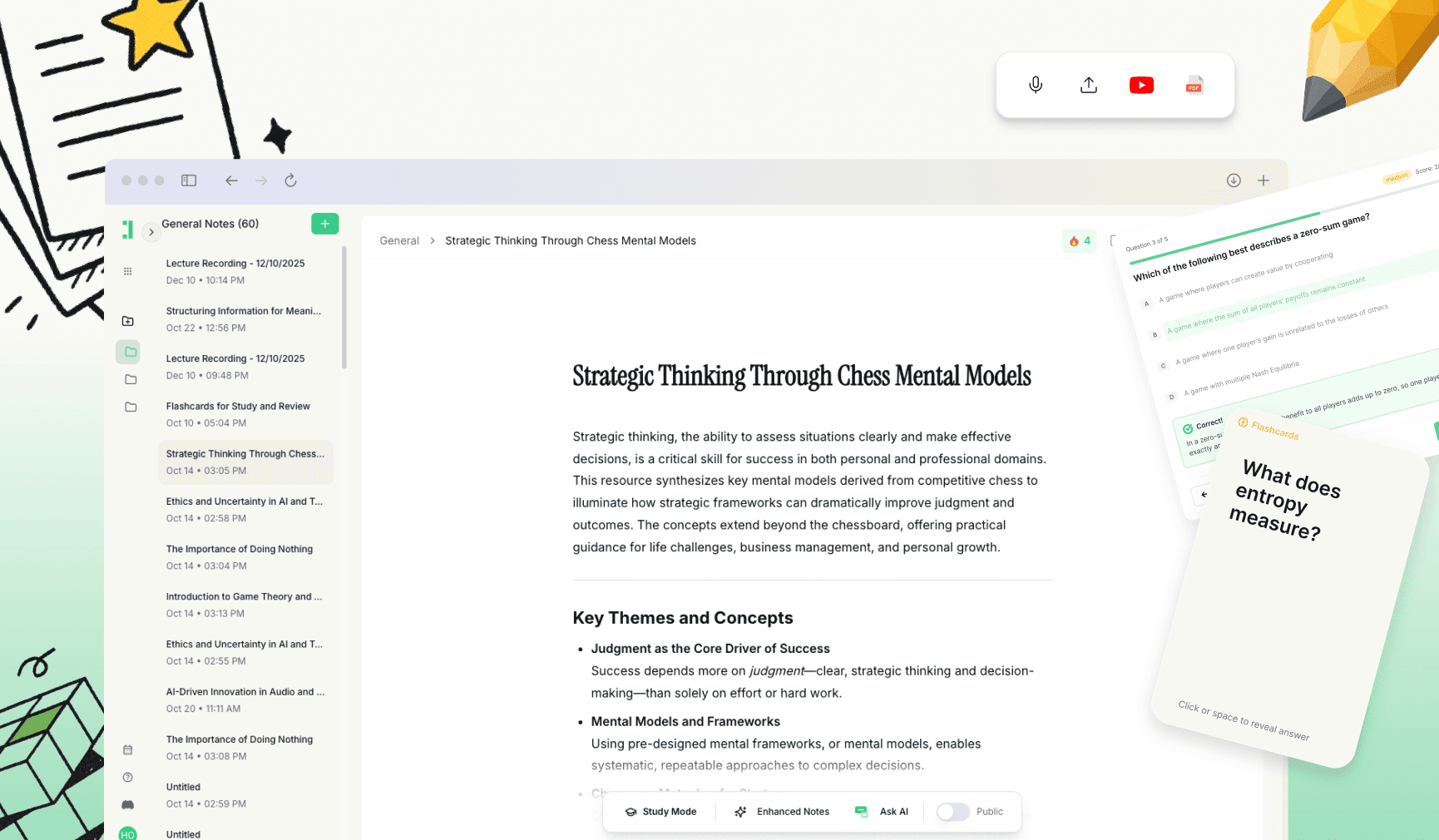
In Duetoday, you simply upload your design resources, our AI generates structured cards, and you can immediately begin reviewing or editing them to fit your specific learning goals.
What are UI/UX Design flashcards?
UI/UX Design flashcards cover the intersection of visual aesthetics and user psychology. They break down complex topics like heuristic evaluations, typography rules, color theory, and interaction patterns into bite-sized questions.
By using flashcards for UI/UX, you move beyond passive recognition. Instead of thinking you know what 'Fitts's Law' is because you've seen it before, you are forced to define the concept and explain its application, building much stronger neural paths for your next design project.
If you already have your design notes ready, Duetoday can generate a targeted study deck in under 60 seconds.
Why flashcards are one of the best ways to study UI/UX Design
UI/UX requires both rote memorization of technical constraints and a deep understanding of human behavior. Flashcards help bridge this gap by using spaced repetition to keep design principles fresh in your mind.
Memorize design patterns (modals vs. tooltips) without cramming.
Separate similar concepts like UI Consistency vs. UI Standards.
Learn the stages of the Design Thinking process in order.
Practice identifying accessibility requirements (WCAG) quickly.

What to include in your UI/UX Design flashcards
Effective UI/UX cards follow the 'atomic' rule: one specific idea per card. This prevents cognitive overload and ensures you actually understand the nuances of user interface design.
Definitions & Key Terms: What is Information Architecture? Define Skeuomorphism.
Processes & Steps: What are the five stages of Design Thinking?
Comparisons: How does Qualitative research differ from Quantitative?
Application: When should you use a radio button instead of a dropdown?
Example prompts for your deck: 'What is the 60-30-10 rule in color theory?', 'Explain the Miller’s Law of memory capacity', and 'Identify 3 common mobile navigation patterns.'
How to study UI/UX Design with flashcards
Mastering design isn't just about reading; it’s about testing. Use a two-pass approach: first, build your deck based on your course or project requirements, then dive into focused review sessions.
Generate a deck from your Figma files or design textbooks.
Perform a rapid round to identify which design laws you struggle to explain.
Review your 'weak' cards every morning to build design intuition.
Mix in technical cards (CSS properties) with theoretical cards (UX psychology).
Generate UI/UX Design flashcards automatically in Duetoday
Manually typing out definitions for every design term is a waste of your creative energy. Duetoday automates the tedious part of studying so you can get back to designing.
Upload your UI/UX PDFs or paste your lecture transcripts.
Click 'Generate Flashcards' to see the AI identify key design principles.
Edit, tag, and start studying your custom deck instantly.
Generate UI/UX Design Flashcards in Duetoday
Start with your notes and get a deck you can actually use today to ace your design portfolio or certification.
Common UI/UX Design flashcard mistakes
Cards are too long: Don't paste entire paragraphs about 'User Personas.'
Only memorizing terminology: Make sure to include 'Why' and 'When' scenarios.
Ignoring accessibility: Ensure you have cards dedicated specifically to WCAG contrast ratios.
No visual context: Whenever possible, describe a visual cue on the back of the card.
FAQ
How many flashcards do I need for UI/UX Design?
A solid foundation usually requires 100-150 cards covering core laws, accessibility, and UI patterns. You can add more as you specialize in fields like Motion Design or UX Research.
What’s the best format for UI/UX Design flashcards?
The 'Problem/Solution' format is best. Present a user frustration on the front and the UI pattern that solves it on the back.
How often should I review UI/UX flashcards?
Daily sessions of 10-15 minutes are most effective for building the long-term memory needed for fast decision-making during design sprints.
Should I make cards from a textbook or Figma files?
Both are great. Use textbooks for theoretical laws and your own project files to memorize specific brand guidelines or project requirements.
How do I stop forgetting UX laws after a few days?
Spaced repetition is the key. Duetoday schedules reviews just as you are about to forget the material, ensuring the laws stick.
What if my flashcards feel too easy?
Increase the complexity by adding 'Scenario' cards, such as: 'How would you apply Hicks’ Law to a checkout page with 20 items?'
Can I generate UI/UX flashcards from a PDF?
Yes, Duetoday can scan your design PDFs and automatically extract the most important definitions and principles into cards.
Are digital flashcards better than paper for UI?
Digital is superior because you can easily update cards as design trends change and use AI to generate them instantly.
How long does it take to make a full UI/UX deck?
With Duetoday, you can turn a 20-page design guide into a full flashcard deck in less than a minute.
Can Duetoday organize my flashcards by design phase?
Yes, you can tag and group your generated cards into categories like 'Ideation,' 'Prototyping,' and 'Testing.'

Duetoday is an AI-powered learning OS that turns your study materials into personalised, bite-sized study guides, cheat sheets, and active learning flows.