Generate Flashcards for Transport Phenomena
Generate or make Transport Phenomena flashcards to master heat, mass, and momentum transfer with this AI study guide.
Generate Flashcards with AI Free

Generate Flashcards for Transport Phenomena
Turn your complex engineering notes, PDFs, textbook chapters, or lecture slides into Transport Phenomena flashcards so you can review faster and remember more. Whether you are tackling momentum, heat, or mass transfer, Duetoday helps you break down complex differential equations and transport properties into bite-sized, testable units.
Generate Transport Phenomena FlashcardsUpload notes / paste text
In Duetoday, the process is simple: upload your materials, and our AI generates a structured deck. You can then review, edit, and use active recall to ensure you're ready for your next exam.
What are Transport Phenomena flashcards?
Transport Phenomena flashcards cover the fundamental principles of how mass, energy, and momentum move through a system. This includes key terms like viscosity and thermal conductivity, Shell balances, the Equations of Change (Navier-Stokes), and dimensionless numbers like Reynolds or Nusselt numbers.
The outcome is a shift from passive reading to active testing. Instead of staring at a 10-page derivation, you test yourself on the assumptions, boundary conditions, and physical meanings behind the math to build genuine long-term recall.
If you already have notes, Duetoday can generate a clean deck in minutes.
Why flashcards work for Transport Phenomena
Transport Phenomena requires more than just memorization; it requires understanding the relationships between different transport mechanisms. Flashcards force you to define these relationships clearly and help you identify which conservation law applies to a specific physical scenario.
By using active recall and spaced repetition, you move the governing equations from your short-term memory into your long-term problem-solving toolkit without the burnout of traditional cramming.
Remember key transport properties and units without confusion.
Separate similar concepts, such as kinematic vs. dynamic viscosity.
Learn derivation steps for Shell balances (momentum, energy, and mass).
Practice identifying the correct boundary conditions for specific geometries.
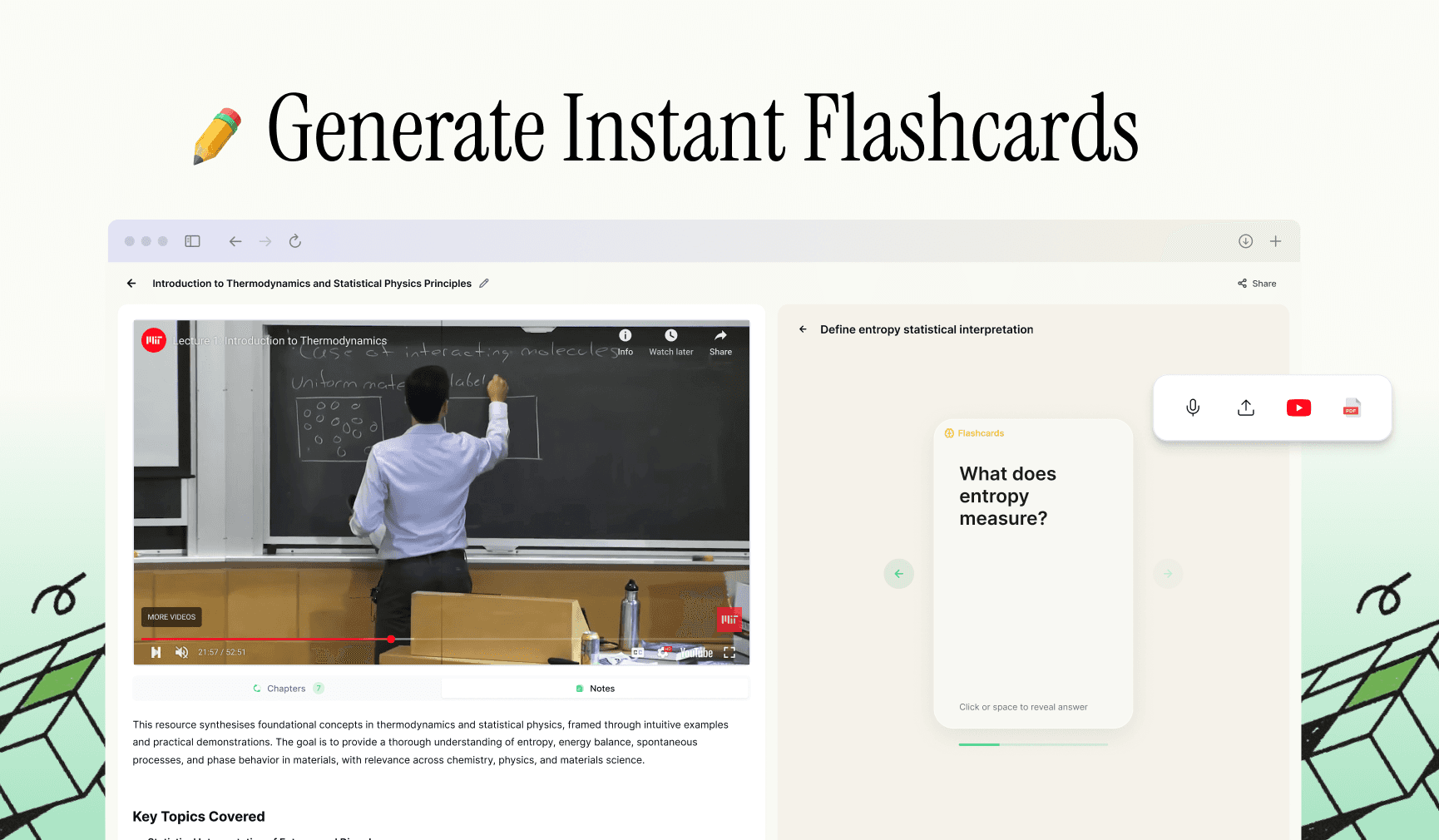
What to include in your Transport Phenomena flashcards
Effective flashcards follow the one idea per card rule. For engineering subjects, this means breaking down a large formula into its individual components or the assumptions required to use it. Your cards should be question-based to trigger your brain's retrieval process.
Definitions & key terms: What is the physical significance of the Prandtl number?
Processes & steps: What is the first step in performing a Shell mass balance?
Comparisons: How does Fourier’s Law of Heat Conduction differ from Fick’s Law of Diffusion?
Application: Which boundary condition applies at a solid-fluid interface for a no-slip condition?
Example prompts include: State the assumptions for the Hagen-Poiseuille equation, Define the Nusselt number in terms of heat transfer coefficients, and What is the difference between convective and molecular transport?
How to study Transport Phenomena with flashcards
To master this subject, use a two-pass approach. First, generate your deck from your syllabus or textbook chapters to establish the foundational definitions. Then, move into rounds where you focus on the application of formulas.
Review the toughest derivations daily. In Transport Phenomena, the struggle is often identifying the right starting point for a problem; use your cards to drill the physical scenarios associated with specific equations.
Make a deck from your lecture notes or PDF chapters.
Do one quick round to find weak spots in your conceptual understanding.
Review high-difficulty cards (like Navier-Stokes components) daily.
Mix in dimensionless number definitions to keep them fresh.
Do a final mixed review of all three transport modes before your exam.
Generate Transport Phenomena flashcards automatically in Duetoday
Creating engineering flashcards manually is slow and tedious, especially when dealing with complex symbols and subscripts. Duetoday eliminates the friction of manual entry, allowing you to focus purely on the learning phase.
Simply upload your PDFs or lecture transcripts, and Duetoday will extract the core concepts, laws, and variables into a ready-to-use study deck.
Upload or paste your Transport Phenomena material.
Click Generate Flashcards.
Review, edit, and start studying immediately.
Generate Transport Phenomena Flashcards in Duetoday
Start with your notes and get a deck you can actually use today.
Common Transport Phenomena flashcard mistakes
Many students make the mistake of putting an entire multi-step derivation on a single card. This leads to recognition rather than recall. Keep your cards focused and specific.
Cards are too long: Break a 5-step derivation into 5 separate cards.
Only memorizing symbols: Ensure cards ask for the physical meaning of variables.
Confusing the three modes: Use comparison cards to distinguish between momentum, heat, and mass.
Ignoring units: Always include a card for the SI and English units of transport properties.
Ready to generate your Transport Phenomena flashcards?
Stop rereading your engineering textbook. Upload your notes, generate your deck, and master transport phenomena with active recall.
Start Generating Flashcards
Works with notes, PDFs, slides, and transcripts.
FAQ
How many flashcards do I need for Transport Phenomena? Most students find that 80-120 cards per major section (Momentum, Heat, Mass) are sufficient to cover core concepts, definitions, and dimensionless numbers.
What’s the best format for these flashcards? A mix of conceptual questions and Given [Scenario], what formula applies? formatted cards works best for engineering subjects.
How often should I review? Because of the mathematical density, a quick 15-minute daily review is better than a 3-hour session once a week.
Should I make cards from a textbook or slides? Use textbook chapters for foundational theory and lecture slides for the specific derivations your professor emphasizes for exams.
How do I stop forgetting the formulas? Don't just memorize the symbols; use cards to explain the 'why' behind each term in the conservation equation.
What if my flashcards feel too easy? Add 'constraint' cards, such as How does this equation change if the fluid is non-Newtonian? to increase difficulty.
Can I generate flashcards from a PDF? Yes, Duetoday is designed to parse engineering PDFs and extract relevant terminology and formulas into cards.
Are digital flashcards better than paper? Yes, because digital tools like Duetoday use Spaced Repetition Systems (SRS) to show you difficult engineering concepts more frequently.
How long does it take to create a deck? With Duetoday, you can turn a 30-page PDF into a study-ready deck in under two minutes.
Can Duetoday organize my cards by topic? Absolutely. You can categorize your decks by Momentum, Heat, or Mass Transfer to stay organized throughout the semester.

Duetoday is an AI-powered learning OS that turns your study materials into personalised, bite-sized study guides, cheat sheets, and active learning flows.