Generate Flashcards for Torque and Angular Momentum
Generate Torque and Angular Momentum flashcards in seconds. Use AI to study smarter. Try out free today!
Generate Flashcards with AI Free
Generate Flashcards for Torque and Angular Momentum
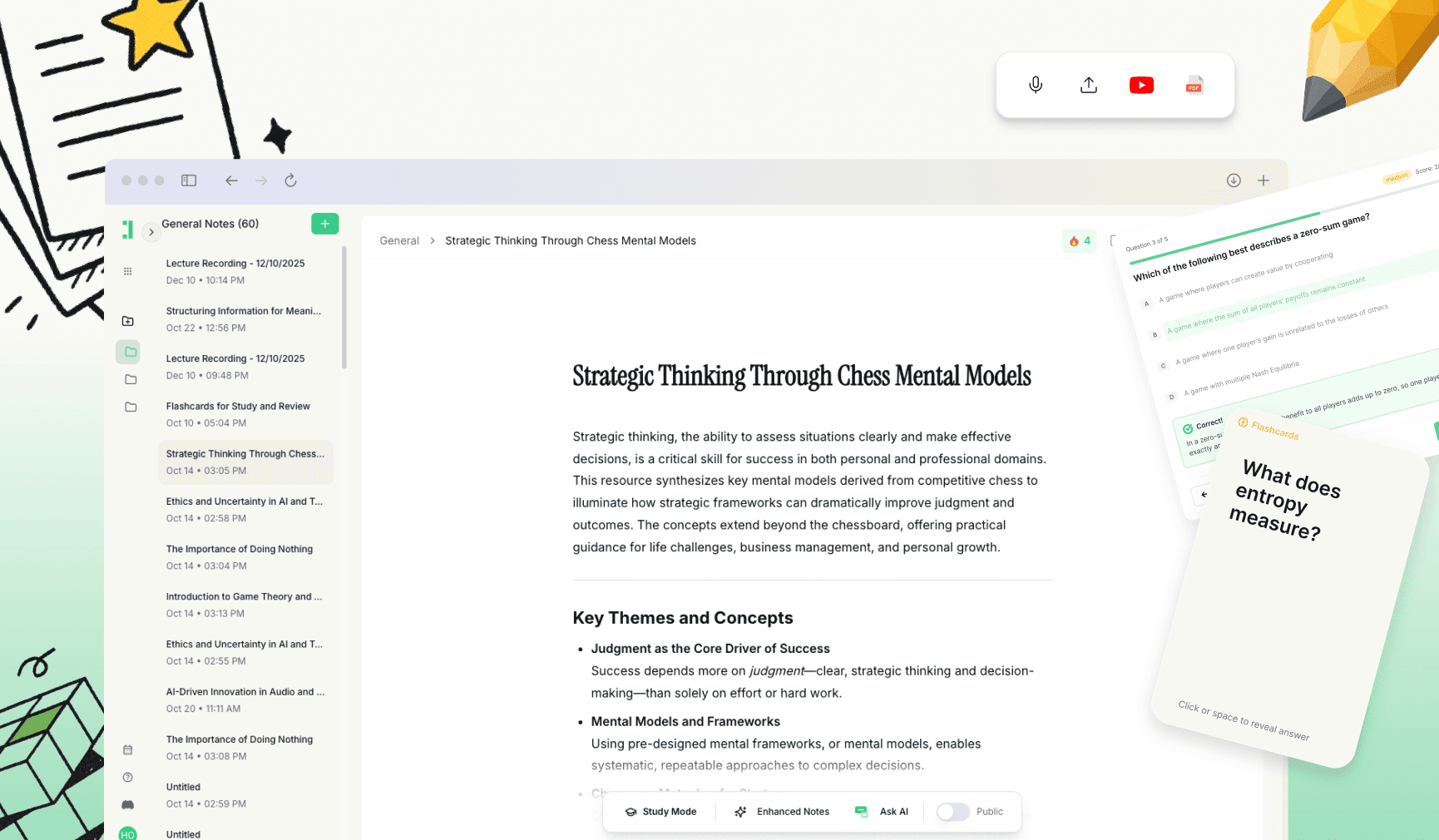
Turn your notes, PDFs, slides, or physics lectures into Torque and Angular Momentum flashcards so you can review faster and remember more. Whether you are tackling cross products or conservation laws, Duetoday helps you master rotational mechanics in minutes.
Generate Torque FlashcardsUpload Physics Notes
In Duetoday, the process is simple: upload your materials, let the AI generate high-quality cards, review or edit the content, and start your study session immediately.
What are Torque and Angular Momentum flashcards?
Torque and Angular Momentum flashcards cover the fundamental principles of rotational dynamics. These cards focus on key terms like moment of inertia, the relationship between force and radius, and the conservation of angular momentum in closed systems. They break down complex vector math into digestible questions.
Instead of staring at a textbook or rereading chapters on rotational motion, these flashcards force you to test yourself. By actively retrieving the information, you build the neural pathways required to solve exam problems quickly and accurately. If you already have notes, Duetoday can generate a clean deck in minutes.
Why flashcards work for Torque and Angular Momentum
Torque and Angular Momentum require a different type of visualization and memory than linear physics. You need to remember specific formulas, the right-hand rule, and how different variables interact in a rotating system. Flashcards leverage active recall and spaced repetition to ensure these formulas stick without the need for last-minute cramming.
Remember key terms like 'fulcrum' and 'lever arm' without confusion.
Separate similar concepts like torque vs. work.
Learn multi-step processes for calculating torque in equilibrium.
Practice applying the right-hand rule to determine vector direction.
What to include in your Torque and Angular Momentum flashcards
The best physics flashcards follow the 'one idea per card' rule. They should be question-based rather than simple definitions to ensure you are actually thinking through the mechanics. Use a mix of conceptual and mathematical prompts.
Definitions & key terms: Focus on moments of inertia and rotational kinamatics.
Processes & steps: Break down how to calculate the net torque on an object.
Comparisons: Contrast angular momentum with linear momentum.
Application: Ask what happens to angular velocity when the radius changes.
Example prompts: 'What is the formula for torque involving the sine of the angle?', 'Define the law of conservation of angular momentum.', 'How does doubling the mass affect the moment of inertia for a point mass?', and 'Which way does the torque vector point if the force is applied counter-clockwise?'
How to study Torque and Angular Momentum with flashcards
Mastering rotational mechanics requires a two-pass approach. First, use Duetoday to build your deck from your syllabus or lecture slides, then engage in rounds of focused review. This builds both conceptual understanding and speed.
Make a deck from your physics notes or upload a PDF.
Do one quick round to identify which formulas you keep forgetting.
Review weak cards daily for at least three days.
Mix in harder application problems (calculating net torque) each session.
Do a final mixed review right before your physics quiz or exam.
Generate Torque and Angular Momentum flashcards automatically
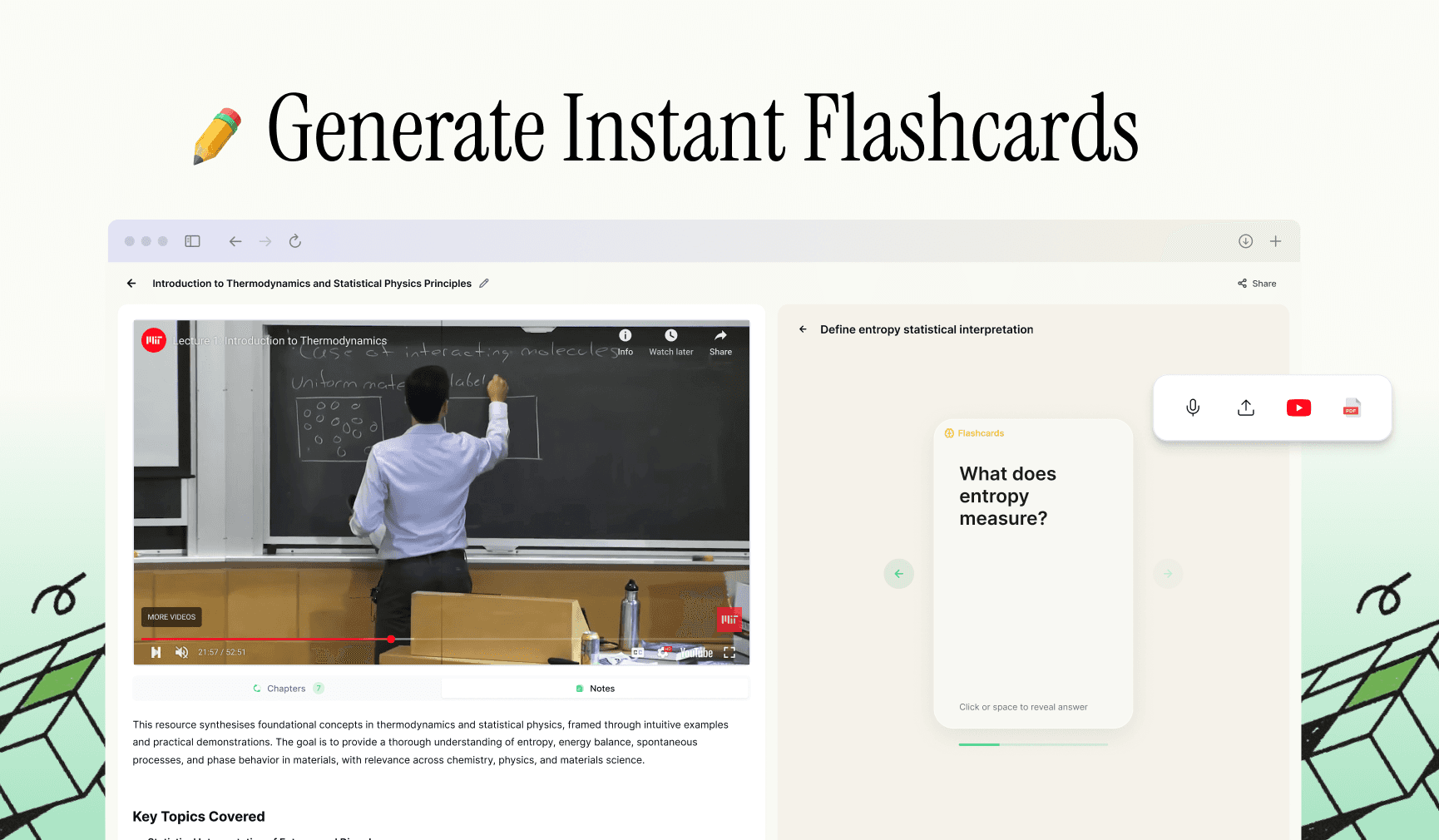
Making physics flashcards manually is slow, especially when trying to format equations or draw diagrams. It often leads to 'passive' studying where you spend more time writing than learning. Duetoday solves this by automating the creation process.
Upload or paste your physics lecture transcripts and PDFs.
Click Generate Flashcards.
Review, edit, and start studying immediately.
Generate Torque Flashcards in Duetoday
Start with your notes and get a deck you can actually use today. Stop rereading and start recalling.
Common Torque flashcard mistakes
Most students make cards that are too wordy, leading to 'recognition' rather than 'recall.' If your cards are long paragraphs, you won't actually learn how to solve the problems on the test.
Cards are too long: Split complex equilibrium problems into individual steps.
Only memorizing words: Always include 'why' or 'calculate' prompts.
Ignoring directions: Add cards specifically for the right-hand rule.
No review schedule: Ensure you repeat the cards for moments of inertia frequently.
FAQ
How many flashcards do I need for Torque and Angular Momentum? Usually, a comprehensive deck consists of 30 to 50 cards covering definitions, formulas, and conceptual scenarios.
What’s the best format for these flashcards? Question-and-answer format is best. For example: 'What happens to torque as the radius increases?' followed by the answer.
How often should I review physics flashcards? Review them daily leading up to an exam, then use spaced repetition to revisit them once a week to keep the concepts fresh.
Should I make cards from a textbook or my notes? Use both. Textbooks provide the core definitions, while lecture notes often contain the specific problem types your professor favors.
How do I stop forgetting formulas after a few days? Spaced repetition is the key. Duetoday tracks your performance and shows you the hardest formulas more often until you master them.
What if my flashcards feel too easy? Add 'application' cards where you have to predict the outcome of a complex physical system rather than just defining a term.
Can I generate flashcards from a physics PDF? Yes, Duetoday can read your physics PDFs and extract the most important information to create a deck instantly.
Are digital flashcards better than paper? For physics, digital is often better because you can easily edit equations and reorganize your deck without messy handwriting.
How long does it take to make a full deck? With Duetoday, you can go from a PDF to a full study deck in less than a minute.
Can Duetoday organize my cards by topic? Yes, you can categorize your cards into Torque, Angular Momentum, and Rotational Kinematics for organized study.

Duetoday is an AI-powered learning OS that turns your study materials into personalised, bite-sized study guides, cheat sheets, and active learning flows.