Generate Flashcards for Topology
Generate topology flashcards to make studying manifolds and theorems easier. Use Duetoday to make flashcards from notes.
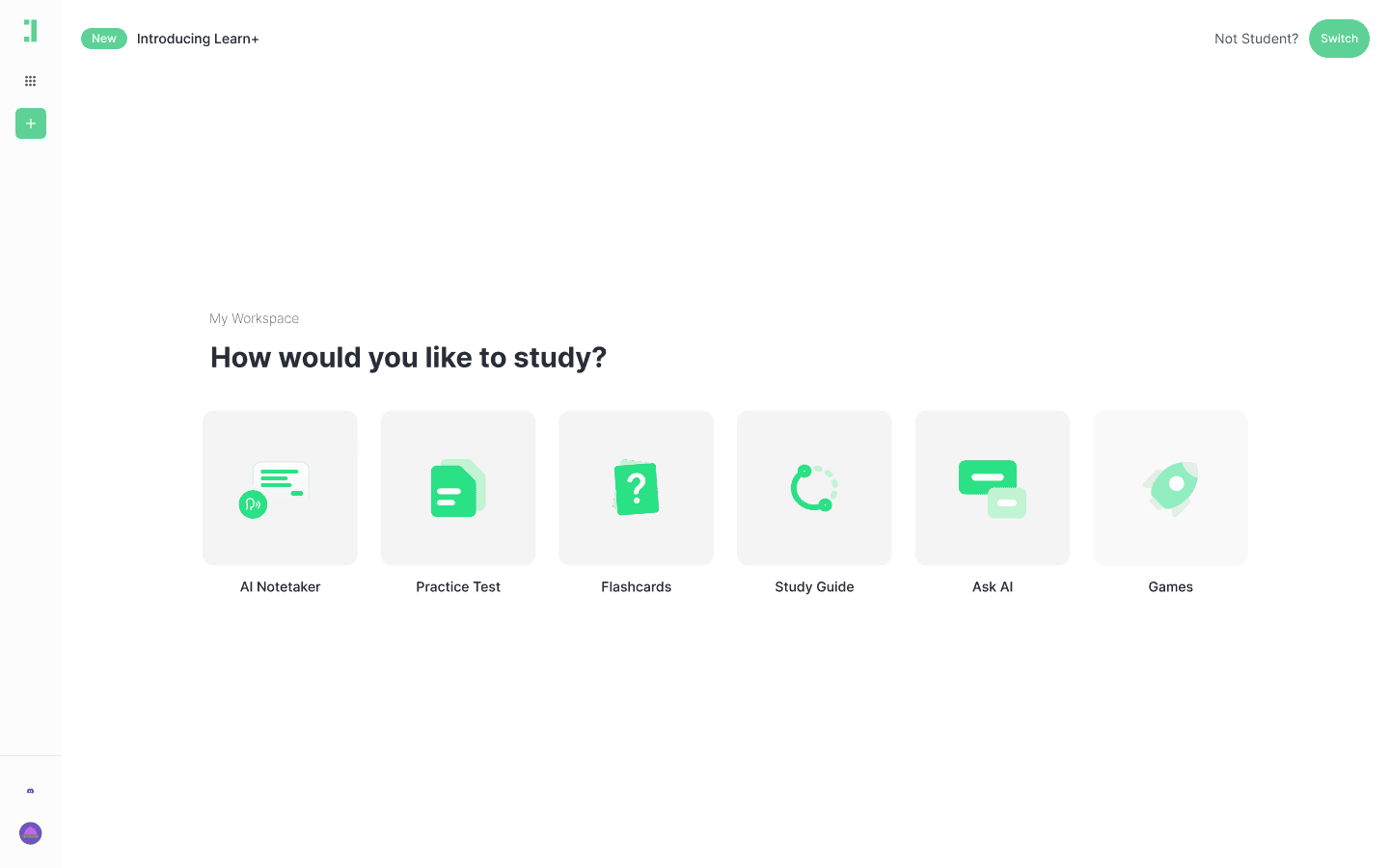
Generate Flashcards with AI Free
What are Topology flashcards?
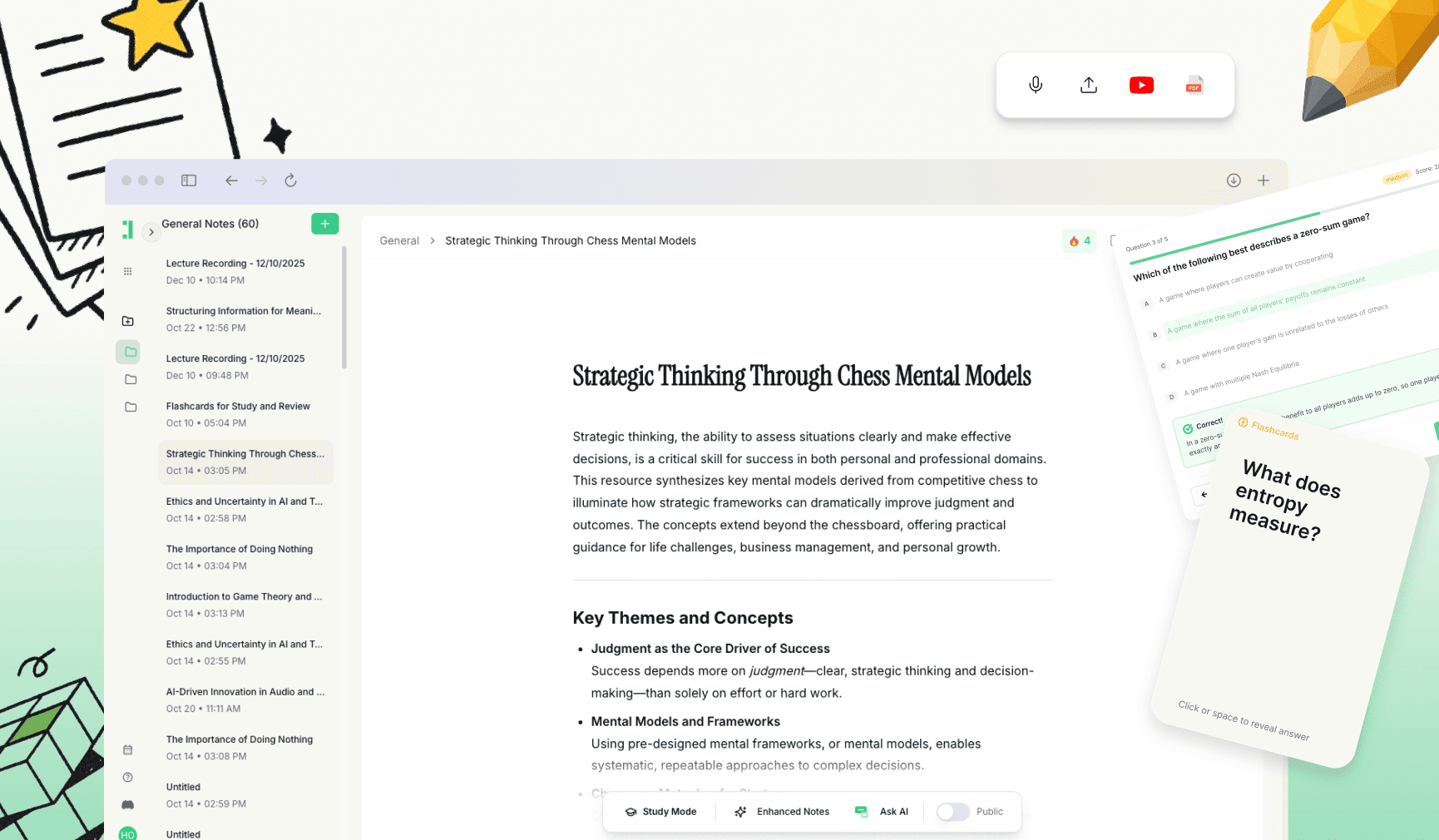
Topology flashcards are active recall tools designed to help you master the properties of space that are preserved under continuous deformations. These flashcards cover critical mathematical concepts like open sets, compactness, connectedness, and homeomorphisms. Instead of simply staring at complex proofs in a textbook, topology flashcards force you to define structures and recall theorems from memory.
The goal is to move beyond passive reading. By testing yourself on specific definitions and properties, you build the mental pathways required to solve advanced topological problems. If you already have lecture notes or specialized textbooks, Duetoday can generate a clean deck of topology flashcards in minutes.
Why flashcards are one of the best ways to study Topology
Topology is a highly abstract branch of mathematics that relies heavily on precise definitions and the relationships between different mathematical structures. Flashcards work perfectly for this subject because they break down high-level abstractions into manageable, testable units of information.
Using techniques like active recall and spaced repetition, you can ensure that fundamental concepts stay fresh in your mind as you move into more complex areas like algebraic topology or knot theory. Flashcards help you:
Memorize rigorous definitions of bases, subbases, and neighborhoods.
Differentiate between similar concepts like T1, T2 (Hausdorff), and regular spaces.
Recall the specific conditions required for theorems like Tychonoff’s or Urysohn's Lemma.
Master the step-by-step logic of standard topological proofs.
What to include in your Topology flashcards
High-quality topology flashcards should follow the "one idea per card" rule. Use question-based prompts to ensure you are actually testing your knowledge rather than just recognizing text. Focus on these four main categories:
Definitions & Key Terms: "What defines a Hausdorff space?" or "Define a Cauchy sequence in a metric space."
Processes & Steps: "What are the three axioms of a topology?" or "How do you prove a function is a homeomorphism?"
Comparisons: "What is the difference between compactness and limit point compactness?"
Application: "Is every metric space a first-countable space? Explain why."
Example prompts: "State the Heine-Borel Theorem," "Give an example of a space that is connected but not path-connected," and "Define the product topology on an arbitrary collection of spaces."
How to study Topology with flashcards (a simple system)
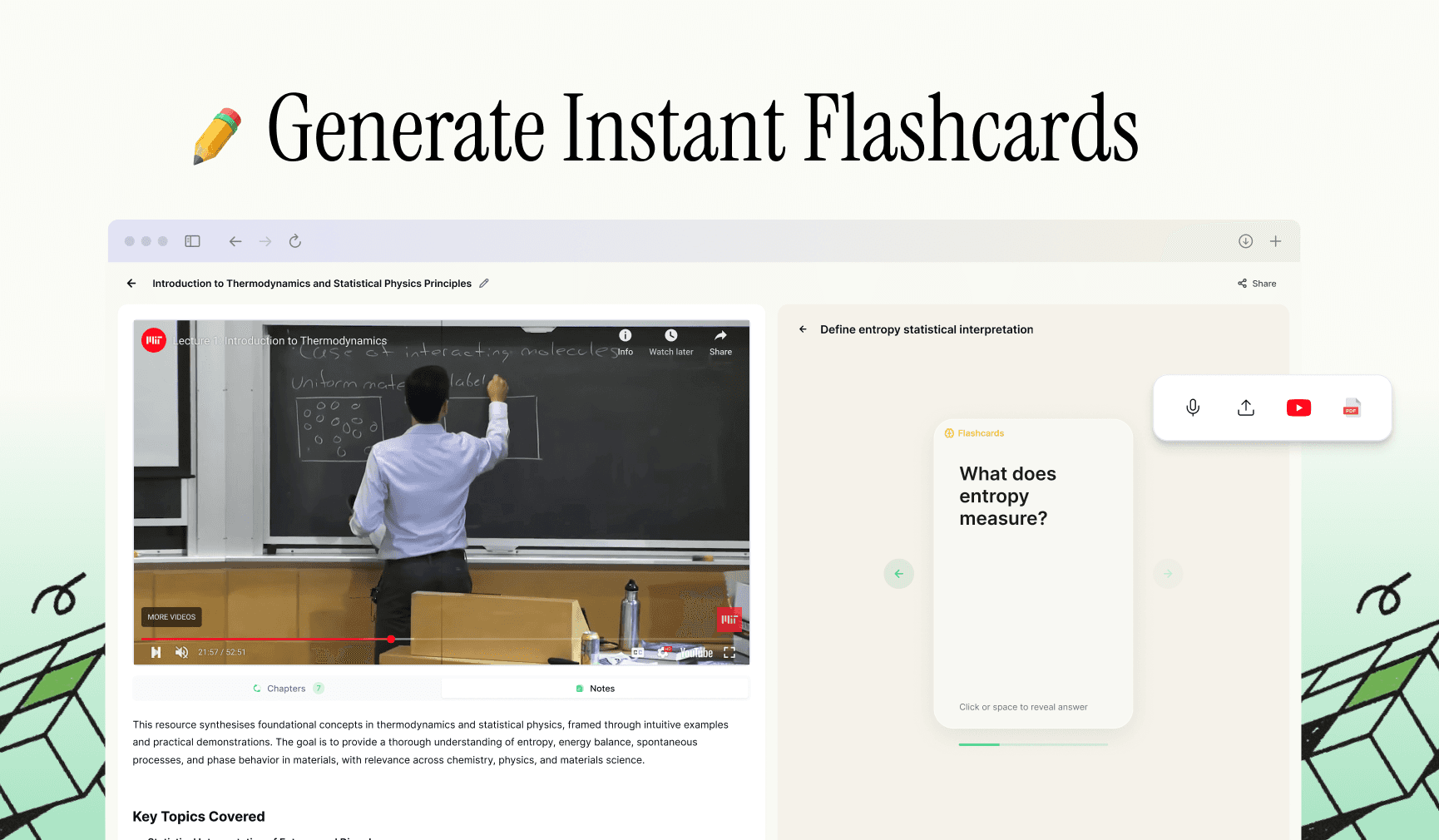
To master topology, use a two-pass approach. Start by generating a deck from your course materials, then move into focused review rounds. Topology requires precision, so be strict with yourself on definitions during the first few sessions.
Consistency is key. Spend 15-20 minutes a day reviewing your deck, focusing specifically on the cards you find difficult. As you gain confidence, mix in cards from earlier chapters to ensure you don't forget the foundations of point-set topology while learning more advanced topics.
Create your deck from notes or PDFs using Duetoday.
Run a quick diagnostic round to identify which theorems you struggle with.
Review these "weak" cards daily for three consecutive days.
Integrate application-based cards that ask for counter-examples.
Perform a cumulative review before your midterms or final exams.
Generate Topology flashcards automatically in Duetoday
Manually writing out math LaTeX or drawing topological diagrams on paper cards is incredibly time-consuming. Duetoday eliminates this friction by using AI to parse your mathematical notes and turn them into structured flashcards instantly.
Whether you are working with handwritten lecture scans or dense academic PDFs, Duetoday extracts the core logic and builds a comprehensive study deck for you.
Upload your Topology PDF, slides, or LaTeX notes.
Click the "Generate Flashcards" button.
Review the generated cards, add your own notes, and start your session.
Common Topology flashcard mistakes (and how to fix them)
Many students create ineffective cards by making them too wordy. In topology, a card that is too long becomes a reading exercise rather than a memory test. Avoid these common pitfalls:
Cards are too long: Don't put an entire five-page proof on one card. Break it into individual logical steps.
Relying on recognition: Just because you recognize a term doesn't mean you can define it. Always say the answer out loud.
Ignoring counter-examples: Topology lives in the exceptions. Make specific cards for spaces that fail certain axioms.
Missing the 'Why': Don't just memorize the name of a theorem; include a card asking for its primary implication.
FAQ
How many flashcards do I need for Topology? For a standard undergraduate point-set topology course, a deck of 150-200 cards usually covers all major definitions and theorems.
What’s the best format for Topology flashcards? Question and answer format is best. Use the front for the term or theorem name and the back for the formal definition or statement.
How often should I review Topology flashcards? Aim for daily reviews of new material and a weekly review of older concepts to benefit from spaced repetition.
Should I make cards from a textbook or lecture notes? Use both. Textbooks provide formal rigor, while lecture notes often highlight which specific examples your professor finds important.
How do I stop forgetting Topology after a few days? Use active recall. Instead of looking at the answer, try to write out the definition or draw the topological space from memory.
What if my flashcards feel too easy? Add "Counter-example" cards. If you know the definition of a compact space, challenge yourself to name a space that is closed but not compact.
Can I generate Topology flashcards from a PDF? Yes, Duetoday can read complex mathematical PDFs and extract definitions to create flashcards automatically.
Are digital flashcards better than paper for Topology? Digital cards are often better because they allow for easier editing of mathematical symbols and use algorithms to schedule your reviews.
How long does it take to make a full Topology deck? Manually it could take hours, but with Duetoday, you can generate a base deck in seconds and spend your time studying instead.
Can Duetoday organize my flashcards by topic? Yes, you can generate and categorize decks by specific chapters like Metric Spaces, Continuity, or Compactness.

Duetoday is an AI-powered learning OS that turns your study materials into personalised, bite-sized study guides, cheat sheets, and active learning flows.