Generate Flashcards for Titrations
Ready for your chemistry lab? Generate Titrations flashcards in seconds. Try it for free!
Generate Flashcards with AI Free
Generate Flashcards for Titrations
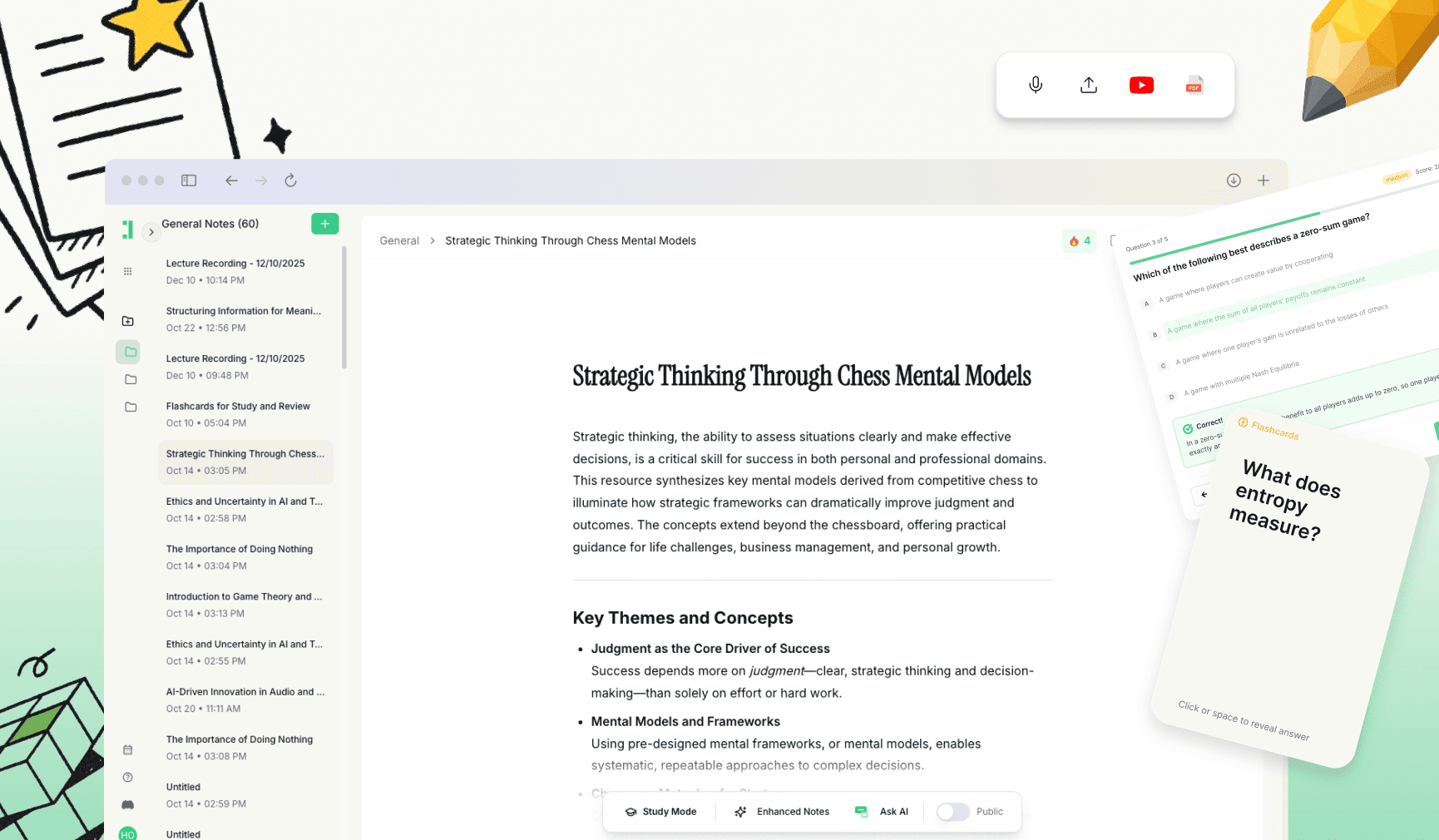
Turn your notes, PDFs, slides, or lab lectures into Titrations flashcards so you can review faster and remember more. Master the complexities of acid-base reactions and redox stoichiometry without spending hours manually writing out cards.
Generate Titrations FlashcardsUpload lab notes
In Duetoday, you simply upload your chemistry materials, and our AI instantly identifies key concepts, formulas, and reaction types. Within seconds, you'll have a deck ready to edit and review using spaced repetition.
What are Titrations flashcards?
Titrations flashcards cover the essential components of volumetric analysis, including definitions of titrants and analytes, identifying equivalence points versus end points, and recognizing the proper indicators for specific pH ranges.
Instead of passively rereading your laboratory manual, these flashcards force you to recall the underlying stoichiometry and procedural steps. This builds the muscle memory needed to solve complex titration curves during exams. If you already have notes, Duetoday can generate a clean deck in minutes.
Why flashcards are one of the best ways to study Titrations
Titrations require a mix of theoretical knowledge—like understanding pKa and buffer regions—and practical math skills. Flashcards help you bridge the gap between knowing a definition and applying a formula under pressure.
Memorize strong/weak acid-base combinations without cramming
Separate similar concepts like Equivalence Point vs. End Point
Learn the color changes of indicators (Phenolphthalein, Methyl Orange)
Practice mental math for molarity and dilution formulas
What to include in your Titrations flashcards
Effective Titrations flashcards follow the "atomic" rule: one specific concept per card. This prevents you from glazing over complex details and ensures you actually know the material.
Definitions: "What is a primary standard?" or "Define the phrase 'standardized solution'."
Processes: "What are the steps to prime a burette?"
Comparisons: "How does a titration curve for a weak acid differ from a strong acid?"
Application: "What indicator is best for a titration with a pH transition at 8.2?"
Example prompts include: "At the halfway point of a weak acid titration, what is the relationship between pH and pKa?" and "What color is phenolphthalein in an acidic solution?"
How to study Titrations with flashcards (a simple system)
Studying chemistry is most effective when you use a two-pass approach. Start by building your deck from your lab results or textbook chapters, then review in focused rounds to cement the logic.
Make a deck from your lab notes (or generate it with Duetoday).
Do one quick round to find weak spots in your stoichiometry.
Review high-difficulty cards daily to master conversion factors.
Mix in curve interpretation cards with definition cards.
Do a final mixed review of all titration types before your lab practical or exam.
Generate Titrations flashcards automatically in Duetoday
Making chemistry flashcards manually is slow, especially when you have to draw curves or write out long equilibrium equations. It’s easy to get bogged down in the formatting rather than the learning.
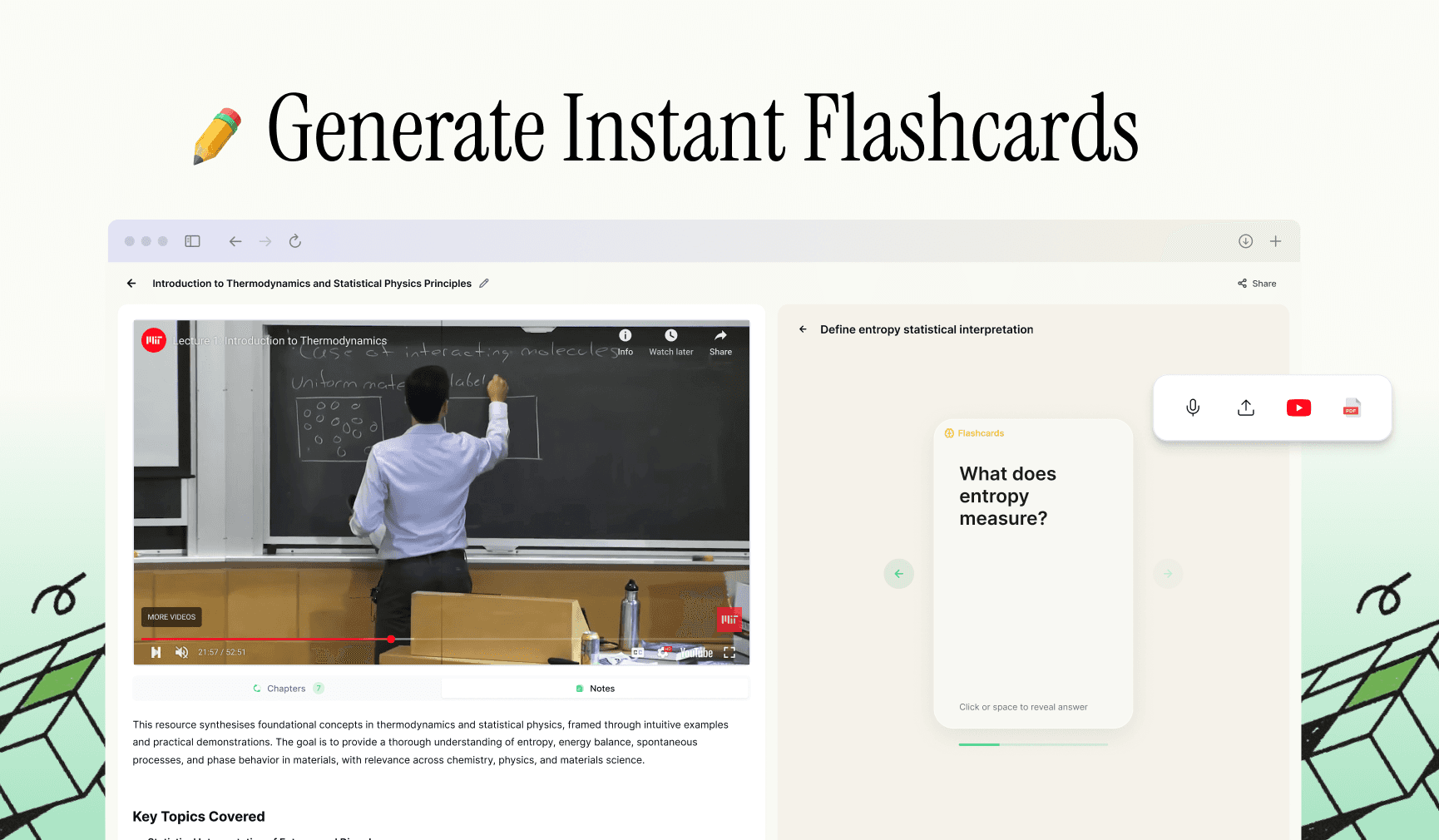
Duetoday streamlines the process: upload your PDF, lab transcript, or slides, and the AI extracts the most important data points to create a comprehensive study deck instantly.
Upload or paste your Titrations material
Click Generate Flashcards
Review, edit, and start studying
Generate Titrations Flashcards in Duetoday
Start with your notes and get a deck you can actually use today.
Common Titrations flashcard mistakes (and how to fix them)
Many students create cards that are far too dense. If a card contains an entire paragraph about the Henderson-Hasselbalch equation, your brain will likely skip the hard parts.
Cards are too long: Split complex molarity problems into individual steps.
Only memorizing colors: Add cards that explain *why* an indicator changes at a specific pH.
Ignoring the lab setup: Include cards on equipment, such as volumetric flasks and burettes.
No review schedule: Chemistry formulas fade quickly; use spaced repetition to keep them fresh.
Ready to generate your Titrations flashcards?
Don't waste time transcribing your textbook. Upload your notes, generate your deck, and start mastering your chemistry lab today with active recall.
Start Generating Flashcards
Works with notes, PDFs, slides, and transcripts.
FAQ
How many flashcards do I need for Titrations? Usually 30 to 50 cards cover the basics, from terminology to common indicator ranges and calculation steps.
What’s the best format for Titrations flashcards? Question-and-answer style works best, specifically for identifying points on a titration curve or predicting pH values.
How often should I review Titrations flashcards? Daily review is best during the week of your lab, followed by weekly maintenance to keep the formulas in your long-term memory.
Should I make cards from a textbook or lab notes? Use both! Lab notes help with the procedure, while textbooks provide the theoretical 'why' behind the curves.
How do I stop forgetting the math steps? Create 'process cards' that break down a molarity calculation into three distinct steps so you don't get lost in the middle.
Can I generate Titrations flashcards from a PDF automatically? Yes, Duetoday can scan your chemistry PDFs and laboratory manuals to create cards instantly.
Are digital flashcards better than paper for Titrations? Digital cards are superior because they allow you to embed images of titration curves and use spaced repetition algorithms.
How long does it take to create a full deck? Manually, it can take over an hour. With Duetoday, it takes less than a minute.
Can Duetoday handle chemistry formulas? Yes, Duetoday's AI understands chemical notation and stoichiometry contexts for accurate card generation.

Duetoday is an AI-powered learning OS that turns your study materials into personalised, bite-sized study guides, cheat sheets, and active learning flows.