Generate Flashcards for Theory of Computation
Make Theory of Computation flashcards to master automata and complexity. Generate study guides from your CS notes.
Generate Flashcards with AI Free
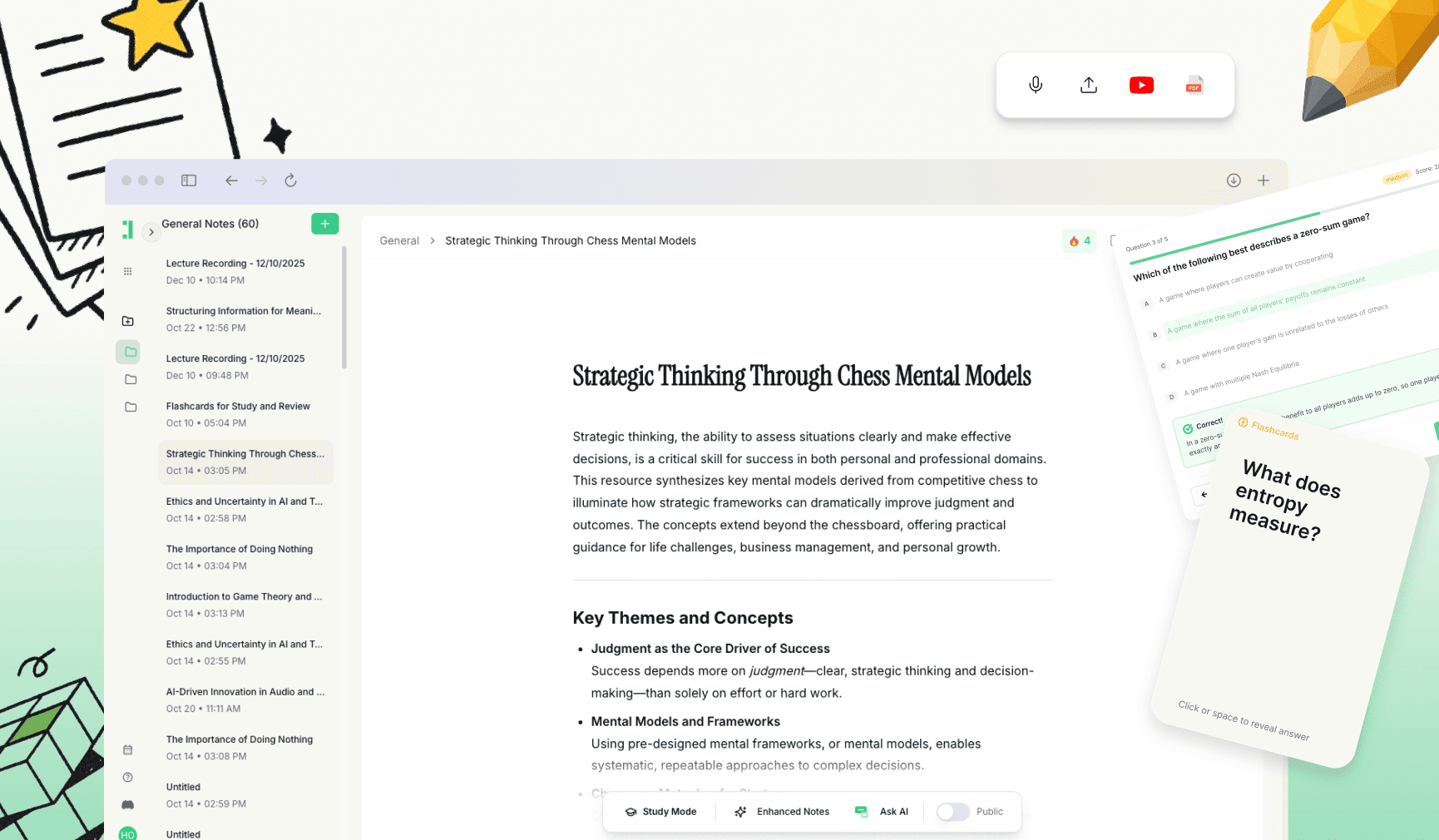
What are Theory of Computation flashcards?
Theory of Computation flashcards are targeted study tools designed to break down abstract mathematical models and computational limits into manageable pieces. They cover essential concepts like Finite Automata (DFA/NFA), Context-Free Grammars, Turing Machines, and complexity classes like P vs NP. Instead of staring at dense proofs in a textbook, these cards force you to recall the specific properties and transitions that define computational logic.
The primary outcome of using these flashcards is moving beyond passive reading to active mastery. By testing yourself on formal definitions and construction steps, you build the mental muscle needed to solve complex problems during exams. If you already have lecture notes or slides, Duetoday can generate a clean deck in minutes, saving you hours of manual entry.
Why flashcards work for Theory of Computation
Theory of Computation requires a blend of rigorous definition memorization and algorithmic thinking. Flashcards are uniquely suited for this because they help you internalize the formal 'alphabet' of the subject—set notation, state transitions, and mapping reductions—so you can apply them to unseen problems without hesitation.
By utilizing active recall and spaced repetition, you ensure that the difference between a Mealy and Moore machine stays sharp in your mind over the long term. This approach prevents 'recognition bias,' where you think you understand a theorem just because it looks familiar, when in reality, you haven't yet mastered how to apply it from scratch.
Remember formal definitions of languages and machines without cramming
Separate similar concepts (e.g., Decidable vs Recognizable languages)
Learn construction processes step-by-step (NFA to DFA conversion)
Practice applying pumping lemma conditions quickly
What to include in your Theory of Computation flashcards
Effective TOC flashcards follow the 'atomic' rule: one specific idea or constraint per card. Use question-based prompts that require a specific mathematical or logical answer rather than broad, open-ended descriptions. This prevents your brain from skipping over the hardest parts of the proof.
Definitions & Key Terms: What is the formal definition of a 5-tuple in a DFA?
Processes & Steps: What are the four parts of a Pumping Lemma proof for regular languages?
Comparisons: How does a Pushdown Automaton differ from a standard Finite Automaton?
Application: Sketch the transition for an NFA that accepts strings ending in '01'.
How to study TOC with flashcards
TOC is a cumulative subject; you cannot understand Turing Machines if your knowledge of Regular Languages is shaky. Use a two-pass approach: first, use the generator to create a deck from your current chapter, and then integrate it into your master deck for cumulative review sessions.
Make a deck from your notes (or generate it from content via Duetoday).
Do one quick round to identify which machine types or proofs are confusing.
Review weak cards daily, specifically focusing on formal notation.
Mix in harder complexity cards (NP-Completeness) with easier automata cards.
Do a final mixed review to ensure you can distinguish between language classes.
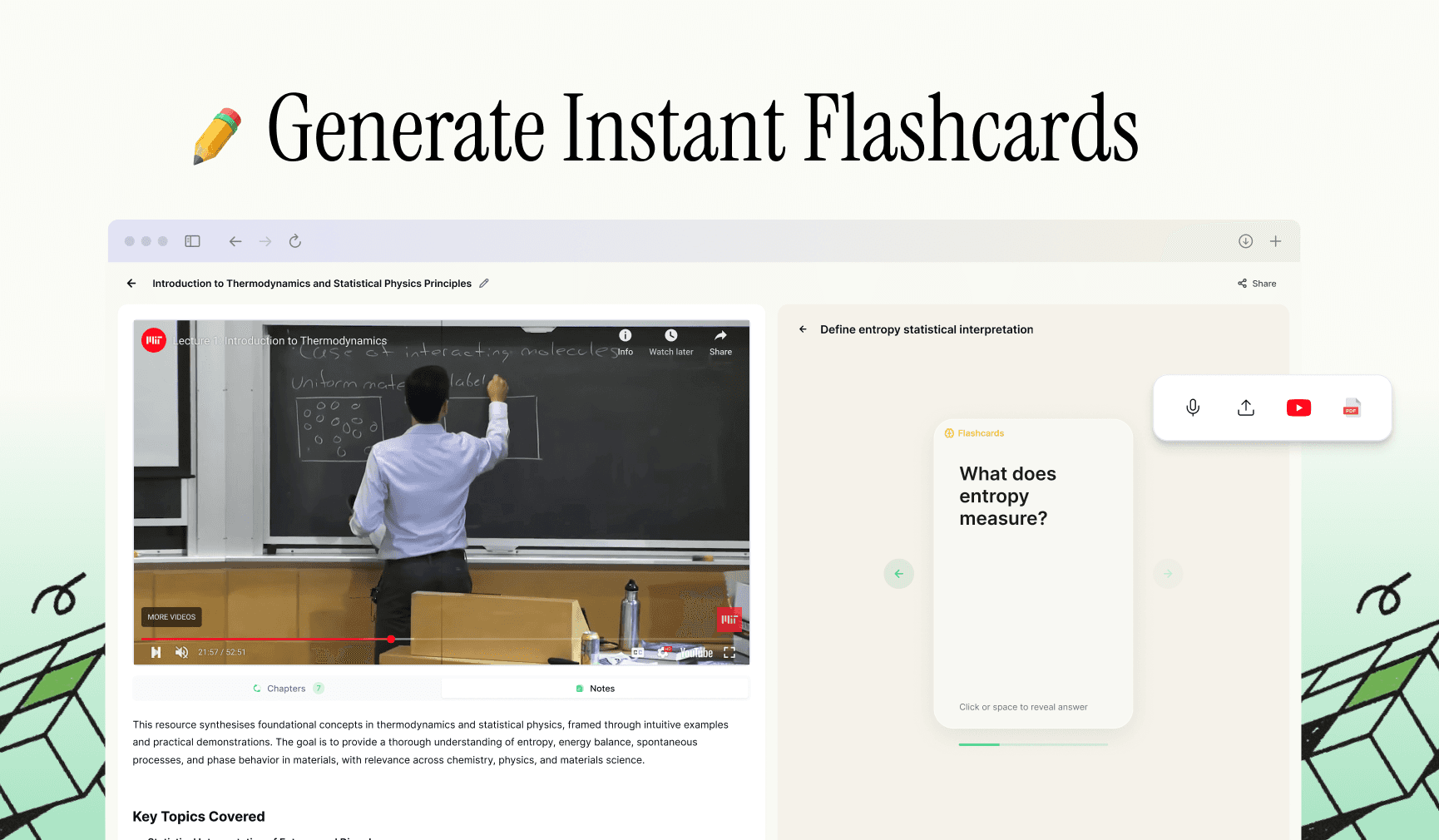
Generate Theory of Computation flashcards automatically in Duetoday
Manually drawing state diagrams and writing out formal definitions is incredibly slow. Duetoday eliminates this friction by transforming your textbook PDFs and lecture slides into high-quality flashcards instantly. You can go from a confusing slide deck to a structured study session in seconds.
Upload your TOC lecture notes or textbook chapters.
Click Generate Flashcards.
Review the AI-generated cards, edit for precision, and start studying.
Common Theory of Computation flashcard mistakes
Cards are too long: Don't put an entire proof on one card; split it into individual steps.
Ignoring negative cases: Ensure you have cards for why a language is *not* regular.
Vague terminology: Use the exact formal language (e.g., transition function vs arrows).
Skipping the math: Include cards that require you to state the mathematical tuple or set notation.
FAQ
How many flashcards do I need for Theory of Computation? Typically, 50-70 cards per major unit (Automata, Grammars, Complexity) is sufficient to cover definitions and common patterns.
What’s the best format for TOC flashcards? Question/Answer format works best, specifically focusing on 'If/Then' scenarios and formal definitions.
How often should I review my cards? Daily review is recommended when learning new machine types, moving to weekly once you have mastered the construction logic.
Should I make cards from a textbook or slides? Both. Textbooks provide the formal definitions, while slides often contain the specific examples your professor prefers.
How do I stop forgetting the Pumping Lemma? Use flashcards to break the lemma into its three specific conditions and the 'adversary' steps of the proof.
Can I generate TOC flashcards from a PDF? Yes, Duetoday can read complex CS documents and extract the core logic into cards.
Are digital flashcards better than paper for TOC? Digital is superior because you can easily include images of complex state diagrams and use SRS algorithms to track progress.
Can Duetoday handle mathematical symbols? Yes, the AI is designed to understand and format the mathematical notation used in computational theory.

Duetoday is an AI-powered learning OS that turns your study materials into personalised, bite-sized study guides, cheat sheets, and active learning flows.