Generate Flashcards for System Design
Make and generate System Design flashcards to master scalability and distributed systems for technical interviews.
Generate Flashcards with AI Free
Generate Flashcards for System Design
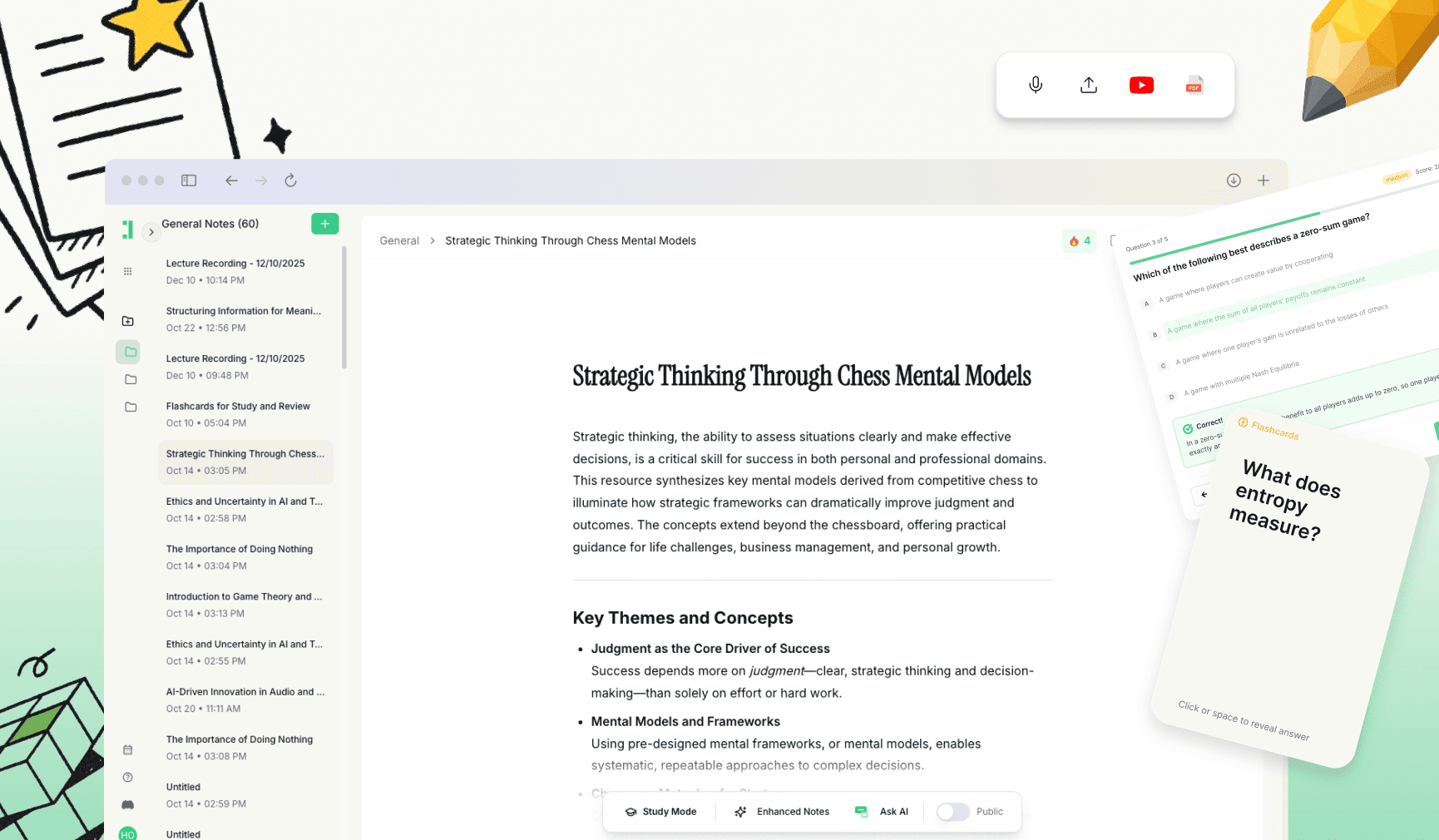
Turn your system design notes, PDFs, architectural diagrams, or lecture transcripts into System Design flashcards so you can review faster and remember more during high-stakes technical interviews.
Generate System Design FlashcardsUpload notes / paste text
With Duetoday, the process is seamless: simply upload your technical documentation or paste your study notes, and our AI instantly identifies key architectural patterns, bottlenecks, and components to create a structured deck for you to review and edit.
What are System Design flashcards?
System Design flashcards are concise study aids that cover the foundational building blocks of scalable software. They focus on key terms like horizontal vs. vertical scaling, consistency models (ACID vs. BASE), database sharding, caching strategies, and load-balancing algorithms.
The outcome is a shift from passive reading to active testing. Instead of skimming a 50-page guide on distributed systems, you test your ability to explain how a specific component—like a Message Queue or a CDN—actually solves a problem in a real-world architecture.
If you already have notes, Duetoday can generate a clean deck in minutes.
Why flashcards are one of the best ways to study System Design
System Design requires a unique blend of rote memorization (definitions of protocols) and high-level application (knowing when to use which tool). Flashcards bridge this gap by forcing you to recall the trade-offs of different architectural decisions quickly.
By using active recall and spaced repetition, you ensure that complex sequences—like how a request travels through a multi-tier system—stay fresh in your mind for your next interview or project.
Remember high-level architectural patterns without hours of cramming
Separate similar concepts (e.g., L4 vs. L7 Load Balancers)
Learn complex processes step-by-step (data replication, leader election)
Practice applying trade-offs (Latency vs. Throughput)

What to include in your System Design flashcards
Effective System Design flashcards follow the one idea per card rule. They should be question-based and focus on the reasoning behind a design choice rather than just definitions.
We recommend focusing on four main categories: fundamental concepts, component interactions, trade-off analysis, and specific use cases.
Definitions & key terms: What is Paxos? Define High Availability in one sentence.
Processes & steps: What happens when a database node fails in a leaderless replication model?
Comparisons: How is SQL sharding different from NoSQL partitioning?
Application: When would you use a WebSocket over a long-polling approach?
Example prompts include: Explain the CAP theorem, List three ways to handle database hotspots, or Compare Latency vs. Throughput in a global system.
How to study System Design with flashcards (a simple system)
System Design is vast, so a structured two-pass approach is essential. First, build your deck based on your core study materials, then use targeted review sessions to solidify your knowledge.
Consistency is more important than duration. Short, daily sessions allow your brain to build the neuro-pathways needed to recall complex diagrams under pressure.
Make a deck from your architectural notes or generate it from technical content.
Do one quick round to find gaps in your knowledge of specific components.
Review weak cards (like complex consistency protocols) daily.
Mix in a few harder architectural scenario cards in each session.
Do a final mixed review before your technical interview.
Generate System Design flashcards automatically in Duetoday
Making technical flashcards manually is slow, messy, and prone to error—especially when dealing with complex networking and database concepts. Duetoday automates the tedious parts of study prep.
Position yourself for success by simply uploading your PDFs, slides, or blog links. Our AI extracts the core concepts, creates technical questions, and organizes them into a study-ready format instantly.
Upload or paste your System Design material
Click Generate Flashcards
Review, edit, and start studying
Generate System Design Flashcards in Duetoday
Start with your notes and get a deck you can actually use today.
Common System Design flashcard mistakes (and how to fix them)
Most engineers make cards that are too verbose, which hinders the learning process. Keep your cards atomic and focused on the Why behind the system.
Cards are too long → Split complex architectures into individual component cards.
Only memorizing words → Add Why use this? prompts to understand trade-offs.
Confusing similar concepts → Create direct comparison cards for SQL vs. NoSQL or TCP vs. UDP.
No review schedule → Use Duetoday’s rhythm to repeat weak cards more often.
No application practice → Include scenario-based cards like Design a URL shortener.
Ready to generate your System Design flashcards?
Stop rereading long whitepapers and start recalling the core principles of distributed systems. Upload your notes today and generate a professional-grade study deck in seconds.
Start Generating Flashcards
Works with notes, PDFs, slides, and transcripts.

FAQ
How many flashcards do I need for System Design? For a comprehensive understanding of interview basics, aim for 100-150 cards covering core components, databases, and patterns.
What’s the best format for System Design flashcards? Question-on-front, answer-on-back works best, specifically focusing on Scenario vs. Solution or Component vs. Trade-off.
How often should I review System Design flashcards? Review your deck daily in the two weeks leading up to an interview, then weekly to maintain long-term architectural knowledge.
Should I make cards from a textbook or lecture notes? Both. Textbooks provide the theory (like the CAP theorem), while lecture notes or blog posts often provide real-world application examples.
How do I stop forgetting System Design after a few days? Use spaced repetition. Duetoday helps by showing you the cards you struggle with more frequently until they stick.
What if my flashcards feel too easy? Increase the difficulty by adding scenario-based questions where you have to justify a design choice under specific constraints.
Can I generate System Design flashcards from a PDF automatically? Yes, Duetoday is designed to parse technical PDFs and extract key terminology and architectural concepts into cards.
Are digital flashcards better than paper for System Design? Yes, because digital cards allow for easier editing of technical diagrams and use algorithms to optimize your review schedule.
How long does it take to make a full System Design deck? Manually it could take hours, but Duetoday can generate a comprehensive 50-card deck in under three minutes.
Can Duetoday generate and organize my flashcards for me? Absolutely. It categorizes cards by topic (e.g., Databases, Caching, Proxies) to keep your study sessions organized.

Duetoday is an AI-powered learning OS that turns your study materials into personalised, bite-sized study guides, cheat sheets, and active learning flows.