Generate Flashcards for Stoichiometry
Master Stoichiometry with AI-generated flashcards. Turn notes into study tools today. Try it for free!
Generate Flashcards with AI Free

Generate Flashcards for Stoichiometry
Turn your chemistry notes, PDFs, slides, or lectures into Stoichiometry flashcards so you can review faster and remember more. Whether you are tackling mass-to-mass conversions or theoretical yields, our AI-powered tool simplifies your study process.
Generate Stoichiometry FlashcardsUpload notes / paste text
When you use Duetoday, you simply upload your chemistry materials, and our AI identifies key formulas and ratios to generate a custom deck. You can then review, edit, and study your cards immediately with active recall.
What are Stoichiometry flashcards?
Stoichiometry flashcards cover the quantitative relationships between reactants and products in a chemical reaction. They help you master key terms like molar mass, Avogadro's number, balanced equations, and the concept of the excess reactant.
Instead of just rereading your textbook, Stoichiometry flashcards force you to test yourself on specific calculations and conversion steps. This active testing builds the mental pathways needed to solve complex chemistry problems during exams.
If you already have notes, Duetoday can generate a clean deck in minutes, saving you hours of manual data entry.
Why flashcards are one of the best ways to study Stoichiometry
Stoichiometry requires a mix of memorization (definitions and constants) and procedural application (calculation steps). Flashcards bridge these two needs by breaking down complex multi-step problems into digestible pieces.
By using active recall and spaced repetition, you ensure that you don't just recognize the terms when you see them, but can actually retrieve the formulas from memory when faced with a blank exam sheet.
Remember Avogadro’s number and gas constants without cramming
Separate similar concepts like empirical vs. molecular formulas
Learn balancing equations step-by-step through practice
Practice applying the mole-to-mole ratio quickly
What to include in your Stoichiometry flashcards
Good flashcards follow the "atomic" rule: one idea per card. For Stoichiometry, your cards should focus on the "how" and "why" behind the math, ensuring you understand the logic of the conversion factor.
Focus on these four main categories to ensure your deck is comprehensive:
Definitions & key terms: "What is a limiting reactant?" "Define molarity in terms of moles and liters."
Processes & steps: "What is the first step in a mass-to-mass conversion?"
Comparisons: "How does theoretical yield differ from actual yield?"
Application: "How many moles are in 22.4L of an ideal gas at STP?"
Example prompts for your deck include: "State the law of conservation of mass," "Define the coefficient in a balanced equation," and "What is the formula for percent yield?"
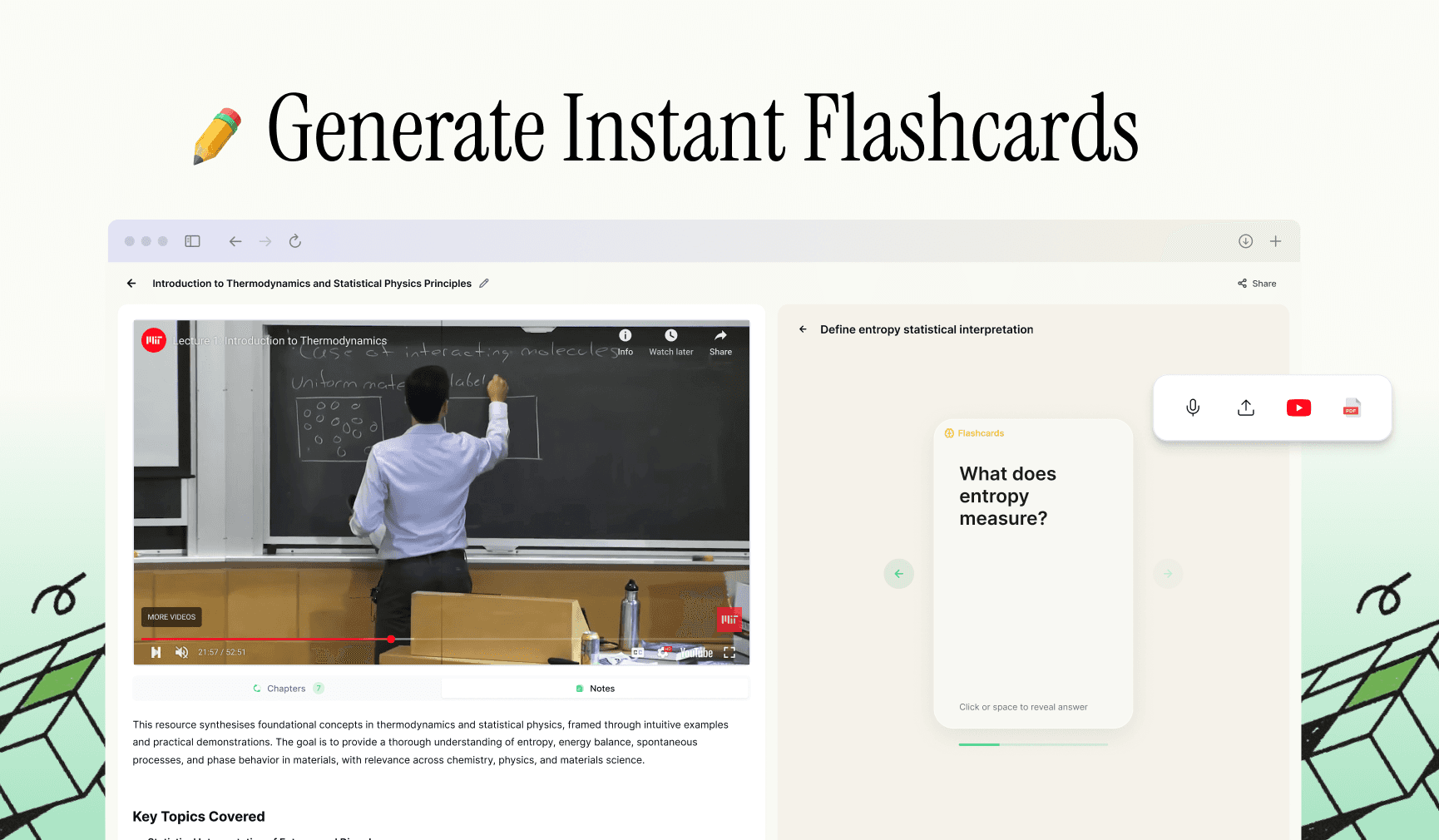
How to study Stoichiometry with flashcards (a simple system)
To master chemistry math, use a two-pass approach. First, build your deck using your class notes or a lab manual, then move into focused review rounds to cement the conversion factors in your mind.
Review in short, frequent sessions rather than one long marathon. This helps your brain move the information from short-term to long-term memory.
Make a deck from your notes or generate it from your textbook PDF.
Do one quick round to find which conversion steps trip you up.
Review weak cards daily for three days to build confidence.
Mix in harder limiting reactant problems with easier balancing cards.
Do a final mixed review before your unit test or quiz.
Generate Stoichiometry flashcards automatically in Duetoday
Making chemistry cards manually is slow and messy. Writing out chemical symbols and subscripts by hand takes time you could be using to actually practice the math. Duetoday automates this distraction.
Positioned as your AI study partner, Duetoday takes your slides or lecture transcripts and turns them into high-quality study materials instantly. You get the benefits of active recall without the manual labor.
Upload or paste your Stoichiometry material
Click Generate Flashcards
Review, edit, and start studying
Generate Stoichiometry Flashcards in Duetoday
Start with your notes and get a deck you can actually use today to ace your next chemistry lab or exam.
Common Stoichiometry flashcard mistakes (and how to fix them)
Most students make cards that are essentially whole textbook paragraphs. These are hard to memorize and don't help during a timed test.
Cards are too long: Split complex mass-volume-moles problems into individual steps.
Only memorizing definitions: Add cards that ask you to apply a ratio to a specific equation.
Confusing units: Ensure your cards always include the units (g, mol, L) to avoid calculation errors.
No review schedule: Use the spaced repetition system to revisit hard cards more often.
Ready to generate your Stoichiometry flashcards?
Stop rereading and start recalling. Upload your notes, generate your deck, and master the math of chemistry with Duetoday.
Start Generating Flashcards
Works with notes, PDFs, slides, and transcripts.
FAQ
How many flashcards do I need for Stoichiometry? Usually, 30 to 50 cards are enough to cover the core definitions, conversion factors, and common problem types for a standard chemistry unit.
What’s the best format for Stoichiometry flashcards? A question-and-answer format is best. For example: 'Question: Formula for Percent Yield? Answer: (Actual/Theoretical) x 100.'
How often should I review Stoichiometry flashcards? Review daily when first learning the concepts, then shift to every 3 days once you feel comfortable with the mole ratios.
Should I make cards from a textbook or lecture notes? Both. Use textbooks for exact definitions and lecture notes for the specific step-by-step methods your teacher prefers.
How do I stop forgetting the steps after a few days? Spaced repetition is key. Duetoday helps you track which cards you've mastered and which ones need more work.
What if my flashcards feel too easy? Add 'Challenge Cards' that combine multiple steps, like going from grams of reactant A to liters of gas product B at non-STP conditions.
Can I generate Stoichiometry flashcards from a PDF automatically? Yes, Duetoday is designed to parse PDFs and extract the most relevant chemical concepts and formulas for you.
Are digital flashcards better than paper for Stoichiometry? Digital is often better because you can easily edit chemical formulas and use AI to generate practice questions instantly.
How long does it take to make a full Stoichiometry deck? With Duetoday, it takes less than a minute. Manually, it can take over an hour to write out 40 cards.
Can Duetoday organize my flashcards for me? Yes, the tool categorizes your cards by topic within the deck, making it easy to focus on specific sub-topics like gas laws or molarity.

Duetoday is an AI-powered learning OS that turns your study materials into personalised, bite-sized study guides, cheat sheets, and active learning flows.