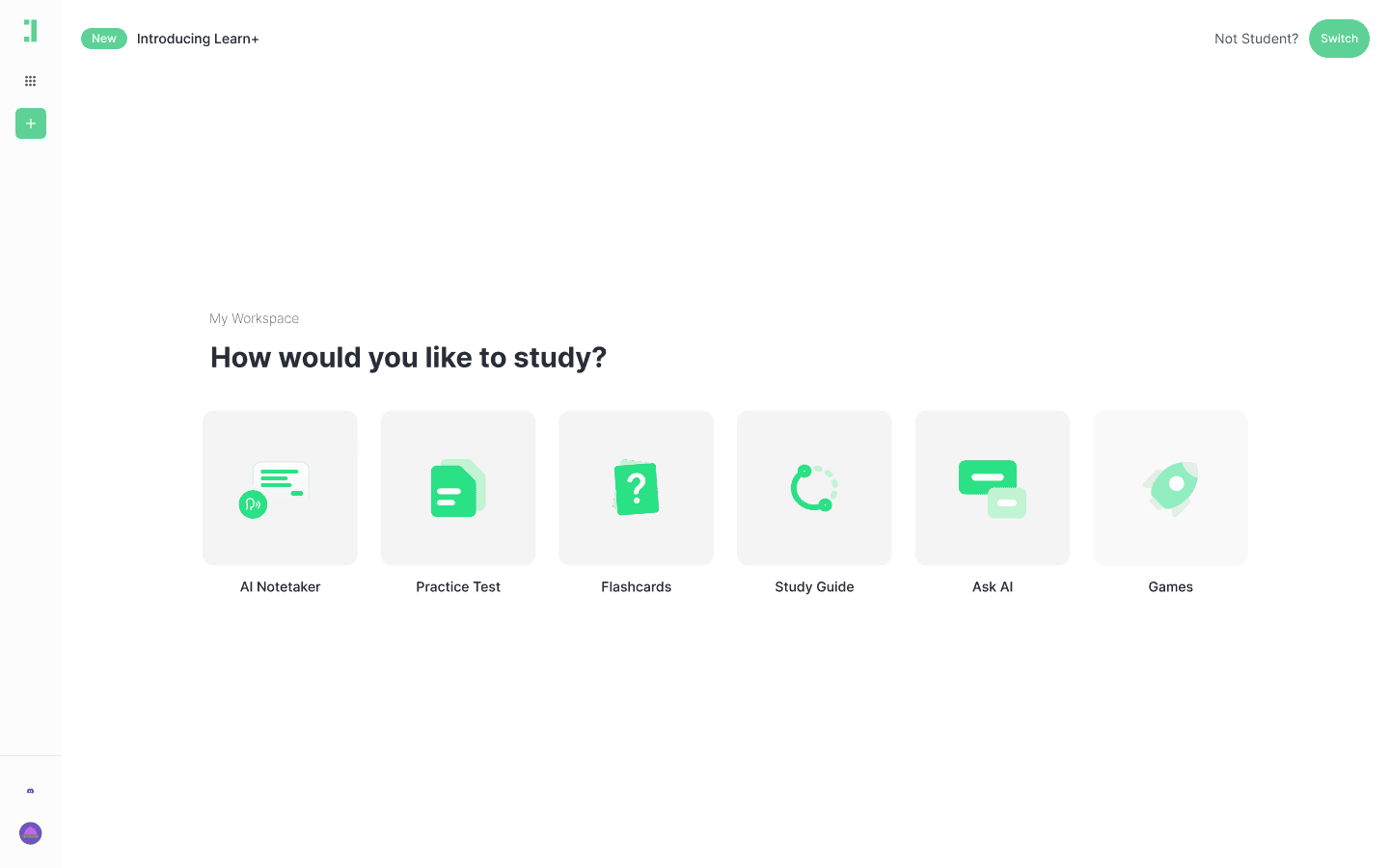
Generate Flashcards for Statistical Mechanics
Generate flashcards for Statistical Mechanics to master physics subjects and make study guides effortlessly.
Generate Flashcards with AI Free
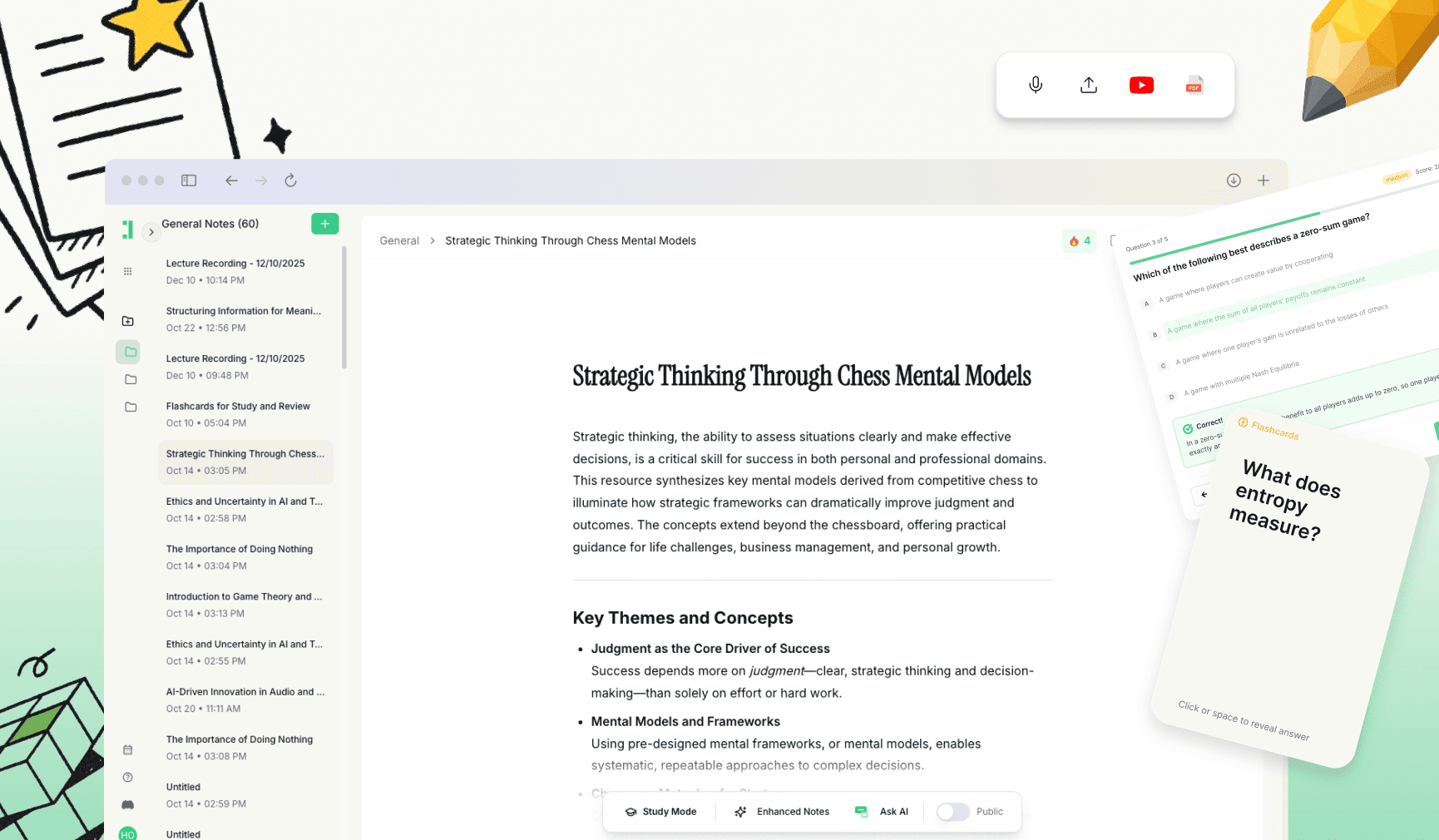
Generate Flashcards for Statistical Mechanics
Turn your notes, PDFs, slides, or lectures into Statistical Mechanics flashcards so you can review faster and remember more. Whether you are tackling Bose-Einstein statistics or the intricacies of the Ising model, Duetoday helps you bridge the gap between complex theory and exam readiness.
Generate Statistical Mechanics FlashcardsUpload notes / paste text
In Duetoday, you simply upload your lecture materials, click generate, and our AI extracts the most critical physics concepts into a structured deck. You can then review, edit, and study them using active recall.
What are Statistical Mechanics flashcards?
Statistical Mechanics flashcards are specialized study tools designed to cover the bridge between microscopic properties of atoms and macroscopic thermodynamic variables. They cover key terms (microstates, ensembles), formulas (Boltzmann distribution), and the mathematical steps required to derive state functions.
Instead of rereading dense textbooks on probability and energy levels, you test yourself on core derivations and conceptual definitions. This active testing builds the neural pathways needed to solve complex problems during your exams. If you already have notes, Duetoday can generate a clean deck in minutes.
Why flashcards work for Statistical Mechanics
Statistical Mechanics requires a unique blend of high-level mathematical application and abstract conceptual understanding. Flashcards help you break down these daunting topics into manageable units of information through active recall and spaced repetition.
Remember key terms like Partition Functions and Chemical Potential without cramming.
Separate similar concepts such as Microcanonical vs. Canonical ensembles.
Learn mathematical processes like the derivation of Maxwell-Boltzmann statistics step-by-step.
Practice applying thermodynamic identities and rules quickly during problem sets.
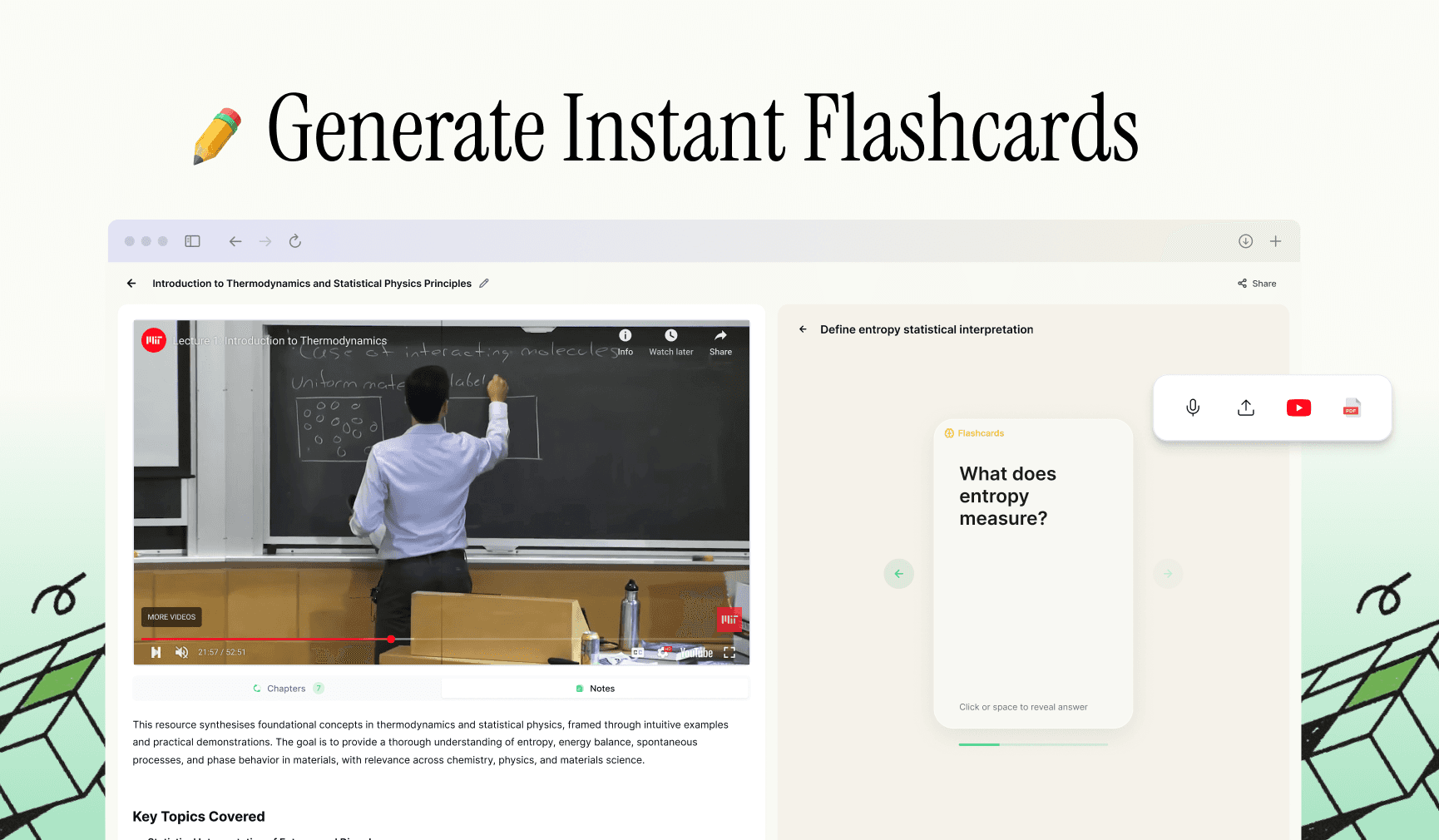
What to include in your Statistical Mechanics flashcards
Effective flashcards follow the "one idea per card" rule. For physics, this means keeping the question specific so you don't get lost in a multi-page derivation. Your deck should focus on making the abstract concrete.
Definitions & key terms: "What is an ergodic system?" "Define the Partition Function (Z)."
Processes & steps: "What are the four steps to calculate the Helmholtz free energy?"
Comparisons: "How do Fermions differ from Bosons in terms of occupancy?"
Application: "When would you use the Grand Canonical Ensemble over the Canonical Ensemble?"
Example prompts include: "Write the formula for Boltzmann's entropy," "State the Equipartition Theorem," and "What happens to heat capacity at low temperatures in the Einstein model?"
How to study Statistical Mechanics with flashcards
Success in physics comes from a two-pass approach. First, build your deck based on your lectures; then, engage in focused review rounds that challenge your memory of both formulas and concepts.
Make a deck from your notes or generate it from your textbook PDF.
Do one quick round to find weak spots in your understanding of probability distributions.
Review weak cards—like those covering the Debye model—daily for a few days.
Mix in a few harder cards, like those requiring thermodynamic derivations, each session.
Do a final mixed review before your midterm or final exam.
Generate Statistical Mechanics flashcards automatically in Duetoday
Making cards for Statistical Mechanics manually is notoriously slow because of the complex equations and specific terminology. Writing them out by hand often leads to messy notes and inconsistent study habits.
Duetoday solves this by allowing you to upload your notes, PDFs, or slides. Our AI understands the physics context and generates flashcards instantly that include the critical formulas and definitions you need. You can then edit them to add your own insights and start studying immediately.
Upload or paste your Statistical Mechanics material.
Click Generate Flashcards.
Review, edit, and start studying.
Common Statistical Mechanics flashcard mistakes
Many students make the mistake of creating flashcards that are far too long. If a card asks you to "Explain the whole Ising model," it is too broad. Split it into smaller questions like "What is the interaction energy in the Ising model?" or "What does the phase transition represent in this model?"
Cards are too long: split into one formula or one definition per card.
Only memorizing words: add "why" prompts to understand the physical significance.
Confusing ensembles: add specific comparison cards for NVE, NVT, and µVT.
No review schedule: use spaced repetition to keep formulas fresh.
Ready to generate your Statistical Mechanics flashcards?
Stop rereading and start recalling. Upload your notes or textbook chapters today and get a high-quality study deck in seconds.
Start Generating Flashcards
Works with notes, PDFs, slides, and lecture transcripts.
FAQ
How many flashcards do I need for Statistical Mechanics? Aim for 100-150 cards per exam to cover the breadth of ensembles, laws, and specific models like the Ideal Gas or Einstein solids.
What’s the best format for Statistical Mechanics flashcards? A mix of 'Question/Answer' for definitions and 'Prompt/Formula' for mathematical relationships works best for physics.
How often should I review Statistical Mechanics flashcards? Review daily when first learning a concept, then every 3-5 days once the formulas begin to stick.
Should I make cards from a textbook or lecture notes? Use lecture notes for exam-specific content and textbooks for deeper conceptual clarity; Duetoday can use both simultaneously.
How do I stop forgetting formulas after a few days? Spaced repetition is the key. By seeing the formula just as you are about to forget it, you move it into long-term memory.
What if my flashcards feel too easy or too hard? Refine them. Split hard cards into two smaller ones, or combine simple terms to make the review more challenging.
Can I generate Statistical Mechanics flashcards from a PDF automatically? Yes, Duetoday is designed to parse complex PDFs and extract the most important study points for you automatically.
Are digital flashcards better than paper for Statistical Mechanics? Digital is often better because you can easily include complex symbols and keep your deck organized and portable.
How long does it take to make a full deck? With Duetoday, it takes less than a minute to generate a full deck from your uploaded material.
Can Duetoday generate and organize my flashcards for me? Absolutely. Our AI handles the extraction and organization so you can focus entirely on learning the material.

Duetoday is an AI-powered learning OS that turns your study materials into personalised, bite-sized study guides, cheat sheets, and active learning flows.