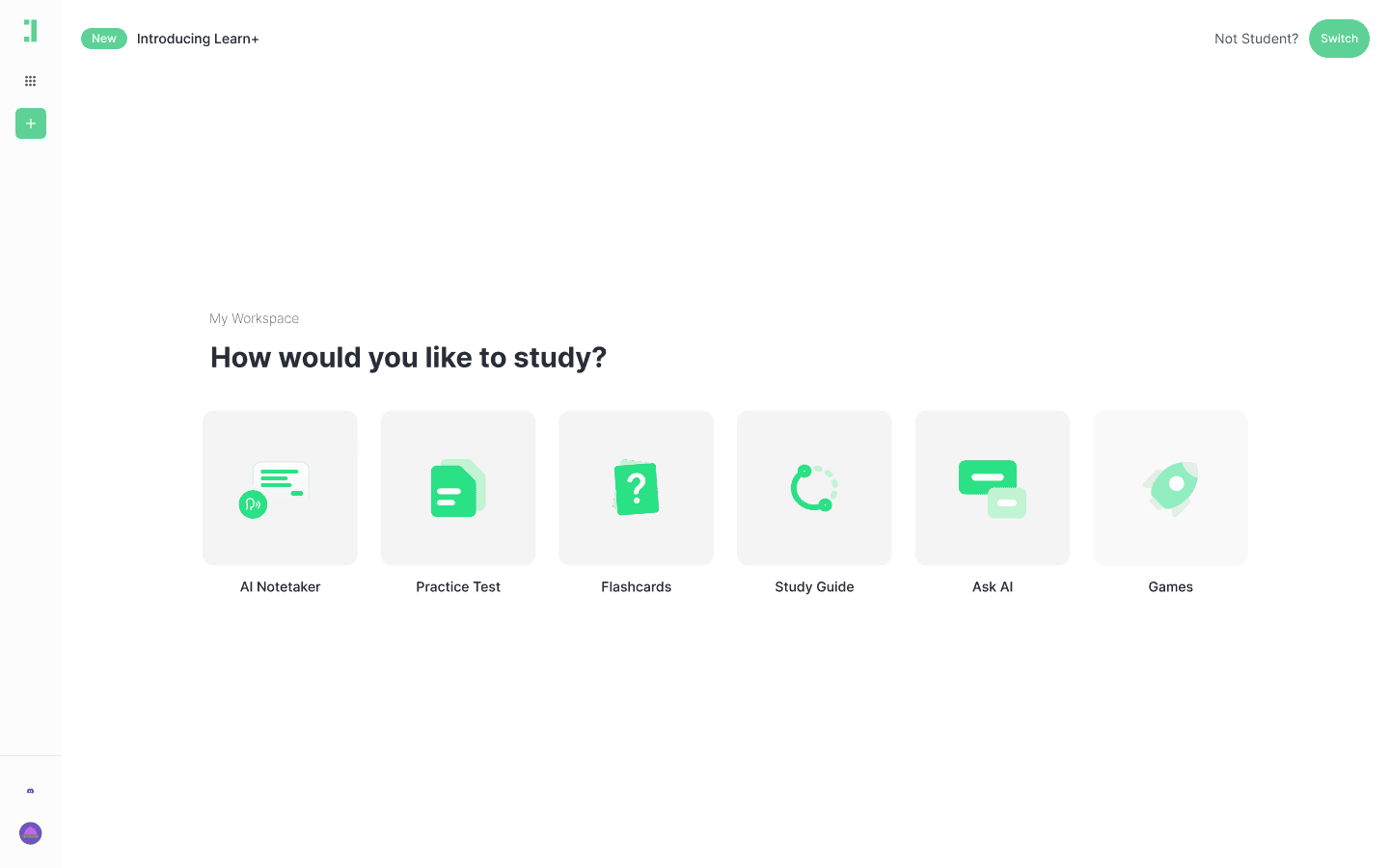
Generate Flashcards for Spectroscopy
Generate or make Spectroscopy flashcards from your chemistry notes and PDFs to master molecular analysis.
Generate Flashcards with AI Free
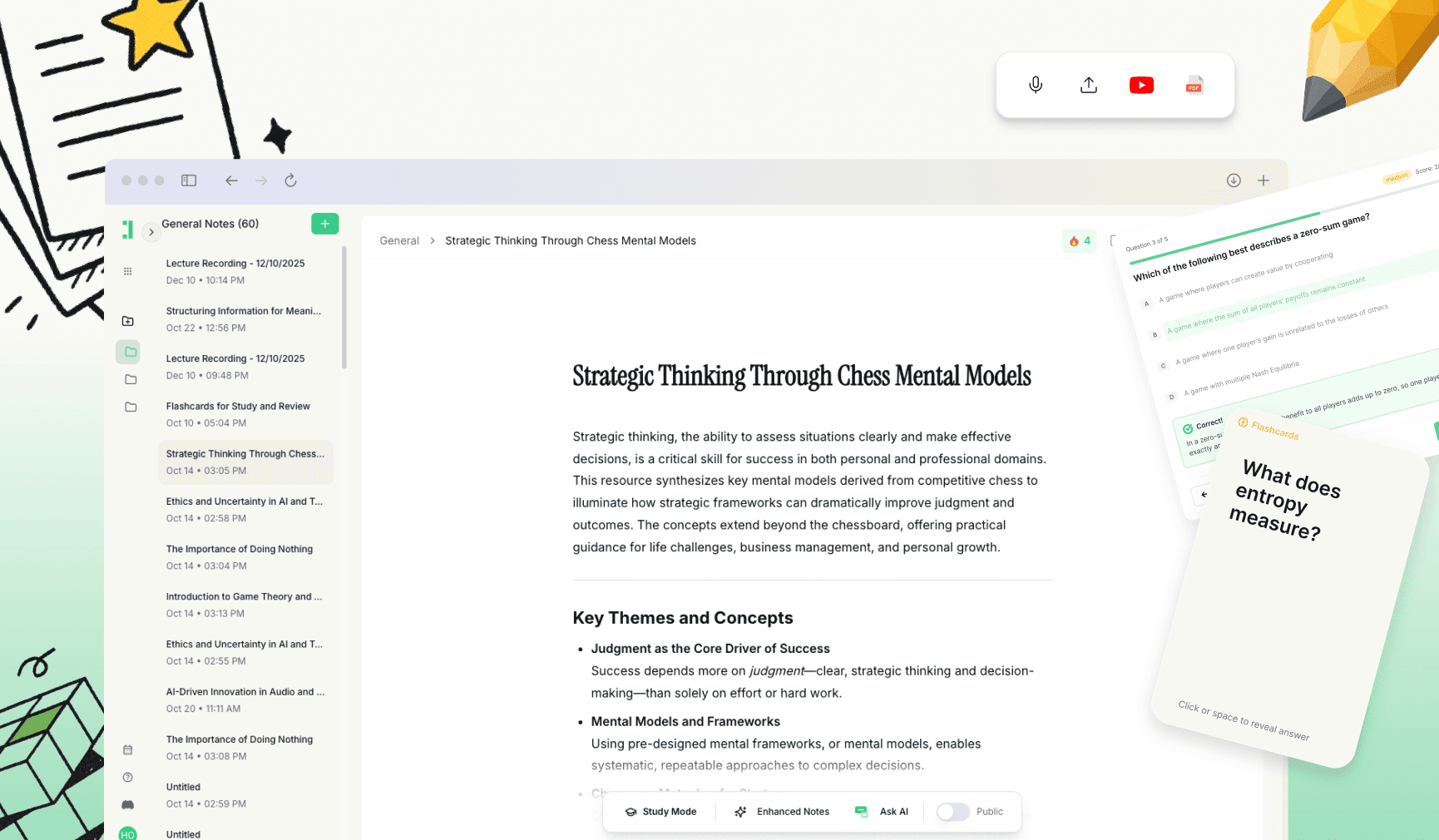
Generate Flashcards for Spectroscopy
Turn your notes, PDFs, slides, or complex lab lectures into Spectroscopy flashcards so you can review faster and remember more. Understanding chemical structures and identification shouldn't require hours of manual card-making.
Generate Spectroscopy FlashcardsUpload notes / paste text
In Duetoday, the process is simple: upload your study material, generate a custom deck, review or edit the insights, and start studying immediately with active recall. No more tedious typing.
What are Spectroscopy flashcards?
Spectroscopy flashcards cover the essential tools used to determine the structure of molecules, including UV-Vis, Infrared (IR), Nuclear Magnetic Resonance (NMR), and Mass Spectrometry. They translate complex wave data and peaks into bite-sized questions about functional groups, chemical shifts, and fragmentation patterns.
Instead of staring at a textbook diagram and hoping it sticks, these flashcards force you to test your knowledge of specific values and correlations. Digital decks build better recall because they focus on identifying the 'fingerprint' of a molecule quickly and accurately.
Why flashcards work for Spectroscopy
Spectroscopy requires a mix of rote memorization (like IR absorption frequencies) and logical application (like interpreting NMR splitting). Flashcards bridge the gap between knowing a formula and applying it to a spectrum.
By using active recall and spaced repetition, you train your brain to recognize chemical patterns without the safety net of your notes nearby. This is critical for timed exams where every second spent guessing a peak value counts.
Memorize functional group IR ranges without last-minute cramming
Distinguish between similar signals (e.g., Aldehyde vs. Ketone C=O peaks)
Internalize NMR chemical shift values for protons and carbons
Learn fragmentation pathways in Mass Spec step-by-step
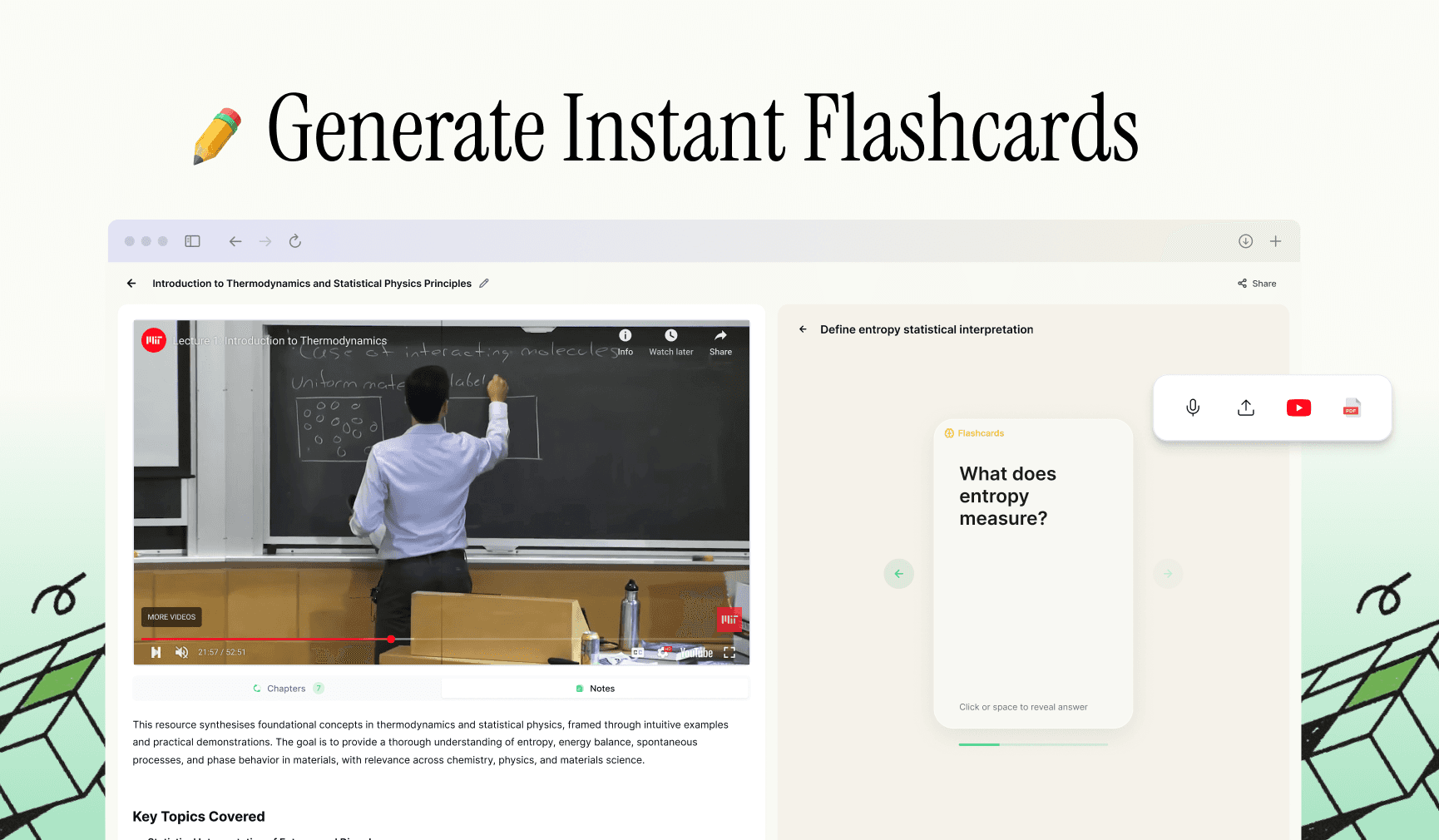
What to include in your Spectroscopy flashcards
The best Spectroscopy flashcards follow the atomic rule: one specific idea per card. Mixing too many concepts into one question leads to blurred memory and slower recall during tests.
To build a comprehensive deck, you should use four main card types that challenge different parts of your analysis skills.
Definitions & Key Terms: What is the shielding effect in NMR? or Define the base peak in Mass Spec.
Analytical Processes: What is the first step in interpreting an IR spectrum?
Comparisons: How does a 1H NMR spectrum differ from a 13C NMR spectrum?
Application: If a peak appears at 1715 cm⁻¹, which functional group is likely present?
Try these example prompts: Predict the splitting for a CH2 group adjacent to a CH3, What does the M+1 peak represent? and Where does an O-H stretch appear in an IR plot?
How to study Spectroscopy with flashcards
Spectroscopy is a skill-based topic, so your study sessions should mirror the way you'll be tested. Don't just flip through cards; use a two-pass tactical approach.
Start by building your deck from your lecture slides or textbook chapters. Perform a rapid first pass to identify which functional groups or shifts you already know and which ones confuse you. Focus your energy on the weak spots.
Generate your deck from Spectroscopy notes or PDF charts.
Do a quick round to flag difficult splitting patterns or shift ranges.
Review high-priority weak cards daily to build fluency.
Incorporate unknown structure cards to practice mixed integration.
Do a final comprehensive review before your chemistry midterm or lab practical.
Generate Spectroscopy flashcards automatically in Duetoday
Manual flashcard creation is the biggest bottleneck in chemistry revision. Writing out chemical shifts and drawing structures by hand takes hours that you could spend actually practicing problems.
Duetoday solves this by automating the busy work. Just upload your PDF chapters or paste your lecture transcript, and our AI identifies the most important spectroscopic data to create a study-ready deck.
Upload your Spectroscopy slides or lab manuals
Click Generate Flashcards
Review the AI-generated peaks and start studying
Generate Spectroscopy Flashcards in Duetoday
Start with your notes and get a deck you can actually use today.
Common Spectroscopy flashcard mistakes
Many students create ineffective cards that don't help them on exam day. Avoid these common pitfalls to ensure your study time is productive.
Cards are too complex: Don't put an entire molecule analysis on one card; break it down by peak.
Ignoring the units: Ensure you include ppm, cm⁻¹, or m/z to stay familiar with the data scales.
Pure memorization: Don't just memorize numbers; include cards that ask Why a peak shifts downfield.
Forgetting the basics: Don't skip the basic physics of spin and resonance, as they provide the logic for the numbers.
Ready to generate your Spectroscopy flashcards?
Stop rereading your textbook and start mastering molecular identification. Upload your materials and let Duetoday build your perfect study guide.
Start Generating Flashcards
Works with notes, PDFs, slides, and transcripts.
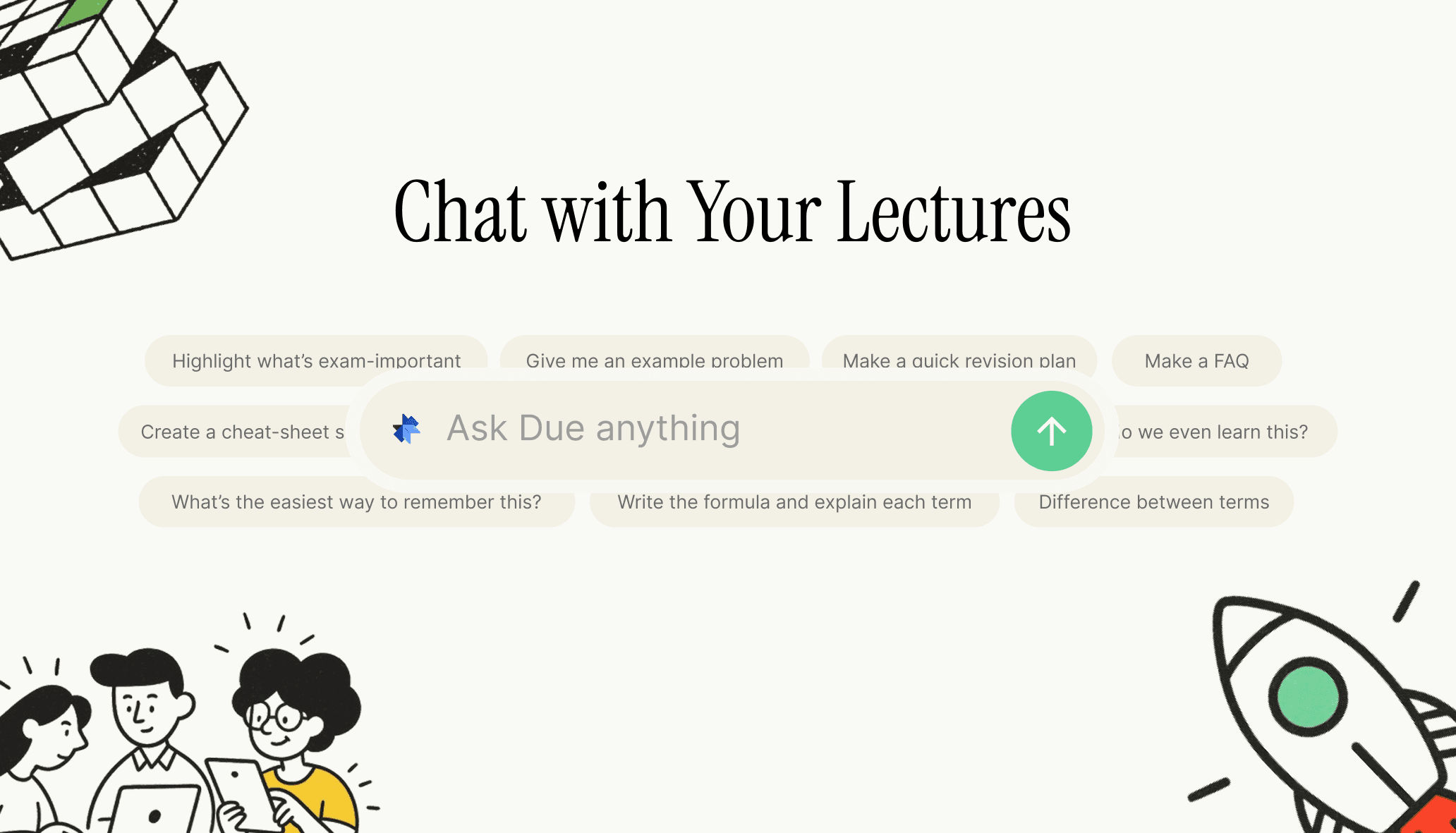
FAQ
How many flashcards do I need for Spectroscopy? Typically, a solid deck for an introductory course ranges from 50 to 100 cards, covering IR ranges, NMR shifts, and basic Mass Spec fragmentation rules.
What's the best format for Spectroscopy flashcards? Question-and-answer format is best. Put a frequency or shift value on the front and the corresponding functional group or environment on the back.
How often should I review Spectroscopy flashcards? Review daily for 15-20 minutes. Spectroscopy is like a language; consistency helps you read spectra without hesitating.
Should I make cards from a textbook or lecture notes? Both, but prioritize lecture notes as they usually contain the specific ranges and correlation tables your professor expects you to use.
How do I stop forgetting shift values after a few days? Use spaced repetition. Duetoday’s system ensures you see the numbers you struggle with more frequently until they stick.
What if my flashcards feel too easy? If the cards feel easy, start adding scenario cards where you have to deduce a structure from multiple pieces of data (IR + NMR).
Can I generate Spectroscopy flashcards from a PDF automatically? Yes, Duetoday can scan your Spectroscopy PDFs and extract key terminology and data points to create cards instantly.
Are digital flashcards better than paper for Spectroscopy? Yes, digital cards allow you to easily embed images of spectra and use AI to organize your learning schedule automatically.
How long does it take to make a full Spectroscopy deck? Manually, it can take hours. With Duetoday, you can generate a comprehensive deck in under sixty seconds.
Can Duetoday generate and organize my flashcards for me? Absolutely. Duetoday uses AI to categorize your notes by sub-topic, ensuring your deck is logical and ready for active recall study.

Duetoday is an AI-powered learning OS that turns your study materials into personalised, bite-sized study guides, cheat sheets, and active learning flows.